
Compare agricultural sheet metal parts by the cost of an accepted component, not the quoted unit price alone. First align the drawing revision, material, finish, quantity and delivery scope. Then account for inspection, approved rework, replacements and any attributable disruption using evidence from the actual project. A lower price is not proof of poor quality, and a higher price is not proof of reliability.
What must match before comparing agricultural parts quotes?
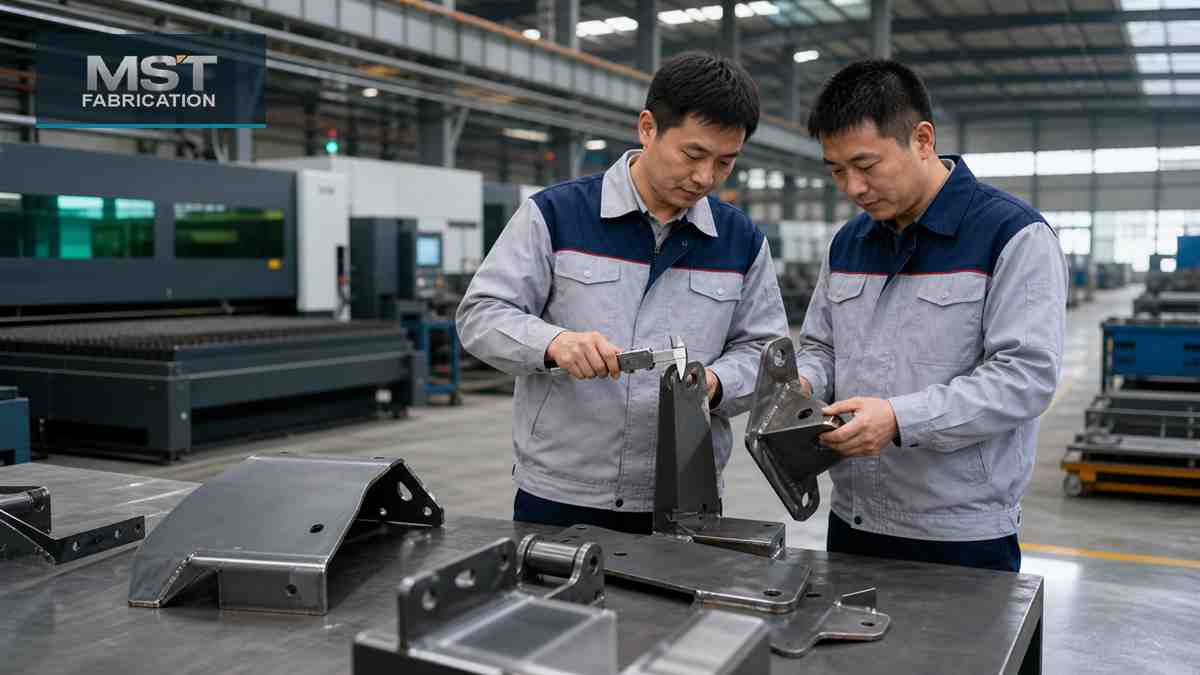
A painted tractor cover, a mounting bracket and a welded support can have very different requirements. Compare suppliers against the same released specification rather than an item description such as “steel bracket.” Confirm the grade and thickness, critical mounting interfaces, joining details, hardware and delivered surface condition.
Also align tooling and setup charges, packaging, delivery destination and the agreed delivery term and named place. A price for unfinished blanks cannot be compared directly with one for formed, coated and inspected parts. List omissions explicitly; do not assume that a short quotation includes every drawing note.
Which costs belong in the comparison?
Use a consistent observation period and define the denominator: parts ordered, parts accepted, or complete equipment sets. For purchasing decisions, cost per accepted component can expose expenses hidden by the invoice unit price. Keep confirmed costs separate from estimates and uncertain future outcomes.
| Cost item | What to record | Comparison safeguard |
|---|---|---|
| Purchase and one-time charges | Quantity, unit price, tooling, setup and any drawing-specific fixture charge. | Separate initial-order costs from repeat-order costs; state how one-time charges are allocated. |
| Freight and delivery | Normal freight, packing, applicable import charges and extraordinary shipments. | Use the same destination and scope. Do not count freight already included in the supplier price twice. |
| Inspection and sorting | Document review, incoming checks, sorting hours and agreed outside testing. | Use actual labor and service costs, not an arbitrary percentage added only to the cheapest quote. |
| Nonconforming components | Approved rework, scrap, replacement costs, supplier credits and resulting accepted quantity. | Retain disposition records and subtract credits. Reworked parts must meet the agreed acceptance requirements. |
| Assembly or field disruption | Documented attributable delays, service visits or expedited replacement work. | Distinguish verified events from scenarios; avoid counting the same labor or lost time under multiple headings. |
A hypothetical cost-per-accepted-part example
Illustration only: assume two offers for 500 identical brackets. Offer A is 8.00 per part and Offer B is8.40. Both include the same normal delivery scope. Suppose A requires 360 of approved rework plus140 of additional freight; B requires neither. Both incur 100 of incoming inspection and ultimately yield 500 accepted parts.
- A: (500 x 8.00 +360 + 140 +100) / 500 = 9.20 per accepted part.
- B: (500 x 8.40 +100) / 500 = 8.60 per accepted part.
These are invented calculation inputs, not market prices, failure-rate forecasts or MSTFAB performance data. They show how the result can change after extra costs are known. If A has no additional rework or freight, its corresponding cost is8.20, lower than B. Replace the assumptions with comparable project records before drawing a sourcing conclusion.
Which agricultural application details can change cost?
Describe the actual exposure: rain, stored moisture, fertilizer contact, cleaning chemicals, debris accumulation or contact abrasion. Identify the relevant surfaces and maintenance expectations. Do not assume that one paint color or a generic “outdoor” note defines an adequate material and coating system.
For mounting brackets, covers and guards, define mating interfaces and the required finished condition. If vibration, impact or structural performance matters, identify the design inputs and required validation. A dimensional report or a smooth-looking weld does not by itself prove service life. Safety-critical requirements need the responsible equipment designer’s review, not a cost-driven material or thickness substitution.
Keep this cost comparison separate from the full agricultural equipment metal parts RFQ checklist, which covers the drawing package and manufacturing scope in greater detail.
How can buyers reduce cost without removing requirements?
- Resolve drawing conflicts early: freeze a common revision before quotes, samples and production are compared.
- Review cost drivers explicitly: ask about nesting, bend access, hardware variety, welding access and finish batches. Evaluate proposals against the required function.
- Specify critical features selectively: connect tolerances and inspection effort to actual interfaces rather than tightening every dimension.
- Approve changes before use: document material, thickness, geometry or finish alternatives and the validation they require.
- Learn from accepted batches: record quantities, inspection effort, nonconformities and corrective actions, then use that evidence for reorder decisions.
ASQ’s cost-of-quality framework distinguishes prevention, appraisal, and internal and external failure costs. It is a useful way to organize quality-related expenses, not evidence that any particular supplier has a specified defect rate or will generate a guaranteed saving.
Frequently asked questions
Are cheaper agricultural sheet metal parts always lower quality?
No. Differences in design, purchasing, production efficiency, volume or quoted scope can change price. Compare the same specification and review acceptance evidence before attributing a lower price to inferior material or workmanship.
How do I calculate cost per accepted metal part?
Add the applicable purchase, setup, delivery, inspection and documented nonconformity costs for a defined scope, subtract relevant credits, and divide by the accepted quantity. Avoid double-counting included charges and keep uncertain future costs separate.
Can a first article prove the lifetime cost of a farm equipment component?
No. A first article can demonstrate the characteristics actually checked on that sample. It does not by itself establish production consistency, field durability or lifetime cost; those require the applicable validation and ongoing records.
Request a comparable agricultural sheet metal quote
Review MSTFAB’s agricultural sheet metal fabrication scope, then send your controlled drawings for quotation. Include quantity, material, finish, critical features, inspection requirements and delivery destination. Ask for explicit inclusions, exclusions and proposed alternatives rather than an unsupported durability or savings promise.
Reference: ASQ: Cost of Quality. The agricultural examples and arithmetic above are explanatory applications, not supplier benchmark data.
 WeChat Contact
 WhatsApp Me Directly