
The Short Answer
To buy custom metal enclosures with low minimum order quantities (MOQ) and fast turnaround, source directly from a digital CNC sheet metal fabricator that uses fiber laser cutting, standard press-brake tooling and in-house hardware insertion rather than hard stamping dies. You can shorten lead times by sending a complete STEP and PDF drawing package, choosing stocked sheet gauges and standard powder coats, and aligning bend radii with the shop’s standard tooling.
Explore this guide
01 / Procurement Channels
Choose the enclosure sourcing route that matches your customization and volume.
Hardware buyers typically compare four options when sourcing metal enclosures: modified off-the-shelf (COTS) boxes, instant-quote online brokers, high-volume stamping houses, and direct custom sheet metal manufacturers. Modified catalog boxes work when a standard rectangular shell fits your PCB, but CNC-milling dozens of cutouts into pre-painted boxes quickly becomes expensive and restricts internal bracket layout.
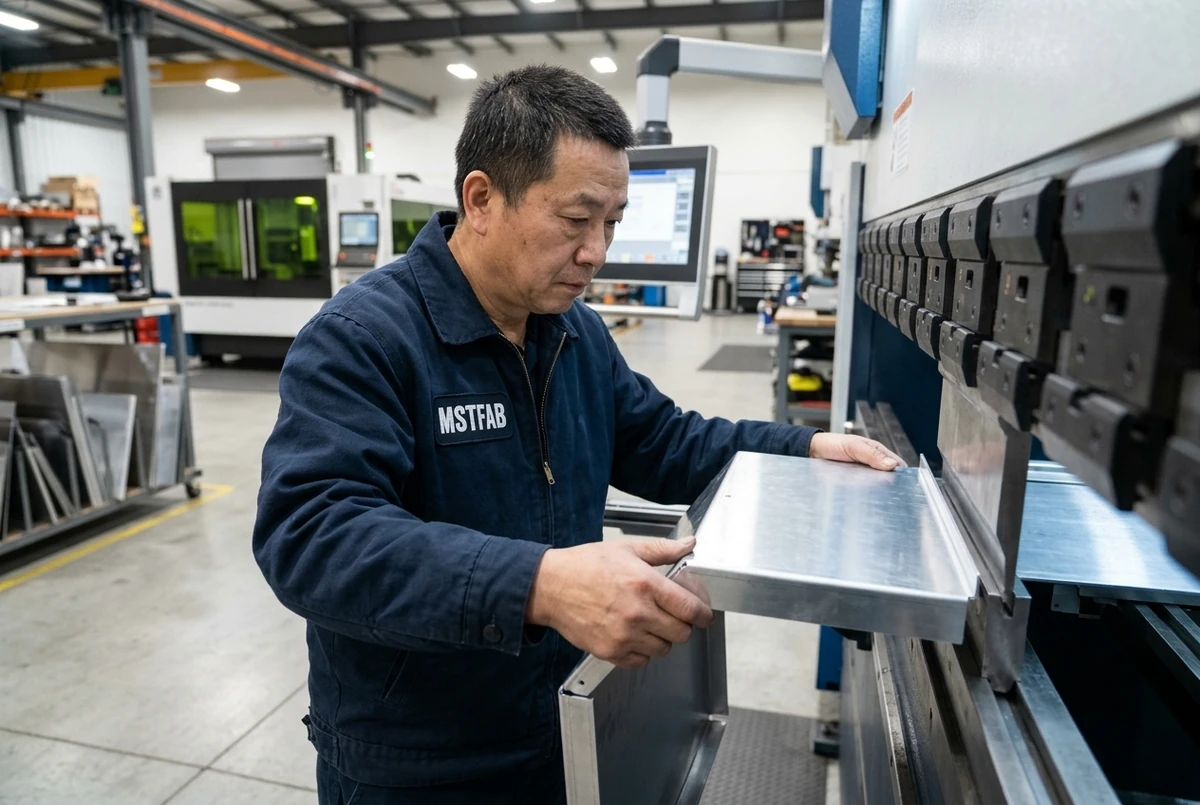
Direct CNC sheet metal fabrication bridges the gap from 1–5 engineering prototypes to hundreds or thousands of production units. Because flat patterns are cut by fiber laser and formed on programmable press brakes, you get exact geometry, integrated PEM standoffs and custom finishes without upfront die investments.
Direct CNC Fabricator
No hard-tooling minimum; direct engineering communication on DFM, welding, hardware clinching and custom surface finishing.
Modified Catalog Box
Useful for 1–5 quick lab tests if standard sizes fit, but limited on internal mounting plates, custom form factors and unit cost at scale.
Hard Stamping Tooling
Economical only after design freeze at high annual volumes where progressive or compound die amortization is justified.
Procurement tip: pick a supplier for your 5-unit pilot run that also has the welding, powder-coating and inspection capacity to run your 500-unit production batch so you do not have to requalify vendors mid-launch.
02 / Low-MOQ Economics
Understand how setup time, batch finishing and hardware drive short-run pricing.
In custom sheet metal, there is rarely a technical minimum order quantity—a laser and press brake can produce a single enclosure. However, unit price drops steeply between 1 piece, 10 pieces and 100 pieces because fixed engineering and machine setups are amortized across the batch.
- CAM & press-brake setup: unfolding the 3D model, nesting laser blanks and setting up segmented press-brake punches and backgauges take the same engineering hours whether the shop bends 2 covers or 50.
- Surface finishing lot charges: pretreatment baths, anodizing racks and powder-coat booth color changeovers carry a minimum batch charge that dominates single-piece pricing.
- Specialty hardware minimums: unusual captive screws, non-standard standoffs or specialty hinges may carry distributor pack minimums unless common metric or unified sizes are selected.
Working directly with a custom sheet metal fabrication supplier lets you see which cost drivers come from fixed setup versus per-piece cycle time.
03 / Lead-Time Optimization
Remove avoidable shop-floor holds with practical DFM choices.
Most schedule delays on fast-turnaround enclosures happen before metal is cut—waiting on missing dimensions, resolving conflicting CAD revisions or sourcing special-order tooling. Designing around standard digital fabrication rules keeps your order moving smoothly through the shop.
- Use uniform inside bend radii (typically ~1× material thickness for mild steel and aluminum) so parts form on standard V-dies without tool changes.
- Replace custom-stamped louvers with laser-cut slotted or hexagonal vent patterns when lead time matters more than raised louver geometry.
- Keep holes and self-clinching fasteners at least 2× material thickness plus bend radius away from bend lines to avoid secondary drilling or deformed threads.
Reviewing fiber laser cutting and CNC bending clearances before release prevents engineering hold queues.
04 / Scaling Production
Use the prototype run to lock down flat patterns, fixtures and packing.
A fast prototype is most valuable when it validates the exact manufacturing process that will build your production units. If your prototype is hacked together differently from your batch run, you risk discovering bend-deduction shifts or assembly interference during your commercial launch.
- Approved flat pattern: once the first article passes fitment with your PCB and wiring harness, the calibrated flat pattern and press-brake program are locked for repeat orders.
- Welding & masking templates: modular welding jigs and die-cut silicone masking templates created during pilot batches speed up subsequent 50- to 500-unit releases.
- Revision control: if pilot testing reveals a needed connector shift, updating the laser program takes minutes—provided the new STEP and PDF carry a clear revision increment.
- Staged release scheduling: once the design is frozen, scheduling predictable batch quantities helps secure raw sheet stock and coating line slots.
Consistent surface treatment and hardware records ensure that Batch 5 matches your approved pilot sample.
05 / Buyer Control Matrix
Confirm lead-time inputs, quality checks and revision handoffs.
Use this matrix to align expectations with your enclosure manufacturer on fast-turnaround and low-MOQ orders.
06 / Inspection Handoff
Do not skip dimensional verification on fast-turnaround orders.
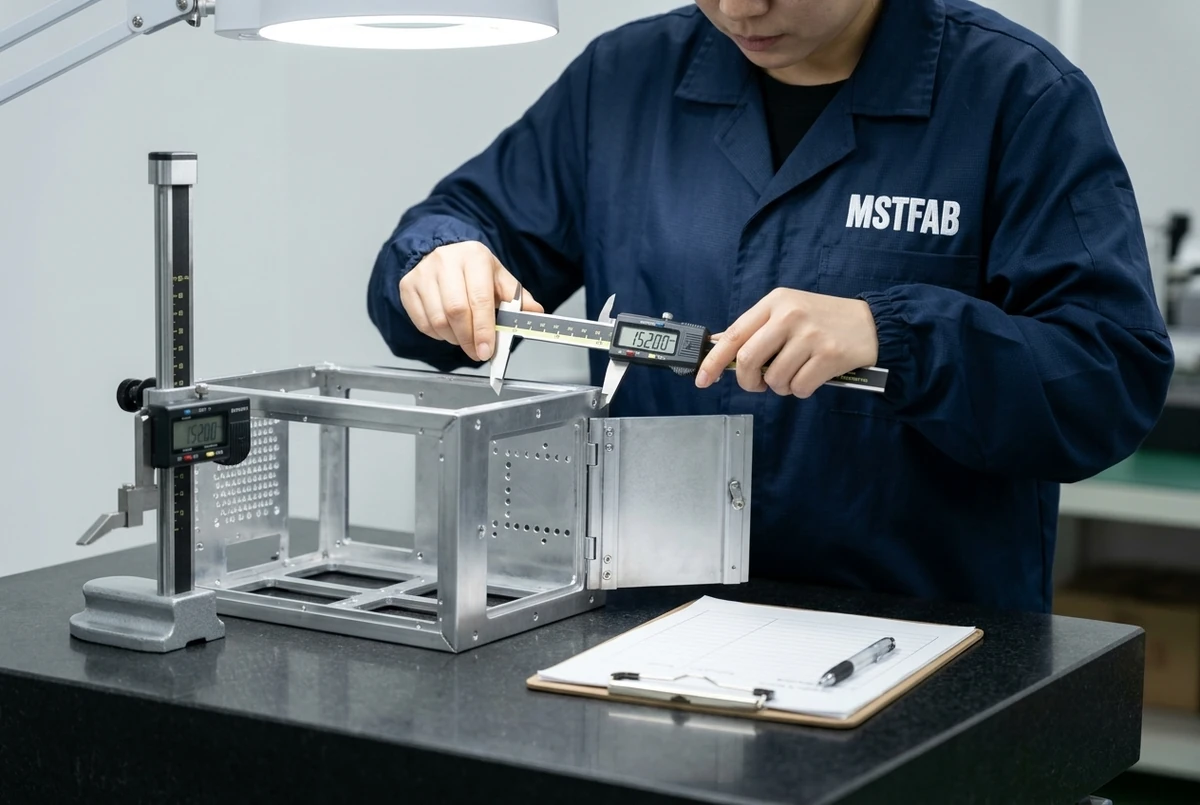
Fast turnaround only helps your project if the enclosure actually fits your electronics on arrival. Receiving an uninspected prototype quickly—only to find that standoffs are 2 mm off or powder coat has filled the M3 threads—costs more time than a structured quality check.
Identify the 5 to 10 Critical-to-Quality (CTQ) dimensions on your 2D drawing: overall envelope, PCB standoff pitch, I/O cutout registration and cover screw alignment. Agree on a clear inspection report and trial-assembly photographs before shipment.
When moving from prototype approval to repeat batches, keep a signed golden sample or documented FAI record as the reference standard.
Review MSTFAB quality control for prototypes and batch runs →
07 / Packing and Release
Match transit packaging to air-freight handling on urgent shipments.
Low-MOQ and prototype enclosures frequently ship via international air courier rather than full-container ocean freight. Parcel and air-cargo hubs subject cartons to repeated conveyor drops, roll-overs and compression.
Specify double-wall cartons, high-density foam corner blocks or compact plywood crates so thin flanges and rack ears do not bend in transit. Separating mating covers with foam sheets prevents powder-coat rub marks before the boxes reach your lab.
Manufacturing scope: MSTFAB manufactures custom sheet metal enclosures, brackets and mechanical assemblies from customer CAD files. Electronic components, wiring harnesses and end-device regulatory certifications are outside our standard scope.
08 / Ready-to-Review RFQ
Send eight items to get an accurate low-MOQ quote without back-and-forth delays.
- 3D STEP assembly + partsExport all sheet metal bodies in one consistent unit system.
- 2D PDF drawingsCall out critical tolerances, threads, grain direction and masking.
- Material alloy & gaugeSpecify stocked gauges (e.g., 1.5 mm 5052-H32 or 1.2 mm SPCC/304).
- Hardware BOMList self-clinching nuts, standoffs, studs and approved equivalents.
- Finish specificationState powder coat RAL/texture, anodize type or brushed passivation.
- Tiered quote quantitiesRequest pricing at e.g. 5, 25 and 100 units to see setup amortization.
- Target delivery dateShare your build schedule and preferred shipping mode (air vs sea).
- Inspection deliverablesNote if you require a formal FAI report, MTRs or trial-fit photos.
Complete RFQ packages let our engineering team review manufacturability and return clear tiered pricing and realistic production schedules.
Buyer questions on low-MOQ and fast-turnaround enclosures
What is MSTFAB’s minimum order quantity for custom sheet metal enclosures?
We do not enforce a rigid high-volume MOQ. We regularly build 1 to 10 prototype units to validate new designs, as well as pilot runs of 20–100 units and recurring production batches.
Why does 1 prototype enclosure cost much more per unit than 25 enclosures?
Programming the CAD/CAM flat patterns, setting up press-brake tooling, welding fixtures and running a powder-coating batch involve fixed setup labor and minimum line charges. Across 25 or 100 units, those fixed costs divide down into a small fraction of each part.
What factors slow down a custom enclosure order the most?
Incomplete drawings (missing material thickness, undefined thread sizes or conflicting 3D/2D revisions), non-standard raw sheet thicknesses, specialty imported latches and complex multi-stage wet paint masking are the most common lead-time bottlenecks.
Should I use 3D printing or sheet metal for an enclosure prototype?
3D printing works for plastic handheld housings, but for industrial equipment that requires EMI shielding, grounding continuity, thermal conduction, structural load capacity and real PEM hardware torque, a fabricated sheet metal prototype tests the actual production mechanics.
Can I order bare metal prototypes first and add powder coating on the production batch?
Yes, ordering bare or conversion-coated prototypes is a common way to verify PCB fitment and connector alignment quickly. Just remember to account for the 60–100 µm per-face coating thickness that will be added on the painted batch.
How do I transition from a 5-piece prototype to a 200-piece production order?
After you test-fit the prototype and confirm any final drawing revisions, we lock the approved flat patterns, bend programs and inspection checklist so your production batch runs on the exact verified setup.
Technical references
The following standards provide reference guidance for sheet metal tolerancing, quality management and enclosure hardware:
Get a tiered prototype and production quote for your enclosure.
Send your STEP and PDF files with your prototype quantity and target batch volume. MSTFAB will review your design and confirm realistic lead times.
Upload Drawings for Fast Quote →
Have a question first? caroline@mstfab.com
 WeChat Contact
 WhatsApp Me Directly