
What OEM Buyers Should Check Before Ordering Tractor Parts
Tractor sheet metal parts do not live an easy life.
They deal with constant vibration, mud, dust, rain, fertilizer residue, impact, and field repairs that often happen when the machine should already be working.
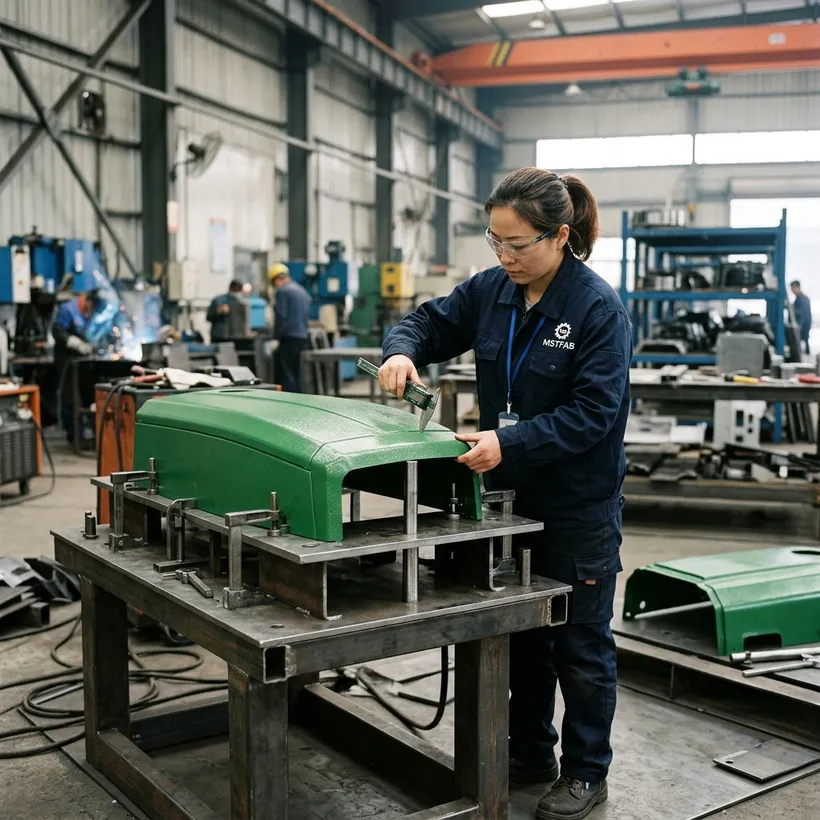
Our inspector verifying the fitment and gap tolerance of a custom tractor engine cover against a master test fixture.
That means tractor sheet metal parts are not just “metal panels.” They must fit correctly, resist vibration, protect components, survive corrosion, support service access, and remain consistent from prototype to batch production.
At MSTFab, we manufacture custom tractor sheet metal parts based on customer STEP files, 2D PDF drawings, samples, or project requirements. For OEM buyers, the real sourcing question is not only “Can you make this part?” but “Will this part fit the tractor, survive field use, and arrive ready for assembly without creating rework?”
Because a cheap tractor panel that rattles, rusts, cracks, or does not fit is not cheap. It is just downtime wearing powder coating.
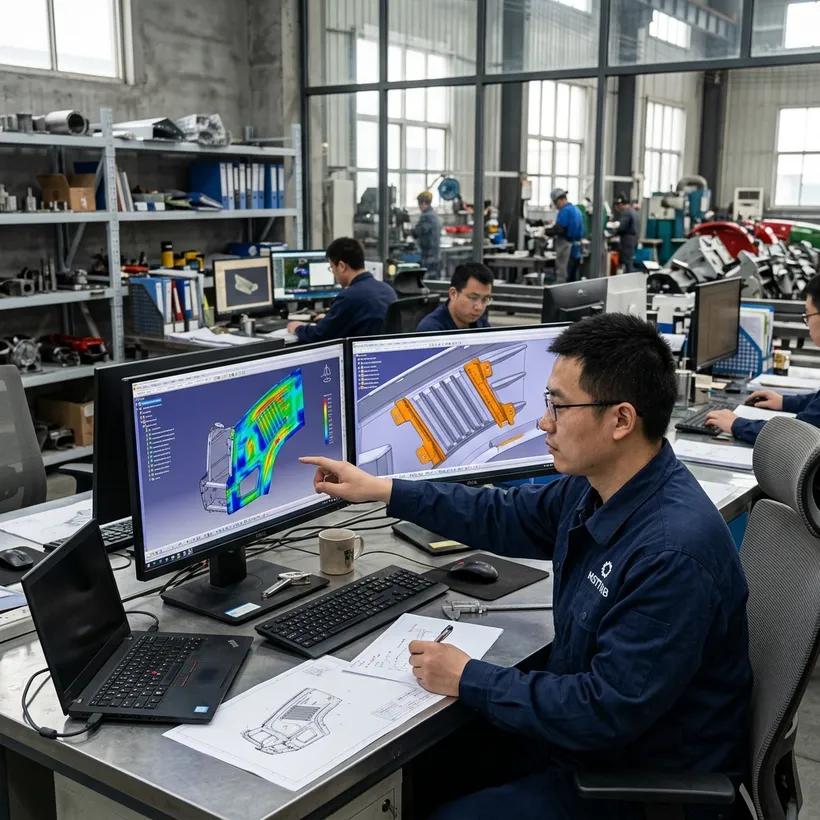
Performing a proactive DFM review on a tractor side panel to add structural reinforcement and prevent field vibration failures.
1. Fitment Is the First Procurement Check
For tractor sheet metal parts, fitment matters more than a nice factory photo. A 2 mm or 3 mm mismatch may look small on a drawing, but in the field, it becomes a very annoying problem.
| Pain Point | Cheap Job Shops (The Nightmare) | MSTFab Engineering Standard |
|---|---|---|
| Hole Misalignment | Bending K-factor guessed. Holes don’t line up during assembly. | Mathematically precise CNC bending guarantees perfect assembly alignment. |
| Welding Distortion | Brackets warp from excessive heat. The part won’t bolt onto the chassis. | Controlled TIG welding and fixture clamping to lock dimensions in place. |
| Cable Entry Disasters | Drilling cable holes after powder coating, inviting immediate rust. | Pre-planned knockouts and precision laser cutting before any coating is applied. |
2. Tractor Parts Must Handle Extreme Vibration
Tractors vibrate heavily. This matters especially for engine covers, belt guards, and control box enclosures. A part that feels strong on a workbench may behave very differently on a tractor crossing rough farmland.
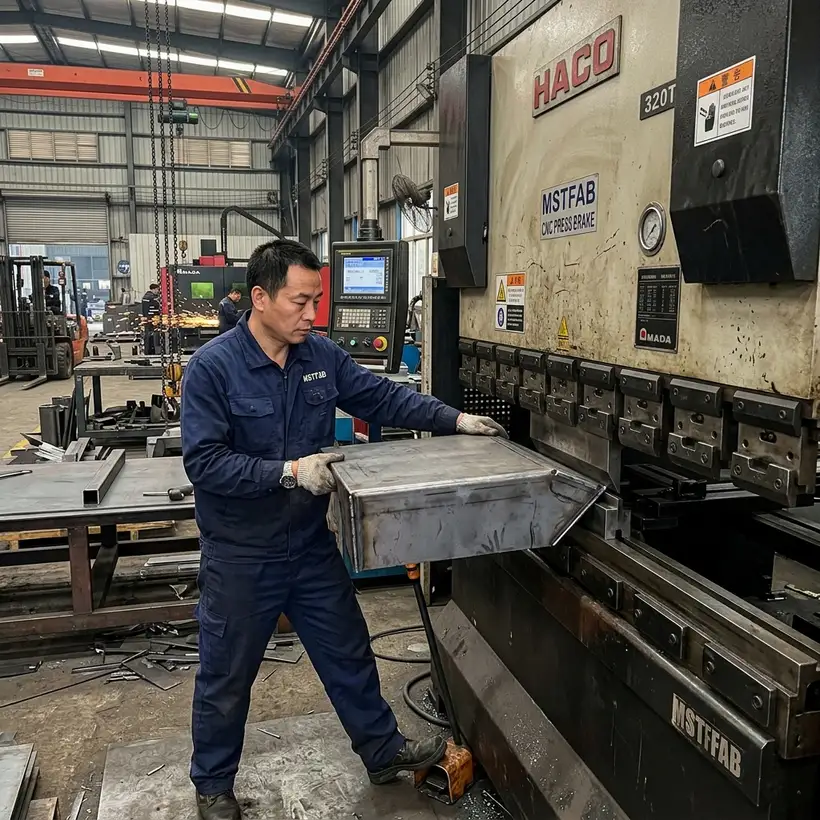
Utilizing massive CNC press brakes to fold thick steel into rigid battery box covers that can withstand constant chassis vibration.
The answer is not always “make it thicker.” Sometimes better geometry (ribs, gussets, folded edges) is the real solution. Heavy and wrong is still wrong. Just harder to install.
3. Welding Must Be Controlled for Strength and Fit
Many tractor metal guards and mounting plates require welding. Poor welding can cause warped panels and early cracking under vibration.
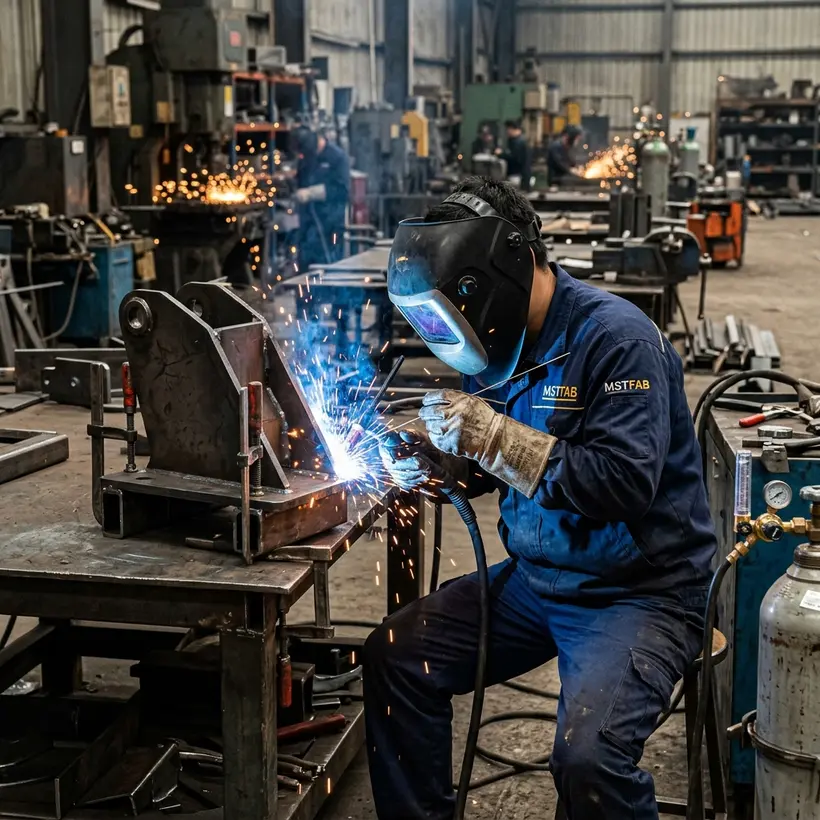
Precise TIG welding of heavy-duty tractor brackets ensures structural integrity without excessive thermal distortion.
A beautiful weld on a warped bracket is still a problem. Just a shiny one.
4. Control Box Enclosures Need Special Protection
Tractor control box enclosures protect critical electrical components from the mud. Cable entry is one of the biggest risks. Drilling cable holes after powder coating is not engineering. It is corrosion with a drill.
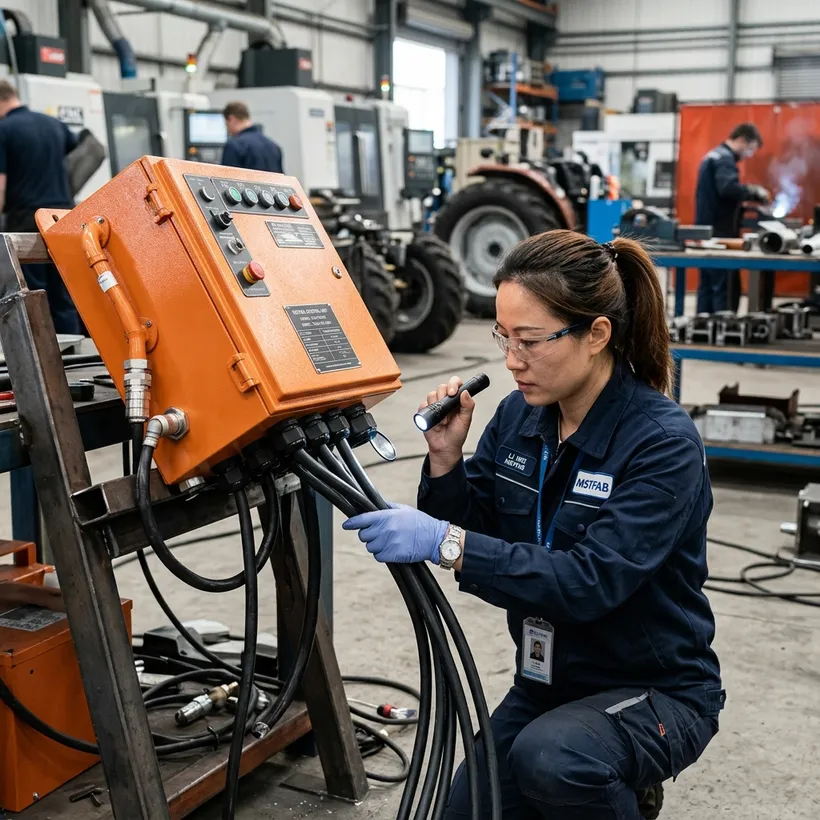
Quality engineer inspecting the pre-cut cable entry points on a powder-coated tractor control box to ensure perfect gland sealing.
5. Export Packaging Must Protect Coated Tractor Parts
Whether it’s shipping farm machinery parts to Australia or the USA, a tractor part that leaves the factory correct but arrives bent is not a successful shipment. It is a logistics problem shaped like a metal panel.
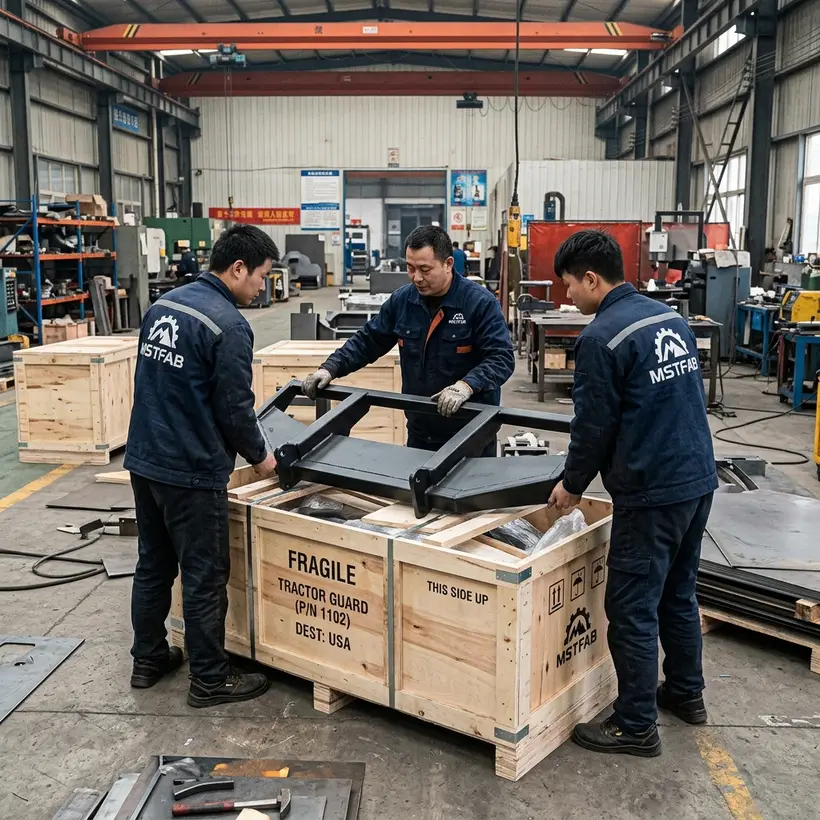
Export packaging is part of quality control, utilizing robust wooden crates and thick foam to separate heavy steel parts.
Stop Dealing with Parts That Don’t Fit Your Tractors.
A cheap quote from a factory that doesn’t understand agricultural physics is just a down payment on a massive field disaster.
We back our custom sheet metal fabrication with predictable global logistics (FOB, CIF, or DDP) directly to your assembly line.
Explore Our Core Capabilities
Discover our full range of agricultural manufacturing services at our core product hub: Custom Agricultural Sheet Metal Parts Fabrication
Related agricultural OEM check: Before releasing tractor brackets, guards, panels or welded assemblies for production, review MSTFAB’s custom tractor metal parts fabrication risk matrix for vibration, corrosion, fitment, welding, coating and RFQ file checkpoints.
sheet metal welding services
MSTFAB provides TIG and MIG sheet metal welding services for structural assemblies, cabinets, frames and OEM metal components.
 WeChat Contact
 WhatsApp Me Directly