
China telecom cabinet supplier shortlist / OEM buyer scorecard
Quick answer: there is no permanent, verifiable universal top five. Build your own five-supplier shortlist around the actual cabinet: site climate, sealing target, thermal interfaces, cable entry, corrosion exposure, inspection evidence and export packing. This guide gives OEM buyers seven comparison dimensions and a trial-order gate before volume production.
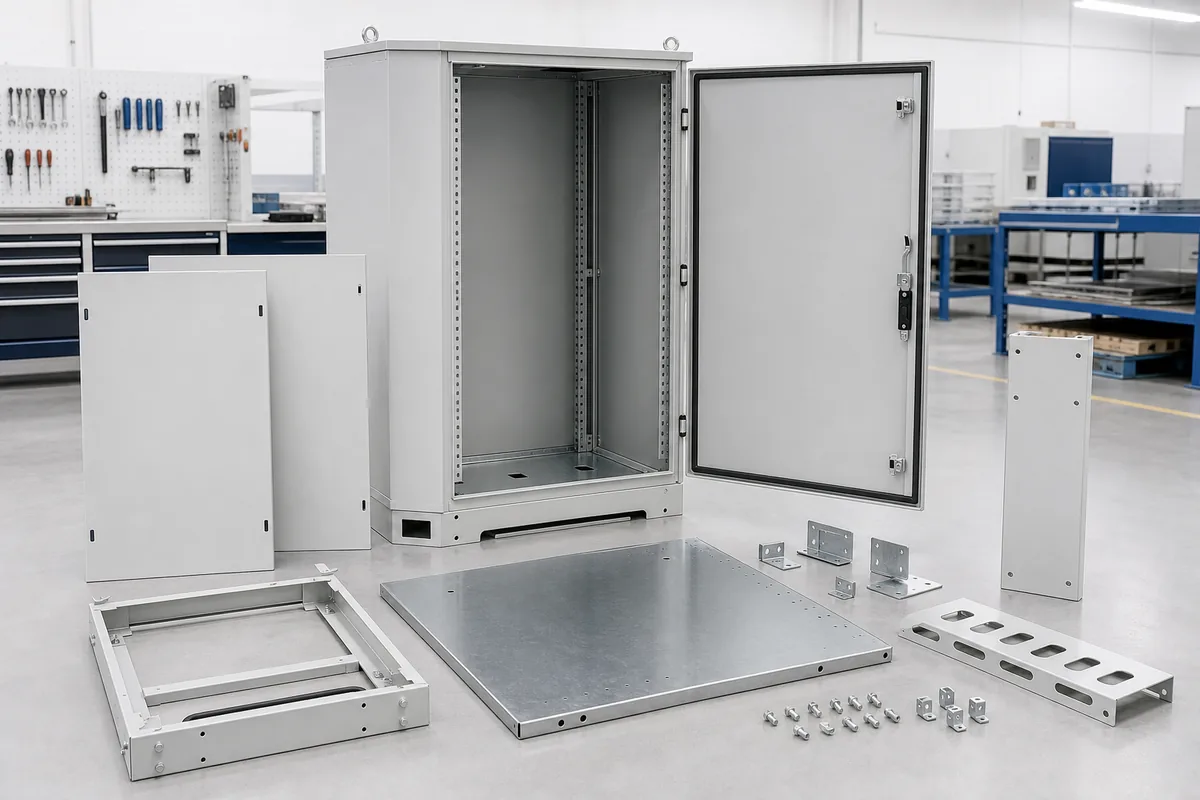
Scope boundary
What MSTFAB can support, and what belongs to the telecom OEM
MSTFAB fabricates empty telecom cabinet shells and sheet metal parts from buyer drawings. Typical work includes laser-cut panels, CNC-bent doors, welded bases, rain lips, mounting plates, cable-entry plates, rack rails, brackets, hinge and lock interfaces, powder coating, dimensional inspection and export packaging.
MSTFAB does not supply complete telecom systems, radios, wiring, power modules, software, RF equipment or final product certification. The buyer, equipment OEM or system integrator remains responsible for live electronics, thermal validation, EMC compliance, grounding design, ingress testing of the assembled cabinet and market approvals.
- Outdoor telecom cabinet metal shells
- Network cabinet frames, doors and side panels
- Laser-cut vents, gland plates and mounting holes
- CNC-bent rain lips, returns and flanges
- Welded plinths, bases and reinforcement frames
- Hardware installation when specified by drawing
- Powder coating, masking and visual checks
- First-article dimensional inspection and export packing
- Telecom radios, batteries, rectifiers and PDUs
- Electrical wiring and live equipment assembly
- RF, EMC, grounding and complete thermal design
- Glands, filters, heat exchangers or A/C selection
- IEC 60529, NEMA, NEBS or ETSI test program
- Field installation, energized validation and certification
- Software, monitoring, payment or network functions
- Regulatory approvals for the complete system
Why a telecom cabinet shortlist needs its own lens
A telecom cabinet is not just an indoor enclosure with a tougher expression. It may sit beside a road, on a roof, near salt air, in summer sun, under monsoon rain, or inside a shelter where the electronics still need clean cable routing and stable mounting points. It may carry RF equipment, power hardware, fiber routing, batteries, grounding bars and field-service access. That is a lot of responsibility for folded metal.
For a buyer, the shortlist problem is simple: the supplier who can make a neat powder-coated indoor box may not be the right supplier for an outdoor network cabinet shell with sealing flanges, rain lips, cable-entry plates, louver patterns, corrosion requirements, hardware interfaces and export packing. The sales brochure rarely admits this. The factory floor usually does.
Why China is worth shortlisting, but still needs verification
China has a deep sheet metal enclosure supply base for telecom, network infrastructure, data center equipment, power distribution and industrial control projects. The value is real: material sourcing, laser cutting capacity, CNC bending, welding, powder coating, hardware supply, assembly labor and export logistics are all available in mature clusters.
The risk is also real. A trading company can rent confidence faster than it can own a press brake. A general metal shop can say “outdoor cabinet” while treating the gasket line like decoration. A low quote can hide subcontracting, weak finishing, poor cable-entry planning or packaging that protects the invoice better than the cabinet. That is why the buyer should rank suppliers with evidence, not adjectives.
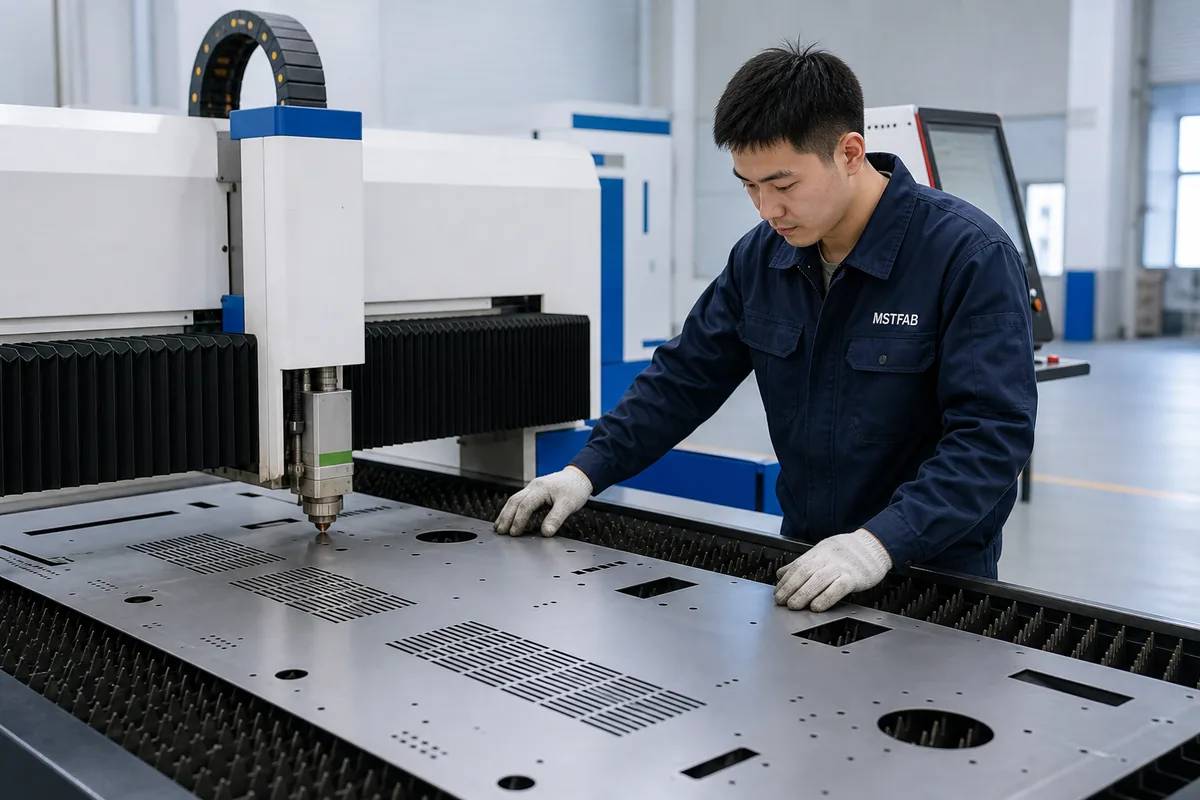
For production metalwork, the cutting route should be assessed as part of the whole cabinet build. See MSTFAB’s laser cutting services for how cutouts, holes and panels fit into downstream bending and assembly.
The seven dimensions that actually rank a telecom cabinet maker
Use the scorecard below to build your own top five. Give each dimension a score from 1 to 5. Dimension 1 and Dimension 6 are hard gates. If a supplier fails either one, it should not stay on the shortlist, even if the price looks charming in a spreadsheet.
| Dimension | Weight | What to verify | Pass or fail signal |
|---|---|---|---|
| D1 Real manufacturer and outdoor cabinet experience | Gate | Owned equipment, cabinet production floor, gasket and assembly work, similar shipped projects | Fail if the supplier cannot prove it actually builds outdoor cabinet shells |
| D2 Thermal-management interface discipline | 20% | Vent patterns, fan plates, heat-exchanger cutouts, filter access and condensation-aware details | Fail if the answer is just “we cut some holes” |
| D3 Weather ingress and corrosion fit | 20% | Rain lip, gasket flange, door gap, material grade, pretreatment, powder coating and coastal notes | Fail if carbon steel is quoted blindly for severe exposure |
| D4 Cable entry, grounding and EMC interface control | 15% | Gland plates, masked bonding faces, grounding tabs, fastener contact areas and continuity-test planning | Fail if coating covers every electrical contact area without discussion |
| D5 Mounting, security and field-service access | 15% | Pole, wall or plinth mounting, anti-pry details, locks, hinges, doors, panels and rail support | Fail if the supplier cannot explain installation load or service access |
| D6 Quality system and evidence package | Gate | Material records, first-article inspection, critical dimensions, coating checks and packing photos | Fail if the supplier refuses drawings-based inspection evidence |
| D7 Commercial clarity and export logistics | 30% | Price breakdown, lead time, volume breaks, Incoterms, packing method, change control and communication | Fail if the quote is cheap because everything important is “extra later” |
D1: verify a real outdoor telecom cabinet fabricator
Do not only ask whether the supplier can make telecom cabinets. Ask them to show the path. A practical video audit should walk past sheet storage, laser cutting, bending, welding fixtures, hardware insertion, coating or coating partners, inspection benches, packing area and actual cabinet work in progress. You are not looking for movie quality. You are looking for a factory that exists in the same universe as the quotation.
For outdoor cabinet shells, the supplier should understand tall door geometry, welded-frame squareness, lifting points, removable panels, cable-entry plates, ventilation features, sealing flanges and corrosion-sensitive finishing. If the shop keeps returning to generic “metal box” language, score it low. Telecom cabinet fabrication is still sheet metal fabrication, but the interfaces are less forgiving.
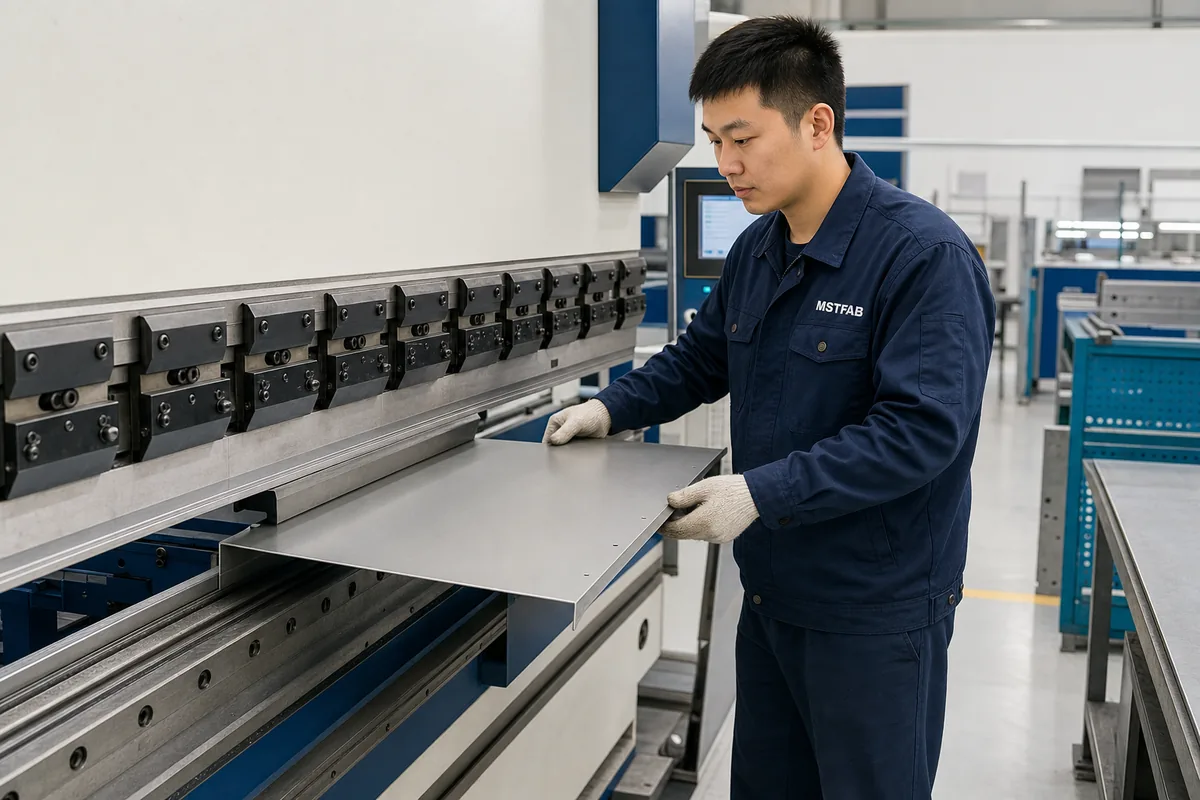
For formed cabinet doors, rain lips and return flanges, review MSTFAB’s sheet metal bending capability.
D2: score thermal-management interfaces, not promises
MSTFAB does not design or certify the complete thermal system for telecom electronics. However, the metal shell must provide accurate mechanical interfaces for the buyer’s thermal strategy. That may mean louvered panels, fan trays, filter doors, heat-exchanger cutouts, A/C mounting openings, rain hoods, drainage features or removable service panels.
Ask each supplier what manufacturing risks they see in the thermal features. Small bridges in louver patterns can distort. Fan openings near bends can warp. Filter doors need access and clearance. Heat-exchanger openings need hole patterns and flat sealing faces. Condensation control may need drain or breather interfaces approved by the buyer. A good fabricator will ask questions before cutting steel. A weak one will say “no problem” and create several.
D3: weather ingress and corrosion are separate questions
A cabinet can have a good sealing concept and still fail outdoors because the finish is wrong for the site. IP or NEMA style language addresses ingress performance of a tested configuration; corrosion life depends on material, pretreatment, coating, exposed edges, weld cleanup, salt exposure, UV exposure and maintenance conditions. Do not let one label do two jobs.
For sheet metal cabinet shells, check door-gasket contact, flange flatness, rain lip geometry, weld dressing near the sealing path, cable-entry plates, gland openings and fastener penetrations. For coastal or high-humidity projects, ask for material grade, coating system, powder specification, masking areas and any salt-spray expectations. The buyer or test owner should define final ingress and corrosion validation, while the fabricator provides drawing-defined metalwork and process evidence.

For exterior finishes, use surface treatment and powder coating planning to define coating thickness, texture, color and masking.
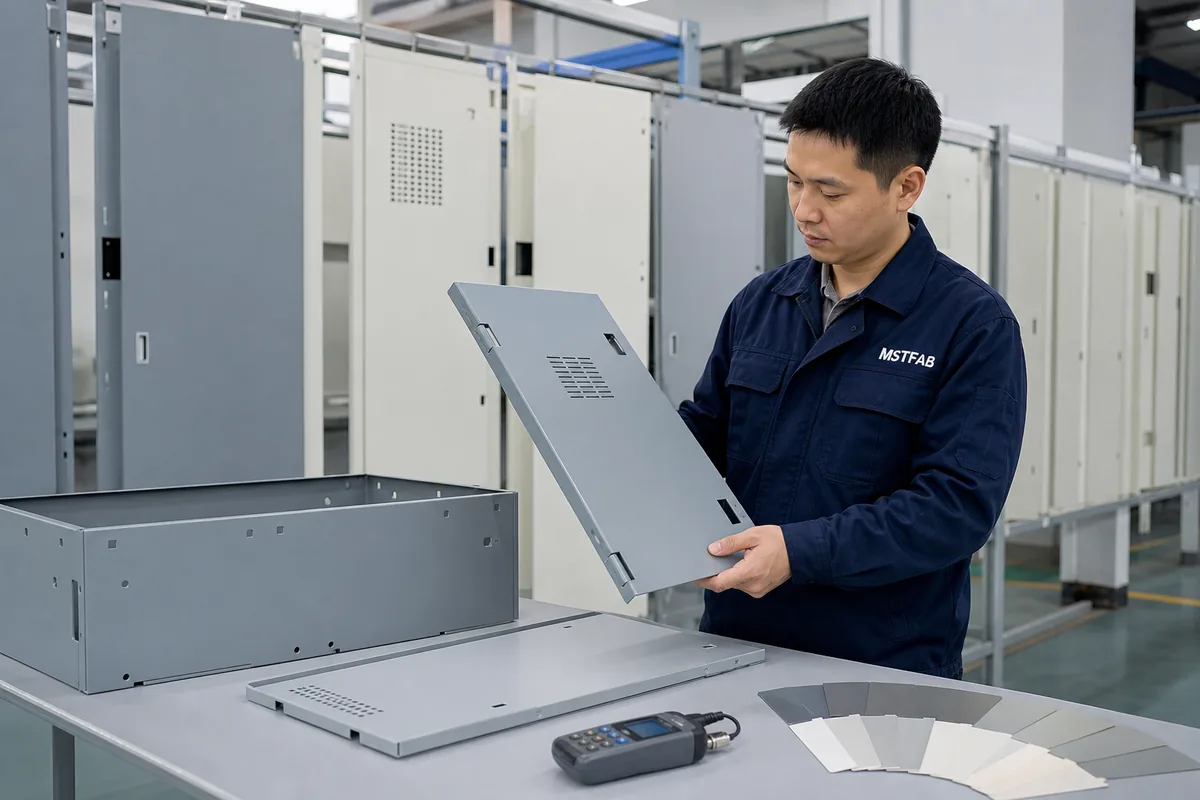
D4: cable entry, grounding and EMC interfaces need drawings
Telecom cabinet buyers often care about EMC, bonding and grounding. MSTFAB can fabricate the mechanical interfaces, but the buyer must define the system requirements and test plan. On the metal side, useful details include masked grounding areas, studs, threaded inserts, copper or stainless contact hardware, cable gland plates, filtered-penetration cutouts, gasketed removable panels and protected fastener locations.
The biggest mistake is treating every cutout as just a hole. A cable gland opening has a gland owner, diameter, tolerance, plate thickness, gasket method, torque expectation and service direction. A grounding tab has a coating or masking decision. A shielding path may need conductive contact surfaces and continuity checks after finishing. If those details are not in the drawing or RFQ, the cabinet may be mechanically attractive and electrically confusing.
D5: mounting, security and service access decide field behavior
Outdoor telecom cabinet shells may be wall mounted, pole mounted, pad mounted, skid mounted or installed inside a shelter. Each mounting style changes loads and cabinet details. A pole-mounted shell may need reinforced back plates and bracket interfaces. A ground cabinet may need plinth strength, lifting points and anchor holes. A service cabinet may need removable doors, protected hinges and enough room to reach cable entries without becoming a weekend acrobatics course.
Security details also matter. Anti-pry seams, concealed fasteners, lock reinforcements, door stiffness and hinge support can be fabricated into the shell when they are included in the drawing. They are much harder to “add later” after coating. If a supplier cannot talk about installation and service, it may be building a cabinet for a catalog photo rather than a field site.
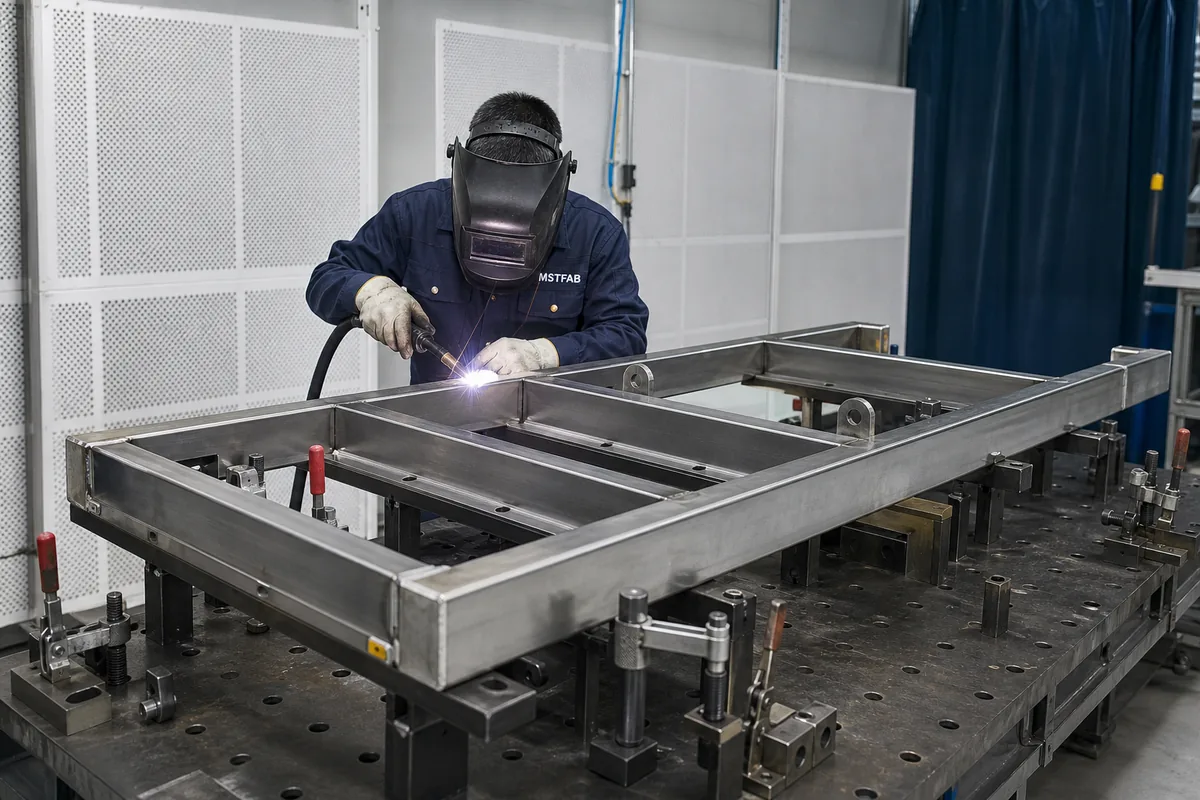
Welded frames, bases and structural supports should be reviewed before production. MSTFAB’s sheet metal welding services page explains our fabrication route for frames and assemblies.
D6: quality evidence is the hard gate
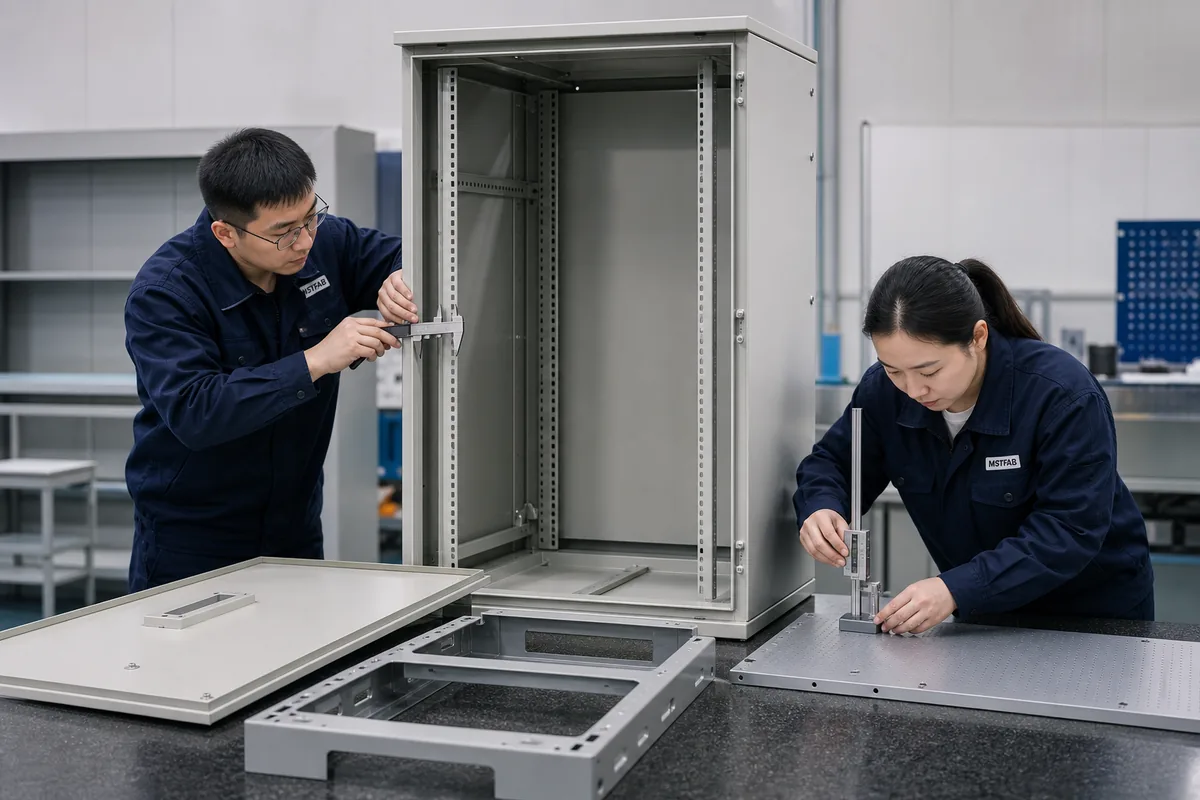
A serious shortlist should require evidence before batch release. That does not mean measuring every dimension on every cabinet. It means agreeing which dimensions protect fit, sealing, mounting, finish and shipping. For a telecom cabinet shell, typical critical checks include overall squareness, rail spacing, door gap, sealing flange width, hinge position, latch position, gland-plate opening, fan or filter cutouts, welded base diagonals, powder coating appearance and masked contact areas.
A first article inspection report is often the most useful paid filter. It turns a sales claim into measured evidence. If the supplier refuses to provide a drawing-based FAI on a trial order, it should not rank. This is the point where a shortlist becomes less emotional and more useful.
D7: commercial clarity and export logistics are part of the score
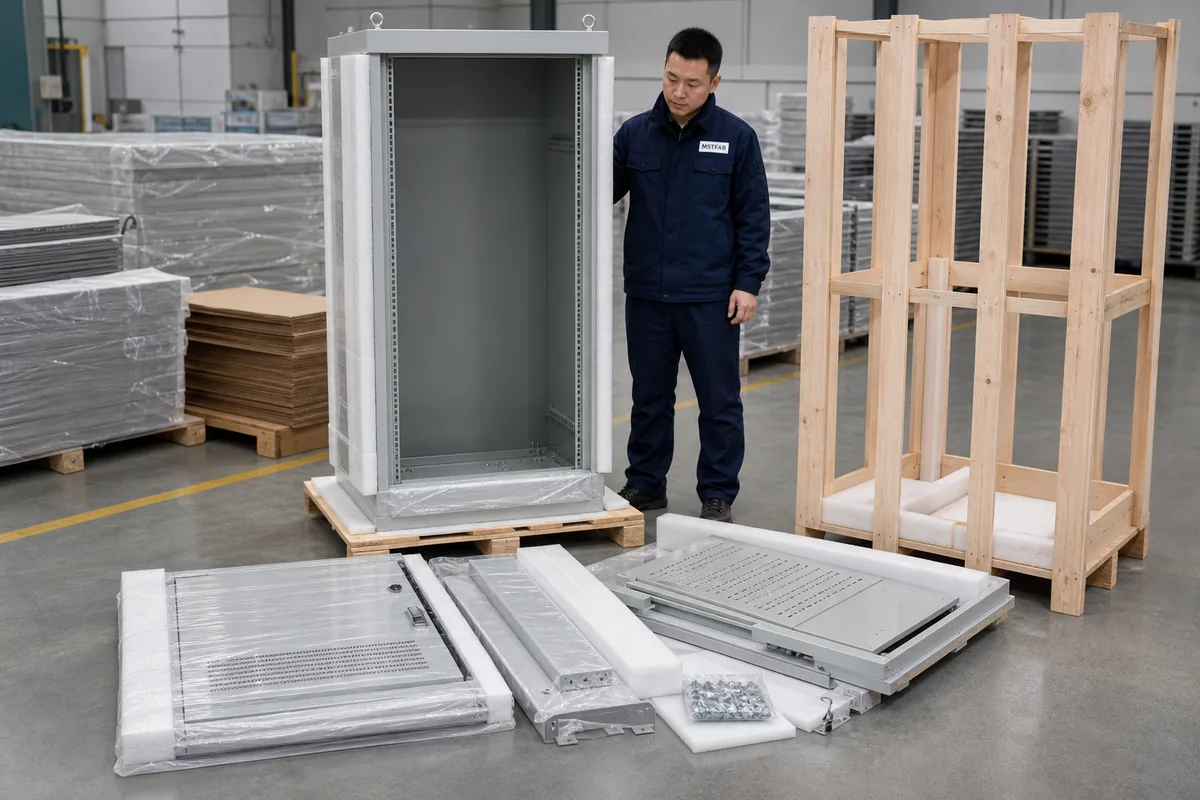
Telecom cabinets are often large, heavy and easy to scratch at corners. Export packaging is not a decoration. It protects door edges, gasket surfaces, painted faces, loose panels, hardware bags and internal rails from freight handling. A supplier that quotes the cabinet but forgets packing has not finished the quote.
Ask for the price breakdown by material, fabrication, welding, hardware, finishing, inspection, packaging and freight term. Confirm prototype lead time, first article approval timing, batch lead time, packing standard, Incoterms, carton or crate dimensions and what happens when drawings change. The cheapest supplier can become the expensive one if the first container arrives with bent doors and silent paperwork.
Evidence table for a telecom cabinet trial order
| Evidence to request | Why it matters | Who should own it | When to request it |
|---|---|---|---|
| Factory video audit or visit photos | Confirms the supplier has real cutting, forming, welding, inspection and packing capability | Buyer sourcing team and supplier | Before shortlist approval |
| DFM review notes | Shows risks around bends, welds, sealing flanges, cutouts, hardware and coating | MSTFAB engineering and buyer engineer | Before quotation or purchase order |
| Material record | Confirms material grade, thickness and heat or batch traceability where required | Supplier purchasing and quality team | Before or during first article |
| First article dimensional report | Verifies critical cabinet geometry, door fit, rail alignment and mounting datums | Supplier quality team | Before batch release |
| Coating and masking record | Protects color, texture, thickness, threads, grounding areas and gasket contact surfaces | Supplier finishing and quality team | Before sample shipment |
| Buyer-directed ingress or EMC test report | Validates the complete assembled configuration against the buyer’s requirement | Buyer, system integrator or approved lab | Before volume production |
| Packing photos | Confirms cabinet body, doors, panels and hardware are protected for international transport | Supplier shipping team | Before every first shipment |
For stronger procurement evidence, define a dimensional inspection report, use first article inspection for the trial order, and confirm export packaging before the cabinet leaves the factory.
Thermal specialist, outdoor cabinet builder or shelter builder?
Your top five should match the job, not the largest catalog. A thermal or EMC specialist may be best when the cabinet carries high heat density or sensitive RF requirements. A full outdoor cabinet builder is often better when you need one route for laser cutting, CNC bending, welding, hardware, coating, inspection and packing. A shelter or integrated-station builder may fit larger walk-in or containerized deployments, but may not be ideal for smaller drawing-defined cabinet shells.
MSTFAB is positioned as a sheet metal fabrication partner for custom cabinet shells and mechanical parts. That makes us useful when the buyer already owns the equipment design and needs reliable metalwork, not when the buyer needs a complete telecom system supplier.
The trial-order gate: the real ranker
Supplier scorecards are helpful, but trial orders are honest. Send the same drawing pack to the strongest three to five suppliers. Include the target environment, material, thickness, finish, mounting style, cabinet interfaces, quantity forecast, inspection requirements and packing notes. Then compare the first articles by measured evidence, communication quality, manufacturing questions, packaging and true landed cost.
A paid trial order should include photos at key stages, the finished empty cabinet shell, critical-dimension report, coating check, door and panel fit photos, hardware or gasket installation record if in scope, and packing photos. If your project requires an IP, EMC, NEBS, ETSI or NEMA result, the buyer should define the complete test sample and responsible test owner. The metal fabricator can support the mechanical sample; the final product test belongs to the product owner.
Red flags that remove a supplier from the shortlist
Eight-step workflow to build your own top five
- Define the site. List climate, corrosion exposure, installation style, thermal load, security need and quantity forecast.
- Freeze the fabrication scope. Separate empty metal shell, purchased hardware, electronics, thermal equipment and final certification ownership.
- Build a long list. Search for outdoor telecom cabinet fabricators, network cabinet shell makers and sheet metal enclosure factories with relevant evidence.
- Verify real makers. Use video audits, factory photos, machine lists and sample records to remove traders or indoor-only shops.
- Score the seven dimensions. Use the weighted table and treat D1 and D6 as hard gates.
- Send a complete RFQ. Include STEP, 2D PDF, material, finish, critical features, hardware scope, inspection plan and packing requirements.
- Run a paid trial order. Compare the same cabinet geometry, evidence package, response quality and landed cost.
- Rank and rescore. Select the top suppliers for your project and rescore after design changes, batches or new site conditions.
What MSTFAB can manufacture for telecom cabinet projects
MSTFAB supports drawing-based sheet metal fabrication for telecom cabinet shells, outdoor enclosure bodies, network cabinet frames, rack rail supports, doors, side panels, cable-entry plates, louvered panels, plinths, brackets, fan plates, grounding tabs and powder-coated cabinet parts. We work from buyer drawings and CAD files, then review manufacturability before production.
For a commercial cabinet shell project, start with outdoor telecom enclosure fabrication, 5G telecom enclosure solutions, or network cabinet fabrication. For the wider route, review our sheet metal fabrication service, custom sheet metal parts from drawings and sheet metal fabrication from CAD files.
Key takeaways
- A trustworthy top five is built from project fit, not copied from a paid directory.
- Telecom cabinet suppliers should be judged on outdoor cabinet evidence, thermal interfaces, sealing geometry, cable-entry control, security, quality records and export packing.
- MSTFAB supplies drawing-defined metalwork only: empty cabinet shells and mechanical sheet metal parts, not complete telecom systems.
- The best ranking method is a paid trial order with a first-article inspection report and buyer-defined validation scope.
- Use clear internal specifications and supplier evidence before scaling. A cabinet that fails in the field rarely fails quietly.
Related fabrication resources
FAQ
Can you name the actual top 5 telecom cabinet manufacturers in China?
No. A universal list would be more confident than useful. The right suppliers depend on cabinet size, outdoor exposure, thermal interface, material, finish, inspection evidence, packaging and product validation scope. Use this scorecard to build a top five that fits your project instead of trusting a paid ranking.
What should I check before shortlisting a telecom cabinet supplier?
Verify that the supplier is a real manufacturer, has outdoor cabinet shell experience, understands sealing and corrosion risks, can fabricate cable-entry and grounding interfaces from drawings, and will provide first-article dimensional evidence before batch production.
Does MSTFAB make complete telecom cabinets with electronics?
No. MSTFAB focuses on empty sheet metal cabinet shells and mechanical parts. We can fabricate the enclosure body, doors, panels, rails, brackets, gland plates, finish and packing according to drawings. The buyer or integrator owns electronics, wiring, RF equipment, software, energized testing and final certification.
How do I compare suppliers without only chasing the lowest price?
Send the same drawing pack, quantity, material, finish, inspection plan and packing requirement to each supplier. Then compare DFM feedback, first-article evidence, response quality, lead time, packaging and true landed cost. Cheap is useful. Surprise-cheap is usually a meeting invitation from the future.
What evidence should a telecom cabinet trial order include?
Useful evidence includes stage photos, material record, critical-dimension report, door and panel fit photos, coating and masking record, hardware or gasket installation record if included, and export packing photos. Product-level IP, EMC, NEBS, ETSI or NEMA validation should be controlled by the buyer or approved test owner.
Can MSTFAB support outdoor telecom cabinet projects for Europe and North America?
Yes, MSTFAB can support export-focused sheet metal fabrication for outdoor telecom cabinet shells and related metal parts. Buyers should provide drawings, material, finish, quantity, inspection requirements, packaging needs and any buyer-controlled test or certification requirements.
Telecom cabinet RFQ review
Need a drawing-defined telecom cabinet shell supplier?
Send your STEP file, 2D drawing, material, thickness, finish, cabinet size, cable-entry details, mounting style, inspection requirements and packaging notes. MSTFAB will review the fabrication route and quote the metalwork scope clearly, without pretending to be your radio, software or certification department.
 WeChat Contact
 WhatsApp Me Directly