
China medical enclosure sourcing guide / OEM buyer scorecard
Quick answer: a public list of the top 5 medical equipment enclosure manufacturers in China is not a sourcing shortcut a serious OEM buyer should trust. Medical enclosure projects vary by device class, audit trail, material grade, surface finish, cleanability, EMI requirement, tolerance stack-up, inspection records and confidentiality rules. This guide helps procurement and engineering teams build their own shortlist with evidence instead of copying a paid directory badge.
Scope boundary
What MSTFAB can support, and what stays with the medical OEM
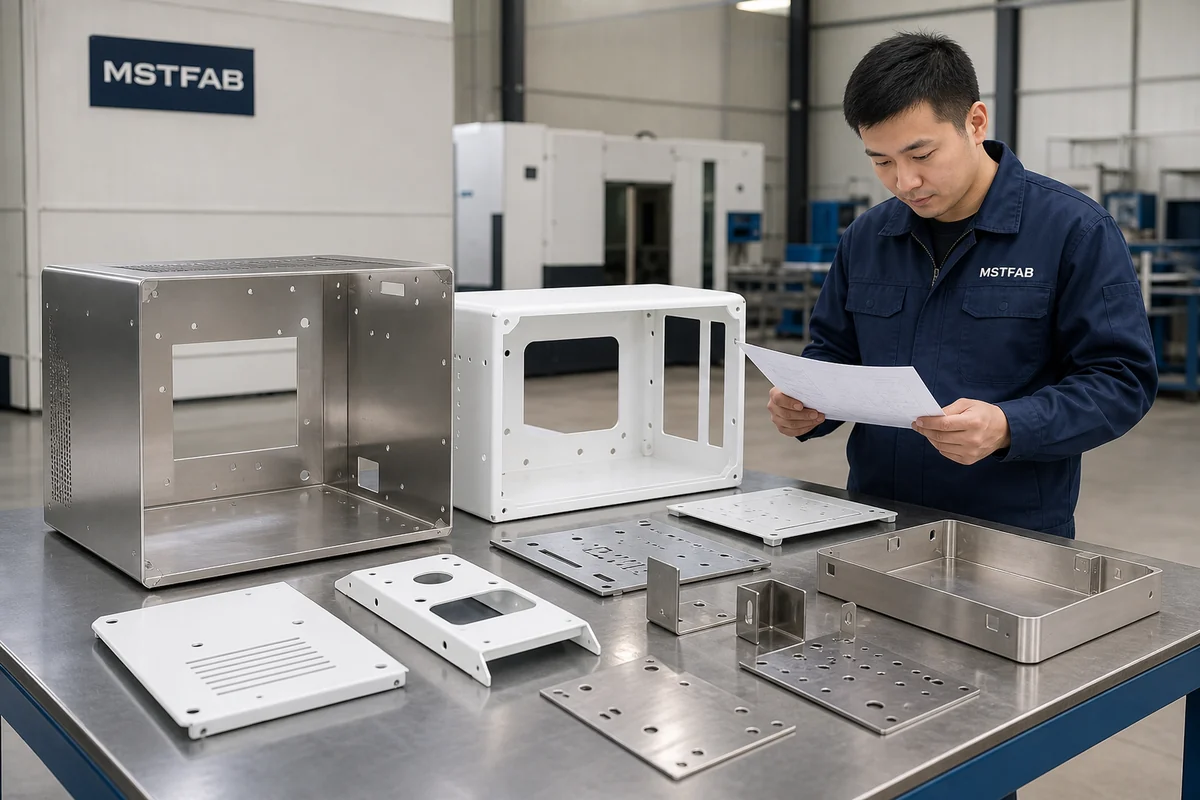
MSTFAB fabricates empty medical equipment enclosure shells and mechanical sheet metal parts from buyer drawings. Typical work includes laser-cut stainless steel panels, CNC-bent covers, welded chassis frames, removable doors, mounting plates, bracket sets, PEM hardware locations, edge deburring, surface finishing, dimensional inspection and export packaging.
MSTFAB does not supply complete medical devices, electronics, software, patient-contact validation, sterilization validation, regulatory submissions, energized testing or final product certification. The buyer, device OEM, regulatory consultant, system integrator or approved laboratory remains responsible for medical device classification, electrical safety, biocompatibility, sterilization validation, cleaning validation, risk management, IEC 60601 testing, OEM quality or EU MDR documentation and final market approvals.
- Empty medical equipment enclosure shells and chassis bodies
- Stainless steel, aluminum or powder-coated panels from drawings
- Doors, covers, bezels, shields, plates, brackets and rails
- Laser-cut cutouts, holes, slots, vent patterns and mounting features
- CNC-bent returns, soft-edge covers, gasket flanges and radius features
- TIG/MIG welded frames, corners and mechanical support structures
- PEM hardware installation, masking zones and finish checks when specified
- First-article dimensional inspection and export packing evidence
- Medical device function, electronics, PCBs, wiring and software
- Patient-contact material validation and biocompatibility decisions
- Sterilization, cleaning-cycle validation and clinical-use risk review
- IEC 60601, EMC, leakage-current and energized equipment testing
- ISO 9001, ISO 9001 quality control, EU MDR and CE technical documentation
- Final assembled-device ingress, safety and regulatory approval
- Approved labels, IFU, traceability rules and complaint handling
- Complete device certification for the target market
Why a medical enclosure shortlist needs its own lens
A medical equipment enclosure is not just a tidy metal cover with a polite white finish. It may sit near patients, protect electronics, survive disinfectant wipe-downs, align with user-interface parts, support grounding paths, shield EMI, accept gaskets and pass through a regulated supply chain. The empty shell does not make the finished device compliant by itself, but the shell can make compliance easier or painfully expensive.
For a buyer, the risky details are usually small: a display cutout that warps after bending, a brushed stainless panel with sharp edges, a PEM standoff too close to a bend, a powder-coated grounding surface that should have been masked, a door gap that changes after welding, or a material lot that cannot be traced when an auditor asks for evidence. These are not glamorous problems. They are the kind that turn a sample meeting into a very quiet room.
Why China is worth shortlisting, with verification
China has a deep base of sheet metal fabrication suppliers, laser cutting shops, CNC bending teams, welding cells, powder coating partners, stainless steel processors and export packing operations. For OEM buyers in North America and Europe, this can create real advantages in prototype speed, scalable production and total cost, especially when the supplier understands drawing-defined enclosure shells rather than trying to sell a finished medical product.
The catch is that medical enclosure sourcing punishes assumptions. A supplier can have clean photos and still be weak on material traceability, revision control, inspection records or finish consistency. A trading company can speak excellent English and still not control the shop that actually bends your panel. A low quote can be useful; a low quote with no questions about critical dimensions is usually just a suspense story with better pricing.
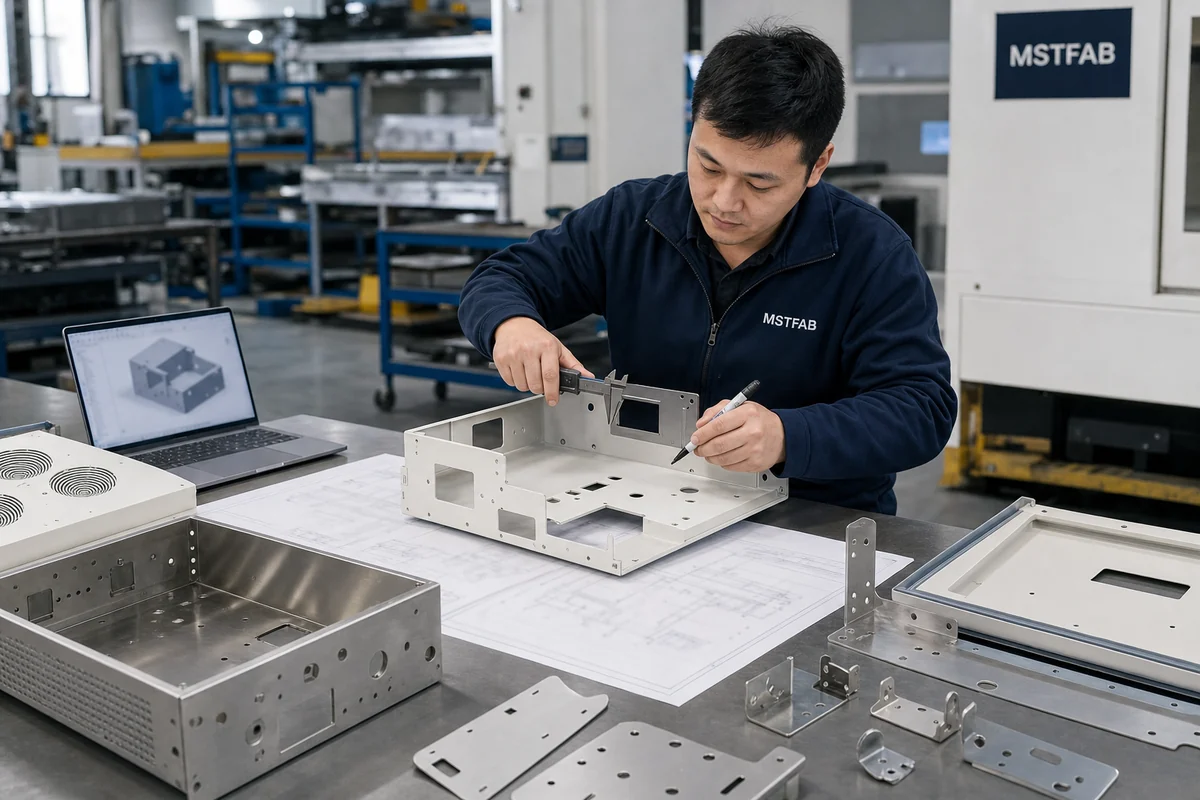
Before sourcing a medical enclosure shell, use clear drawings and a DFM review. Our guide on what files are needed for a sheet metal fabrication quote explains why STEP files, 2D drawings, material grades, finish notes and critical dimensions should travel together.
The seven dimensions that actually rank a medical enclosure supplier
Use this scorecard to build your own shortlist. Score each dimension from 1 to 5. Dimension 1, Dimension 2, Dimension 4 and Dimension 6 are hard gates. If a supplier fails one of those, do not rescue the quote with optimism. Optimism is not a quality procedure.
| Dimension | Weight | What to verify | Pass or fail signal |
|---|---|---|---|
| D1 Real factory identity and enclosure shell evidence | Gate | Owned or controlled cutting, bending, welding, hardware, finish inspection and packing workflow; similar empty medical enclosure shells and panels | Fail if the supplier cannot prove it fabricates the metal parts it quotes |
| D2 Regulatory and quality-system discipline | Gate | Document control, revision control, traceability habits, audit support and willingness to work within buyer-defined medical quality requirements | Fail if the supplier dismisses records, revisions or traceability as paperwork decoration |
| D3 Medical enclosure fabrication capability | 20% | Laser-cut openings, soft-edge bending, clean TIG welds, flat panels, user-facing cosmetics, gasket flanges, EMI shielding features and hardware installation | Fail if the supplier only shows generic industrial boxes with no medical-style finish discipline |
| D4 Material certification, PMI and heat or batch traceability | Gate | Material grade, thickness, mill certificate, batch identity, PMI where required and stainless or aluminum finish evidence | Fail if specified stainless or aluminum grade cannot be supported with evidence |
| D5 Cleanability, edge control and finish durability | 15% | Radius edges, burr removal, corner blending, masking, passivation or powder coating notes, wipe-zone appearance and cosmetic acceptance criteria | Fail if surface quality is treated as a final-minute polish job |
| D6 First article inspection and audit-ready records | Gate | FAI report, calibrated measurement tools, drawing revision, critical dimensions, photos, coating checks and record retention | Fail if the supplier refuses measured first-article evidence before production release |
| D7 Confidentiality, communication and export logistics | 25% | NNN/NDA posture, controlled drawings, lead time, change control, Incoterms, packing plan and response quality across time zones | Fail if the quote is fast because every hard detail was skipped |
D1: verify a real medical enclosure fabricator
Start with factory identity. Ask for a live video walk through sheet storage, laser cutting, CNC bending, welding, PEM hardware insertion, deburring, surface inspection, packing and the quality bench. Ask to see similar empty enclosure shells, not only finished device photos. Finished device photos may look impressive, but they do not prove the supplier controlled the enclosure fabrication.
A real fabricator should ask questions about material grade, sheet thickness, bend radius, flatness, visible faces, surface grain direction, edge breaks, hole-to-bend spacing, grounding masks, PEM hardware, critical-to-quality dimensions, finish texture, packing and revision control. A supplier that asks no questions may feel easy in the inbox. It often becomes expensive on the assembly bench.
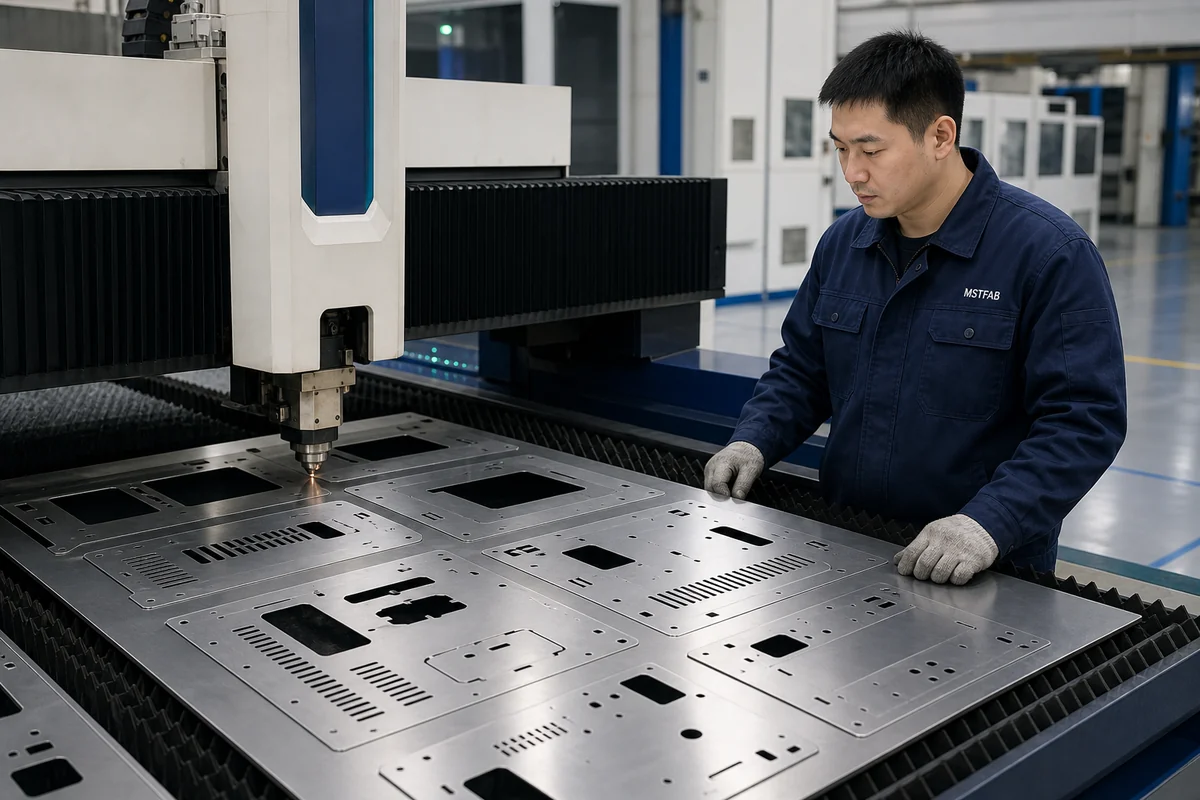
For the cutting stage behind panels, bezels, cutouts and vents, review MSTFAB’s laser cutting services. Laser accuracy is useful only when later bending, welding, surface treatment and inspection keep the features where the drawing expects them.
D2: treat regulatory and quality-system discipline as a hard gate
Medical device compliance belongs to the medical OEM and approved regulatory pathway, not to an empty sheet metal shell by itself. Still, a fabrication supplier should understand why revision control, material evidence, inspection records and change control matter. If an auditor later asks which material lot was used for a production batch, the answer should not be “probably the shiny one.”
Depending on device class and target market, the buyer may require ISO 9001 supplier controls, ISO 9001 quality control alignment, EU MDR documentation support, IEC 60601 considerations for powered equipment, RoHS/REACH declarations or specific cleaning and sterilization evidence. MSTFAB can support the mechanical fabrication evidence in the buyer’s required format when defined in the RFQ, but the buyer owns the finished-device regulatory file and approval route.
D3: score medical enclosure fabrication capability, not vocabulary
Medical enclosure parts often need clean stainless welding, smooth rounded covers, flat mounting faces, tight panel fit, removable access panels, consistent cosmetic surfaces and hand-safe edges. These requirements are different from a rough industrial guard or a hidden internal bracket. The parts must work mechanically and look controlled when the buyer’s customer opens the device, wipes the surface or checks panel alignment.
Ask how the supplier controls bend sequence, weld sequence, panel flatness, bracket alignment, hardware insertion, thread protection, masking, burr removal and surface handling. If the part uses a front bezel, display opening or gasket flange, confirm the inspection method before the sample is produced. A great looking CAD file does not automatically become a great looking bent shell; the press brake has opinions.
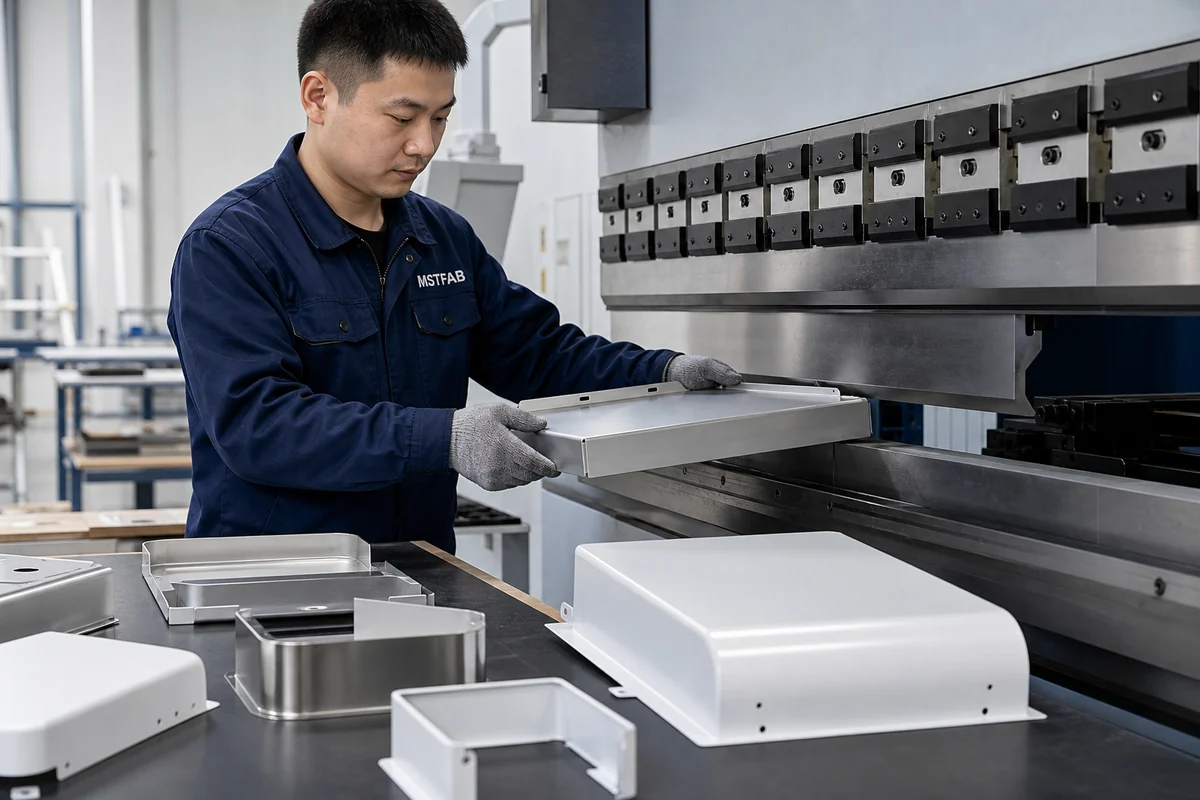
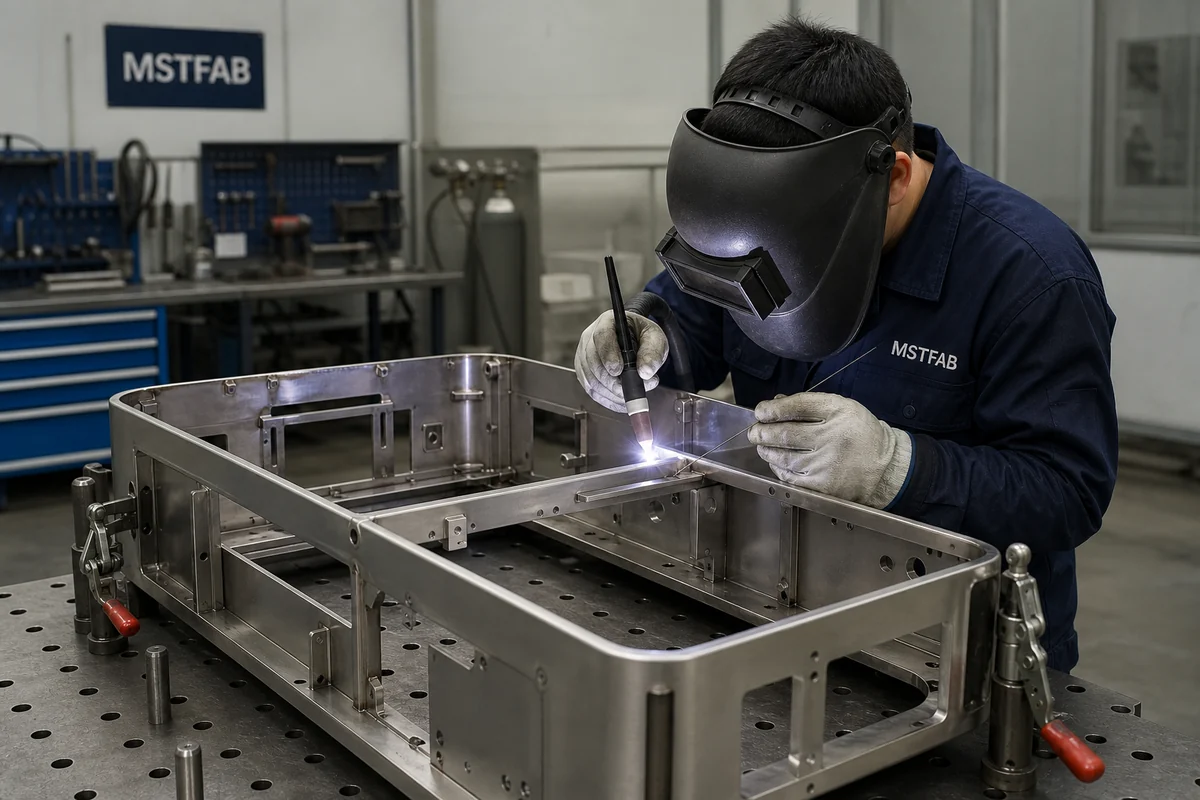
For formed covers, soft-edge returns and enclosure flanges, see MSTFAB’s sheet metal bending capability. For broader medical part examples, review sheet metal parts for medical device manufacturers.
D4: material certification, PMI and traceability are hard gates
Medical enclosure buyers may specify 304 stainless, 316 stainless, aluminum, galvanized steel or powder-coated cold rolled steel depending on cleaning exposure, weight, cosmetics and internal assembly. The supplier should quote the specified material, keep the grade clear and provide certificate or PMI evidence when required by the project. Substituting a nearby grade because it was available that week is not a manufacturing improvement.
For stainless steel, buyers may request EN 10204 3.1 material certificates, heat or batch identity, PMI verification, grain direction control, passivation or brushed finish notes. For aluminum, buyers should define alloy, temper, finish and flatness. For powder-coated parts, define pretreatment, texture, color tolerance, masking zones, film thickness and cosmetic inspection level. MSTFAB can manufacture to those buyer-defined notes and provide mechanical inspection evidence for the supplied empty shell parts.
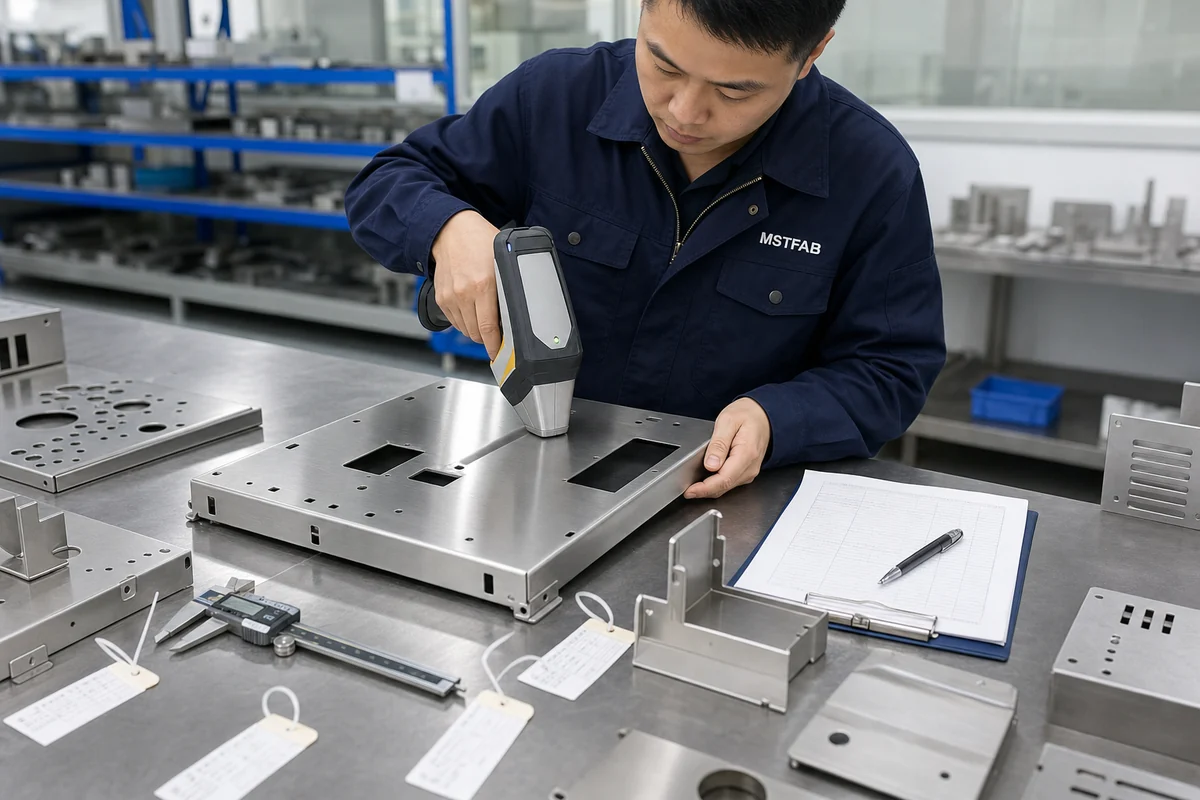
For material tradeoffs, see common materials used in sheet metal fabrication and stainless steel sheet metal fabrication.
D5: cleanability, edges and finish decide buyer confidence
Medical equipment enclosures may be wiped repeatedly with approved cleaning agents, handled by operators, installed close to sensitive equipment or inspected under bright indoor lighting. Even when the enclosure is not patient-contact, the surface still needs discipline. Burrs, sharp laser corners, dirt-trapping seams, coating chips, exposed rust at cut edges and inconsistent grain direction can make a buyer question the whole supply chain.
Good drawings should call out edge breaks, corner radius, weld grind level, visible faces, brushed direction, coating texture, masking zones, allowable scratches, protective film and packing. Good suppliers should confirm which faces are cosmetic and which are functional. If the buyer cares about a front cover, the supplier should not treat it like the bottom of a toolbox.
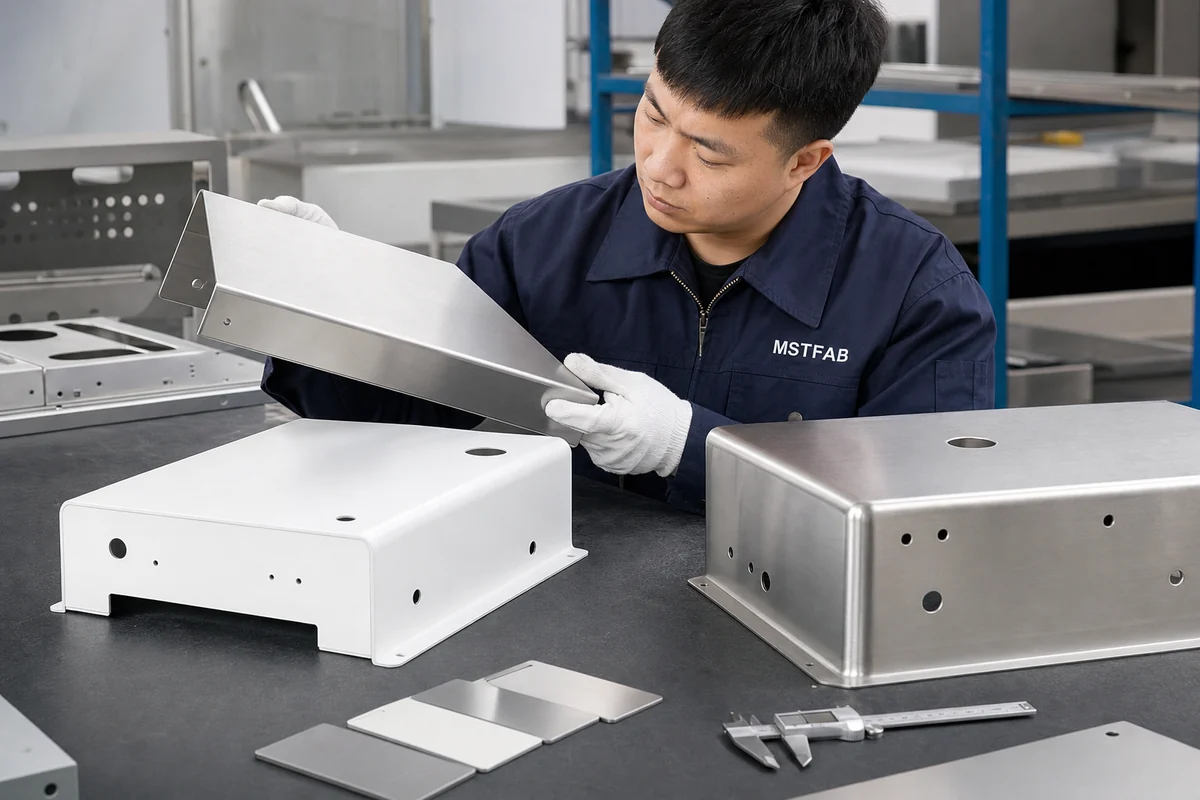
For finish-related procurement checks, review MSTFAB’s surface treatment page and the article on medical equipment enclosure cleanability and cosmetic finish.
D6: first article inspection turns claims into evidence
A medical enclosure shortlist should become real only after a first article inspection. The sample should be measured against the drawing revision that the buyer actually approved. The report should cover overall size, flatness, hole positions, panel openings, bend angles, door gap, gasket flange, bracket locations, PEM hardware, thread condition, visible surfaces and any critical-to-quality dimension that affects assembly.
The first article does not replace the buyer’s medical validation. It answers a narrower but vital question: did the supplier build the empty sheet metal shell correctly and consistently enough to move toward production? That is the part a fabricator can prove. The device OEM still owns device-level safety, usability, sterilization, cleaning validation and regulatory submission.
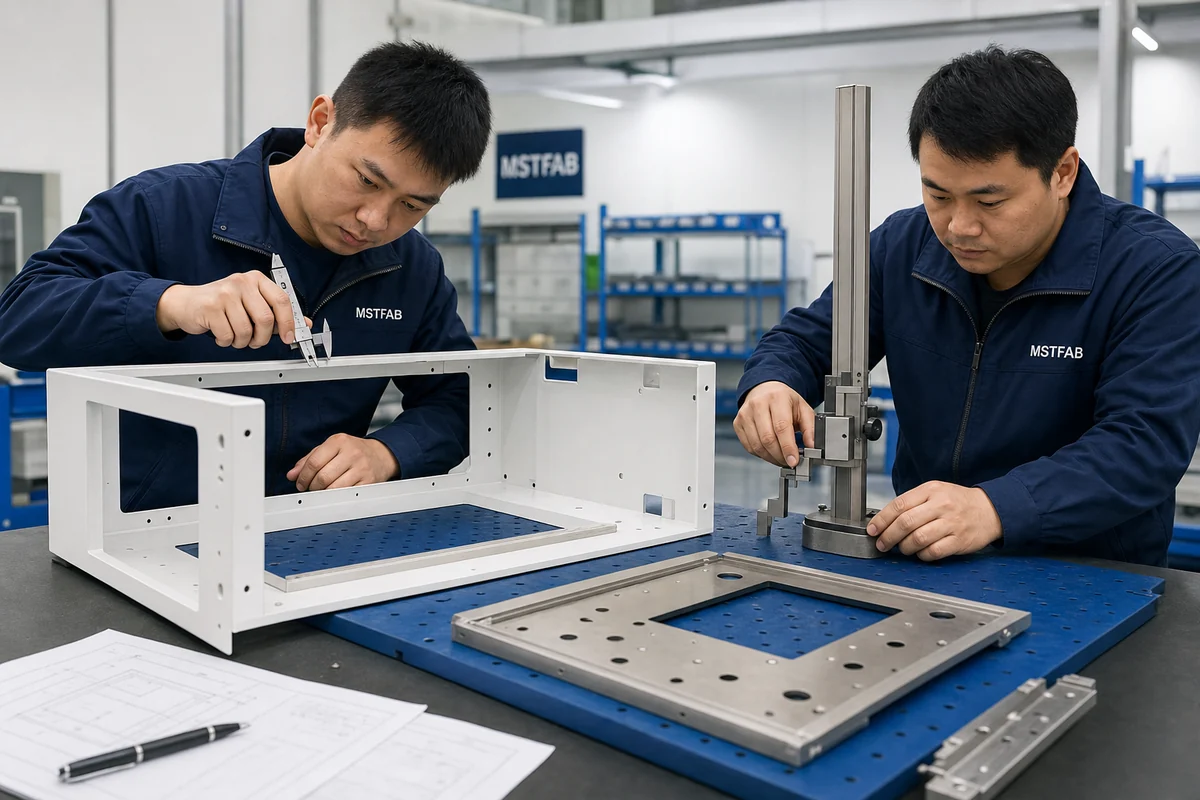
For evidence planning, compare MSTFAB resources on dimensional inspection reports and first article inspection.
D7: confidentiality, communication and export logistics matter
Medical enclosure drawings often reveal product architecture, user-interface layout, regulatory decisions and upcoming launch timing. The supplier should treat drawings as controlled documents, not casual attachments. Ask how revisions are received, quoted, approved and locked before production. Ask whether old drawing versions are removed from the production route. Ask who can access files. The answer does not need theater; it needs discipline.
Export logistics also affect quality. White powder-coated panels, brushed stainless covers and soft-edge aluminum parts can be damaged by careless stacking. Good packaging uses protective film, foam separators, corner protection, labeled hardware bags, moisture control when needed and clear package lists. If the first article arrives scratched, the inspection conversation becomes less cheerful very quickly.
For shipping evidence, use MSTFAB’s export packaging guide, then check factory photos and process evidence before production release.
Evidence table for a medical enclosure trial order
| Evidence to request | Why it matters | Who should own it | When to request it |
|---|---|---|---|
| Factory identity evidence | Confirms the supplier can fabricate empty enclosure shells, panels, covers and brackets instead of reselling unknown work | Buyer sourcing team and supplier | Before shortlist approval |
| DFM review notes | Shows risks around hole-to-bend spacing, soft edges, weld distortion, PEM hardware, masking and finish handling | Supplier engineering and buyer engineer | Before quotation or purchase order |
| Material certificate and PMI record where required | Supports grade, thickness and traceability for stainless steel, aluminum or coated steel enclosure parts | Supplier purchasing and quality team | Before or during first article |
| First article dimensional report | Verifies critical geometry, openings, flatness, bracket positions, panel gaps and mounting features | Supplier quality team | Before batch release |
| Finish and cleanability evidence | Documents visible faces, edge condition, passivation or coating notes, masking and cosmetic acceptance | Supplier finishing and quality team | Before sample shipment |
| Buyer-directed regulatory or validation tests | Confirms the complete medical device, not the empty shell alone, meets the target market requirement | Buyer, device OEM or approved lab | Before volume launch |
| Packing photos and package list | Protects cosmetic covers, stainless surfaces, doors, panels, brackets and hardware during international transport | Supplier shipping team | Before every first shipment and batch shipment |
How the top five would actually sort themselves
If you run this scorecard on eight to ten candidates, the list usually sorts into three groups. The first group is medical-aware enclosure specialists or precision fabricators with strong documentation habits, controlled finishes, inspection evidence and traceability discipline. They rise to the top when the device has strict cosmetic, cleanability or audit requirements.
The second group is capable sheet metal fabricators that do not market themselves as medical specialists but can support empty medical enclosure shells when the buyer supplies clear drawings, quality requirements and validation ownership. This group can be a strong fit for OEMs that control the regulatory file and need a manufacturing partner for repeatable metalwork.
The third group is trading companies or general suppliers that present finished medical-device photos but cannot prove the actual fabrication route. They may be responsive and inexpensive, but they should not pass the real-factory gate unless the buyer qualifies the making factory directly. For medical sourcing, the supplier behind the curtain matters more than the curtain.
The trial-order gate: the real ranker
A paid trial order should use representative geometry, not a tiny souvenir bracket that politely avoids every real risk. Send the same drawing pack to the strongest candidates: STEP file, 2D drawing, revision level, material, thickness, finish, visible faces, edge requirements, critical dimensions, PEM hardware, masking notes, annual volume, packaging expectation and any buyer-required record format.
The trial package should include the empty enclosure shell or representative assembly, stage photos, material evidence, PMI record when required, first-article dimensional report, finish inspection notes, edge and burr checks, hardware installation record if in scope and packing photos. If the project requires ISO 9001 supplier controls, IEC 60601 testing, EMC, cleaning validation, sterilization validation, OEM quality, MDR, CE, RoHS or REACH evidence, define who owns each item before the purchase order. The sheet metal supplier can support the mechanical evidence; the medical OEM owns the finished device.
Red flags that remove a supplier from the shortlist
Eight-step workflow to build your own top five
- Define the enclosure type. Separate desktop instrument shell, cart enclosure, wall-mount cabinet, control console, stainless cover, shield, bracket set or rack-style enclosure.
- Freeze the supplier scope. Separate empty metal shell fabrication, purchased hardware, electronics, software, sterilization, cleaning validation and regulatory ownership.
- Build a long list. Search for medical enclosure shell fabricators, precision sheet metal suppliers and China factories with relevant empty enclosure evidence.
- Verify real makers. Use video walks, factory photos, sample records and machine lists to remove traders or shops without enclosure-shell capability.
- Score the seven dimensions. Treat factory evidence, quality-system discipline, material traceability and first-article records as hard gates.
- Send a complete RFQ. Include STEP, 2D PDF, material, finish, critical dimensions, cosmetic faces, hardware, masking, inspection and packing requirements.
- Run a paid trial order. Compare the same geometry, record package, response quality, packing method and true landed cost.
- Rank and rescore. Select suppliers for your device stage and rescore after design changes, market changes or volume increases.
What MSTFAB can manufacture for medical enclosure projects
MSTFAB supports drawing-based sheet metal fabrication for empty medical equipment enclosure shells, stainless steel covers, aluminum panels, powder-coated housings, formed bezels, removable access panels, welded frames, bracket rails, internal shields, mounting plates, door panels, cable-entry plates and PEM hardware locations. We focus on the metalwork the buyer defines, then review manufacturability before prototype or batch production.
For related commercial pages, review custom medical device enclosure fabrication, OEM enclosure shell fabrication checklist, metal enclosure box fabrication and sheet metal fabrication. For process depth, see laser cutting services, sheet metal bending, welding services, PEM hardware installation and surface treatment.
Key takeaways
- A useful top five is built from project evidence, not copied from a generic supplier list.
- Medical enclosure suppliers should be judged on real empty-shell fabrication evidence, quality-system discipline, material traceability, clean finish control, inspection records and confidentiality.
- MSTFAB supplies drawing-defined metalwork only: empty medical equipment enclosure shells and mechanical sheet metal parts, not complete medical devices or regulatory approvals.
- The best ranking method is a paid trial order with DFM notes, material evidence, first-article inspection and buyer-defined validation scope.
- Clear scope protects both sides. It also prevents the classic procurement headache: everyone thought someone else owned the detail with the sharp edge.
Related fabrication resources
FAQ
Can you name the actual top 5 medical equipment enclosure manufacturers in China?
No. A universal list would be more confident than useful. The right supplier depends on the device type, material, finish, cleanability, inspection evidence, confidentiality needs, target market and buyer-controlled regulatory pathway. Use this scorecard to build a top five that fits your project.
Does MSTFAB make complete medical devices?
No. MSTFAB fabricates empty medical equipment enclosure shells and mechanical sheet metal parts from buyer drawings. We do not supply complete medical devices, electronics, software, patient-contact validation, sterilization validation, regulatory submissions, energized testing or final product certification.
What should I verify before shortlisting a medical enclosure supplier?
Verify real factory capability, drawing control, material traceability, finish control, first-article inspection, hardware installation scope and export packaging. If your project needs ISO 9001, IEC 60601, OEM quality, MDR, CE or sterilization evidence, define the responsible owner before the trial order.
Is stainless steel always required for medical equipment enclosures?
No. Stainless steel is useful for corrosion resistance, cleaning exposure and premium surfaces, but aluminum or powder-coated steel can be appropriate for many non-patient-contact shells. The buyer should define material grade, finish and validation needs, then ask the fabricator to provide evidence for the specified metalwork.
What should a medical enclosure first article include?
A useful first article includes the empty shell or representative assembly, material evidence, PMI record where required, measured critical dimensions, bend and flatness checks, hole-position results, edge and burr review, finish inspection, hardware installation record and packing photos.
Can MSTFAB support medical enclosure projects for Europe and North America?
Yes, MSTFAB can support export-focused sheet metal fabrication for empty medical equipment enclosure shells and related mechanical parts. Buyers should provide drawings, revision level, material, finish, quantity, inspection requirements, packaging needs and buyer-controlled validation requirements.
Medical enclosure RFQ review
Need a drawing-defined medical enclosure shell supplier?
Send your STEP file, 2D drawing, material, thickness, finish, visible faces, edge requirements, hardware locations, inspection plan and packaging notes. MSTFAB will review the sheet metal fabrication route and quote the empty enclosure shell scope clearly, without pretending to be your medical device, electronics, software, sterilization, regulatory or certification department.
 WeChat Contact
 WhatsApp Me Directly