
Sourcing Low-Volume Custom Sheet Metal Fabrication in China (1–500 Pcs)
When ordering 1 to 500 custom sheet metal parts or enclosures in China, unit economics depend on soft-tooling process agility rather than stamping press tonnage: fiber laser cutting + CNC press brake forming eliminates $3,000–$15,000 hard tooling NRE while holding ISO 2768-m tolerances.
- Soft-Tooling Crossover Point: Use laser cutting + CNC bending + TIG/laser welding from 1 to ~1,000 pcs before evaluating progressive or stage stamping dies.
- Setup Cost Reduction: Standardize internal bend radii (R = t) across all flanges on a part so the press brake operator completes the part in a single V-die setup.
- Stock Gauge Availability: Design around standard mill gauges (`1.0 mm`, `1.2 mm`, `1.5 mm`, `2.0 mm`, `3.0 mm` in `SPCC`, `SGCC`, `5052-H32`, `SUS304`) to avoid raw-material MOQ surcharges.
China low-volume sourcing guide / OEM buyer scorecard
Quick answer: a public list of the top 5 low-volume sheet metal manufacturers in China is not a shortcut a serious buyer should trust. Low-volume sourcing depends on no-MOQ discipline, setup transparency, DFM speed, first-article inspection, material evidence, short-run repeatability and whether the shop actually wants your 20-piece order instead of sighing at it from across the quoting desk.
Scope boundary
What MSTFAB can support, and what stays with the OEM buyer
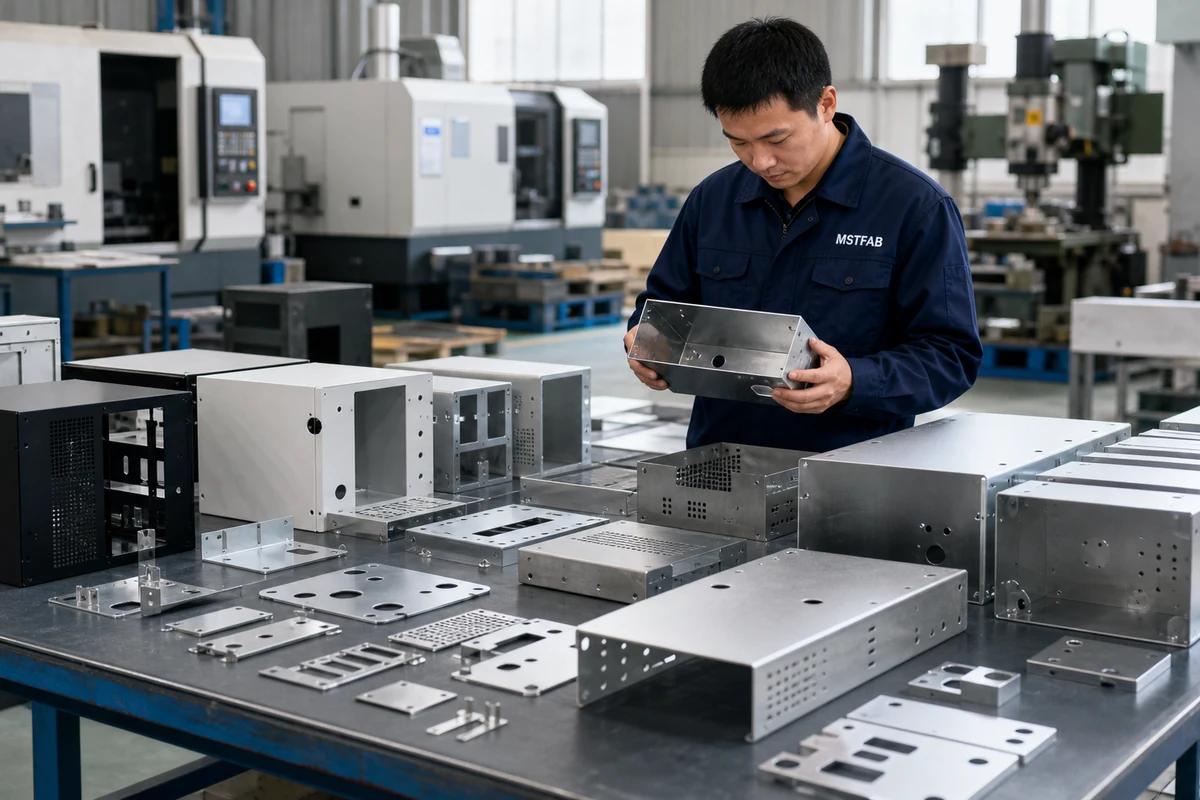
MSTFAB fabricates low-volume sheet metal enclosure shells and mechanical parts from buyer drawings. Typical work includes CNC laser-cut panels, CNC-bent covers, welded chassis frames, small-batch enclosure bodies, brackets, mounting plates, PEM hardware locations, deburring, powder coating, dimensional inspection, first-article support and export packaging.
MSTFAB does not supply complete finished products, electronics, software, energized testing, final assembly validation or market certification. The buyer, product owner, system integrator or approved laboratory remains responsible for electrical function, software, wiring, finished-product safety, compliance testing, regulatory approvals and final use validation.
- Low-volume empty enclosure shells, chassis, cabinets, covers and guards
- Laser-cut flat panels, vents, cutouts, holes and bracket blanks
- CNC-bent flanges, returns, lids, rails and soft-edge covers
- Fixture-welded frames, base plates, support structures and mounting rails
- PEM nuts, standoffs, threaded inserts, hinge points and handle hardware when specified
- Powder coating, brushing, deburring, masking and surface inspection
- First-article dimensional inspection for buyer-defined critical dimensions
- Small-batch export packing with separators, labels and photo evidence
- Electronics, wiring, firmware, software, battery modules or charging modules
- Finished device function, energized testing and final assembly validation
- UL, CE, IEC, FCC, EMC, IP, NEMA or market certification of the complete product
- Thermal architecture, product risk assessment and installation instructions
- Product labels, serial-number rules, service manuals and warranty obligations
- Design ownership, revision approval, critical dimensions and acceptance criteria
- Supplier qualification rules, quality clauses and compliance evidence format
- Final decision on whether a trial part is released to the next stage
Why low-volume sourcing needs a different scorecard
Low-volume sheet metal purchasing is its own game. A factory optimized for 5,000 identical cabinets may not be the right partner for 30 prototype-ready enclosure shells, 80 revised chassis frames or a spare-parts run that repeats twice a year. The machines may be excellent, but the business model may be wrong. A production-only shop sees your short run as a disturbance. A real low-volume partner sees it as normal work.
The problems buyers feel are usually practical: a supplier quotes a pleasant unit price but hides the setup cost; a simple revision restarts the quotation process from zero; the first sample is acceptable but batch three drifts; the shop skips inspection because “it is only 25 pieces”; or the buyer discovers after delivery that every panel rubbed against the next one in the carton. None of these problems looks dramatic in a brochure. They are dramatic when your launch date is next Tuesday.
How this page is different from a general low-volume guide
This article is not a broad explanation of low-volume production models. MSTFAB already has a related guide on low-volume production models and manufacturer types. This page is narrower: it helps overseas procurement teams build a China supplier shortlist for drawing-defined sheet metal enclosure shells, panels, brackets, covers and mechanical parts.
That difference matters for SEO and for real buyers. A startup founder may first search for what kind of low-volume manufacturer exists. A procurement manager with drawings, revision notes and a short-run launch plan needs to know how to score suppliers in China without falling for a directory list wearing a shiny “Top 5” hat. This page is for that second moment.
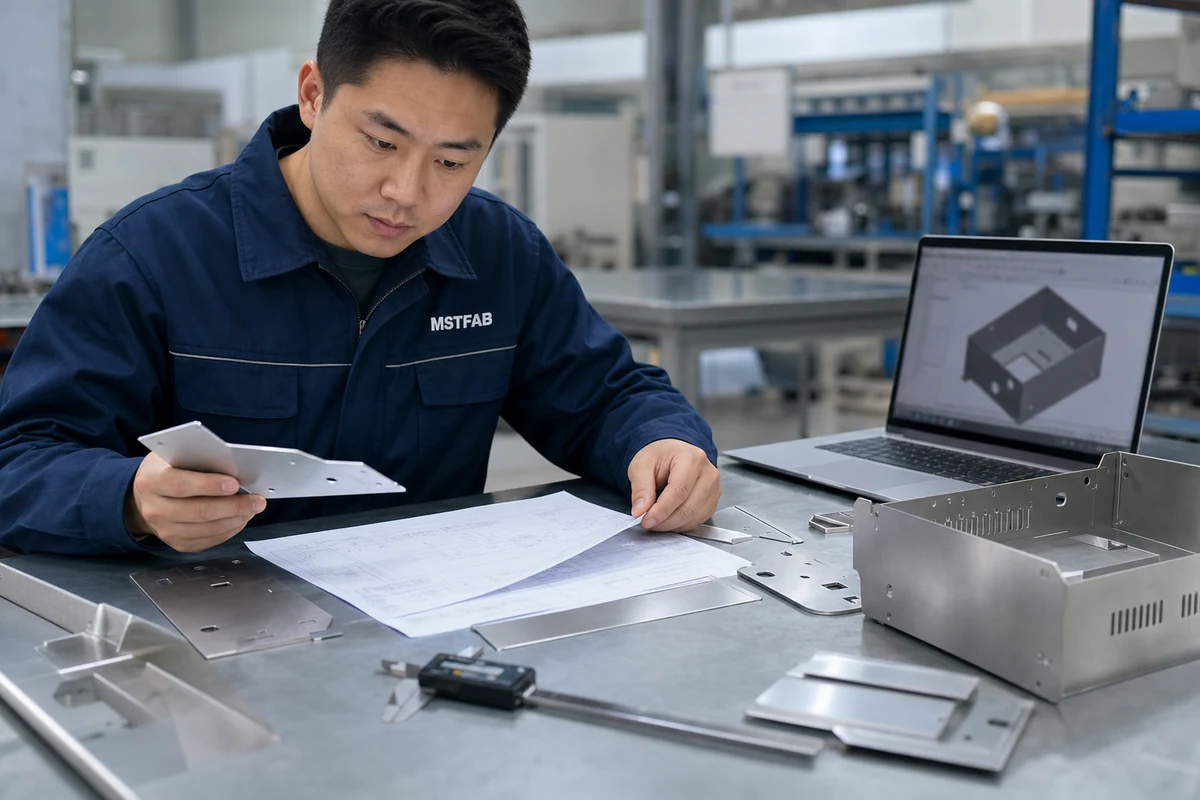
Before sending an RFQ, prepare the drawing package. Our guide on what files are needed for a sheet metal fabrication quote explains why STEP files, 2D drawings, material notes, surface finish, tolerances, PEM hardware and quantity breaks should travel together.
Why China is worth shortlisting, with verification
China has a deep sheet metal fabrication base: laser cutting, CNC bending, welding, PEM hardware, powder coating, surface treatment, dimensional inspection and export packing are close together in many manufacturing regions. For low-volume OEM buyers, that can mean shorter development loops, reasonable prototype-to-batch cost and one supplier coordinating several processes.
The advantage only works when the supplier’s operating model matches the order. Some factories are excellent at mass production but painful for small batches. Some trading companies are smooth communicators but do not control the workshop. Some job shops are flexible but weak on inspection records. The answer is not to avoid China; the answer is to qualify the supplier like the project matters. Because, annoyingly, it does.
The seven dimensions that actually rank a low-volume sheet metal supplier
Use this scorecard to build your own shortlist. Score each dimension from 1 to 5. D1 and D5 are hard gates. D2 is the defining gate for low-volume work. If a supplier fails those, do not let a low price drag the project into a swamp with a delivery note.
| Dimension | Weight | What to verify | Pass or fail signal |
|---|---|---|---|
| D1 Real factory identity and small-batch floor evidence | Gate | Owned or controlled cutting, bending, welding, hardware insertion, inspection and packing workflow; recent 10 to 100 pc enclosure-shell or bracket orders | Fail if the supplier cannot show real short-run sheet metal work in its own process |
| D2 Low-volume fit, no-MOQ policy and setup transparency | Defining gate | Will quote 1 to 50 pcs, 50 to 200 pcs and repeat batches; separates setup/NRE from unit price; handles revisions without drama | Fail if a 500 pc minimum appears before the drawing is even understood |
| D3 Capability breadth for enclosure shells and mechanical parts | 20% | Laser cutting, bending, welding, PEM hardware, deburring, surface treatment, assembly-fit checks and packing under a controlled route | Fail if the buyer must coordinate five unrelated shops for a 30 pc enclosure run |
| D4 DFM support and change-control speed | 15% | Feedback on bend reliefs, hole-to-bend spacing, weld distortion, PEM locations, finish masks, visible faces and revision impact | Fail if the supplier cuts exactly what you drew, including the mistake you were hoping someone would catch |
| D5 Material certification, PMI and batch traceability | Gate | Material grade, thickness, mill certificate where required, PMI where specified, heat or batch identity and lot separation | Fail if specified material cannot be supported with evidence when the buyer requires it |
| D6 First article inspection and short-run repeatability | 20% | Measured first article, critical dimensions, flatness, hole positions, bend angles, weld appearance, hardware, finish and batch-to-batch check plan | Fail if inspection is skipped because the quantity is small |
| D7 Commercial fit, confidentiality and export logistics | 25% | NRE transparency, revision costs, lead time, Incoterms, NNN/NDA posture, packing photos, communication quality and true landed cost | Fail if the quote is fast only because all the hard questions were ignored |
D1: verify a real small-batch sheet metal factory
Ask for a live video floor walk. You want to see sheet stock, laser cutting, press brakes, welding tables, PEM hardware stations, deburring, inspection benches, packaging and job-lot racks. A low-volume shop should be able to show small batches in progress: trays of panels, short-run brackets, sample enclosure shells, revised lots and work orders separated by project.
A factory that only shows large production lines may still be strong, but it may not be the right fit for your 20 to 80 piece launch run. A supplier that only shows finished product photos without process evidence may be a reseller. Real factory verification is basic hygiene. It is not rude; it is how procurement avoids surprise subcontracting and mystery geometry.
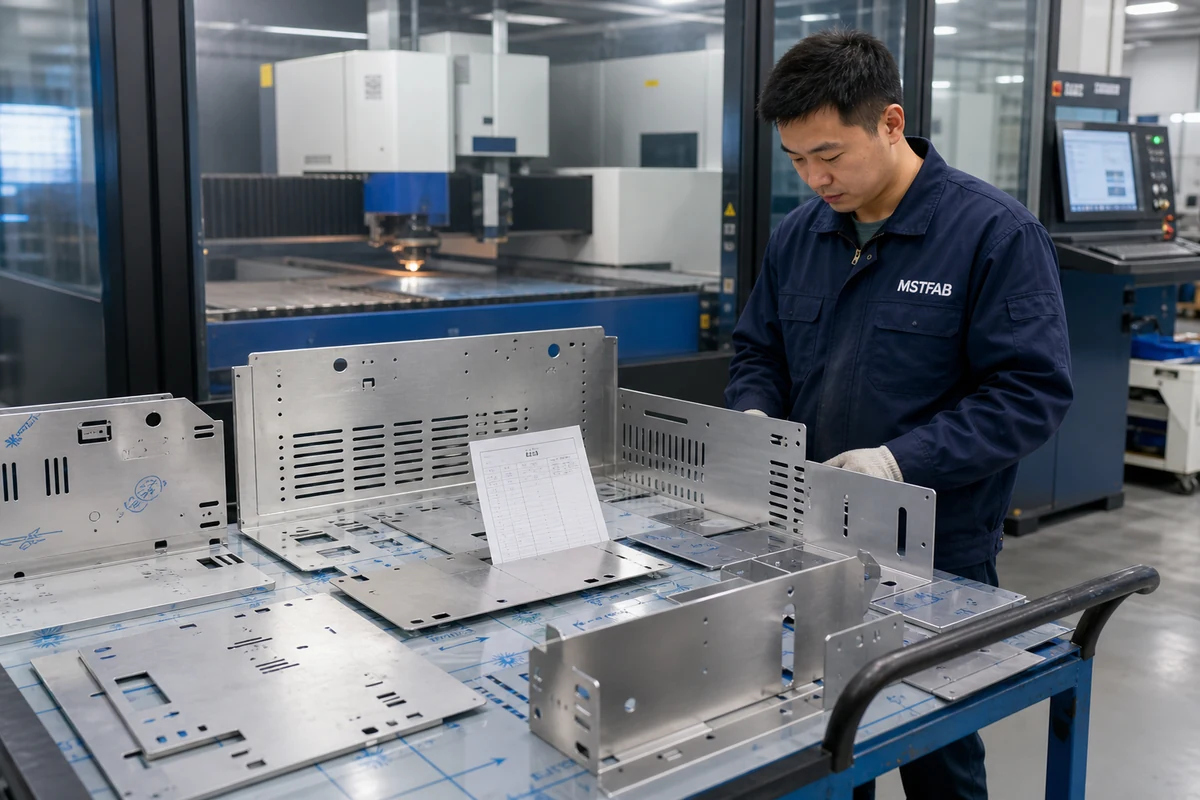
For the cutting stage behind covers, plates, vents and brackets, review MSTFAB’s laser cutting services. Laser accuracy is useful only when later bending, welding, hardware installation and inspection keep the part within the drawing.
D2: low-volume fit is the defining gate
The core question is simple: will the supplier treat a small batch like real manufacturing? A good low-volume supplier can quote 1 piece, 10 pieces, 30 pieces, 100 pieces and repeat annual batches without pretending every order must become mass production. It can also explain the setup cost, fixture cost, programming time, powder coating setup and inspection effort separately enough for the buyer to make decisions.
This is especially important when the design is still moving. A buyer may change a cable opening, add PEM standoffs, adjust a flange, thicken a bracket or revise a front panel after the first fit test. The supplier should explain whether the change affects laser programming, bend tooling, welding fixtures, masking, hardware, coating or inspection. If every small change becomes a three-week mystery, the supplier is not built for low volume.
D3: score capability breadth for enclosure shells
Low-volume buyers often need one supplier to manage several operations because splitting a 30-piece run across many vendors creates coordination cost, freight cost, revision confusion and accountability gaps. For sheet metal enclosure shells and mechanical parts, the useful chain is usually laser cutting, CNC bending, welding or hardware insertion, deburring, surface treatment, inspection and packaging.
Capability breadth does not mean every process must be physically under one roof, but the supplier must control the route. If powder coating is outsourced, ask how masking instructions, color samples, coating thickness and cosmetic defects are controlled. If welding fixtures are used, ask whether they are included in NRE or absorbed into the unit price. If PEM hardware is specified, ask who verifies pull-out risk and thread condition. Tiny unclear details become loud when the batch is already boxed.
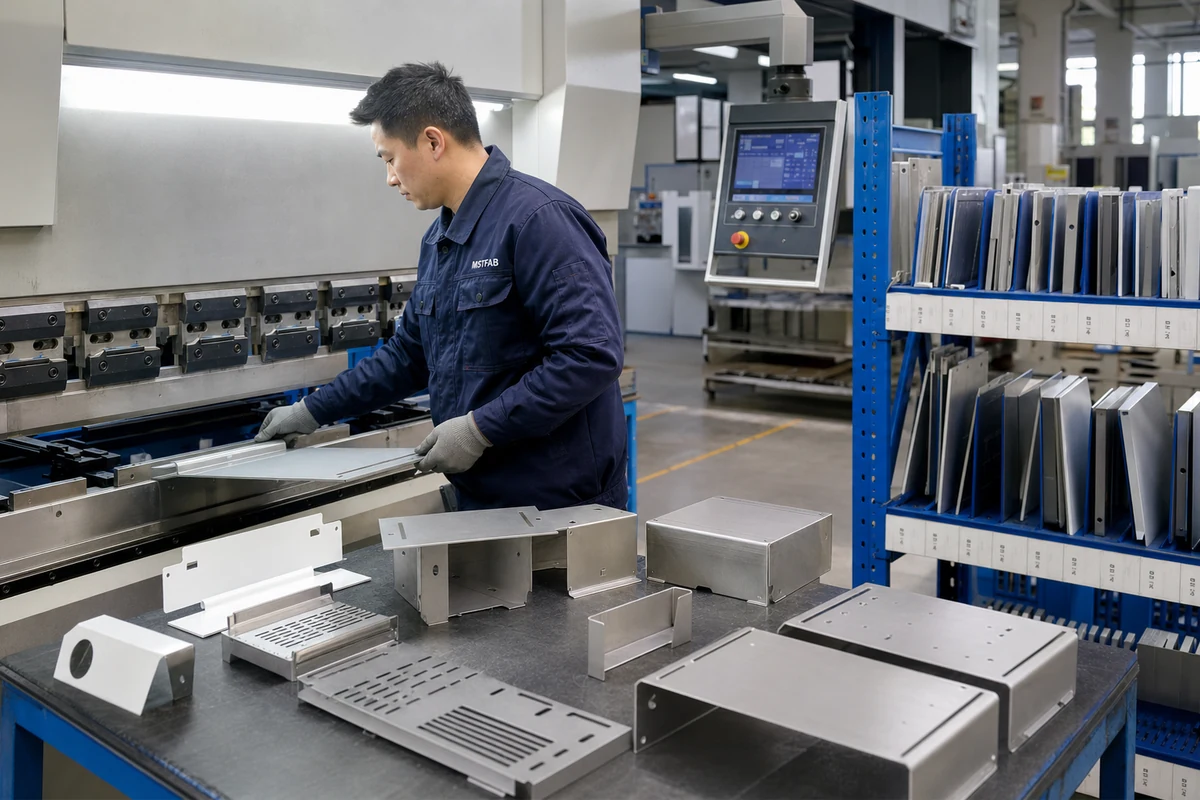
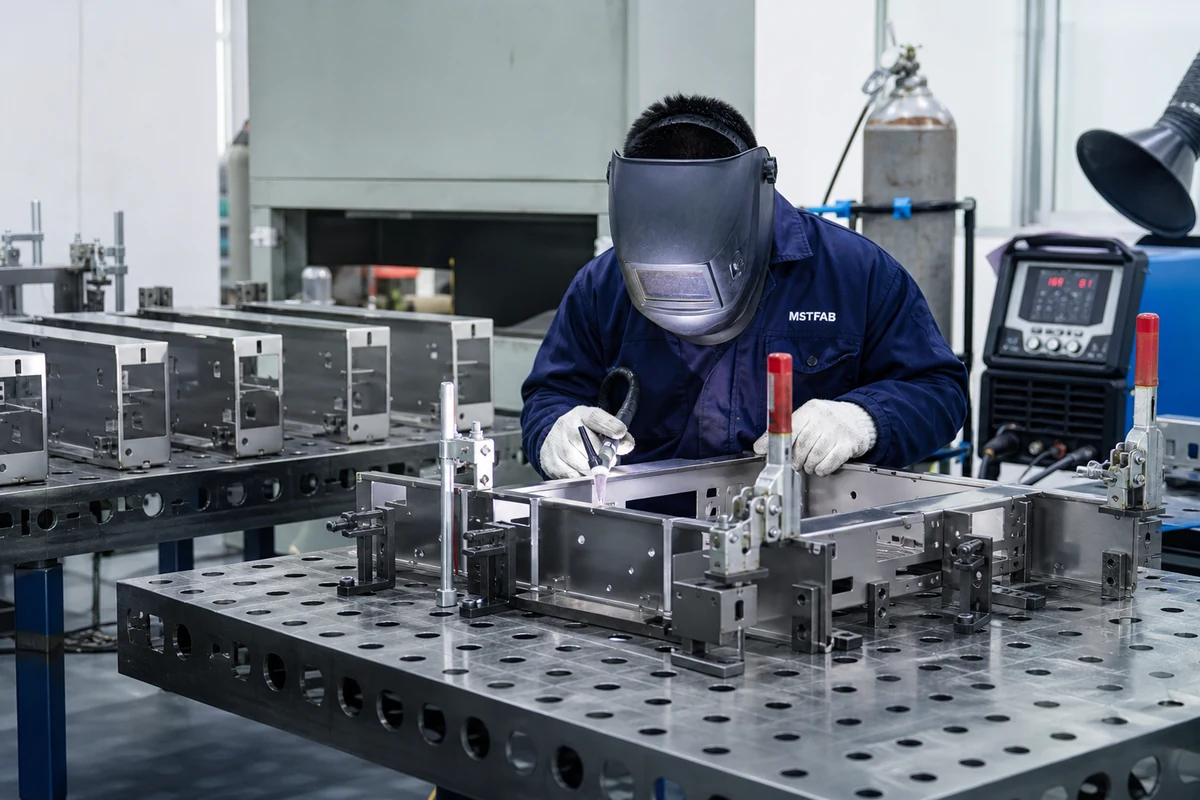
For forming and welded structures, review sheet metal bending and welding services. For broader commercial fit, see MSTFAB’s sheet metal fabrication page.
D4: DFM support prevents expensive little surprises
Low-volume does not forgive poor design. It simply makes the pain arrive earlier. A good supplier should catch hole-to-bend spacing that may distort, bend reliefs that are missing, flanges too short for tooling, PEM hardware too close to an edge, weld seams likely to pull the frame out of square, cosmetic faces that need grain direction control and masking zones that must stay conductive or paint-free.
DFM should be practical and specific. “Looks fine” is not a DFM review. Useful feedback says, for example, “move this PEM standoff 2 mm away from the bend,” “change this radius to match standard tooling,” “add weld fixture datum here,” or “define whether this face is cosmetic before powder coating.” Good suppliers do not redesign the product without permission, but they should protect the buyer from obvious manufacturability traps.
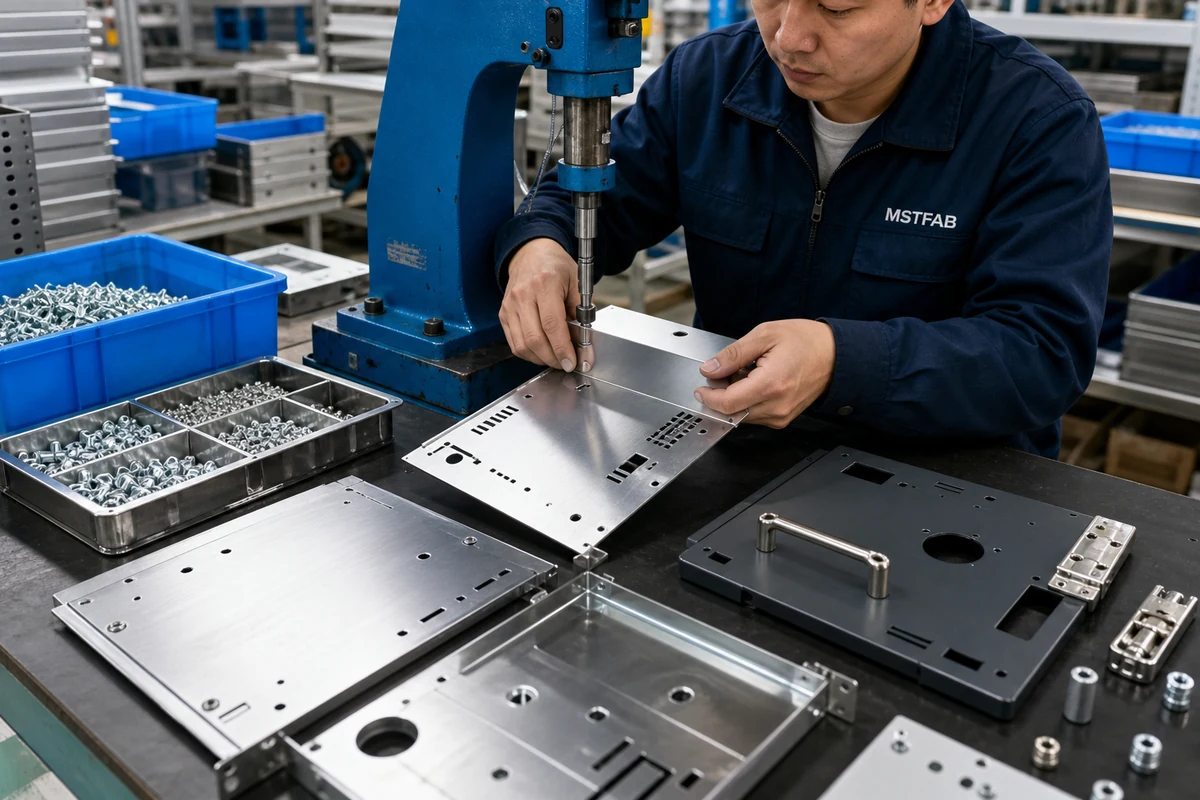
For hardware planning, see PEM hardware installation for sheet metal fabrication. This is often where a clean prototype turns into a repeatable small-batch assembly.
D5: material certification and traceability are still required on small batches
A 20-piece order can still fail if the wrong material is used. Stainless steel, aluminum, galvanized steel and cold rolled steel do not behave the same in bending, welding, corrosion exposure or powder coating. If the drawing calls for a material grade, thickness and finish, the supplier should quote that specification and provide evidence when the buyer requires it.
For critical projects, buyers may request EN 10204 3.1 material certificates, heat numbers, batch identity, PMI readings, RoHS/REACH declarations, coating data or finish certificates. Not every low-volume project needs a thick record package, but the decision belongs to the buyer’s risk level and market requirement. The supplier should be able to support the defined evidence instead of waving vaguely at a sheet rack.
For material planning, review common materials used in sheet metal fabrication, stainless steel sheet metal fabrication and aluminum sheet metal fabrication.
D6: first article inspection keeps batch three honest
A first article inspection report is not only for huge production runs. It is often more useful in low volume because the buyer is validating fit, assembly, finish and supplier discipline at the same time. The first article should measure the dimensions that matter: overall size, mounting holes, panel openings, bend angles, flatness, bracket positions, weld distortion, hardware locations and finish-sensitive areas.
Then the supplier should protect repeatability. If batch one uses one bend setup and batch three uses a different operator, the approved geometry still needs to hold. If a welding fixture is used, confirm whether it remains available for the next batch. If powder coating uses a new lot, confirm color and texture acceptance. “Small batch” should mean flexible quantity, not flexible memory.
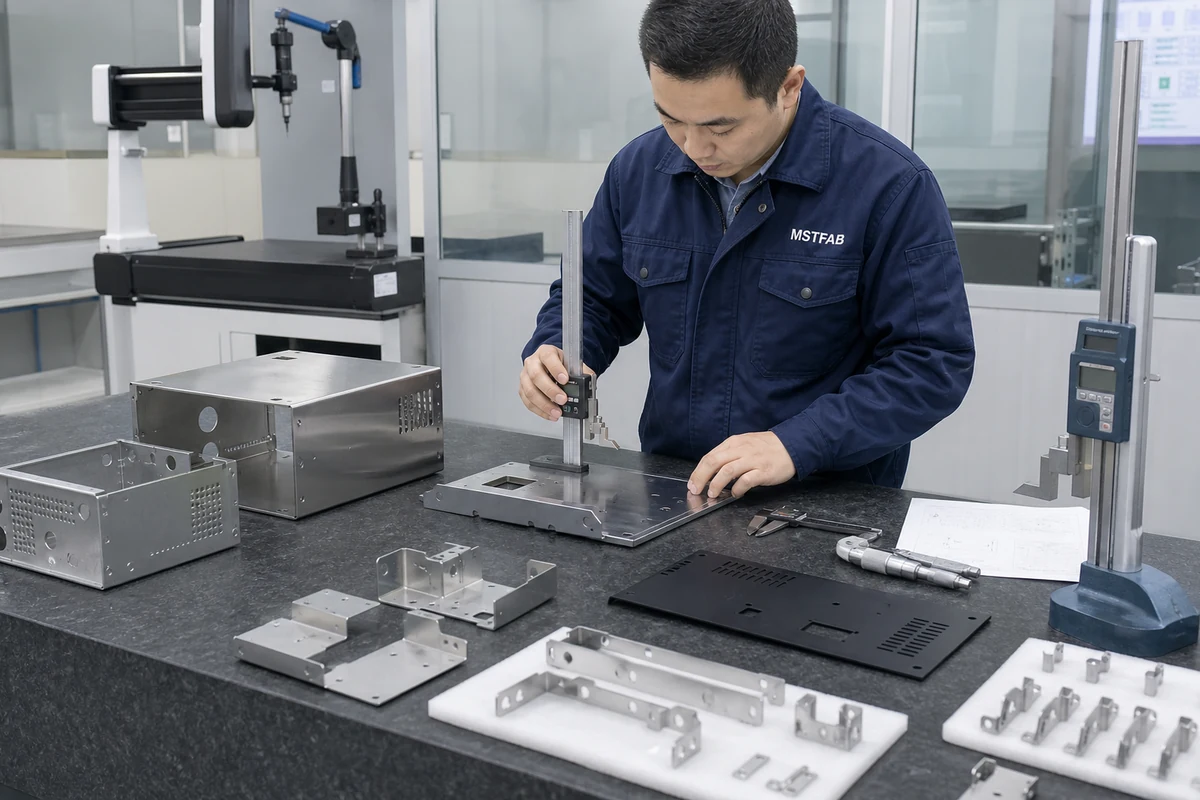
For measured evidence, see MSTFAB resources on dimensional inspection reports and first article inspection.
D7: commercial fit, confidentiality and export logistics decide the true cost
Low-volume projects are often connected to new products, R&D programs, market tests, spare-part obligations or configured equipment. That means drawings may be confidential, quantities may change, and revisions may happen after the first fit test. A useful China supplier should handle NNN/NDA expectations, revision control, quote updates, payment terms, Incoterms, shipping method and packing evidence without turning every email into an archaeology project.
Export packaging deserves real attention. Small batches can be high value because they are tied to launch timing, samples for customer approval or urgent service needs. Powder-coated covers need separators. Brushed panels need protection. Brackets need bagging or trays so they do not chew each other in transit. Hardware should be labeled. Packing photos help the buyer catch problems before the crate crosses an ocean and develops a personality.
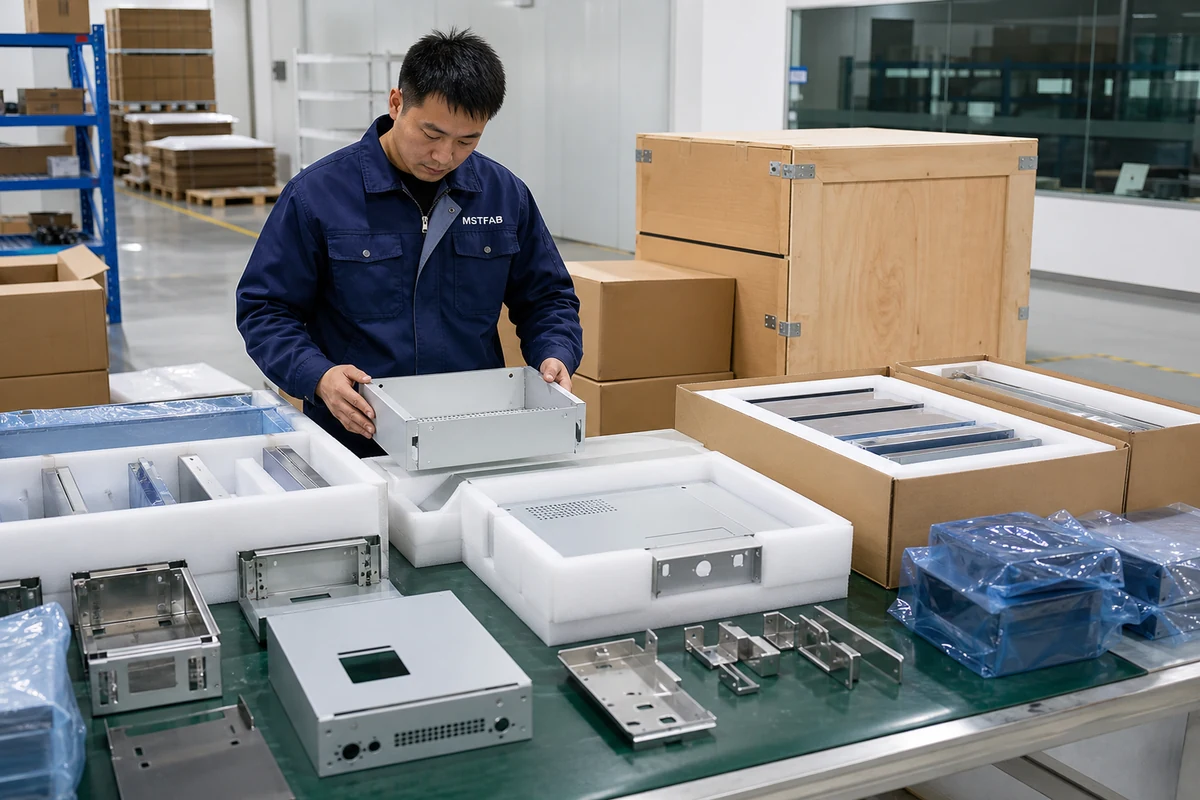
For shipping control, review MSTFAB’s export packaging guide and factory photos.
Trial-order evidence table
The trial order is the real ranking test. Do not send a harmless coupon-sized bracket if your project is a welded enclosure shell with PEM hardware and a cosmetic powder-coated cover. Send representative geometry so the supplier has to prove the actual risks.
| Evidence to request | Why it matters for low volume | Who should own it | When to request it |
|---|---|---|---|
| Same drawing pack for each candidate | Prevents one supplier quoting a simplified scope while another quotes the real part | Buyer engineering and sourcing | Before quotation |
| Itemized setup or NRE | Shows programming, fixture, coating setup, inspection and change cost instead of hiding everything in the unit price | Supplier commercial team | During quotation |
| DFM review notes | Catches bend, weld, hardware, finish and tolerance risks before the first sheet is cut | Supplier engineering and buyer engineer | Before purchase order |
| Material certificate or PMI where required | Confirms the buyer-defined material grade and supports traceability for critical parts | Supplier quality team | Before or during first article |
| First article dimensional report | Verifies geometry, holes, flatness, bend angles, weld distortion, hardware and critical features | Supplier quality team | Before batch release |
| Batch comparison photos | Shows short-run repeatability from the first approved sample to the next production batch | Supplier production and quality team | For repeat orders |
| Packing photos and package list | Protects cosmetic surfaces, separates parts and reduces receiving confusion | Supplier shipping team | Before shipment |
How the top five would actually sort themselves
If you score eight to ten candidates, three groups usually appear. The first group is dedicated low-volume or prototype sheet metal job shops. They score well on no-MOQ behavior, fast DFM, quick revisions, itemized setup and inspection records. They may not be the cheapest on unit price, but they often save the launch schedule.
The second group is mid-size fabricators with a real low-volume cell. They can be a strong fit when the buyer needs laser cutting, bending, welding, powder coating, hardware and export packaging from one coordinated route. They may ask for more planning around fixture cost and lead time, but the evidence can be solid.
The third group is production-only factories or trading companies. They may communicate quickly and quote aggressively, but fail if they impose high MOQ, hide the actual making factory, resist first-article records or cannot show small-batch work on the floor. They are not automatically bad companies; they are simply the wrong match for a low-volume enclosure-shell project.
Red flags that remove a supplier from the shortlist
Eight-step workflow to build your own top five
- Define the part family. Separate enclosure shells, chassis, panels, covers, brackets, guards, frames, rails and mounting plates.
- Define the volume reality. Share expected first order, annual demand, repeat frequency, revision risk and quantity breaks.
- Prepare the drawing pack. Include STEP, 2D PDF, material, thickness, finish, tolerances, hardware, visible faces, critical dimensions and packing notes.
- Verify real factories. Use live video, process photos, recent small-batch jobs and machine evidence to remove traders or mismatched factories.
- Score the seven dimensions. Treat real factory evidence, low-volume fit and material evidence as gates.
- Request DFM before PO. Ask for practical comments on manufacturability, cost, risk and change impact.
- Run a paid trial batch. Use representative geometry and require first-article evidence before batch release.
- Rank by evidence and landed cost. Choose the supplier that holds geometry, protects parts, communicates clearly and survives repeat orders.
What MSTFAB can manufacture for low-volume OEM projects
MSTFAB supports low-volume sheet metal fabrication for empty enclosure shells, electrical cabinet bodies, control boxes, equipment covers, chassis frames, telecom panels, battery storage cabinet panels, EV charger enclosure shells, brackets, machine guards, mounting plates, internal shields and sheet metal mechanical parts. We manufacture from buyer drawings and support DFM review, process planning, small-batch production, inspection and export packing.
For process and service pages, review sheet metal fabrication, laser cutting services, sheet metal bending, welding services, surface treatment, metal enclosure box fabrication, low-volume sheet metal enclosure fabrication and drawing upload support.
Key takeaways
- A trustworthy top five is built from project evidence, not copied from a generic supplier ranking.
- Low-volume buyers should score no-MOQ fit, setup transparency, DFM speed, process breadth, material evidence, first-article inspection and export packing.
- MSTFAB fabricates low-volume sheet metal enclosure shells and mechanical parts from buyer drawings. We do not supply finished products, electronics, software, energized testing, final assembly validation or market certification.
- The real ranking method is a paid representative trial batch with DFM notes, itemized setup, material evidence, first-article inspection and packing photos.
- A low-volume supplier should make small batches feel controlled, not like a favor being performed under fluorescent lighting.
Related fabrication resources
FAQ
Can you name the actual top 5 low-volume sheet metal manufacturers in China?
No. A universal public ranking would be too easy to manipulate and too vague to trust. The right shortlist depends on your part geometry, quantity, revision risk, material, finish, tolerance, inspection needs, confidentiality rules and export requirements. Use this scorecard to build a top five that fits your project.
Does MSTFAB make complete finished products?
No. MSTFAB fabricates low-volume sheet metal enclosure shells and mechanical parts from buyer drawings. MSTFAB does not supply complete finished products, electronics, software, energized testing, final assembly validation or market certification.
What quantity counts as low-volume sheet metal fabrication?
It depends on the part and process, but many OEM buyers use low volume for prototype follow-up batches, 10 to 100 piece launch runs, spare-parts orders, configured equipment and annual demand that does not justify mass-production tooling. The important point is not the exact number; it is whether the supplier’s quoting, setup and inspection model fits the quantity.
Should I still request FAI for a 20-piece order?
Yes, if the part affects fit, assembly, safety, finish or launch timing. A first article report confirms the supplier built the drawing-defined metalwork correctly before the rest of the batch is released. Low quantity does not make a bad hole position become charming.
How do I compare low-volume quotes fairly?
Ask each supplier for the same drawing pack and the same quantity breaks. Request setup or NRE as a separate line, then compare unit price, tooling or fixture cost, DFM feedback, inspection package, finish handling, packing, lead time and landed cost. A low unit price with hidden setup may not be the lowest total cost.
What files should I send for a low-volume sheet metal RFQ?
Send STEP files, 2D PDF drawings, revision level, material grade, sheet thickness, finish, visible faces, tolerance notes, PEM hardware, critical dimensions, expected quantity breaks, annual demand, packing requirements and any inspection-report format you need. The clearer the RFQ, the less room there is for creative quoting.
Low-volume sheet metal RFQ review
Need a small-batch sheet metal enclosure shell supplier?
Send your STEP file, 2D drawing, material, thickness, finish, quantity breaks, critical dimensions, hardware notes, inspection needs and packaging requirements. MSTFAB will review the low-volume sheet metal fabrication route clearly, without pretending to be your electronics department, software team, test lab or certification office.
 WeChat Contact
 WhatsApp Me Directly