
The Short Answer
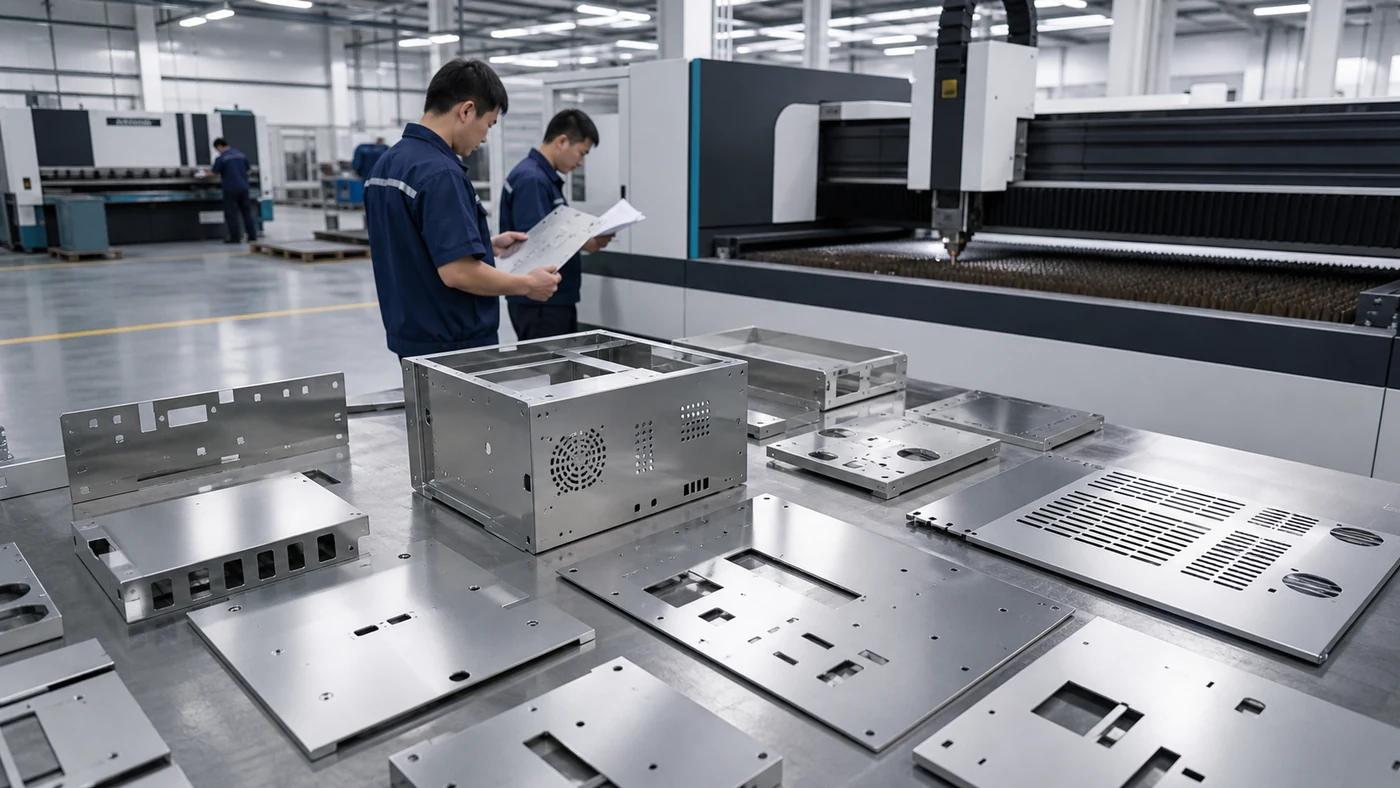
To select the right China laser cutting manufacturer for sheet metal enclosure parts, look beyond raw kilowatt ratings: evaluate whether the supplier controls nitrogen-assisted oxide-free edges, thermal distortion across dense louver/vent arrays, precision deburring, and downstream CNC press brake forming and welding under one roof.
Explore this guide
Supplier Landscape & Segmentation
Comparing Five Laser Cutting Supplier Profiles in China for Enclosure Buyers
Nearly every metalworking workshop in China owns fiber laser cutting tables, yet OEM buyers sourcing enclosure panels, rack faceplates, sub-plates, and internal chassis brackets regularly encounter burred edges, bowed perforated sheets, or paint delamination caused by oxidized cut edges.
Instead of treating all laser shops as interchangeable commodity cutters, classify candidate suppliers across five distinct operational models before issuing your RFQ:
Full-Process Enclosure Sheet Metal Fabricators
Integrated ISO 9001 factories combining high-speed fiber laser cutting with rotary brush deburring, CNC bending, PEM hardware insertion, TIG/laser welding, and powder coating.
Flat-Blank-Only Laser Job Shops
High-throughput sheet cutters that ship raw flat blanks rapidly but outsource or omit forming, tapping, countersinking, and surface finishing—splitting quality accountability.
Heavy Plate & Structural Flame/Laser Cutters
Facilities geared toward 15 mm to 50 mm construction plates where kerf taper, pierce splatter, and table slat marks are unacceptable for cosmetic enclosure skins.
Where the other two profiles fit: Ultra-thin micro-laser stencil shops specialize in shim foils rather than structural 1.0 mm to 6.0 mm cabinet parts, while online broker platforms route orders across unverified sub-tier workshops with inconsistent assist-gas and nesting practices.
Process Physics & Edge Quality
Seven Technical Checks That Separate Precision Enclosure Laser Cutting from Commodity Blanking
When a laser-cut blank moves directly into press brake tooling, PEM insertion presses, and electrostatic powder coating lines, flat-pattern cutting quality dictates downstream assembly accuracy.
- Assist gas selection and oxide-free edge chemistry: Using high-purity nitrogen assist gas on stainless steel, aluminum, and powder-coated carbon steel panels prevents brittle black iron oxide scale that causes paint flaking along cut edges.
- Kerf compensation and lead-in/pierce placement: Programming pierce points inside scrap slugs and placing micro-joints away from datum edges that register against CNC press brake backgauges.
- Thermal bow management on dense perforation patterns: Applying skip-pitch cutting sequences and heat-dissipation pauses on server rack doors and honeycombed EMI vent panels so thin sheets stay flat.
- Automated slag removal and edge rounding: Running cut blanks through wide-belt abrasive deburring and edge-rounding machines so cables, operator hands, and press brake dies never encounter sharp micro-burrs.
Verify how your supplier synchronizes flat-pattern unfolding with laser cutting and CNC bending K-factors so hole-to-hole distances across bent flanges match your 3D CAD model.
Supply Chain Architecture
Why Enclosure Buyers Prefer an Integrated Sheet Metal Fabricator Over a Laser-Only Shop
Even when an assembly contains flat mounting plates or laser-cut busbar supports, buying from a full-scope enclosure fabricator eliminates multi-vendor handoff failures.
- Single-source flat pattern development: the same engineering team that programs the fiber laser owns the press brake V-die radius and bend deduction table.
- Secondary machining under one roof: countersunk M3/M4 holes, tapped standoffs, chamfered slots, and pressed PEM fasteners are completed before parts leave the cell.
- Grain direction and PVC film discipline: brushed stainless and anodized-grade aluminum sheets are nested consistently along the rolling grain with laser-safe protective film intact.
- Slat-spatter protection: clean copper/ceramic slat maintenance prevents back-side blowback marks on cosmetic Class A enclosure doors.
- Unified First Article Inspection: one CMM/optical flat-pattern scanner and one final dimensional inspection team validate both the cut blank and formed geometry.
Consolidating flat laser blanks and formed cabinet assemblies with one ISO 9001 fabricator simplifies revision control and ensures every panel fits the master welded frame.
Read our Laser Cutting Tolerance Checklist for Downstream Bending and Welding →
DFM for Laser-Cut Enclosure Components
Design-for-Manufacturing Guidelines for Cutouts, Vent Slots and Hardware Holes
Optimizing your CAD geometry for industrial fiber laser cutting prevents heat accumulation, narrow-web warping, and secondary re-reaming operations.
- Minimum hole diameter to sheet thickness ratio: Keep laser-cut holes at or above 1.0x material thickness (and at least 1.2x on thicker stainless steel) so pierce blowouts do not spoil thread engagement or PEM mounting bores.
- Web width between ventilation louvers and hex cutouts: Maintain bridge widths of at least 1.5x to 2.0x sheet thickness between adjacent airflow slots to prevent thermal buckling during high-speed cutting.
- Bend relief notches and corner radii: Specify laser-cut tear-drop or rectangular bend reliefs with width >= 1.0t and depth beyond the bend tangent line to avoid corner tearing on formed trays.
- Tab-and-slot self-fixturing geometry: Add precision laser-cut locating tabs and mating slots on welded chassis sub-assemblies to lock squareness automatically before TIG tacking.
During pre-quote DFM review, our engineers check every DXF and STEP file for undersized slots, zero-radius internal corners, and holes placed inside the bend deformation zone.
Supplier Qualification Table
Buyer Scorecard Matrix for Ranking China Laser Cutting Suppliers
Apply these five verification gates when comparing quotes and trial samples from prospective Chinese laser cutting and sheet metal partners:
Trial Order Validation
How to Structure a Low-Risk Laser Cutting and Forming Trial Order
Unit price per cut meter rarely tells you what a part costs at your assembly line if operators must hand-file burrs, chase undersized PEM holes, or shim warped mounting plates.
Select three representative parts for your trial run: a high-density perforated ventilation panel (to test thermal flatness), a multi-bend bracket with tight hole-to-bend callouts (to test flat-pattern compensation), and a powder-coated front bezel (to test edge preparation and cosmetic finish).
Evaluating all three parts against a ballooned First Article Inspection report gives your procurement and quality teams hard data before awarding annual volume.
Explore MSTFAB integrated laser cutting and CNC bending services →
Manufacturing Scope & Boundaries
What MSTFAB Laser Cuts and Fabricates—and What Falls Outside Our Scope
MSTFAB is a direct, ISO 9001 certified custom sheet metal fabricator in China. We produce precision laser-cut panels, perforated doors, mounting sub-plates, copper/aluminum busbar blanks, internal chassis brackets, and complete welded and powder-coated enclosure shells from 0.5 mm up to heavy structural gauges.
Every project moves through unified CAD unfolding, nitrogen fiber laser cutting, mechanical deburring, CNC press brake forming, hardware insertion, and documented quality inspection before custom export crating.
Manufacturing scope: MSTFAB manufactures custom drawing-based sheet metal parts and empty enclosure shells only. We do not supply photochemical foil etching, ultra-thick (>30 mm) oxy-fuel structural shipbuilding plates, or pre-wired electrical control systems; final system integration and end-product certification remain with the OEM.
Buyer Execution Checklist
Eight-Step Checklist to Source Laser-Cut Sheet Metal Parts Without Rework
- Supply 3D STEP alongside 1:1 DXF filesInclude 3D models so the fabricator can verify formed dimensions rather than cutting an uncompensated flat DXF.
- Call out material standard and temperSpecify exact grades such as SUS304 2B, 5052-H32, or SPCC/SECC along with required mill certification.
- Specify assist gas or edge conditionNote oxide-free nitrogen cutting where edges will be powder coated, TIG welded, or left exposed.
- Define deburring and grain directionIndicate brush grain orientation on cosmetic panels and require edge breaking on all accessible openings.
- Separate tapped, countersunk and PEM holesUse clear hole tables on the 2D PDF so laser pilot diameters are sized accurately for secondary operations.
- Mark datum edges for press brake registrationEnsure micro-tabs and lead-in points are never placed on critical bend backgauge reference edges.
- Request optical flat-pattern FAI dataRequire first-piece dimensional verification of hole positions and profile tolerances before batch cutting.
- Specify interleaved pallet or crate packingProtect flat panels and bent brackets with foam separators, edge guards, and moisture barrier wrapping.
Defining these eight parameters upfront eliminates ambiguity between your CAD screen and the laser cutting bed.
Frequently Asked Questions About China Laser Cutting Manufacturers
Should I send flat DXF files or 3D STEP models when quoting bent sheet metal parts?
Always provide the 3D STEP model and 2D PDF drawing as the master authority. Flat DXF patterns exported with default CAD K-factors rarely match the exact V-die and punch radii on the fabricator’s press brakes; letting the manufacturer unfold the 3D model ensures accurate formed dimensions.
What sheet thicknesses and metals can MSTFAB laser cut for enclosure projects?
We routinely laser cut cold-rolled steel (SPCC), galvanized steel (SGCC/SECC), stainless steel (304, 316L), aluminum alloys (5052, 6061), and copper/brass in gauges ranging from 0.5 mm precision shields up to 12 mm–20 mm heavy mounting plates and brackets.
Why does nitrogen vs oxygen laser cutting matter for powder-coated carbon steel panels?
Oxygen cutting leaves a tightly adhered iron-oxide layer along the cut edge. When powder coating is applied over that oxide layer, thermal expansion or minor impact can cause the oxide scale to shear away from the base steel, taking the paint film with it. Nitrogen cutting produces a clean, oxide-free metallic edge that bonds reliably.
How do you keep thin perforated vent plates flat during fiber laser cutting?
We program staggered row cutting sequences, optimize pierce dwell times, use high-pressure nitrogen cooling, and run parts through precision roller leveling and deburring when dense perforation patterns introduce residual stress release.
Can MSTFAB handle hardware insertion, bending, welding, and finishing after laser cutting?
Yes. MSTFAB is a full-service sheet metal fabricator offering CNC bending, PEM hardware installation, TIG/MIG/laser welding, brushing, anodizing, chromate conversion, and powder coating under one ISO 9001 quality system.
What dimensional tolerances are standard for industrial fiber laser cutting?
On gauges from 0.8 mm to 3.0 mm, standard laser profile and hole-to-hole positional tolerances are typically +/-0.10 mm to +/-0.15 mm, with tighter tolerances achievable on specific datum features when highlighted during DFM review.
Technical references
Reference standards and related MSTFAB engineering guides for laser cutting and forming:
Ready to Quote Laser-Cut Panels, Brackets or Complete Enclosures?
Upload your 3D STEP, DXF, and 2D PDF drawings for a fast engineering DFM check and itemized quotation from MSTFAB.
Request a Laser Cutting & Fabrication Quote →
Have a question first? caroline@mstfab.com
 WeChat Contact
 WhatsApp Me Directly