
⚡ Direct Answer: How to Negotiate Lower MOQs in Custom Sheet Metal Fabrication?
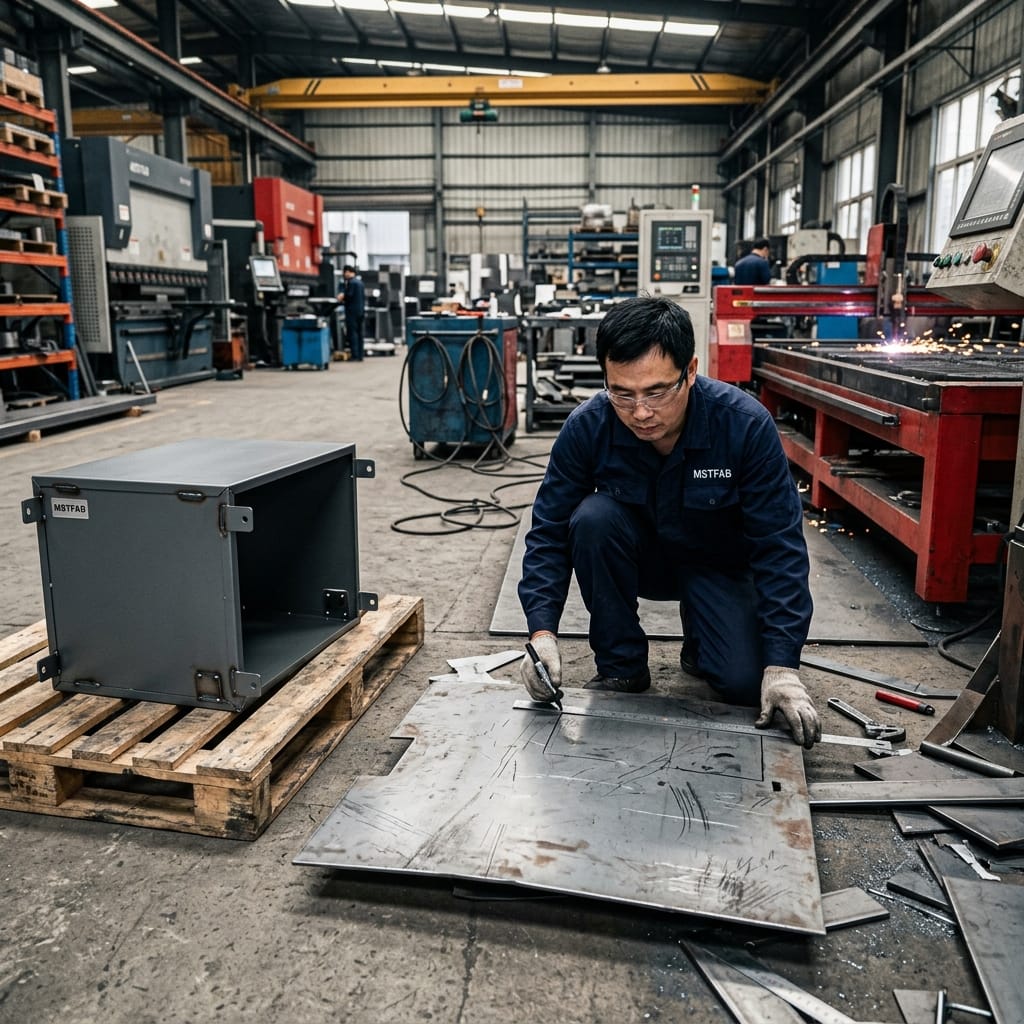
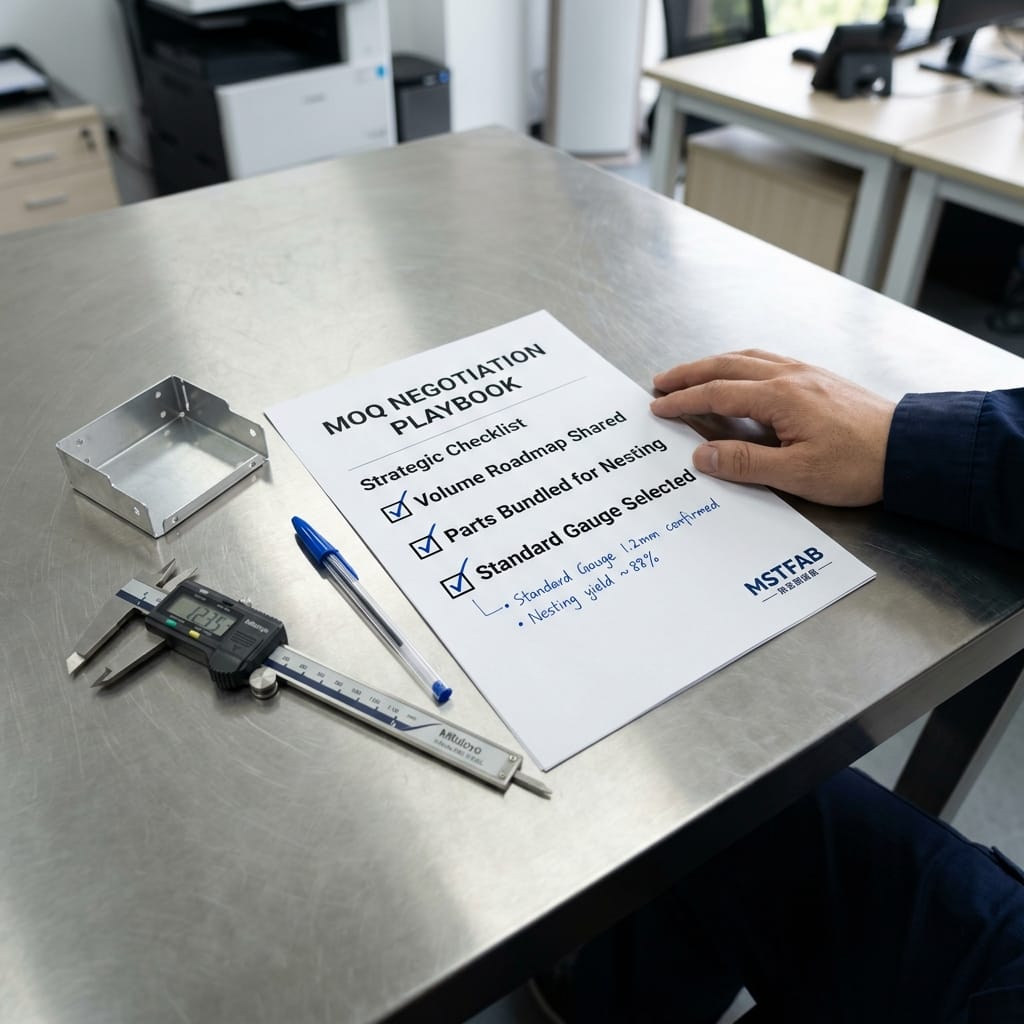
Fabricators enforce high Minimum Order Quantities (MOQs) not to be difficult, but to amortize fixed machine setup costs (fiber laser nozzle alignment, CNC press brake tooling swaps, automated powder booth wash cycles) and avoid whole-sheet raw metal scrap. Startups and procurement teams can successfully lower MOQs from 500+ units down to 20–50 units using 4 proven negotiation levers: 1) Pay a Transparent Setup Fee Rather than Accepting MOQ Bloat: Unbundle fixed machine setup hours (80-150/setup) from piece-part price; 2) Standardize Material Gauges Across the Entire Bill of Materials: Standardizing 5 different brackets to 1.5mm 5052-H32 aluminum allows the factory to nest all parts on one sheet layout; 3) Present a Concrete Phase-Gated Volume Roadmap: Provide estimated annual consumption (EAC) tied to prototype, EVT, DVT, and PVT release milestones; and 4) Utilize Factory Remnant Sheet Programs: Permit cutting from in-stock offcut sheets (“drops”) to eliminate whole-sheet purchasing minimums.
Hardware startups and low-volume industrial OEMs frequently encounter a brutal dilemma: suppliers demand 500-unit minimums for a custom sheet metal enclosure when the engineering team only needs 25 units for customer beta testing. Tying up scarce capital in unvalidated metal inventory risks complete obsolescence if testing prompts a single CAD drawing revision. Mastering MOQ negotiation protects vital startup runway.
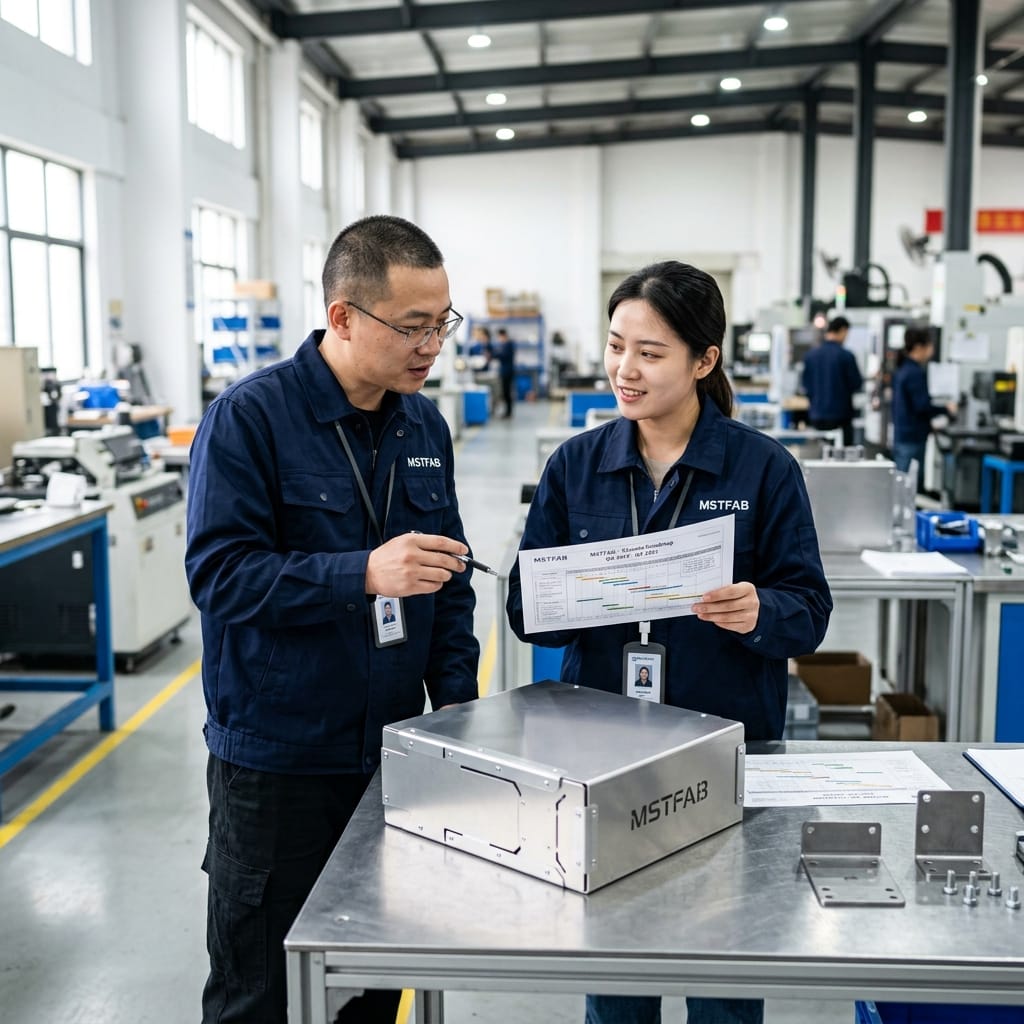
The 4 Real Cost Drivers Behind Sheet Metal MOQs
To negotiate effectively, you must understand the shop-floor economics that cause a factory estimator to quote high MOQs:
| Manufacturing Stage | Hidden Cost Driver | Impact on 20-Unit Batch | Buyer Counter-Strategy |
|---|---|---|---|
| 1. Raw Material Sourcing | Steel service centers sell full sheets (e.g. 1250 × 2500 mm). Rare alloys require ordering minimum 5-sheet bundles. | 80% of purchased sheet becomes unused inventory scrap. | Select standard shop-stock gauges (e.g. 1.2mm / 1.5mm 304 stainless, AL 5052, or CR SPCC). |
| 2. CNC Fiber Laser Cutting | CAM programming, nesting optimization, optical alignment, and shuttle loading take 30-45 minutes. | Setup time exceeds actual beam cutting time (10 min cut vs 40 min setup). | Bundle all sub-brackets into a shared cutting nest; pay an explicit one-off50 setup fee. |
| 3. CNC Press Brake Bending | Swapping punch and V-die tool segments, test bending scrap pieces, calibrating backgauge. | Requires 2-3 trial parts scrapped per bend line to achieve angle accuracy. | Design with standard internal bend radii (R = 1.0T) compatible with universal brake tooling. |
| 4. Powder Coating & Finishing | Color changeover on automated powder lines requires full spray booth vacuum purging (45-60 min). | Coating 20 parts costs the same energy/labor as coating 500 parts. | Use standard factory RAL colors (e.g. RAL 7035 Grey or RAL 9005 Black) currently running on lines. |
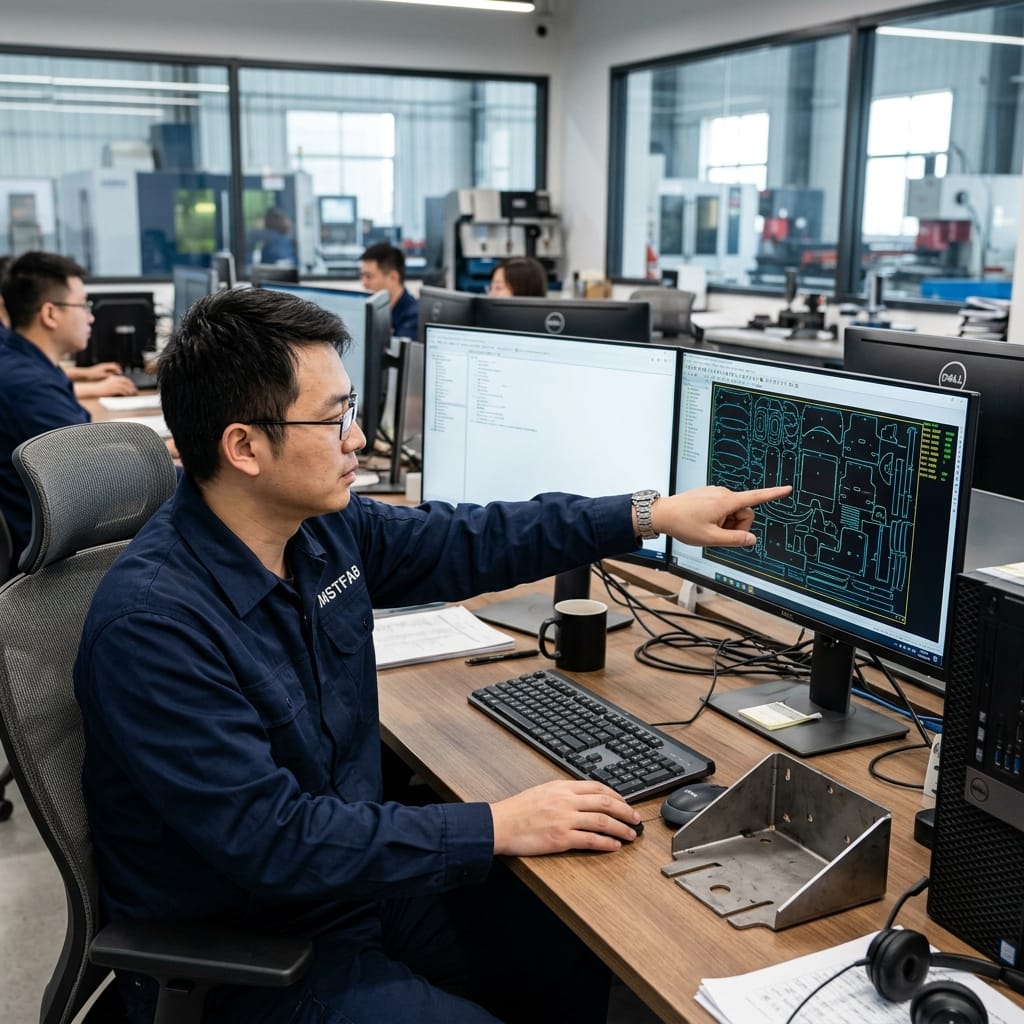
5 Tactical Steps to Unlock Low MOQ Orders
When presenting your RFQ to a precision fabricator like MSTFAB, structure your request using this 5-step playbook:
- Offer Setup Fee Transparency: Tell the estimator upfront: “We understand the machine setup overhead. Please quote our pilot run of 30 units with setup and programming unbundled as separate line items.”
- Share Your Commercial Scaling Timeline: Show the factory where this part is headed. Fabricators eagerly accept pilot runs of 20 units if they see an EVT → DVT → PVT ramp toward 2,000 annual units.
- Harmonize Hardware & Fasteners: Standardize PEM studs and nuts across all parts (e.g. stick to M3 and M4 clinch standoffs) so the automated insertion press runs without tooling swaps.
- Accept Pre-Sheared Remnants: Inquire if the shop has remnant drops in stock. Authorizing the use of factory offcuts eliminates minimum sheet purchases.
- Issue a Blanket PO with Staged Releases: Commit to 300 units on a 12-month Blanket PO, with Release #1 at 30 units, Release #2 at 100 units, and Release #3 at 170 units.
Secure & Scalable Low-MOQ Prototype & Scaling Sourcing With MSTFAB
MSTFAB combines direct factory manufacturing, China-enforceable NNN IP security, transparent tooling ownership, and flexible low-MOQ rapid prototyping. Protect your designs and streamline precision production.
Frequently Asked Questions (FAQ)
What is MSTFAB’s minimum order quantity for custom sheet metal parts?
At MSTFAB, we do not impose arbitrary piece-count MOQs. For prototype and qualification batches, we routinely fabricate orders as small as 1 to 5 units. For production ramp, our automated fiber laser and robotic press brake lines handle batches from 25 to 10,000+ units with seamless scalability.
Why does custom powder coating carry higher MOQs than bare metal?
Custom RAL colors require purging the automated powder spray booth, loading a dedicated 20kg box of virgin powder, and adjusting electrostatic gun currents. If coating only 5 parts, 90% of the powder remains unutilized in the recovery cyclones. Choosing standard in-stock colors (RAL 7035, RAL 9005, RAL 9016) eliminates batch finishing penalties.
How does part nesting across multiple SKUs lower the total order MOQ?
When you order five different brackets (e.g. 10 pcs each = 50 total parts) designed from the same 2.0mm aluminum alloy, our CAM software nests them together on a single 4×8 ft sheet. The machine cuts all 50 parts in a single automated cycle, achieving 85%+ sheet utilization without scrap penalty.
 WeChat Contact
 WhatsApp Me Directly