
A STEP file is one of the best things you can send to a sheet metal enclosure manufacturer.
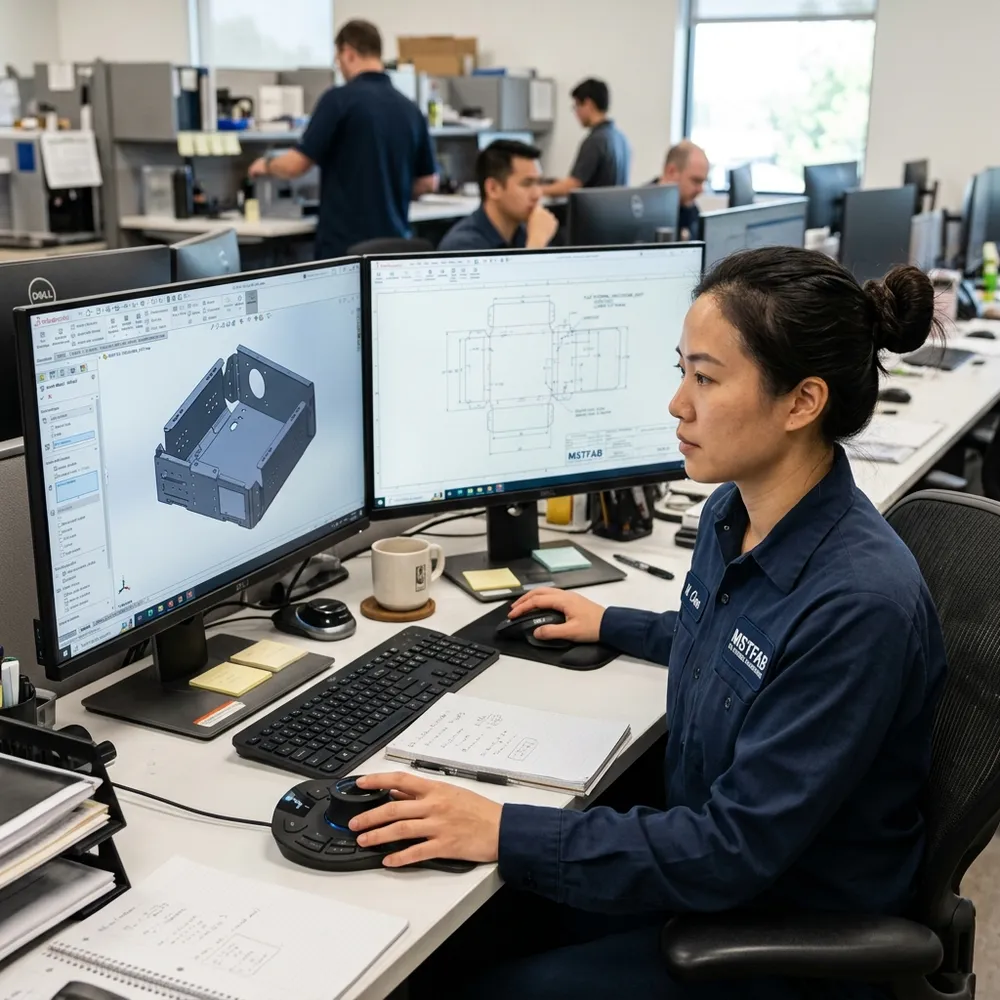
It shows the real 3D structure of your enclosure: bends, panels, doors, covers, mounting areas, brackets, cutouts, and internal space. It helps the engineering team understand the part faster and reduces the guessing that usually turns a quote into a manufacturing horoscope.
But let’s be honest. A STEP file is powerful, but it is not magic.
It tells the factory what the enclosure looks like. It does not always tell the factory what material to use, what tolerance matters, what surface finish is required, what hardware should be installed, or which dimensions are critical.
For OEM buyers, engineers, and procurement teams, the best quotation package is usually: 3D STEP file + 2D PDF drawing + project requirements.
That combination helps the supplier quote faster, review manufacturability, reduce mistakes, and move from design to prototype or batch production with fewer surprises.
MSTFAB manufactures custom sheet metal enclosures from customer STEP files, drawings, samples, or project requirements. Our process can include DFM review, laser cutting, CNC bending, welding, surface finishing, hardware installation, inspection, export packaging, and prototype-to-batch production support.
Why STEP Files Are Useful for Sheet Metal Enclosures
A sheet metal enclosure is not just a flat panel. It may include front panels, side panels, doors, covers, mounting plates, internal brackets, cable entry plates, ventilation holes, hinges, locks, handles, PEM nuts, and welded frames.
A STEP file helps the manufacturer see how these parts relate to each other. It makes it easier to check:
- Overall enclosure structure and Bend sequence
- Assembly fit and Internal clearance
- Door and cover relationship
- Mounting plate position and Cable entry layout
- HMI or display cutout position
- Possible interference risks
A screenshot can show the idea. A STEP file shows the geometry. Big difference. One is useful for discussion. The other is useful for manufacturing.
What a STEP File Helps Us Review
1. Flat Pattern Feasibility
For sheet metal fabrication, the 3D enclosure must be unfolded into flat patterns before laser cutting. A STEP file helps engineers review bend locations, flange lengths, corner reliefs, bend radius, material stretching, hole positions before and after bending, and whether the geometry can be unfolded properly.
If the model cannot unfold cleanly, that is a warning sign. Better to find that problem during DFM review than after cutting expensive metal.
2. Bend Radius and Cracking Risk
CAD software can create sharp corners easily. Real sheet metal does not care how beautiful the CAD model looks. It has thickness, grain direction, springback, and a strong dislike for impossible bend radii.
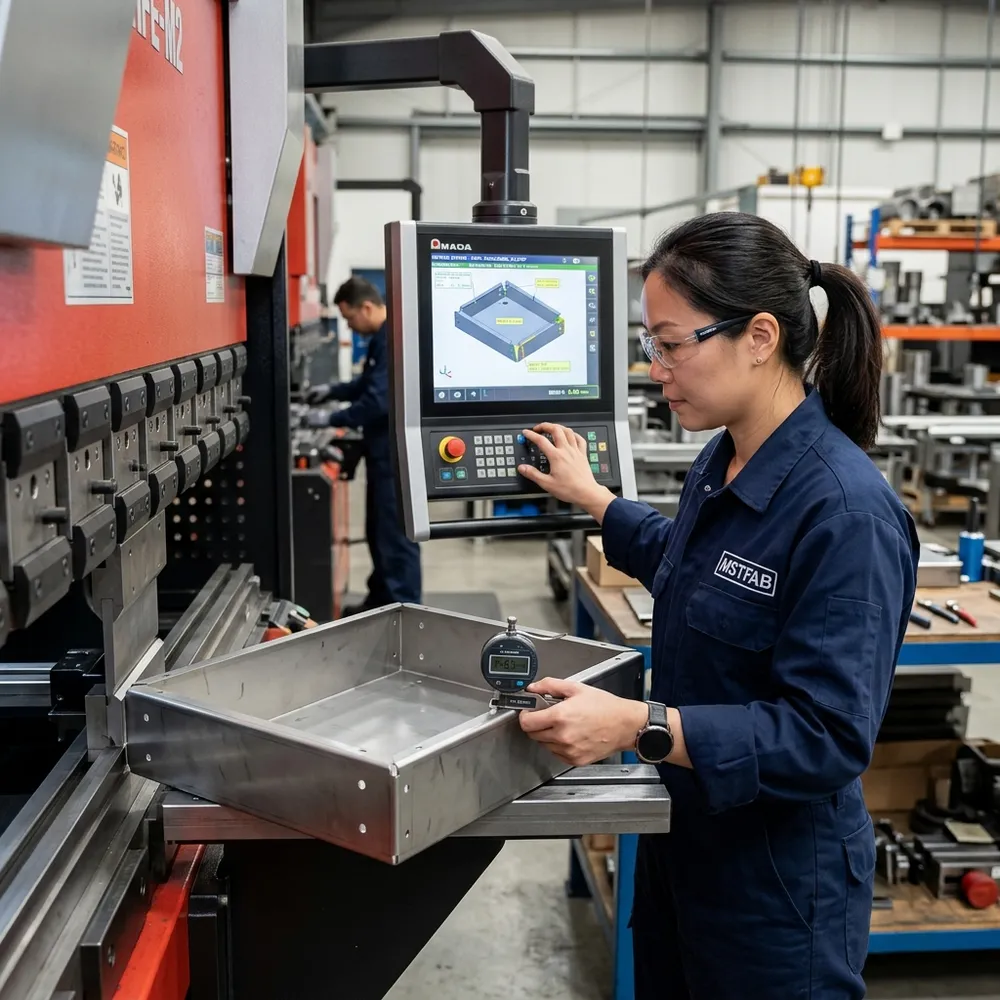
A STEP file helps identify bends that may be too tight for the selected material (especially stainless steel or thick sheet metal). A bend that works in software may crack in production if the radius is unrealistic. That is not a factory attitude problem. That is physics.
3. Hole-to-Bend Clearance
Holes, slots, connector cutouts, cable entries, and HMI openings should not be too close to bend lines. During bending, nearby features can deform. This can cause oval holes, misaligned mounting points, poor assembly fit, and rejected parts.
A STEP file helps us see whether critical openings are too close to formed areas. A mounting hole that is “almost right” is still wrong when the bolt refuses to enter.
4. Assembly and Interference Check
Custom enclosures often include internal brackets, mounting plates, doors, and covers. The STEP file helps review whether parts may interfere during assembly.
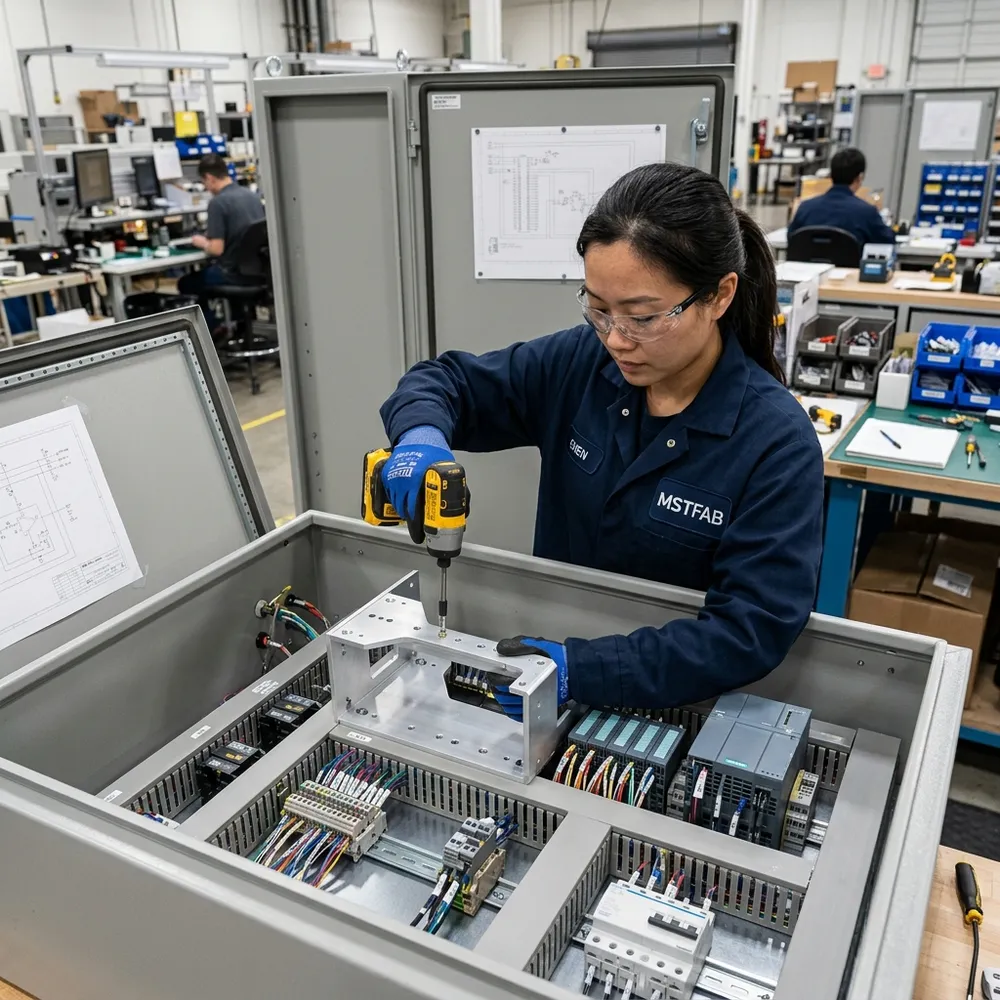
Common issues include mounting plates that are difficult to install, brackets blocking cable routing, doors interfering with internal components, hardware installed too close to bends, and HMI cutouts too close to stiffeners.
This is where STEP files save time. They help catch the “it looked fine in 2D” problem before it becomes a production headache.
STEP File Alone Is Not Enough for Final Production
A STEP file is excellent for geometry. But final production also needs manufacturing instructions.
The STEP file usually does not fully confirm material grade, sheet thickness, surface finish, color or RAL code, tolerance requirements, critical dimensions, welding notes, hardware callouts, or inspection requirements.
That is why a 2D PDF drawing is still important. The STEP file tells us the shape. The PDF drawing tells us the rules.
For a serious enclosure quote, send both. A STEP-only quote may be enough for early budget review. A production-ready quote should include the PDF details.
What to Send with Your STEP File
To get a practical quote, send the STEP file together with:
- 2D PDF drawing
- Material requirement and Sheet thickness
- Quantity
- Surface finish and Color or RAL code
- Tolerance requirements and Welding notes
- Hardware list
- Cable entry details and Ventilation requirements
- Sealing or IP requirement
- Application environment and Packaging requirement
The more complete the package, the faster the quote. “Here is a STEP file, please quote urgently” is a start. “Here is the STEP file, PDF drawing, material, thickness, quantity, finish, hardware list, and application environment” is how serious projects move faster.
STEP File Manufacturing: Engineering Partner vs. Standard Job Shop
| Sourcing Action | Professional OEM Factory (MSTFAB) | Generic Job Shop |
|---|---|---|
| Unfolding & Flat Pattern | Virtually unfolds your STEP file to check for tearing, stretching, or impossible bend radii. | Assumes the CAD model is perfect, cuts it, fails to bend it, and bills you for the ruined metal. |
| Interference Checks | Reviews the 3D assembly to ensure doors won’t hit internal components or cables. | Ignores assembly context, resulting in a cabinet where the door won’t close once populated. |
| File Integration | Cross-references your STEP file against your PDF to lock in tolerances and finishes. | Only looks at the STEP file, guessing the material and finish to offer a superficially low quote. |
Common Enclosure Projects from STEP Files
Electrical Enclosures: A STEP file helps review the cabinet structure, cable gland plates, and internal layout before fabrication.
Industrial Control Cabinets: The STEP file helps check whether the cabinet can be assembled cleanly. Nobody wants to discover the PLC does not fit after the cabinet is beautifully coated.
Telecom Enclosures: A STEP file helps review airflow space, internal brackets, and service access.
EV Charger Enclosures: STEP files are useful for checking enclosure appearance, internal clearance, and assembly structure.
Material Selection Still Matters
The STEP file shows geometry, but material still needs to be specified. Common materials include Cold-Rolled Steel, Galvanized Steel, Stainless Steel (SUS304/SUS316), Aluminum, and Carbon Steel.
Writing only “metal” inside the RFQ is not enough. The factory needs the actual material grade and thickness. Otherwise, the quote will be based on assumptions, and assumptions are where project budgets go to get injured.
Surface Finish and Hardware Must Be Confirmed
Surface finish affects appearance, corrosion resistance, and service life. A cabinet can be dimensionally correct, but if the visible surface looks scratched, uneven, or poorly coated, the buyer will still reject it. That is not being picky. That is quality control.
Custom enclosures often require installed hardware (PEM nuts, standoffs, hinges, locks). The STEP file may show some hardware positions, but the RFQ should clearly state what hardware is included. If hardware is not listed, suppliers may exclude it from the quote. That is not savings. That is delayed math.
Clear Manufacturing Scope
MSTFAB focuses on custom sheet metal fabrication and metal structure manufacturing. We manufacture custom metal enclosure parts, electrical cabinets, telecom enclosures, EV charger cabinets, mounting plates, brackets, chassis, and cabinet panels.
We do not design software. We do not write PLC programs. We do not design circuitry. We do not require proprietary electronic schematics, source code, automation logic, or internal system design. Our scope is the physical metal enclosure.
Request Fabrication Review from Your STEP File
Have a 3D CAD model ready? Upload your STEP file and PDF drawings to MSTFAB. Our engineering team will conduct a thorough DFM review (unfolding, bend radius check, interference) and provide a professional manufacturing quote.
Related engineering resource: If your project involves EV charging infrastructure, review our custom EV charger enclosure fabrication capabilities for outdoor sheet metal cabinet design, powder coating, and export-ready manufacturing.
Related factory capability: For OEM buyers comparing a custom sheet metal enclosure factory, review how MSTFAB handles final assembly, protective packaging, export packing checks, and shipment-ready enclosure delivery.
Frequently Asked Questions
Can sheet metal enclosures be fabricated from STEP files?
Yes. STEP files are useful for reviewing enclosure geometry, bend structure, internal layout, assembly relationships, and manufacturability.
Is a STEP file enough for a final quote?
A STEP file can support early quotation, but a 2D PDF drawing is strongly recommended for final pricing because it confirms material, thickness, tolerance, surface finish, hardware, welding, and inspection requirements.
Why should I send both STEP and PDF drawings?
The STEP file shows the 3D geometry. The PDF drawing confirms the manufacturing specifications. Together, they reduce misunderstandings and improve quote accuracy.
Can you provide DFM review from a STEP file?
Yes. We can review bend feasibility, flat pattern development, hole-to-bend clearance, welding risk, assembly fit, hardware positions, and surface finish concerns from STEP files.
What file formats are useful for sheet metal enclosure fabrication?
STEP files are useful for 3D structure review. PDF drawings are useful for specifications. DXF or DWG files can also help with flat laser-cut profiles.
Can you make prototypes from STEP files?
Yes. STEP files can be used for prototype review and fabrication, but final production details should be confirmed with PDF drawings and project specifications.
CNC sheet metal bending services
MSTFAB provides CNC press brake bending services for precision sheet metal parts, enclosures, brackets and OEM assemblies.
 WeChat Contact
 WhatsApp Me Directly