
Quick answer: send the released STEP model and matching PDF drawing, then identify the enclosure interfaces that must fit: doors, mounting plates, hinges, latches, gasket lands and cable openings. The quote should state which metal parts, hardware, finishes and inspection records are included.
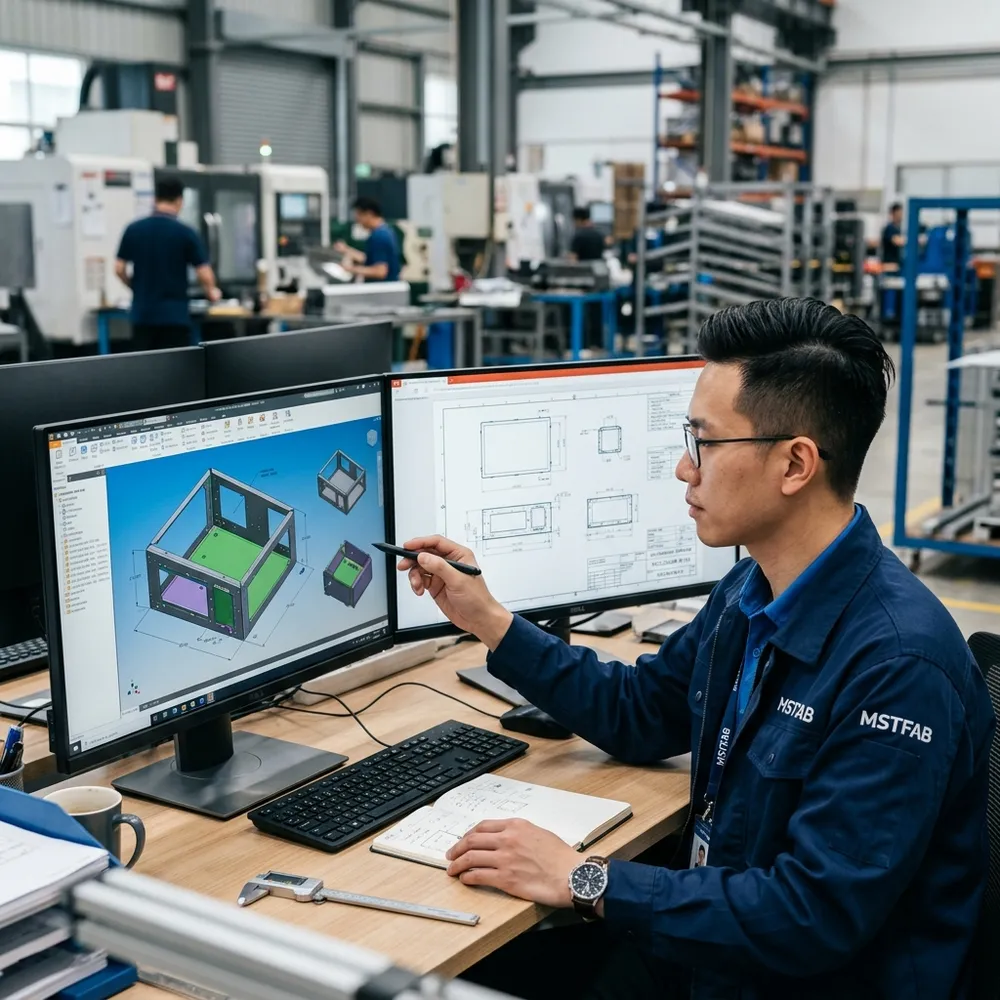
Only have a sketch, photo or sample? You can still start a discussion. It may support a budget estimate, but hidden interfaces and acceptance criteria need to be defined before a production price or drawing is approved.
This guide focuses on enclosure fit and the handoff between the OEM and fabricator. For a general list of file types and commercial inputs, use the sheet metal RFQ file checklist.
The useful question is not simply “Did the factory open the file?” It is “Are we quoting the same assembled shell, with the same revision and acceptance requirements?”
MSTFAB manufactures custom sheet metal enclosures based on customer drawings, samples, or project requirements. Our process can include laser cutting, CNC bending, welding, surface finishing, hardware installation, inspection, export packaging, and DFM review.
Why Drawings Matter for Custom Enclosures
A sheet metal enclosure is not just a metal box. It may include front panels, side panels, doors, mounting plates, internal brackets, cable entry plates, ventilation holes, hinges, locks, handles, PEM nuts, welding structures, and powder coating.
If the drawing is unclear, every one of these details becomes a possible problem.
- A missing hole can delay assembly.
- A wrong bend radius can crack the part.
- A poor door design can ruin the gasket seal.
- A vague surface finish note can create coating disputes.
- A missing hardware list can make a quote look cheaper than it really is.
Clear drawings help the manufacturer quote faster, produce more accurately, and avoid expensive surprises.
STEP File and PDF Drawing: Send Both
For custom enclosure projects, the best file package includes both a 3D STEP file and a 2D PDF drawing.
3D STEP File
The STEP file helps the manufacturer understand the full structure. It shows overall shape, bend structure, part relationships, assembly space, internal layout, mounting positions, and possible interference areas. The STEP file is especially useful for DFM review because it helps engineers see how the enclosure will actually be formed and assembled.
2D PDF Drawing
The PDF drawing confirms the manufacturing requirements. It should include material grade, sheet thickness, critical dimensions, tolerance requirements, surface finish, welding notes, hardware callouts, inspection notes, and special requirements.
The STEP file shows what the enclosure looks like. The PDF drawing tells the factory how it should be made.
For serious OEM projects, send both. A STEP-only quote may work for early budget review, but final production pricing usually needs the PDF details.
What Information Should Be Included?
To get a practical sheet metal enclosure quote, please provide:
- 3D STEP file and 2D PDF drawing
- Material grade and sheet thickness
- Prototype quantity and expected batch quantity
- Surface finish, color/RAL code and faces to mask
- Critical tolerances, functional datums and welding notes
- Hinge, latch, handle and insert part numbers; buyer-supplied or factory-supplied status
- Mounting-plate datums, cutout locations and cable-entry plate details
- Door opening direction, service clearance, gasket interface and any required enclosure test scope
- Application environment
- Packaging or shipping requirement
The more complete the information, the faster the quote. A complete RFQ is like giving the factory a map. An incomplete RFQ is like saying, “Drive somewhere industrial-looking and call me when you arrive.”
What If You Only Have a Sample or Photo?
A sample or photo can help with early discussion. But for accurate production, drawings are still strongly recommended.
Photos cannot reliably confirm material grade, sheet thickness, internal structure, bend radius, critical tolerances, surface finish specification, or hidden mounting details.
If you only have a sample, the project may require reverse measurement or drawing preparation before a final quote. Photos are useful for communication. Drawings are useful for manufacturing. There is a difference.
Why DFM Review Should Happen Before Quotation Approval
A 3D model can look perfect on screen and still create problems in real fabrication. Sheet metal has thickness. It bends. It springs back. It warps during welding. Powder coating adds thickness. Hardware needs clearance.
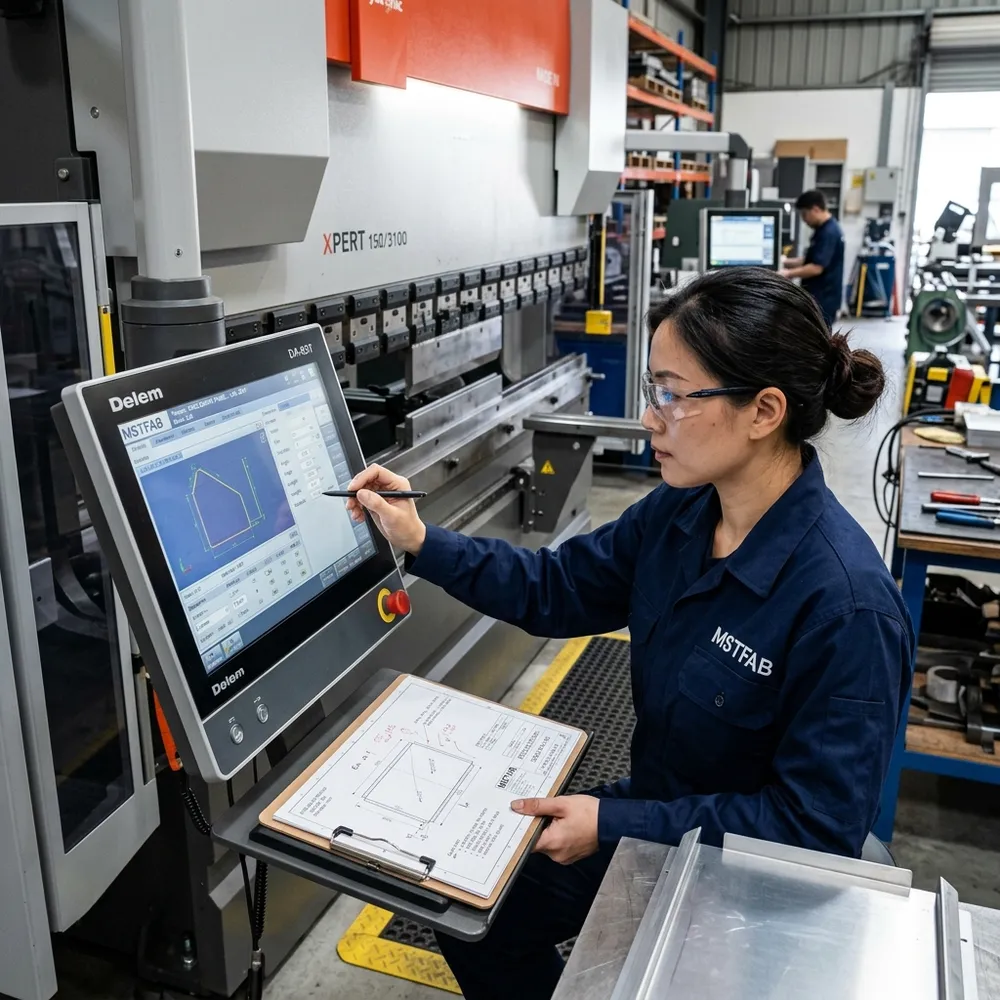
A DFM review helps check material suitability, bend radius, hole-to-bend clearance, tooling access, welding distortion risk, door alignment, and gasket contact surfaces.
A design issue found before production is a drawing correction. A design issue found after production is a pallet of expensive metal parts and a meeting nobody wants to attend.
DFM review is not a delay. It is how you avoid the delay.
Material Options
Material selection affects price, strength, corrosion resistance, appearance, bending, welding, and finishing. Writing only “metal” on a drawing is not enough.
- Cold-Rolled Steel: Used for indoor cabinets, control boxes, and powder-coated enclosures.
- Galvanized Steel: Used for electrical cabinets, telecom enclosures, and semi-outdoor applications.
- Stainless Steel: Used when corrosion resistance or premium appearance is important. (SUS304 or SUS316).
- Aluminum: Used for lightweight enclosures, HMI panels, and EV charger housings.
- Carbon Steel: Used for reinforced frames, heavy-duty bases, and brackets.
Surface Finish Details
Surface finish affects appearance, corrosion resistance, and product life. Common options include powder coating, wet painting, brushing, polishing, galvanizing, zinc plating, anodizing, and passivation.
A cabinet can be dimensionally correct, but if the visible surface looks scratched, uneven, or poorly coated, the buyer will still reject it. That is not being picky. That is OEM quality control.
Hardware Should Be Listed Clearly
Many sheet metal enclosures require installed hardware before shipment (PEM nuts, threaded inserts, hinges, locks, handles, grounding studs). If the hardware is not listed, some suppliers may exclude it from the quote.
The price looks lower. Then later everyone discovers the enclosure is missing the parts that make it useful. That is not savings. That is delayed math.
Enclosure Drawing Review: Three Handoffs to Confirm
| Review point | OEM provides | Quotation should confirm |
|---|---|---|
| Released geometry | Matching model, drawing and BOM revisions; the controlling document if files conflict. | Which revision is priced, unresolved conflicts and who approves any DFM change before manufacture. |
| Mechanical interfaces | Door gaps, hinge/latch/gasket details, mounting datums, hardware list and coating/masking notes. | Supply exclusions, trial-fit conditions, critical dimensions and the agreed inspection records or tests. |
| Controlled information | The mechanical data needed for fabrication and any confidentiality restrictions before transfer. | Agreed NDA, access, document-transfer and retention arrangements where required. A metal-only scope is not an IP-security guarantee. |
How Sending Complete Drawings Speeds Up the Quote
Complete drawings help reduce back-and-forth questions. They also help the manufacturer confirm material, estimate cutting/bending time, review welding, confirm hardware, identify DFM risks, provide a clearer lead time, and separate prototype and batch pricing.
An unclear package can make even a simple enclosure slow. Fast quotation starts before the factory replies. It starts with what you send.
Protecting Your IP
OEM enclosure drawings often contain valuable product information. A professional sheet metal manufacturer should keep the project scope clear. MSTFAB focuses on physical sheet metal structures.
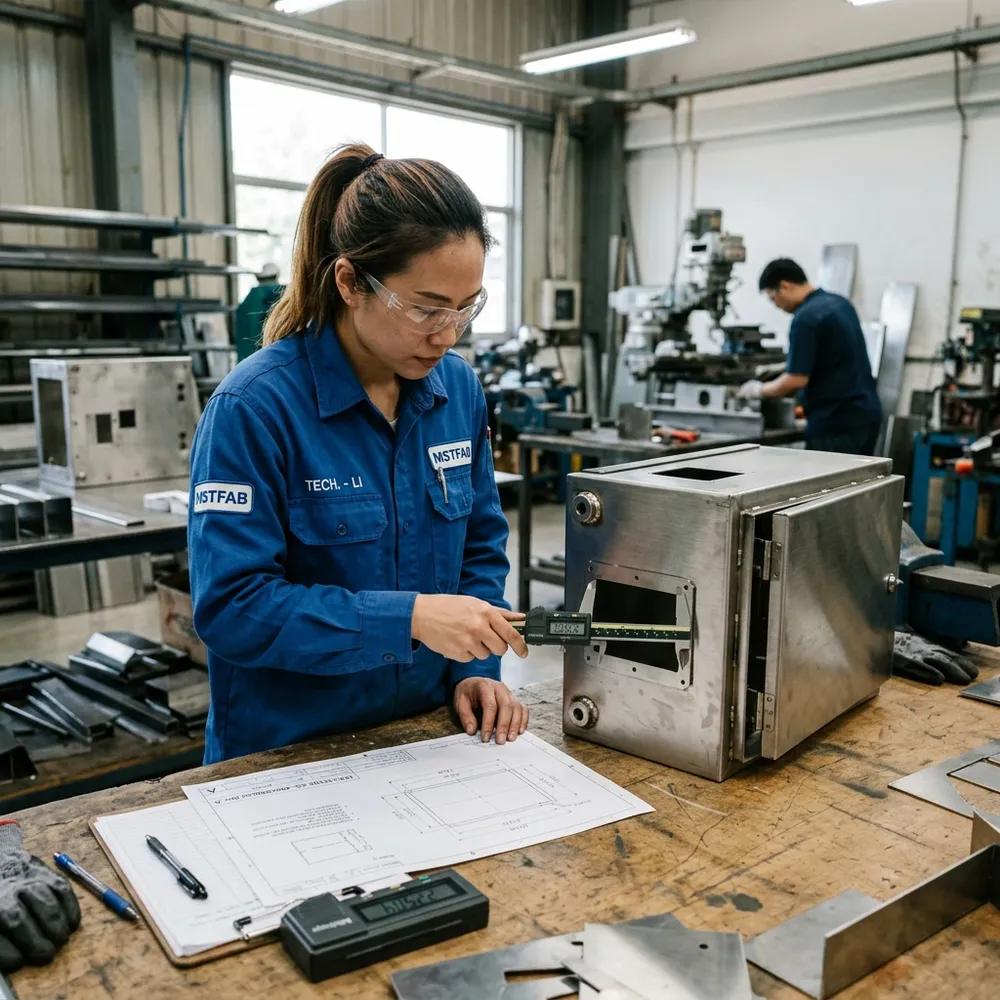
We manufacture sheet metal enclosures, custom metal enclosure parts, electrical cabinets, telecom enclosures, EV charger cabinets, mounting plates, and brackets.
We do not design software. We do not write PLC programs. We do not design circuitry. We do not require proprietary electronic schematics, source code, automation logic, or internal system design. Our scope is the physical metal enclosure.
Share only the mechanical information needed for fabrication. Keeping the scope clear can limit unnecessary disclosure, but confidentiality also depends on agreed document-handling arrangements. Discuss an NDA before transferring restricted files.
What Happens After You Send Drawings?
A typical review process includes file check, material review, manufacturability review, cutting/bending/welding evaluation, hardware confirmation, DFM feedback, quotation, and lead time confirmation.
If information is missing, we will ask questions before quoting. That is not slow service. That is how serious manufacturing avoids expensive assumptions.
Send Your Drawings for a Professional Review
Send the enclosure model, matching drawing revision, quantity and critical interfaces. Mark the hardware supply boundary and required records so the quotation can address the actual mechanical scope.
Related engineering guide: Before releasing a drawing for quotation, review our guide to reading sheet metal drawings for thickness, bend notes, hole dimensions, tolerance callouts, and manufacturability checkpoints.
Frequently Asked Questions
Can I send drawings to get a sheet metal enclosure quote?
Yes. You can send 3D STEP files and 2D PDF drawings for quotation. These files help the manufacturer review structure, material, thickness, tolerances, finish, hardware, and manufacturability.
What files are best for custom sheet metal enclosures?
A 3D STEP file and a 2D PDF drawing are recommended. DXF or DWG files can also be useful for flat laser-cut parts.
Can I get a quote with only a photo?
A photo can support early discussion, but it is usually not enough for an accurate production quote. Drawings are recommended for reliable pricing and manufacturing.
Why does the manufacturer ask for both STEP and PDF drawings?
The STEP file shows the 3D structure, while the PDF drawing confirms material, thickness, tolerances, surface finish, hardware, welding notes, and inspection requirements.
Do you provide DFM review?
Yes. We can review material, thickness, bend radius, hole clearance, welding structure, hardware position, door alignment, surface finish, assembly method, and packaging risk before production.
Do you manufacture internal electronics?
No. Our scope is custom sheet metal fabrication. We manufacture the physical enclosure, cabinet, panel, bracket, chassis, frame, and structural parts. Internal electronics, software, circuitry, and programming are outside our standard scope.
custom sheet metal enclosure fabrication
MSTFAB manufactures custom sheet metal enclosures, electrical cabinets, control boxes and industrial metal housings for OEM buyers.
 WeChat Contact
 WhatsApp Me Directly