
⚡ Direct Answer: How to Ensure RoHS 3 Compliance for Galvanized Steel DIN Rail Telecom Enclosures?
Ensuring RoHS 3 (EU Directive 2015/863) compliance for galvanized steel DIN rail telecom enclosure shells exported to the European Union and North America requires strict chemical control across all homogeneous materials. Compliance mandates 4 material and chemical verifications: 1) Hexavalent Chromium Elimination (Cr6+ Free): Utilizing strictly trivalent chromium (Cr3+) or chromium-free organic chemical passivations on hot-dip galvanized steel sheet; 2) Lead-Free & Cadmium-Free Fasteners: Enforcing <0.1% lead (Pb) and <0.01% cadmium (Cd) limits on all zinc-plated PEM studs, DIN rails, and cabinet screws (eliminating unapproved brass alloys); 3) Phthalate-Free Gasketing: Verifying that robotically dispensed polyurethane or EPDM door gaskets contain zero banned plasticizers (DEHP, BBP, DBP, DIBP <0.1%); and 4) EN 10204 3.1 & SGS RoHS Test Reports: Archiving third-party laboratory chemical assay certificates for every raw material lot.
Telecom equipment destined for European carriers (such as Vodafone, Deutsche Telekom, or Orange) cannot pass CE marking without verifiable RoHS 3 compliance documentation. If an enclosure uses legacy hexavalent chromate passivated steel or non-compliant cable gland gaskets, the entire shipment risks customs impoundment. MSTFAB maintains complete chemical traceability, delivering empty telecom enclosure shells certified 100% RoHS 3 compliant.

RoHS-compliant telecom enclosure shell: Built from trivalent passivated galvanized steel with certified lead-free captive hardware.
RoHS 3 Homogeneous Material Mapping for Telecom Enclosure Shells
| Component / Subassembly | Homogeneous Material | RoHS 3 High-Risk Substance | MSTFAB Material Verification |
|---|---|---|---|
| Enclosure Body & Door | ASTM A653 G90 Galvanized Sheet | Hexavalent Chromium (Cr6+) in yellow passivations | 100% RoHS Cr3+ clear trivalent passivated prime mill sheet. |
| Perimeter Door Gasket | Foamed-in-place Polyurethane (FIPFG) | Phthalates (DEHP, DBP, BBP, DIBP > 1,000 ppm) | Phthalate-free chemical raw material formulations with SGS test certificates. |
| Captive PEM Fasteners | Zinc-plated carbon steel studs/nuts | Lead (Pb) in free-machining steel & yellow dichromate | Genuine PennEngineering (PEM) hardware with clear trivalent zinc plating. |
| Internal DIN Rail (TS35) | Zinc-electroplated steel rail | Cadmium (Cd) & hexavalent chromium (Cr6+) | Certified RoHS compliant zinc-clear plated cold-rolled steel rails. |
RoHS Material Traceability & Metrology Protocols
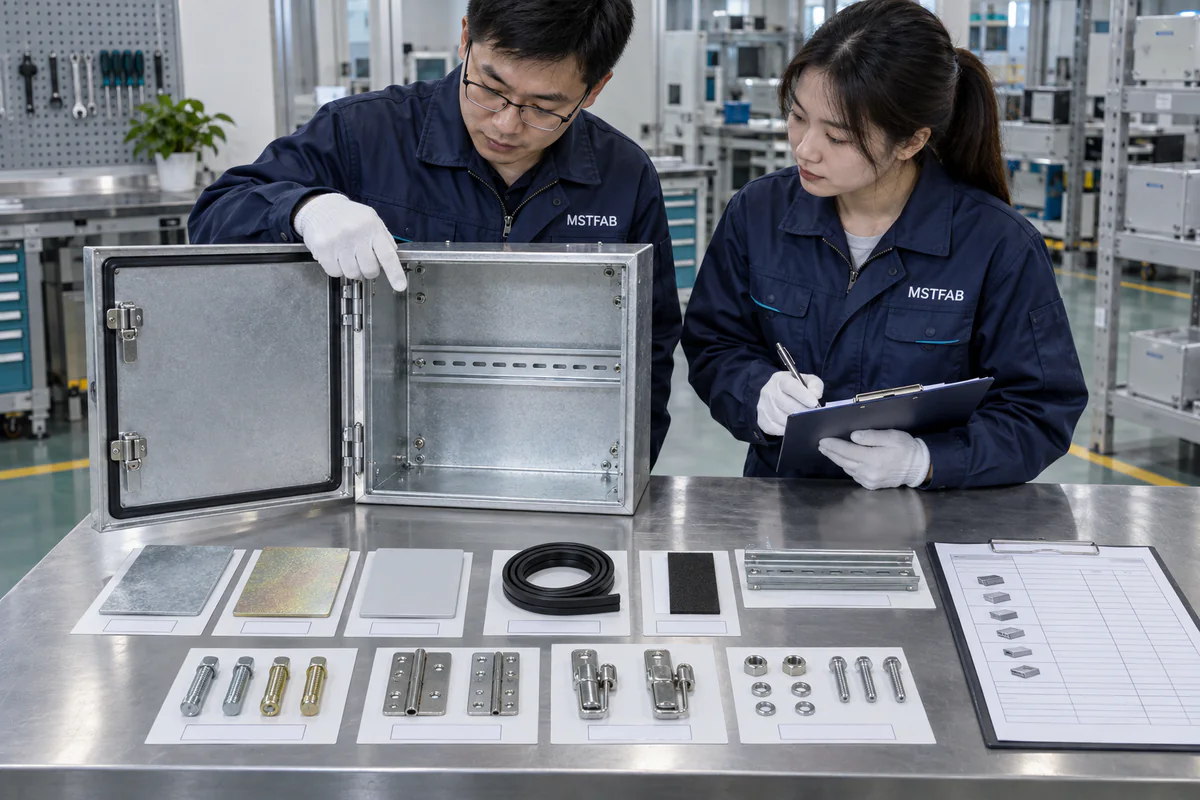
Homogeneous Substance Mapping
Our quality engineering team maintains a complete RoHS Substance Declaration database linking raw steel, powder resins, gaskets, and screws to laboratory assay reports.
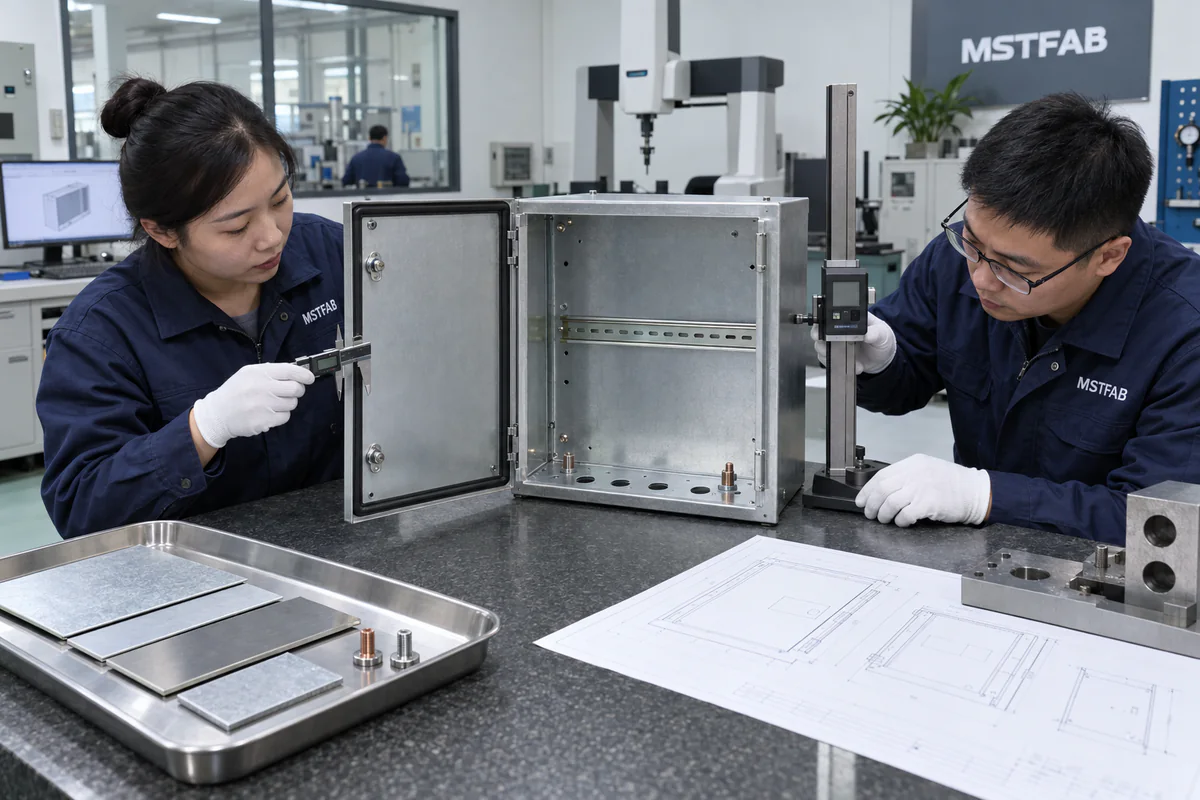
FAI Dimensional & RoHS Verification
Every production lot receives a comprehensive First Article Inspection report certifying dimensional accuracy, mechanical squareness, and RoHS Certificate of Conformance (CoC).
Custom RoHS-Compliant DIN Rail Telecom Enclosure Shells
Send your telecom enclosure drawings and environmental specifications. MSTFAB delivers certified RoHS 3 compliance, high-precision CNC bending, and complete material documentation.
Frequently Asked Questions (FAQ)
What is the difference between RoHS 2 and RoHS 3 for sheet metal enclosures?
RoHS 2 (2011/65/EU) restricted 6 substances: Lead, Mercury, Cadmium, Hexavalent Chromium, PBB, and PBDE. RoHS 3 (Directive 2015/863) added 4 phthalate plasticizers (DEHP, BBP, DBP, DIBP). For sheet metal, RoHS 3 primarily impacts plasticizers in foam door gaskets and cable grommets.
Does MSTFAB provide third-party RoHS test reports?
Yes. We supply annual SGS / TÜV third-party chemical laboratory assay reports for our raw galvanized steel, powder coat resins, and gasket materials upon request.
Are REACH regulations also satisfied alongside RoHS?
Yes. All materials utilized in our telecom enclosures comply with EU REACH SVHC (Substances of Very High Concern) candidate lists (<0.1% w/w).
 WeChat Contact
 WhatsApp Me Directly