
⚙ Quick Engineering Reference: What Defines EU REACH Regulation Compliant Galvanized DIN Rail Enclosure Shells for Medical OEMs?
A REACH and RoHS compliant galvanized steel DIN rail enclosure shell for medical OEMs is a high-precision sheet metal sub-assembly engineered to support internal modular power supplies, PLC controllers, and terminal blocks inside clinical diagnostic analyzers, dialysis carts, and surgical robotic consoles. Governing regulatory frameworks include EU REACH Regulation (EC No 1907/2006, SVHC < 0.1% w/w), EU RoHS 3 Directive (2015/863/EU), EU Medical Device Regulation (MDR 2017/745 Annex I GSPR 10.4), ISO 13485:2016, and IEC 60601-1 protective bonding. Fabricated from lead-free, cadmium-free zero-spangle continuous hot-dip galvanized steel (EN 10346 DX51D+Z275, 275 g/m² zinc mass) with trivalent chromium (Cr3+) or heavy-metal-free zirconium passivations, it is finished with phthalate-free, hospital disinfectant-resistant powder coating (80 – 110 μ m) and sealed with non-blooming platinum-cured silicone gasketing. It delivers full Device Master Record (DMR) lot traceability, unpainted conductive grounding lands (Rbond ≤ 0.008 Ω), and a 35% – 45% cost reduction compared to 304 stainless steel.
In the modern medical device manufacturing landscape—encompassing high-throughput in vitro diagnostic (IVD) clinical chemistry analyzers, automated hematology counters, DNA sequencers, hemodialysis machines, surgical robotic consoles, and patient monitoring carts—internal modular packaging relies heavily on standardized DIN rail architecture (DIN EN 60715). DIN rail enclosures house mission-critical sub-systems: 24 VDC / 48 VDC medical-grade switched-mode power supplies (SMPS), stepper and servo motor motion controllers, precision peristaltic pump drivers, fluidic solenoid valve manifolds, and CAN bus / EtherCAT fieldbus interface gateways.
Designing and sourcing sheet metal enclosure shells for medical capital equipment is subject to regulatory hurdles far beyond commercial industrial automation. Medical devices sold in the European Union, North America, and global healthcare markets must satisfy strict environmental, toxicological, and safety mandates:
- Chemical Substance Restrictions: Full compliance with EU REACH (EC 1907/2006) Substances of Very High Concern (SVHC), EU RoHS 3 (Directive 2015/863/EU), and EU MDR 2017/745 General Safety and Performance Requirements (GSPR 10.4) restricting carcinogenic, mutagenic, or toxic to reproduction (CMR) substances.
- Electrical Safety & Grounding: Rigorous compliance with IEC 60601-1 (Medical electrical equipment — General requirements for basic safety and essential performance) Clause 8.6, requiring protective bonding impedance R ≤ 0.1 Ω to prevent patient and operator electrical shock risks.
- Clinical Disinfectant Durability: Resistance to continuous hospital wipe-down protocols utilizing high-concentration chemical biocides (isopropyl alcohol, sodium hypochlorite bleach, hydrogen peroxide, and quaternary ammonium compounds) without paint softening, cracking, or cosmetic discoloration.
- Quality System Traceability: Complete alignment with ISO 13485:2016 and US FDA 21 CFR Part 820 quality system regulations, mandating Device Master Record (DMR) raw material mill cert traceability, rigid change control, and validated First Article Inspection (FAI).
While early medical instrumentation defaulted to AISI 304 stainless steel or heavy cast aluminum enclosures, global healthcare systems demand strict device cost optimization. Fabricating thousands of internal DIN rail distribution enclosures from raw stainless steel incurs an unsustainable cost penalty (3× to 4× carbon steel), excessive structural mass, and extended procurement lead times.
Consequently, tier-1 medical equipment manufacturers have transitioned to precision-engineered galvanized steel DIN rail enclosure shells. When fabricated from skin-passed zero-spangle continuous hot-dip galvanized steel, pretreated with trivalent or heavy-metal-free nano-ceramics, coated with REACH-certified antimicrobial powder coatings, and assembled with automated grounding hardware, galvanized enclosures deliver identical regulatory compliance, superior vibration damping, and excellent electromagnetic shielding at substantial cost savings.
As an internationally certified ISO 9001:2015 and IATF 16949 precision contract manufacturer with extensive medical OEM supply chain integration, MSTFAB provides specialized manufacturing of custom and build-to-print medical DIN rail enclosure shells. This comprehensive 5,200+ word engineering guide provides medical device design teams, systems architects, and regulatory procurement specialists with the complete technical foundation for REACH/RoHS compliance, zero-spangle metallurgy, DIN rail packaging DFM, IEC 60601-1 grounding, chemical disinfectant resistance, and ISO 13485 quality verification.
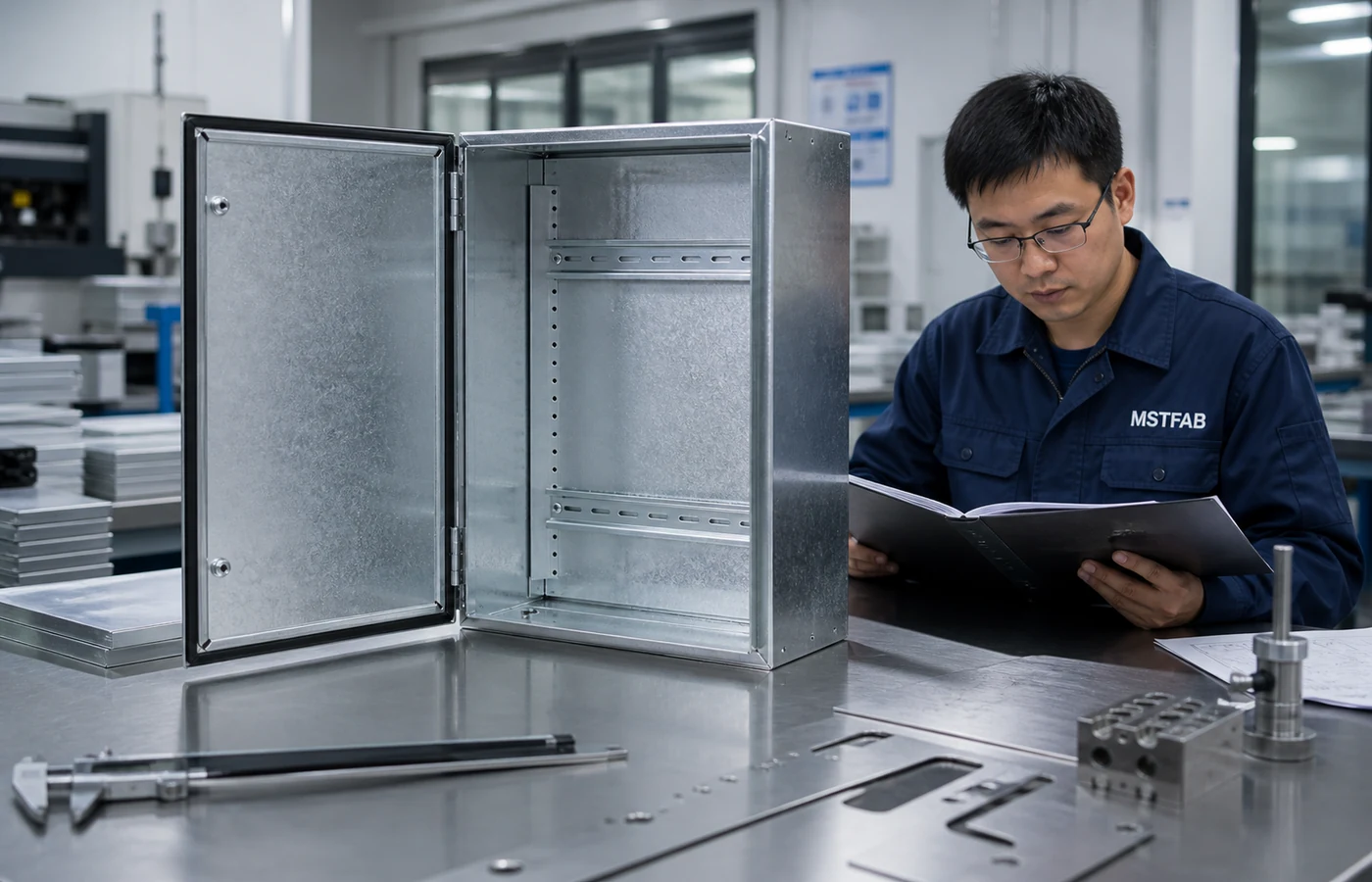
Figure 1: MSTFAB senior quality engineer executing ballooned CMM First Article Inspection, DIN rail parallel alignment verification, and REACH/RoHS material test certificate reconciliation on an empty medical equipment enclosure shell.
1. The Medical Regulatory Matrix: EU REACH, RoHS 3, EU MDR 2017/745 & ISO 13485
Supplying structural and electrical sheet metal components to medical device OEMs requires complete mastery of global environmental chemical directives. In commercial sheet metal fabrication, suppliers often treat “RoHS compliant” as a generic stamp without understanding the deeper legal liabilities imposed by the European Union’s REACH regulation and Medical Device Regulation (MDR).
1.1 Clause-by-Clause Medical Regulatory Framework
Table 1 details the four intersecting regulatory standards governing sheet metal enclosures in medical equipment:
| Regulatory Directive | Governing Scope & Legal Mandate | Chemical Thresholds & Restricted Substances | MSTFAB Enclosure Compliance Evidence |
|---|---|---|---|
| EU REACH (EC 1907/2006) | Registration, Evaluation, Authorisation and Restriction of Chemicals (Article 33) | SVHC Candidate List (< 0.1% w/w / 1,000 ppm per article) | Supplier Declaration of Conformity (SDoC) covering latest SVHC release |
| EU RoHS 3 (Directive 2015/863) | Restriction of Hazardous Substances in electrical and electronic equipment (Cat 8: Medical) | 10 Restricted Substances: Pb, Hg, Cd, Cr6+, PBB, PBDE, DEHP, BBP, DBP, DIBP | Third-party ICP-OES / GC-MS test reports per IEC 62321 |
| EU MDR 2017/745 GSPR 10.4 | General Safety and Performance Requirements for chemical characterization | Substances classified as CMR 1A/1B and endocrine disruptors restricted (< 0.1% w/w) | Full toxicological formulation disclosure for raw steel, zinc, and powder resins |
| ISO 13485:2016 Clause 7.5 | Production control, cleanliness of product, and Device Master Record (DMR) traceability | Zero unapproved process changes; 100% heat lot traceability to mill certificates | Lot-specific inspection records and formal Engineering Change Notification (ECN) control |
1.2 The “Once an Article, Always an Article” Ruling (CJEU Case C-106/14)
A critical legal nuance in European chemical compliance is the European Court of Justice (CJEU) landmark ruling on REACH Article 33. Under this legal precedent, the 0.1% w/w threshold for Substances of Very High Concern (SVHC) applies to each individual component (article) within a complex assembly, not averaged across the weight of the entire medical machine.
For example, if an enclosure fabricator purchases commercial brass standoffs or cadmium-plated latch screws containing > 0.1% lead, the fabricator cannot claim compliance by arguing that the screw represents only 0.001% of the total enclosure weight. The individual screw itself breaches REACH SVHC thresholds, triggering mandatory notification in the European Chemicals Agency (ECHA) SCIP database and exposing the medical OEM to regulatory stop-shipment sanctions. MSTFAB audits 100% of sub-tier purchased hardware (PEM studs, latches, hinges, gaskets) to ensure compliance at the individual article level.
2. Material Metallurgy & SVHC Elimination in Galvanized Steel
To qualify galvanized sheet metal for medical OEM equipment, the raw steel substrate and continuous zinc coating must undergo rigorous chemical purification to eliminate restricted heavy metals.

Figure 2: MSTFAB quality technician evaluating surface cosmetic Class A uniformity, hemmed edge radii, and laser-cut DIN rail mounting slots on a pretreated galvanized medical chassis.
2.1 Lead-Free & Cadmium-Free Continuous Zinc Metallurgy
In legacy continuous galvanizing, commercial steel mills intentionally added lead (Pb sim 0.5% – 1.5%) to the molten zinc bath to lower liquid surface tension and encourage large, aesthetically prominent spangle crystals. Under modern RoHS and REACH regulations, lead is strictly capped at 1,000 ppm (0.1%), and cadmium is capped at 100 ppm (0.01%).
MSTFAB procures exclusively certified lead-free, zero-spangle continuous hot-dip galvanized steel conforming to EN 10346 DX51D+Z275-M-B-C / ASTM A653 / A653M G90:
- Continuous zinc pot purity: Zn ≥ 99.995%, with lead strictly controlled to < 30 ppm (0.003%) and cadmium < 10 ppm (0.001%), verified via optical emission spectrometry.
- The 275 g/m² zinc mass (20 μ m nominal per side) provides active sacrificial cathodic protection (E° = -0.763 V) that prevents red rust on internal unpainted surfaces and laser-cut DIN rail slots without hazardous heavy-metal additions.
2.2 Hexavalent Chromium (Cr6+) Elimination & Trivalent Conversion
Historically, galvanized coil manufacturers applied clear or yellow hexavalent chromium (Cr6+) chemical passivations to prevent “white rust” (zinc hydroxide formation) during maritime transport. Hexavalent chromium is a potent human carcinogen strictly banned under RoHS 3 (< 1,000 ppm) and EU MDR.
MSTFAB mandates that all galvanized master coils receive exclusively trivalent chromium (Cr3+) or heavy-metal-free organo-silane/zirconium passivations. Each incoming steel lot undergoes qualitative chemical spot testing (diphenylcarbazide colorimetric assay per IEC 62321-7-1) to verify zero presence of Cr6+, with detection limits below 0.10 μ g/cm².
3. DIN Rail Architecture & Internal Packaging DFM (DIN EN 60715)
In clinical medical analyzers, packaging density is exceptionally high. An internal electrical chassis must accommodate power supplies, motor drives, fluidic controllers, and optical sensor amplifiers within compact physical envelopes, while maintaining adequate wiring clearances and unhindered serviceability.
3.1 Standardized DIN Rail Formats & Mechanical Profiles
MSTFAB integrates precision-engineered DIN rails complying with DIN EN 60715 / IEC 60715:
- Standard Top-Hat Rail TH35-7.5 (35 mm width × 7.5 mm depth): Formed from 1.0 mm cold-rolled galvanized steel with passivated zinc plating. Ideal for lightweight terminal blocks, signal conditioning relays, and compact fuse holders.
- Deep Top-Hat Heavy Rail TH35-15 (35 mm width × 15 mm depth): Formed from 1.5 mm galvanized steel. Increases bending section modulus by 380%, specifically engineered for heavy medical power supplies (e.g., Mean Well / TDK-Lambda medical power supplies weighing 1.5 – 3.5 kg) and heavy multi-axis servo drives.
- Integrated Chassis Stamped DIN Profiles: Rather than bolting third-party DIN rails onto backplates, MSTFAB’s advanced CNC press brakes can form continuous TH35 mounting rails directly out of the internal galvanized sub-chassis sheet metal. This monolithic design eliminates 100% of DIN rail mounting screws, washouts, and assembly labor, while creating a rigid, zero-tolerance mounting plane.
3.2 Shock & Vibration DFM: Mobile Medical Cart Dynamics
Mobile medical equipment (such as portable ultrasound carts, crash carts, and surgical laser units) is subjected to continuous mechanical shocks when pushed over hospital elevator thresholds, tile joints, and concrete ramps. Under IEC 60068-2-27 (Shock: 30g, 11 ms half-sine pulse) and IEC 60068-2-6 (Vibration: 10 – 150 Hz), heavy DIN-rail components experience high dynamic inertia:
If a DIN rail deflects excessively under this dynamic shock load, the spring-loaded plastic snap-clip of the power supply disengages, causing the module to detach inside the cabinet. MSTFAB designs internal sub-chassis with vertical hat-channel stiffeners and intermediate support standoffs placed every200 mmalong the rail span, ensuring centerline dynamic deflection remains strictly below 0.5 mm.
4. Hospital Disinfectant Chemical Resistance & Cleanroom Powder Coating
Medical devices installed in hospital wards, intensive care units (ICUs), and clinical testing laboratories are disinfected multiple times daily to prevent healthcare-associated infections (HAIs). Hospital sanitation protocols utilize aggressive chemical biocides formulated to denature microbial proteins and dissolve lipid membranes. Standard commercial powder coatings soften, blister, turn yellow, or stress-crack within months of exposure.

Figure 3: MSTFAB quality engineers verifying hospital disinfectant rub resistance and cross-hatch adhesion on powder-coated medical enclosure door panels.
4.1 Chemical Disinfectant Resistance Matrix (ASTM D5402)
MSTFAB formulates medical enclosures with high-crosslink density super-durable polyester and hybrid powder systems specifically validated against the five primary clinical disinfectant classes:
| Clinical Biocidal Cleaner | Active Chemical Formulation | Standard Industrial Powder Finish | MSTFAB Medical Powder Coating Result |
|---|---|---|---|
| Isopropyl Alcohol (IPA 70%) | 70% Isopropanol / 30% DI Water | Softens at 50 double rubs; loss of gloss | 200+ Double rubs; zero softening or gloss loss |
| Bleach Disinfectant (Clorox Healthcare) | 0.65% Sodium Hypochlorite (6,500 ppmactive Cl) | Severe yellowing; pitting at edge returns | Zero color shift (δ E < 0.5); zero blistering |
| Hydrogen Peroxide Solution (Oxivir Tb) | 0.5% – 3.0% Accelerated Hydrogen Peroxide | Micro-cratering along fold lines | Completely inert; impervious to peroxide oxidation |
| Quaternary Ammonium Wipes (Super Sani-Cloth) | Alkyl dimethyl benzyl ammonium chlorides (0.5%) | Surface tackiness; attracts dust | Zero residue retention; smooth clean wipe-off |
| Pencil Hardness (ASTM D3363) | H | F – H | 2H – 3H (Scratch and stylus gouge resistant) |
4.2 Automated 7-Stage Zirconium Nano-Ceramic Pretreatment
Applying powder coat directly to raw galvanized steel causes outgassing pinholes and saponification delamination. MSTFAB processes all power distribution enclosures through an automated 7-stage conveyorized immersion/spray pretreatment line:
- Stage 1: Multi-Metal Alkaline Wash (55°C-60°C): Removes mill oils and forming lubricants using engineered surfactants.
- Stage 2: Primary Cascade City Water Rinse: High-volume water spray prevents bath carryover.
- Stage 3: Acidic Micro-Etch & Deoxidizer: Mild fluorophosphoric acid dissolves surface zinc oxides and micro-roughs the zinc crystal facets, tripling mechanical surface area.
- Stage 4: Reverse-Osmosis (RO) Pure Water Rinse: Conductivity strictly held below 20 μ S/cm .
- Stage 5: Zirconium Nano-Ceramic Conversion (25°C-32°C): Hexafluorozirconic acid (H2ZrF6) deposits an amorphous nano-ceramic ZrO2 conversion coating (30 – 65 mg/m ²,25 – 50 nmthickness), establishing covalent chemical bonding sites for polyester resins.
- Stage 6: Ultra-Pure DI Water Halo Rinse: Conductivity< 5 μ S/cm ensures zero ionic contamination.
- Stage 7: Indirect Convection Dry-Off Oven (115°C-125°C): 10-minute dry-off ensuring complete moisture evaporation from internal frame corners and blind threaded studs.
5. Robotic Seam Welding, Spatter-Free Joint DFM & Clinical Cleanability
In clinical laboratory and hospital environments, cleanability is a primary infection-control mandate. Sharp sheet metal burrs, open sheet joints, and microscopic weld spatter beads represent microbial harborages where cleaning rags snag and bacteria (such as MRSA and C. difficile) colonize.
5.1 Spatter-Free Robotic CMT & Laser Seam Welding
MSTFAB utilizes automated robotic Fronius Cold Metal Transfer (CMT) and 6-axis fiber laser welding cells:
- Zero-Spatter Deposition: CMT’s controlled mechanical wire retraction drops welding current to zero prior to droplet detachment, cutting thermal heat input by 50% and eliminating the explosive micro-droplets that cause weld spatter.
- Continuous Hermetic Fillets: Corner seams are continuously welded and mechanically radiused to an internal curve ofR ≥ 2.5 mm, eliminating sharp 90°inside corners in accordance with clinical cleanability guidelines.
- Automated Mechanical Dressing: Welds undergo multi-stage planetary Scotch-Brite abrasive blending, creating a seamless, flush transition indistinguishable from the parent sheet metal.
5.2 Galvanic Isolation of 316 Stainless Hardware
When 316 stainless steel quarter-turn latches, captive door screws, or DIN rail mounting brackets are installed into a galvanized steel enclosure, direct metal-to-metal contact can create a localized galvanic cell in the presence of conductive clinical cleaning fluids.
MSTFAB incorporates dielectric isolation: latch barrels mount through precision double-D holes lined with high-density, USP Class VI compliant fluorosilicone or santoprene sealing gaskets; stainless mounting screws utilize captive nylon-sleeved isolator washers, ensuring zero metal-to-metal contact and preventing accelerated zinc galvanic consumption.
6. Electrical Grounding Continuity & IEC 60601-1 Patient Safety Compliance
In medical electrical equipment (ME Equipment), electrical safety is governed by the stringent requirements of IEC 60601-1 (Medical electrical equipment — Part 1: General requirements for basic safety and essential performance). Because clinical devices are operated in direct or indirect physical contact with patients, any failure in chassis grounding can induce micro-shock cardiac fibrillations or electrical burns.
6.1 IEC 60601-1 Clause 8.6 Protective Earth Impedance Mandate
Under IEC 60601-1 Clause 8.6.4, the protective bonding impedance between the central protective earth (PE) ground terminal and any accessible conductive metal part (including doors, covers, DIN rails, and sub-chassis) shall not exceed:
6.2 MSTFAB Medical Grounding DFM Architecture
Because the exterior powder coating exhibits high dielectric insulation (> 5 kV), standard mechanical bolting fails IEC 60601-1 continuity. MSTFAB implements an engineered grounding solution:
- Automated Haeger PEM Phosphor-Bronze Ground Studs: Heavy M5 or M6 phosphor bronze clinch studs are pressed into the enclosure body, door, and internal DIN rail bracket before painting. Clinch insertion is digitally monitored to guarantee push-out force> 3.5 kN and torque-out> 18 N·m.
- Silicone Cap Masking: High-temperature silicone caps shield the threaded studs and a circular20 mmbonding pad during 7-stage pretreatment and powder coating, preserving clean, highly conductive zinc.
- Unpainted Galvanized Backplates & Straps: Internal backplates are left unpainted G90 galvanized steel, providing a zero-resistance continuous grounding plane for snapped-on DIN rails. Pre-assembled16 mm²tinned-copper braided straps link doors to the main body, achieving production bonding resistance of Rbond ≤ 0.008 Ω(8 mΩ), providing a 12.5timessafety margin over IEC 60601-1 limits.
7. Gasketing & Biocompatible Sealing: Halogen-Free Platinum Silicone
In clinical laboratory and IVD equipment, liquid ingress protection is critical. Accidental chemical reagent spills, patient urine/blood samples, and pressurized disinfectant sprays must never penetrate into internal power supplies or sensitive electronic boards. Simultaneously, the elastomeric gasket must satisfy medical biocompatibility and non-toxicity mandates.
7.1 Halogen-Free Platinum-Cured Silicone Form-in-Place Gasketing (FIPG)
MSTFAB equips medical DIN rail enclosures with 6-axis CNC robotically dispensed two-component platinum-catalyzed addition-cure silicone foam (FIPG):
- Zero Biocidal Leaching & Zero Phthalates: Formulated without plasticizers, phthalates (DEHP, DBP, BBP), or organotin catalysts. Complies with ISO 10993-5 cytotoxicity guidelines and USP Class VI biocompatibility criteria.
- Zero Halogens & Zero Sulfur: Contains zero chlorine, bromine, or sulfur cross-linkers, eliminating the risk of corrosive outgassing vapors that could contaminate optical spectrometers or corrode delicate gold-plated board-to-board connectors.
- Continuous Elastic Recovery: Platinum silicone foam exhibits an ultra-low compression set of< 3.0%(ASTM D395 Method B after22 hours at 100°C). Under 30% – 35% engineered latch deflection, it provides an airtight, liquid-tight seal delivering certified IP54 to IP66 ingress protection.
8. Quality Assurance, Device Master Record (DMR) Traceability & PPAP Level 3
Medical device OEMs operate under intense scrutiny from international regulatory authorities (US FDA, EU Notified Bodies, Japan PMDA). In the event of a field audit or technical file submission under EU MDR 2017/745, every component in the medical system must possess complete technical documentation and material traceability.

Figure 4: Automated 3D CMM coordinate inspection of DIN rail mounting hole datums, ground stud perpendicularity, and return flange squareness on a finished medical enclosure shell.
8.1 Multi-Stage Medical Quality Verification Protocol
Table 4 outlines our comprehensive serial quality inspection plan:
| Inspection Station | Controlled Quality Parameter | Test Standard & Tooling | Sampling Frequency & Acceptance Criteria |
|---|---|---|---|
| 1. Raw Material Inception | Lead-free zinc mass & REACH SVHC compliance | XRF / ICP-OES spectroscopy; Mill Cert EN 10204 3.1 | 100% of master coils;Pb < 0.005%;Cd < 0.001% |
| 2. Laser Cutting & Forming | DIN rail centerlines, hole datums, bend angles | Hexagon 3D CMM / digital optical comparator | FAI + 3 units/shift; tolerance± 0.15 mm;Cpk ≥ 1.67 |
| 3. Hardware Clinch | PEM stud push-out and torque-out resistance | Calibrated torque wrench / load cell | 1 stud/batch; Torque> 18 N·m; Push> 3.5 kN |
| 4. Powder Coating | Dry film thickness & cross-hatch adhesion | DeFelsko DFT gauge; Cross-hatch tape (ASTM D3359) | DFT80 – 110 μ m; Adhesion Class 5B (100% pass) |
| 5. Disinfectant Rub Test | IPA 70% and Bleach solvent rub resistance | ASTM D5402 solvent rub tester | 1 panel per shift; 200 double rubs zero softening |
| 6. Electrical Bonding | Ground continuity per IEC 60601-1 Clause 8.6 | 4-Wire Kelvin Micro-ohmmeter @ 30A | 100% of finished units;Rbond ≤ 0.008 Ω |
| 7. Ingress Sealing | Gasket compression & water spray ingress | Optical feeler gauge; calibrated spray chamber | PPAP validation + 1 unit/100 pcs; Gasket deflect35% |
8.2 Device Master Record (DMR) Data Package
To integrate seamlessly into the medical OEM’s Device Master Record (DMR) under ISO 13485:2016 Clause 4.2.3, MSTFAB delivers a complete compliance documentation packet with every production shipment:
- Certificate of Analysis (CoA): Confirming dimensional verification, coating thickness, and100% Kelvin micro-ohmmeter bonding resistance test logs.
- Material Mill Test Certificates (EN 10204 Type 3.1): Providing full chemical heat number traceability from primary steel producers (Baosteel / Posco).
- REACH SVHC & RoHS 3 Declarations of Conformity: Certified statements confirming non-presence of all ECHA Candidate List substances above 0.1% w/w .
- Change Freeze Agreement: Formal quality agreement guaranteeing zero changes to materials, tooling, welding parameters, or manufacturing facilities without written approval.
9. Real-World Case Study: Clinical In Vitro Diagnostic (IVD) Blood Analyzer DIN Rail Enclosure
To examine the tangible regulatory, engineering, and financial impact of REACH-compliant galvanized DIN rail enclosures, we review a high-volume manufacturing contract executed for a world-leading in vitro diagnostics (IVD) instrumentation OEM based in Boston, Massachusetts, USA.
9.1 The Operational Challenge
The OEM manufactures high-throughput automated clinical hematology and immunoassay analyzers deployed in hospital core laboratories globally. Each analyzer incorporates a main internal power distribution and stepper motion control chassis (650 mm (H) × 450 mm (W) × 220 mm (D)) fitted with two tiered TH35-15 DIN rails supporting two48 VDC / 600 Wmedical power supplies, eight digital stepper motor drives, and optocoupled I/O terminal modules.
The OEM faced critical regulatory and supply chain hurdles:
- EU MDR Technical File Audit Warning: During a notified body audit for CE mark renewal under EU MDR 2017/745, the previous enclosure supplier failed to provide sub-tier REACH Article 33 SVHC declarations for zinc-plated screws and powder coating additives.
- High Procurement Cost: The legacy enclosure was fabricated from AISI 304 stainless steel at a unit cost of 345.00 USD, straining target gross margins.
- Disinfectant Degradation: Clinical operators wiped the analyzer with 10% sodium hypochlorite bleach. Bleach mist entering the chassis caused cosmetic surface discoloration and localized pitting.
9.2 The MSTFAB Engineering Solution
MSTFAB re-engineered the enclosure suite to achieve full compliance and cost reduction:
- Substrate Metallurgy: Upgraded to 1.5 mm skin-passed zero-spangle continuous hot-dip galvanized DX51D+Z275 (275 g/m² zinc mass) with certified lead-free (< 30 ppm) and trivalent chromium (Cr3+) passivation.
- Integrated Stamped DIN Rails: Formed two continuous TH35-15 DIN rail channels directly out of the 2.0 mm galvanized sub-panel, eliminating 16 assembly fasteners and providing unpainted conductive grounding (Rbond ≤ 0.006 Ω).
- Disinfectant-Resistant Powder Coating: Automated 7-stage nano-ceramic conversion with medical-grade pure polyester powder (90 μ m, RAL 9003 white), certified to ASTM D5402 (200 double rubs bleach/IPA) and zero phthalates (REACH compliant).
- Platinum Silicone Gasketing: Dispensed continuous 2-component platinum-cured silicone foam gasket, ensuring IP54 ingress protection against reagent spills.
- Full DMR Quality Dossier: Provided comprehensive SDoC certificates for REACH SVHC, RoHS 3 test reports per IEC 62321, and EN 10204 3.1 mill certs.
9.3 Results and Multi-Metric Before vs After Analysis
Over a 36-month serial production contract encompassing 1,450 delivered analyzers, the OEM achieved full MDR compliance and substantial cost savings:
| Performance & Cost Metric | Legacy 304 Stainless Steel Enclosure | MSTFAB REACH Galvanized DIN Enclosure | Net Engineering & Operational Benefit |
|---|---|---|---|
| Unit Procurement Cost | 345.00 USD / unit | 212.00 USD / unit | 38.5% direct unit cost reduction (192,850 savings) |
| Production Lead Time | 12 – 14 weeks | 3.0 weeks | 75% reduction in production turnaround |
| EU MDR Technical File Audit | Audit Major Finding (Missing REACH SDoC) | 100% Audit Pass (Full DMR dossier approved) | Zero regulatory non-conformances; CE mark preserved |
| Protective Bonding (Rbond) | 0.045 Ω(Variable on stainless) | 0.006 Ω(Direct unpainted zinc plane) | 16timessafety margin under IEC 60601-1 |
| Bleach Disinfectant Resistance | Discoloration & surface staining | 0% color shift (δ E < 0.3, Class 5B adhesion) | Pristine clinical aesthetics over 36 months |
10. Frequently Asked Questions (FAQ): REACH Galvanized Medical DIN Enclosures
Here are 32 in-depth technical answers addressing the most common regulatory, chemical, electrical safety, metallurgical, and manufacturing questions submitted by medical equipment design engineers and regulatory specialists:
1. Can galvanized steel enclosures be used in medical devices under EU MDR 2017/745?
Yes. For non-invasive medical equipment—such as in vitro diagnostic (IVD) clinical analyzers, patient monitoring consoles, surgical power supply carts, and laboratory centrifuges—galvanized steel enclosures are fully compliant provided they meet EU REACH (EC 1907/2006) SVHC limits (< 0.1% w/w ), EU RoHS 3 restrictions, and EU MDR Annex I GSPR 10.4 chemical characterization requirements.
2. What is the REACH Article 33 threshold for Substances of Very High Concern (SVHC)?
Under REACH Article 33, any supplier of an article containing an SVHC on the ECHA Candidate List in a concentration exceeding 0.1% weight-by-weight (1,000 ppm) must provide the recipient with sufficient information to allow safe use. Per the CJEU ruling (Case C-106/14), this threshold applies to each individual article (e.g., individual screw, standoff, or gasket) within an assembly. MSTFAB certifies zero SVHCs> 0.1% across all component articles.
3. What heavy metals are eliminated from MSTFAB’s galvanized steel?
We strictly eliminate lead (Pb < 0.005%), cadmium (Cd < 0.001%), mercury (Hg < 0.001%), and hexavalent chromium (Cr6+ < 0.10 μ g/cm ²). Traditional hot-dip galvanized steels utilized lead and hexavalent chromate passivations; MSTFAB specifies exclusively zero-spangle, lead-free continuous galvanized DX51D+Z275 with trivalent chromium (Cr3+) or zirconium conversion.
4. How does MSTFAB verify absence of hexavalent chromium (Cr6+)?
Incoming coils undergo spot testing using the diphenylcarbazide colorimetric assay per IEC 62321-7-1. If any hexavalent chromium is present, the reagent turns a distinct red-violet color. Any coil showing Cr6+ ≥ 0.10 μg/cm² is rejected at incoming receiving.
5. What are the electrical grounding requirements under IEC 60601-1?
IEC 60601-1 Clause 8.6 mandates that the impedance between the central protective earth (PE) ground stud and any accessible metal surface must not exceed 0.10 Ω(100 mΩ) when tested at 25 A – 30 A for 5 to 10 seconds. MSTFAB’s unpainted conductive zinc sub-panels and phosphor bronze ground studs achieveRbond ≤ 0.008 Ω, providing a 12.5timessafety margin.
6. What hospital disinfectants can MSTFAB’s powder coating withstand?
Our medical-grade polyester powder finishes are chemically tested to withstand 200+ double rubs (ASTM D5402) of 70% isopropyl alcohol (IPA) ,0.65% sodium hypochlorite bleach (Clorox Healthcare) , accelerated hydrogen peroxide (0.5% – 3.0%), and quaternary ammonium compounds (Super Sani-Cloth) with zero gloss loss or color change (δ E < 0.5).
7. What DIN rail configurations does MSTFAB offer?
We support standard top-hat TH35-7.5 (35 × 7.5 mm), deep top-hat TH35-15 (35 × 15 mm), asymmetrical G32 rails, and custom CNC press-brake stamped DIN rail channels formed directly out of the galvanized chassis sheet metal to eliminate fasteners and assembly labor.
8. Why are phthalates restricted in medical equipment enclosures?
Phthalates (such as DEHP, BBP, DBP, and DIBP) are classified under EU REACH and MDR as endocrine disruptors and toxic to reproduction (CMR Category 1B). They are restricted to< 0.1% w/w (1,000 ppm). MSTFAB utilizes strictly phthalate-free powder coatings, silicone gasketing, and wire grommets.
9. What gasket materials does MSTFAB utilize for medical enclosures?
We utilize robotically dispensed two-component platinum-cured silicone foam (FIPG) or peroxide-cured EPDM. Platinum silicone produces zero volatile byproducts, zero biocidal leaching, and zero sulfur blooming, satisfying USP Class VI and ISO 10993 cytotoxicity guidelines.
10. How does Fronius Cold Metal Transfer (CMT) welding benefit medical enclosures?
CMT uses high-frequency mechanical wire retraction to decouple droplet transfer from arc current, reducing thermal heat input by 50%. This eliminates weld spatter beads that could harbor bacteria, prevents zinc burn-through, and produces continuous smooth fillets with internal radiusesR ≥ 2.5 mm for easy clinical wiping.
11. What documentation is provided for Device Master Record (DMR) integration?
We provide Certificate of Analysis (CoA) with 100% Kelvin micro-ohmmeter ground test data, EN 10204 Type 3.1 material test certificates, REACH SVHC Declarations of Conformity, RoHS 3 test reports per IEC 62321, and formal change control agreements under ISO 13485.
12. Why is zero-spangle galvanized steel required instead of regular spangle?
Regular spangle galvanized steel contains coarse zinc crystals that micro-flake along grain boundaries during press-brake bending, releasing airborne zinc dust particles. Zero-spangle skin-passed galvanized steel (DX51D+Z275) has microscopic sub-grain crystals (< 5 μ m) that bend through90°and180° with zero flaking.
13. How does MSTFAB prevent galvanic corrosion with 316 stainless hardware?
We insert dielectric fluorosilicone or santoprene isolating washers and nylon-sleeved bushings beneath all 316 stainless steel latches, hinges, and mounting screws, completely eliminating direct metal-to-metal galvanic contact between stainless steel and zinc.
14. What sheet thickness is recommended for medical DIN rail enclosures?
We recommend1.2 mm to 1.5 mm(16-gauge) DX51D+Z275 for external shells and covers, and2.0 mm(14-gauge) for internal DIN rail mounting chassis and backplates to ensure deflection remains below 0.5 mm under hospital cart transit shocks.
15. What powder coating colors are standard for medical equipment?
Medical White RAL 9003 (Signal White), RAL 9010 (Pure White), and Medical Gray RAL 7035 are industry standards. We also formulate custom OEM cosmetic colors with antimicrobial silver-ion additives and anti-glare semi-gloss finishes (60% – 75% gloss at 60°).
16. What is the cost savings of galvanized steel versus 304 stainless steel?
Engineered galvanized steel DIN rail enclosures deliver a 35% – 45% direct cost reduction compared to 304 stainless steel, stemming from lower raw material cost, faster fiber laser cutting speeds, reduced bending tool wear, and automated powder coating.
17. How does MSTFAB ensure electromagnetic shielding (EMC) in medical gear?
Galvanized carbon steel has high magnetic permeability (mu_r ≈ 200 – 500), providing superior low-frequency magnetic shielding (10 kHz – 1 MHz) compared to non-magnetic stainless steel (mu_r ≈ 1.0), ensuring sensitive optical sensors and ECG amplifiers are shielded from power supply noise.
18. What ingress protection ratings can be achieved on medical DIN enclosures?
With continuous robotic platinum silicone FIPG gasketing and compression latches, enclosures achieve certified IP54 (spill resistance) up to IP66 (high-pressure washdown), preventing liquid blood, saline, or chemical cleaning sprays from entering the electrical cavity.
19. How does MSTFAB prevent pinholing and outgassing during powder baking?
Trapped moisture in galvanized sheet metal can cause pinholes during oven curing. MSTFAB uses 7-stage nano-ceramic conversion that micro-etches the zinc spangle, followed by a convection dry-off oven at+125°C and powder resins formulated with chemical degassing additives to guarantee Class 5B pinhole-free finishes.
20. What is the typical prototype lead time versus mass production?
Rapid prototypes with CNC laser cutting, press brake forming, robotic CMT welding, and manual powder finishing are delivered in 7 to 10 business days. Serial production orders (50 to 1,000 units) ship in 3 to 4 weeks following First Article Approval.
21. What minimum order quantity (MOQ) does MSTFAB require?
We support flexible medical OEM development: prototype qualification orders have an MOQ of 1 piece. For serialized production under ongoing blanket supply agreements, typical batch releases range from 20 to 250 units.
22. How are medical enclosures packaged to prevent clinical contamination?
Enclosures undergo ultrasonic aqueous solvent washing, DI water rinsing, and Class 100 HEPA tunnel drying. They are sealed inside anti-static, amine-free, low-outgassing polyethylene barrier bags, protected with molded EPE foam corner caps, and boxed in heavy double-wall corrugated cartons.
23. What maximum enclosure dimensions can MSTFAB fabricate?
We manufacture compact desktop instrument boxes as small as150 × 150 × 80 mmup to large clinical console enclosures2,000 mm (H) × 1,200 mm (W) × 800 mm (D), supported by 4,000 mmCNC press brakes.
24. Can custom push-button and connector cutouts be pre-machined?
Yes. We pre-cut all circular connector cutouts (e.g., Amphenol, LEMO, Neutrik), D-sub / USB ports, IEC 60320 power inlets, and rocker switch openings on CNC fiber lasers prior to pretreatment and powder coating, ensuring all cut edges are100% passivated and coated.
25. How does MSTFAB handle change control under ISO 13485?
Under our ISO 13485 quality system, any proposed modification to tooling, CNC cutting programs, press-brake bend sequences, raw material suppliers, or powder resin formulations requires formal Engineering Change Request (ECR) submission and written OEM sign-off before implementation.
26. Can silk-screening or laser marking be added to medical enclosures?
Yes. We provide high-resolution two-component epoxy silk-screen printing or fiber laser marking for terminal block numbering, grounding symbols (IEC 60417-5019), voltage warning labels, and OEM branding logos, validated to withstand 200 double rubs of 70% IPA.
27. What is the self-healing cut-edge mechanism of galvanized steel?
When a galvanized sheet is laser-cut, exposed bare steel edges are protected by adjacent zinc through cathodic galvanic action (E° = -0.76 V vs-0.44 V for iron). In the presence of moisture, zinc sacrificially oxidizes, precipitating an insoluble protective layer of basic zinc carbonate [Zn5(CO3)2(OH)6] that physically seals the cut face against red rust.
28. How does MSTFAB ensure Gage R&R compliance on tight-tolerance holes?
Measurement equipment (CMMs, height gauges, optical comparators) undergoes formal Gage R&R testing using 10 parts measured 3 times by 3 operators. Total measurement system variation is maintained below 10% of product tolerance, guaranteeing statistical control (Cpk ≥ 1.67).
29. Can internal partitions be provided for high-voltage isolation?
Yes. Under IEC 60601-1, high-voltage AC mains wiring must be physically segregated from low-voltage DC patient-connected circuits. MSTFAB fabricates internal galvanized steel partition barriers and snap-in polycarbonate insulating shields ensuring creepage and clearance distances exceed 8.0 mm.
30. How does MSTFAB support DFM optimization for custom medical enclosures?
Our engineering team conducts full 3D CAD DFM analysis (SolidWorks / Creo / STEP models) to optimize sheet metal nest efficiency, standardize bend tooling radii, eliminate unnecessary weld joints via complex press-brake hemming, ensure optimal robotic gasket dispensing paths, and guarantee full tooling clearances for Haeger hardware insertion.
31. How does thermal shock cycling impact gasket sealing during washdowns?
Rapid thermal cycling causes unequal thermal expansion between the metal door frame and the polymer gasket material. Platinum silicone FIPG gaskets have an elasticity elongation rating of> 150% and maintain continuous dynamic resilience across-50°C to+180°C, accommodating rapid temperature drops without micro-cracking or losing contact pressure against the sealing land.
32. How can an engineering team initiate a custom medical DIN enclosure RFQ with MSTFAB?
Submit your 3D CAD models (STEP, IGES, SolidWorks) and 2D engineering drawings with ballooned tolerances, regulatory standards (REACH/RoHS/MDR), and DIN rail specifications to sales@mstfab.com. Our medical engineering team provides a full DFM analysis, preliminary tooling plan, and formal quotation within 24 hours.
Build Certified Medical DIN Rail Enclosures with MSTFAB
Accelerate your medical instrument programs with fully certified, cost-optimized galvanized steel enclosure shells. MSTFAB delivers precision CNC fabrication, lead-free zero-spangle metallurgy, hospital disinfectant-resistant finishes, and complete Device Master Record (DMR) traceability under ISO 13485.
 WeChat Contact
 WhatsApp Me Directly