
The Real Challenge of Powder Coated Agricultural Equipment Guards
Powder coated agricultural equipment guards may look simple to most people. Cut the steel, bend the guard, weld the brackets, spray some paint, pack it, and ship it. Nice story, right?
Well, as any experienced OEM buyer knows, real farm machinery is not that friendly.
These agricultural metal parts operate in the harshest environments imaginable: dust, mud, continuous vibration, crop residue, harsh fertilizers, pesticides, heavy rain, and scorching sunlight. A guard that looks perfect in a supplier’s factory photos can still fail disastrously in its first harvest season if the material, edge treatment, coating process, and packaging aren’t meticulously controlled.
At MSTFab, we manufacture custom agricultural equipment guards, covers, brackets, and shields for farm machinery OEMs. Let’s be honest: asking “Can you powder coat this?” isn’t enough. The real question is: “Will it survive field vibration, chemical exposure, and rust around the bolt holes?”
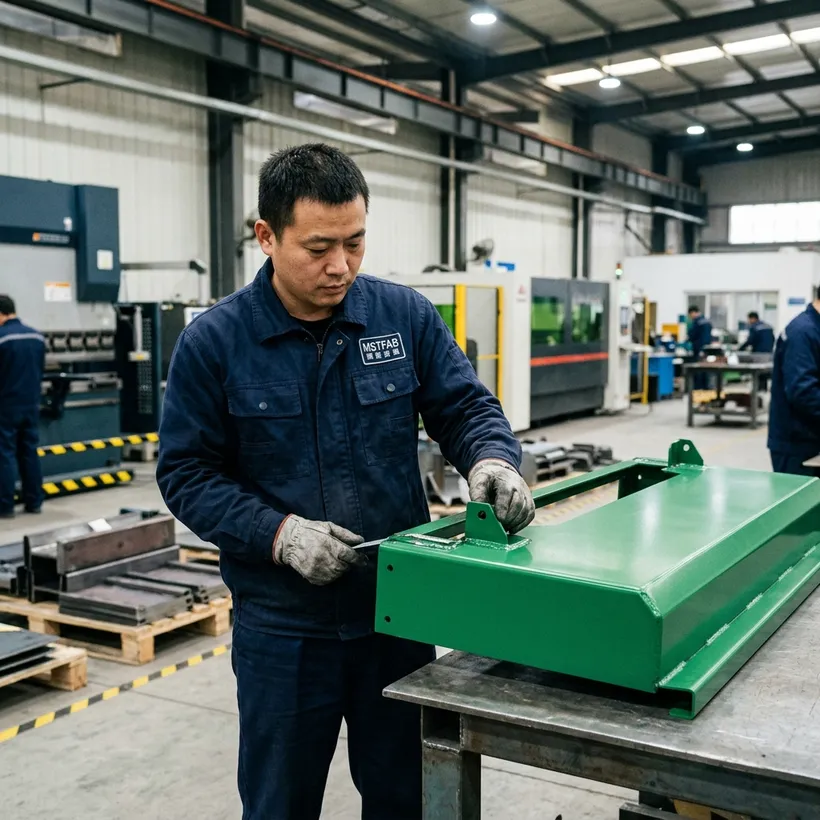
Our engineering team verifying edge coverage and coating thickness on an agricultural guard before final assembly.
1. The “Cheap Job Shop” Trap vs. MSTFab Engineering
Many buyers try to save a few pennies by going to generic job shops. They ask for “black powder coating” and assume everything will be fine. Fast forward six months: the paint is peeling, rust is bleeding from the bolt holes, and farmers are submitting warranty claims.
A bad weld under powder coating is still a bad weld—it’s just wearing makeup.
| Pain Point | Cheap Job Shops (The Nightmare) | MSTFab Solution (The Professional Way) |
|---|---|---|
| Edge Rusting | Laser-cut edges left sharp. Paint thins out on corners, rusting immediately in the field. | Proper deburring and edge rounding. Even coating distribution prevents premature corner failure. |
| Hole Alignment | Holes are drilled “close enough,” but powder coating buildup makes bolts impossible to insert. | Precise DFM review accounts for coating thickness. Thread masking ensures smooth assembly. |
| Vibration Fatigue | Weak brackets crack under tractor vibration. Paint chips off around fastener points. | Reinforced bracket designs and structural analysis. Durable coating adhesion resists mounting stress. |
| Shipping Damage | Guards thrown into boxes with zero protection. Arrive with metal-on-metal scratches. | Export-grade packaging with foam separation and robust crates. Parts arrive ready for assembly line. |
2. Material Selection: You Can’t Paint Over a Bad Choice
Powder coating isn’t magic. If you use the wrong base metal, you are just writing the first chapter of a rust story.
- Mild Steel: Great for heavy-duty harvester covers and belt guards, but absolutely requires proper surface prep before coating.
- Galvanized Steel: Offers a zinc-layer defense, ideal for outdoor irrigation or sprayer guards. But remember, laser-cut edges still need protection.
- Stainless Steel: The premium choice for fertilizer and washdown areas.
3. The Real Culprits: Edges, Welds, and Vibration
Rust rarely starts in the middle of a beautiful flat panel. It attacks the weak points: mounting slots, uncleaned weld spatter, sharp corners, and bottom-facing surfaces. If a factory doesn’t clean the weld properly before coating, the adhesion will fail. A guard that feels strong on an office desk will rattle itself to pieces on a tractor crossing rough farmland if the vibration isn’t accounted for.
Furthermore, if your guard doesn’t have proper drainage holes, it becomes a mud storage tray. Farm equipment already collects enough dirt; the guard shouldn’t help.
Stop Dealing with Warranty Claims Due to Poor Paint Jobs
At MSTFab, we understand that an agricultural guard is only as good as the metal preparation, edge protection, and coating control behind it. Send us your STEP files and 2D PDFs for a comprehensive DFM review.
Final Thoughts: Prototyping and Packaging
Never skip the prototype phase for functional guards. The flat pattern is not the final part—the installed guard is. You must verify hole clearances, bracket strength, and service access. And please, don’t let a beautifully manufactured part get ruined by terrible logistics. Packaging is not an afterthought; it is the final step of quality control.
Whether you need components for the USA market or Australian farm machinery, MSTFab is your reliable agricultural metal parts manufacturing partner.
Explore Our Core Capabilities
Discover our full range of agricultural manufacturing services at our core product hub: Custom Agricultural Sheet Metal Parts Fabrication
custom sheet metal fabrication services
MSTFAB provides custom sheet metal fabrication services for OEM enclosures, brackets, cabinets and industrial metal parts.
 WeChat Contact
 WhatsApp Me Directly