
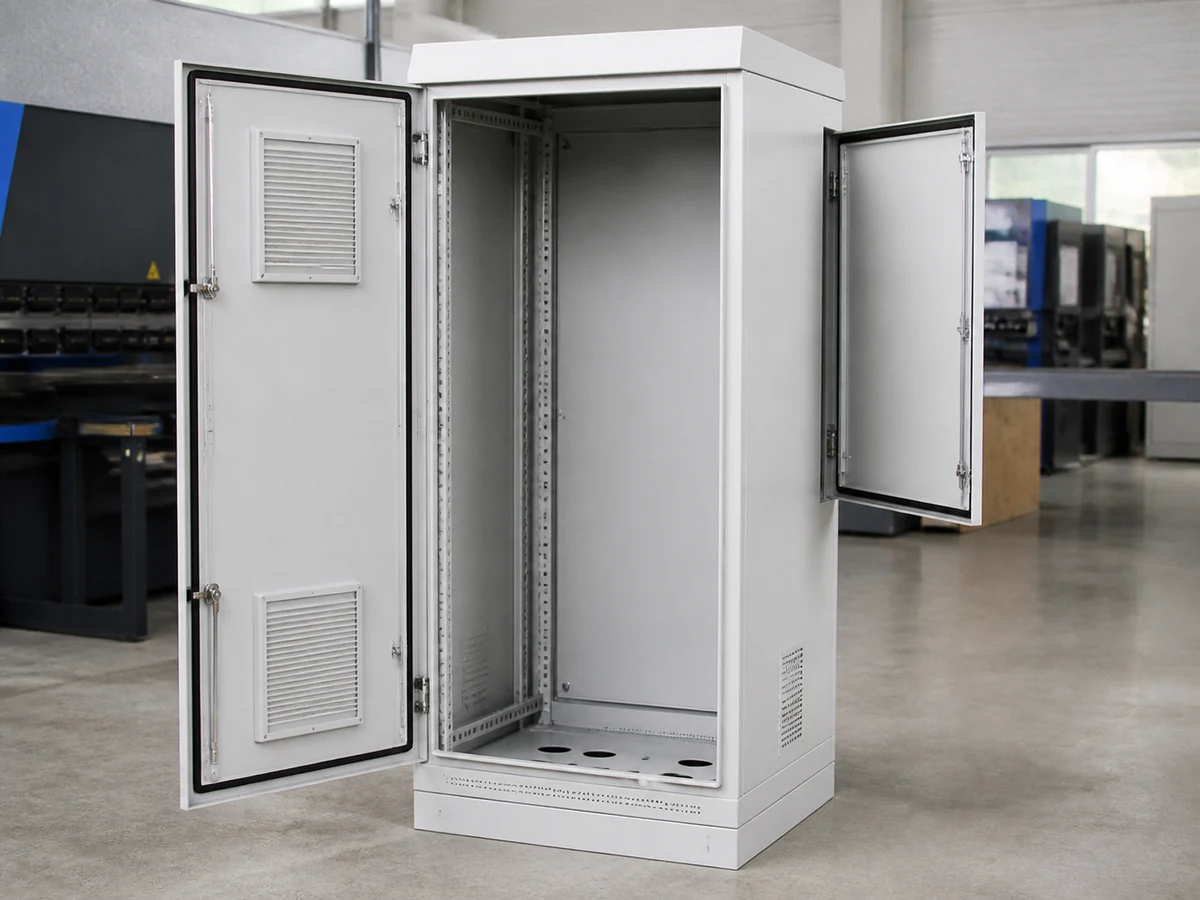
What buyers need to settle before an RFQ
- Pole-mounted: confirm the host owner’s approval, loaded cabinet weight, projected area, bracket interface and service access.
- Pad-mounted: confirm the foundation, anchor pattern, cable route, drainage and maintenance clearance.
- Mechanical scope: MSTFAB makes drawing-defined cabinet shells, panels and brackets. The OEM specifies electrical equipment and final product approval.
- Commercial scope: quantity, finish, inspection, MOQ and lead time are agreed after a drawing review, not from a universal chart.
MSTFAB (Guangzhou Maisituo Sheet Metal Manufacturing Co., Ltd.) supports OEM buyers with build-to-print outdoor telecom cabinet shells. A pole-mounted cabinet and a pad-mounted street cabinet may look similar in a photograph, but the mounting load path, access plan and approval owner are different. The useful first question is not “Which model is standard?” It is “What does this shell have to fit, protect and survive at this site?”
Choose the mounting approach
Pole mounting can avoid a new ground footprint, but the host structure must be approved for the complete installed assembly. Pad mounting needs a foundation and civil interface, yet can make access to a larger cabinet easier. Neither option is automatically cheaper or faster.
| Application | Mounting decision | Buyer input |
|---|---|---|
| Fiber distribution | Pole, wall or pad depending on payload and site access | Equipment envelope, cable route and owner permission |
| Small-cell or edge equipment | Pole or pad depending on total mass, wind area and service method | Installed weight, thermal openings and maintenance clearance |
| Street-side aggregation | Often pad-mounted when the assembly and service space grow | Foundation drawing, anchor pattern and site loading criteria |
Define ratings and evidence before quotation
Terms such as IP, NEMA, IK and GR-487 describe different requirements. A drawing can be designed around a target, but a bare metal shell does not inherit a certified rating just because the target appears in an RFQ. The OEM should identify the edition, test method, responsible test party and acceptance record for its finished assembly.
| Requirement | What the buyer should specify | Evidence to agree |
|---|---|---|
| Water and dust ingress | Target rating, door and gland configuration, gasket details | Sample or assembly test plan, if required |
| Impact and security | Accessible faces, lock type and impact target | Approved hardware and relevant test record |
| Telecom or carrier rules | Exact specification and applicable clauses | Buyer-approved compliance matrix, not a blanket claim |
| Corrosion exposure | Site environment, material and coating system | Finish sample and test scope when specified |
MSTFAB can review the mechanical features that affect these targets: seams, gasket lands, drain paths, door compression, hardware and protected cable entries. Final equipment certification remains with the OEM or the party named in the approved project scope.
Materials and drawing control
Galvanized steel, stainless steel and aluminum can all be sensible choices. The right one depends on exposure, weight, weld design, finish and the buyer’s inspection plan. MSTFAB does not apply one wall thickness or one tolerance to every telecom enclosure.
| Material option | Useful reason to consider it | Drawing decision |
|---|---|---|
| Galvanized steel | Cost-conscious painted shells | Specify cut-edge treatment, weld protection and finish |
| Stainless steel | Corrosion-sensitive or appearance-critical sites | Specify grade, grain direction and weld finish |
| Aluminum | Weight-sensitive assemblies | Check stiffness, joining and galvanic isolation |
Mark critical hole positions, door gaps, gasket lands and mounting datums on the drawing. A first article inspection can then focus on the features that stop installation when they are wrong. General shop capability numbers are not substitutes for a part-specific tolerance agreement.
Design the mounting interface, not just the box
For pole-mounted shells, send the pole material and geometry, permitted fixing method, loaded mass, center of gravity and cable approach. For pad-mounted shells, send the foundation plan, anchor layout, base opening, drainage path and lifting method. A bracket can be fabricated accurately and still be wrong for the site if the host structure was never checked.
- Pole bracket: define clamp or band contact, corrosion isolation, fastener retention and access to torque the hardware.
- Pad base: define anchor datums, cable-entry clearance, splash exposure and how the cabinet will be leveled.
- Assembly check: agree who supplies the mating parts and who signs off the installed structural connection.
Review site loads with the approval owner
There is no universal maximum cabinet weight for a “standard utility pole.” Capacity depends on the pole, existing equipment, attachment height, projected area, local wind and ice criteria, and the host owner’s rules. The engineer of record should set the load cases; MSTFAB can fabricate and inspect the approved bracket and shell geometry.
Finish and corrosion review
Outdoor durability starts with the complete detail, not a coating-hour slogan. The RFQ should identify exposed edges, welds, drainage, dissimilar-metal contact and the finish areas that must remain free of coating for bonding or assembly. Powder coating and other finishing steps may be performed by qualified long-term partners according to the approved scope; they should not be described as automatically in-house.
If the buyer needs a salt-spray result, agree the substrate, pretreatment, coating, specimen preparation, test method and pass criteria before ordering. A published hour count from a different sample does not prove the finished cabinet will pass.

Cable, door and thermal details
Buyers often discover interface problems after the shell has been painted. That is an expensive time to notice that a gland plate blocks a cable bend or a cooling opening conflicts with a stiffener. Review these items together before releasing the flat pattern:
- Removable gland plates, connector clearance and cable bend radius.
- Door swing, latch reach, gasket compression and service access.
- Protective earth and bonding points, including coating-free contact areas.
- Fan, heat-exchanger or vent openings only when the OEM supplies the thermal interface drawing.
MSTFAB’s quoted scope is the mechanical shell and specified metalwork. Cooling units, rectifiers, batteries, wiring and final functional testing belong to the OEM or an explicitly agreed partner scope.
Cost drivers and a useful RFQ package
Cost depends on geometry, material, hardware, finish, inspection and order quantity. A percentage from another cabinet is not a reliable price for yours. Send enough information for a drawing review and ask for assumptions to be stated on the quote.
| Send with the RFQ | Why it matters |
|---|---|
| STEP/STP model and DXF/DWG/PDF drawings with revision | Separates the approved geometry from an old file |
| Material, thickness, finish and cosmetic faces | Sets the fabrication and finishing route |
| Pole or pad interface and site load inputs | Identifies brackets and approval boundaries |
| Prototype and production quantities, destination | Lets MSTFAB quote tooling, packing and schedule for this order |
| Critical dimensions and inspection or test requirements | Defines the first-article and acceptance plan |
After reviewing the files, MSTFAB can confirm manufacturability, exclusions, quotation basis, MOQ if any, and a project-specific lead time. If a requirement is missing, the right answer is a question, not a made-up standard number.
Ready for a drawing review?
Send the latest revision, expected quantity and mounting conditions. MSTFAB will confirm the mechanical scope before quoting.
Upload Drawings for ReviewBuyer questions
How much weight can a pole-mounted cabinet carry?
There is no site-independent limit. The pole owner and engineer of record must approve the installed cabinet, bracket and load cases. Send that approval basis with the RFQ.
Is pole mounting always cheaper than pad mounting?
No. Compare the bracket and installation work with foundation, access, cable routing and maintenance costs for the actual site. The least expensive shell is not always the least expensive installed system.
Does a shell automatically meet IP, NEMA or carrier requirements?
No. The OEM must specify the target and acceptance evidence. Mechanical details can be designed and inspected against that plan, but a finished equipment rating needs the relevant assembly validation.
What are the MOQ and lead time?
They depend on the drawing, process route, finish, inspection scope and quantity. Send the current files and volume so MSTFAB can confirm them for your project.
Can MSTFAB ship a complete powered telecom cabinet?
The normal scope is a drawing-defined empty cabinet shell and specified mechanical parts. Electronics, batteries, wiring and final equipment certification are buyer-controlled unless a separate approved scope says otherwise.
MSTFAB manufactures custom sheet metal enclosures, electrical cabinets, control boxes and industrial metal housings for OEM buyers.
 WeChat Contact
 WhatsApp Me Directly