
The Short Answer
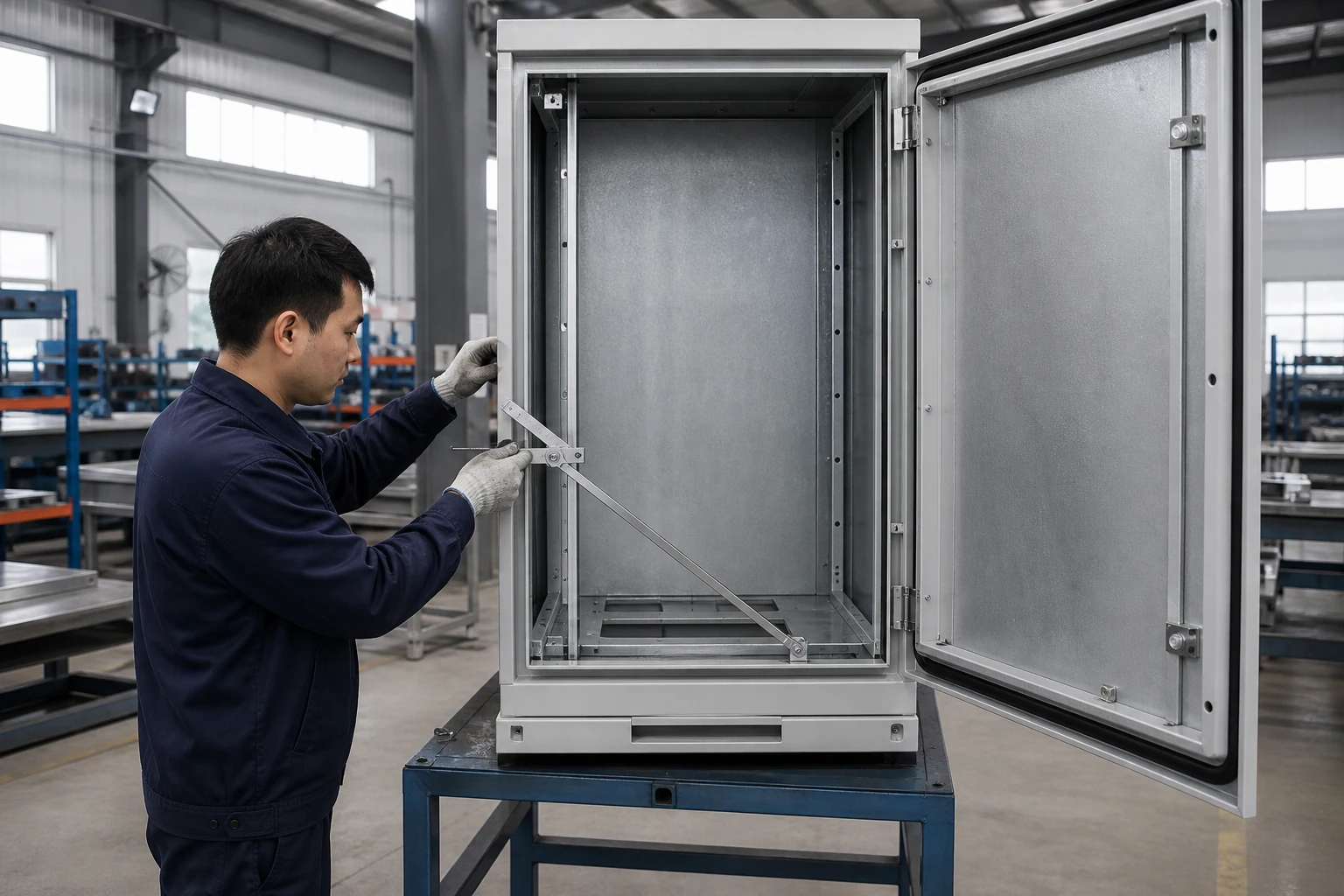
Outdoor telecom enclosure door stay DFM ensures that an open cabinet access door can withstand sudden field wind gusts without tearing out thin sheet metal door skins, buckling hinges or slamming onto a technician’s hands. Because a door stay attaches near the hinge quarter-span, aerodynamic wind pressure on the door face multiplies reaction forces by 3x to 4x—requiring internal door doubler plates, reinforced cabinet sill brackets, positive mechanical lock detents at 95°–120° and sealed hardware penetrations outside the perimeter gasket line.
Explore this guide
01 / Wind-Gust Lever Mechanics
Calculate the 3x–4x mechanical lever amplification at the door-stay pivot.
When a field technician opens an outdoor 5G cabinet, roadside ITS controller or battery backup enclosure on a rooftop or highway corridor, the open door acts as a flat aerodynamic sail. Even a moderate 60 to 100 mph wind gust (referenced in outdoor telecom benchmarks such as Telcordia GR-487) applies significant drag force at the geometric center of the door panel.
To keep the front access opening clear for 19-inch rack maintenance, the door stay must anchor to the cabinet sill and door bottom flange at only 25% to 35% of the door width from the hinge axis. That short moment arm acts as a class-3 / class-1 lever that magnifies axial tension, compression buckling load and shear on the sheet metal mounting studs by 300% to 400%.
Opening Gust Over-Travel (Tension)
Wind catching the inside of the door pulls the stay arm in tension; without a positive end stop and reinforced hinge leaf, the door wraps backward against the cabinet wall.
Closing Gust Slam (Compression)
Wind pushing the back of the door drives the stay arm into Euler column compression; unlatched or thin bar links buckle and slam the door onto the technician.
Torsional Door Twist
A single bottom-mounted door stay resists wind at the lower edge while the top corner deflects, requiring a rigid box-formed door return flange or hat stiffener.
Never rely on gas springs alone for wind restraint: pressurized nitrogen dampers assist smooth opening on heavy doors, but cold-weather seal wear and gust over-pressure require a solid mechanical stop bar or detent track.
02 / Door-Stay Hardware Topologies
Select sliding detent tracks, folding scissor arms or drop-pin rods for your cabinet.
Different outdoor telecom and utility cabinets demand different door-stay kinematics depending on door mass, opening angle (typically 95°, 105° or 120°) and bottom sill space.
- Slotted sliding track with detent catch: a heavy-gauge 304/316L stainless steel slotted channel mounted inside the bottom or top door flange guides a clevis pin into a notched locking pocket at full open; compact, ice-tolerant and self-engaging.
- Folding two-bar scissor stay: pivoting stainless link bars fold flat when closed and snap over-center or into a thumb-release notch when opened; high axial column strength for wide doors but requires anti-pinch clearance.
- Pivoting wind-stop rod & drop socket: a solid 8 to 10 mm stainless steel rod stored in a door clip that drops manually into a reinforced cabinet sill receiver hole; virtually indestructible under extreme coastal wind buffeting.
Coordinate door-stay mounting geometry with perimeter rain gutters and gasket lands in our enclosure door sealing and gutter DFM guide.
03 / Sheet Metal Doubler Plates and Sill Brackets
Reinforce thin door skins with welded doubler plates and structural hat stiffeners.
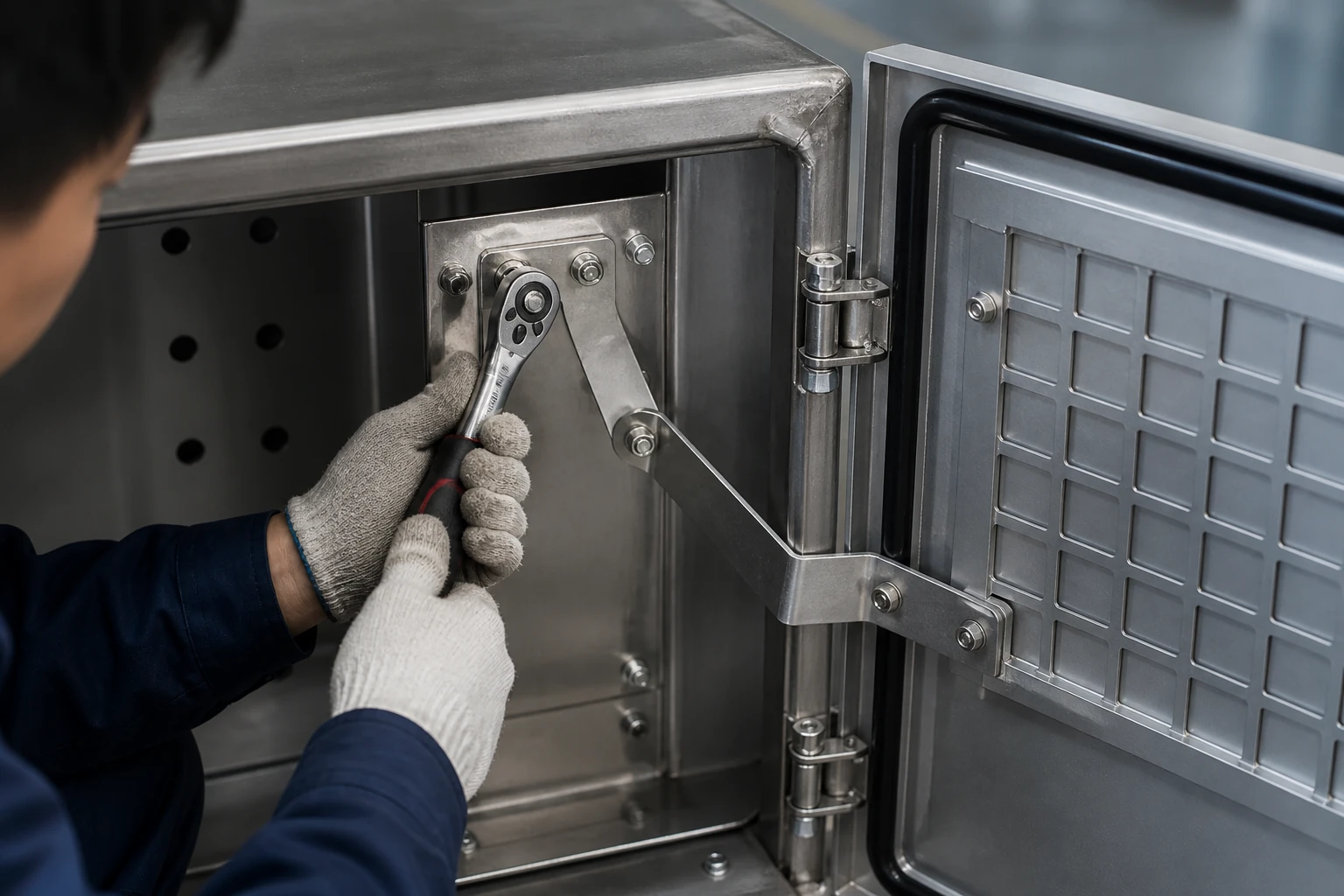
The #1 field failure of outdoor enclosure door stays is not the stainless steel bar breaking—it is two M5 or M6 self-clinching studs ripping straight out of a 1.5 mm aluminum or carbon steel door return flange during a sudden wind gust.
- Weld or structural-bond a 2.5 to 3.0 mm internal doubler backing plate inside the bottom door return flange—or anchor the door stay directly into the door’s internal vertical/horizontal hat-channel stiffener frame.
- Form the cabinet-side mounting bracket from 3.0 to 4.0 mm stainless steel with return flanges welded to the bottom sill rail so shear loads transfer into the main chassis floor rather than flexing the door gutter lip.
- Maintain at least 6 to 8 mm of vertical clearance between the folded door-stay arms and the cabinet bottom sill to prevent powder-coat scraping when the door closes.
See how cabinet frame stiffness and rear mounting coplanarity work together in our wall-mounted telecom enclosure rear clearance DFM guide.
Review outdoor corrosion pretreatment and powder coat specs →
04 / Anti-Pinch Ergonomics and Ice/Sand Drainage
Design single-hand gloved release geometry and self-clearing track slots.
Field technicians servicing telecom cabinets in winter sleet or desert windstorms wear thick insulated or arc-rated gloves. If disengaging the door stay requires two hands or places fingers inside a scissoring hinge trap while the wind pushes on the door, pinch injuries are inevitable.
- Gloved pull-ring or lift-tab release: specify an oversized pull ring, spring-loaded plunger or upward lift tab located away from the folding knuckle so a technician can hold the door handle with one hand and release the catch safely with the other.
- Ice and sand self-cleaning slots: avoid closed-bottom guide channels that pack with wind-blown desert sand or freezing rain; use open-bottom slotted tracks and nylon/PTFE shoulder washers that shear through frost buildup.
- Marine galvanic compatibility: pair 316L passivated stainless steel door stays with isolating nylon bushings when mounting onto 5052-H32 aluminum telecom doors to prevent bimetallic seizing in salt-fog environments.
Check how roof overhangs and drip shields protect upper door hardware in our enclosure drip protection DFM guide.
05 / Engineering Verification Matrix
Verify opening stop angles, folded stack height and anchor weld strength at FAI.
Use this DFM verification matrix to confirm that outdoor telecom door stays operate smoothly without interfering with gaskets, cables or pull-out equipment trays.
06 / Kinematic CAD Check and First Article Trial
Simulate the closed-to-open swing arc before cutting sheet metal.
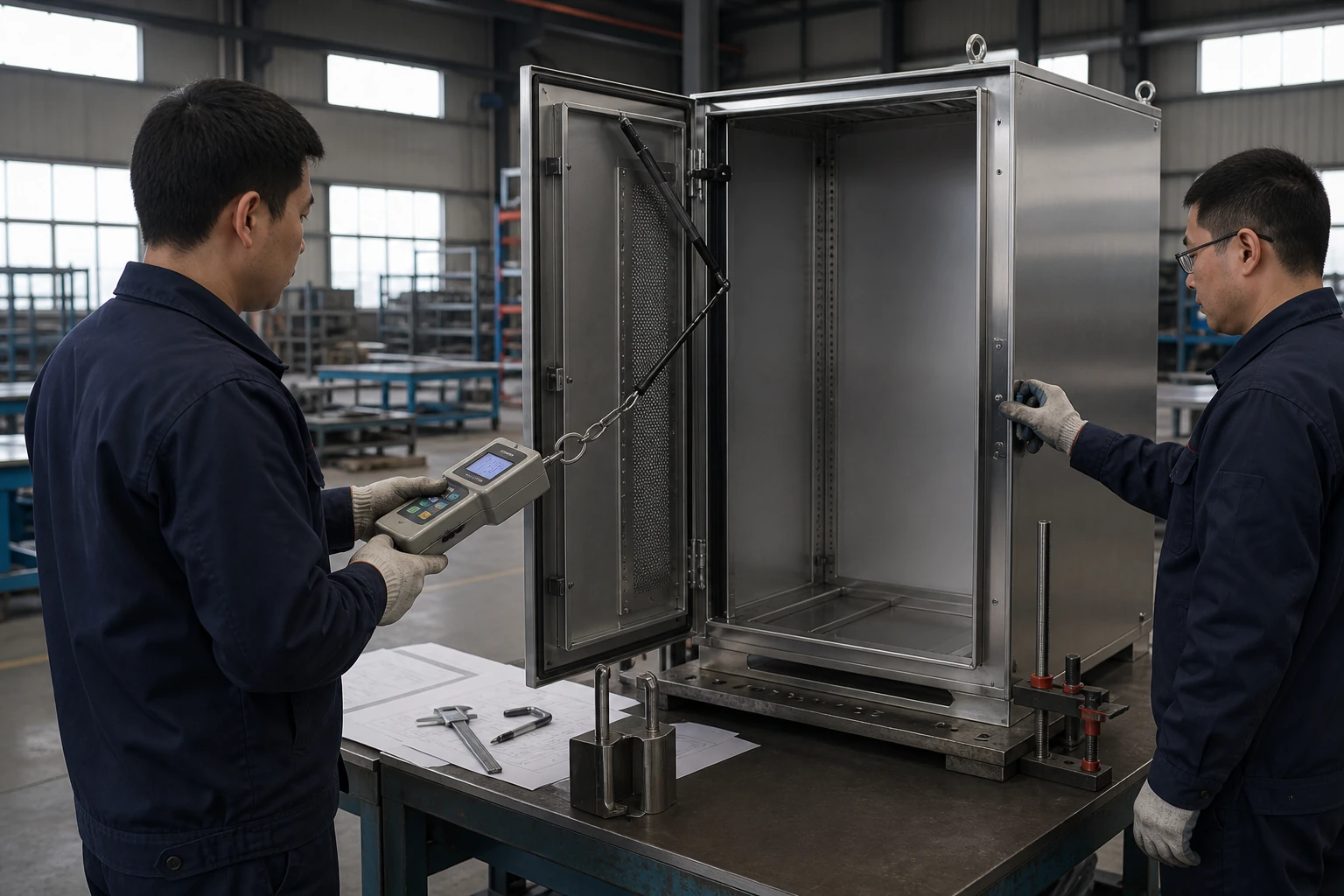
Moving a door-stay pivot hole by just 8 mm toward or away from the hinge centerline can change the full-open angle by 12 to 15 degrees—or cause the sliding track end to bottom out before the door closes completely. During pre-production DFM review, our engineers verify the four-bar pivot geometry in 3D CAD across both the 0° closed state and the 105°–120° locked state.
On the first-article enclosure shell, we assemble the production hinges, perimeter gasket, multi-point latch and door stay to verify that the stay locks automatically at full swing without springing the hinges or rubbing the powder-coated sill.
We also confirm that dual-door cabinets or cabinets with internal swing-out 19-inch frames have coordinated stay positions that never collide with battery shelves or bottom cable glands.
Explore MSTFAB first-article assembly and inspection standards →
07 / Transit Restraint and Scope Boundary
Keep doors latched and stays rattle-free during international shipping.
During ocean or truck transit, an unlatched door or loose metal stay arm can vibrate repeatedly against the cabinet sill and wear through powder coating. We engage the primary multi-point compression latches, add removable foam shipping blocks under the door bottom flange and secure stay pivots before crating.
All wooden pallets and crates comply with IPPC ISPM 15 international export packaging regulations and include corner protection and moisture-barrier wrapping.
Manufacturing scope: MSTFAB operates under an ISO 9001 quality management system and fabricates custom build-to-print sheet metal telecom enclosure shells, reinforced doors, doubler plates and mechanical hardware assemblies. Final field wind-load certification, active telecom electronics integration and site safety compliance remain the responsibility of the OEM.
08 / Ready-to-Review RFQ Package
Include eight mechanical inputs when specifying outdoor enclosure door stays.
- 3D STEP assembly modelComplete cabinet shell, door panel, hinges, internal stiffeners and door-stay mounting points.
- 2D PDF drawingsPivot hole datum dimensions from the hinge axis, required opening angle (e.g., 105° ±3°) and weld callouts.
- Door weight & mounted gearSpecify whether the door is an empty skin or carries a heavy door-mounted heat exchanger / HVAC unit.
- Stay hardware preferenceSliding slotted detent track, folding scissor stay, solid drop-rod or approved vendor part number.
- Reinforcement architectureDoor doubler plate thickness, hat-channel tie-in and cabinet sill bracket gauge.
- Gasket & sill envelopeAvailable dry vertical space between the bottom door return flange and the cabinet gutter/sill.
- Material & marine grade304 vs. 316L stainless steel stay hardware and nylon/PTFE isolating washer requirements.
- FAI & batch volumePrototype sample quantity, kinematic trial-fit requirements and production delivery schedule.
Reinforcing door-stay pivot zones and validating the kinematic swing envelope in CAD eliminates field wind damage and keeps outdoor maintenance safe.
Outdoor telecom enclosure door stay questions from hardware engineers
What opening angle should an outdoor telecom enclosure door stay provide?
Most outdoor 19-inch rack and battery cabinets specify a positive locking angle between 100° and 120°. Opening past 95° ensures that slide-out rack equipment, battery trays and splice drawers can be pulled straight out without hitting the inner door flange or gasket.
Why do door-stay mounting studs sometimes tear out of sheet metal doors in high winds?
Because the door stay mounts only 25% to 35% of the way across the door width from the hinge, wind gusts pushing on the door face create a 3x to 4x lever amplification at the stay pivot. Adding a 2.5–3.0 mm welded doubler plate or tying into an internal hat stiffener prevents sheet metal tear-out.
Can we mount a door stay at the top of the door instead of the bottom sill?
Yes. Top-mounted sliding track stays keep the bottom cable entry zone and battery sill completely unobstructed. However, on tall cabinets (over 1,600 mm), verify that a short technician can still comfortably reach the release catch—or specify a bottom stay.
Are gas struts suitable as the primary wind stop on an outdoor telecom door?
Standard gas struts lose pressure over years of outdoor thermal cycling and can compress or fail if a strong wind gust slams the door. If gas struts are used to assist opening a heavy HVAC door, always pair them with a positive mechanical locking catch or safety stop bar.
How do we prevent the door stay from compromising an IP66 / NEMA 4X enclosure seal?
Mount the cabinet-side bracket inside the perimeter gasket line or on an extended dry sill flange outside the gasket track, and use blind weld studs on the door return flange so no through-bolted holes penetrate the wet exterior skin.
Does MSTFAB supply and install the stainless steel door stay hardware on custom shells?
Yes. Under our ISO 9001 quality system, MSTFAB fabricates the reinforced cabinet shell and door, welds all doubler plates and sill brackets, and installs specified 304/316L stainless steel door stays, hinges and latches for complete trial-fit verification.
Technical references
These industry references provide background on outdoor enclosure wind and environmental performance, machinery ergonomics and sheet metal tolerances.
Send your outdoor telecom enclosure drawings for a door-stay DFM review.
Share your 3D STEP cabinet assembly, door load and hardware specs. MSTFAB will verify swing kinematics, doubler reinforcement and production manufacturability.
Request a Telecom Enclosure DFM Quote →
Have a question first? caroline@mstfab.com
 WeChat Contact
 WhatsApp Me Directly