
Direct Answer: Specifying Small Wall-Mounted Stainless & Carbon Steel Sheet Metal Boxes
Custom small wall-mounted sheet metal boxes (150 × 150 × 80 mm to 600 × 400 × 250 mm) are fabricated from 1.2–2.0 mm SPCC carbon steel or 304/316L stainless steel using CNC laser blanking, 90° press brake rain-gutter returns, and continuous TIG corner seams to achieve NEMA 4/4X and IP65/IP66 protection at ISO 2768-m (±0.15 mm) tolerances.
- Material Cost vs. Environment: Specify 1.5 mm powder-coated SPCC/SGCC for indoor NEMA 12/3R use, or 1.5 mm 304/316L stainless steel for washdown NEMA 4X sites.
- Wall-Mount Lug DFM: Use external welded 3.0 mm mounting ears or sealed rear keyhole bosses with EPDM washers so mounting bolts never breach the IP65 gasket perimeter.
- Internal Sub-Plate & Grounding: Include a removable 2.0 mm galvanized sub-plate on M6 PEM standoffs and a masked M6 door-to-body copper ground stud (<0.1 Ω).
OEM sourcing guide
A small wall-mounted metal box is easy to underestimate. The sheet area may be small; the door gap, cable entry and mounting holes still have to meet the equipment around them. A cheap quote stops looking cheap when the installer reaches for a drill.
MSTFAB (Guangzhou Maisituo Sheet Metal Manufacturing Co., Ltd.) fabricates drawing-defined empty wall-mounted sheet metal boxes and mechanical parts. The scope can include the body, door, mounting plate, brackets, specified hardware, finish and packing. Electrical devices, wiring, energized testing and finished-equipment certification belong to the buyer or its integrator unless a separate approved scope states otherwise. A powder-coated finish may be coordinated through long-term partners when included in the quotation.
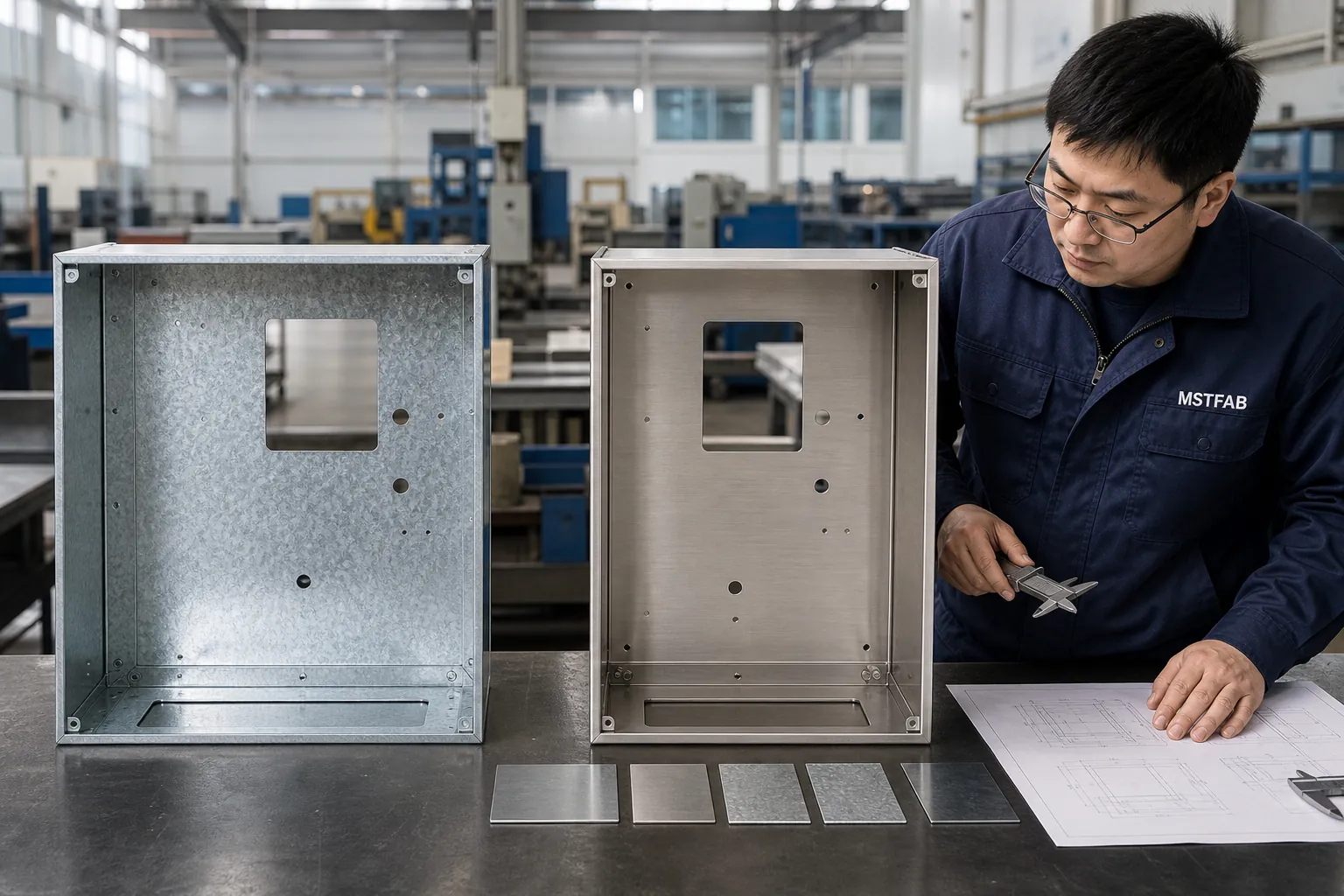
Choose the material from the installation conditions
Ask where the box will be mounted, what reaches its surface and how it will be cleaned. Then specify the sheet grade and finish. “Stainless” and “steel” are starting points, not complete procurement specifications.
| Candidate | Useful starting point | What the buyer should confirm |
|---|---|---|
| Galvanized steel with a specified finish | Cost-sensitive housings where the coating system and exposure are suitable | Base material, zinc surface, coating route, cut-edge protection, color, masking and cosmetic acceptance |
| 304 stainless steel | A stainless option where the actual environment and cleaning chemistry support it | Grade evidence, surface finish, weld cleanup, water traps and contact with other metals |
| 316L stainless steel | A candidate when chloride exposure or the buyer’s corrosion specification calls for greater resistance | The measured or expected exposure, cleaning agents, grade evidence and any project test requirement |
Neither a distance from the coast nor a material name guarantees a service life. Where corrosion performance matters, the buyer should define the environment and acceptance evidence. The quotation can then identify the proposed material and finishing route instead of promising a universal number of salt-spray hours.
Four small-box failures worth preventing early
- Door fit is left to chance. Agree the hinge position, latch pull, door opening clearance and finished closing gap. Coating thickness and welded corner distortion can change a fit that looked fine in the flat pattern.
- The sealing boundary is incomplete. Define the gasket path, gland plate, cable entries, fasteners and any drain or vent. An ingress target applies to a defined assembled configuration and its validation plan; an empty shell does not acquire an IP rating by having a gasket in a photograph.
- Mounting features miss the mating equipment. Send wall-fixing points, backplate or DIN-rail positions, service clearances and the mating part envelope. A drawing without installation datums leaves too much room for interpretation.
- The finish survives production but not shipping. Identify visible faces, protected edges and the packing route. Specify how doors, loose plates and hardware will be separated so that a satisfactory first article does not arrive scratched.
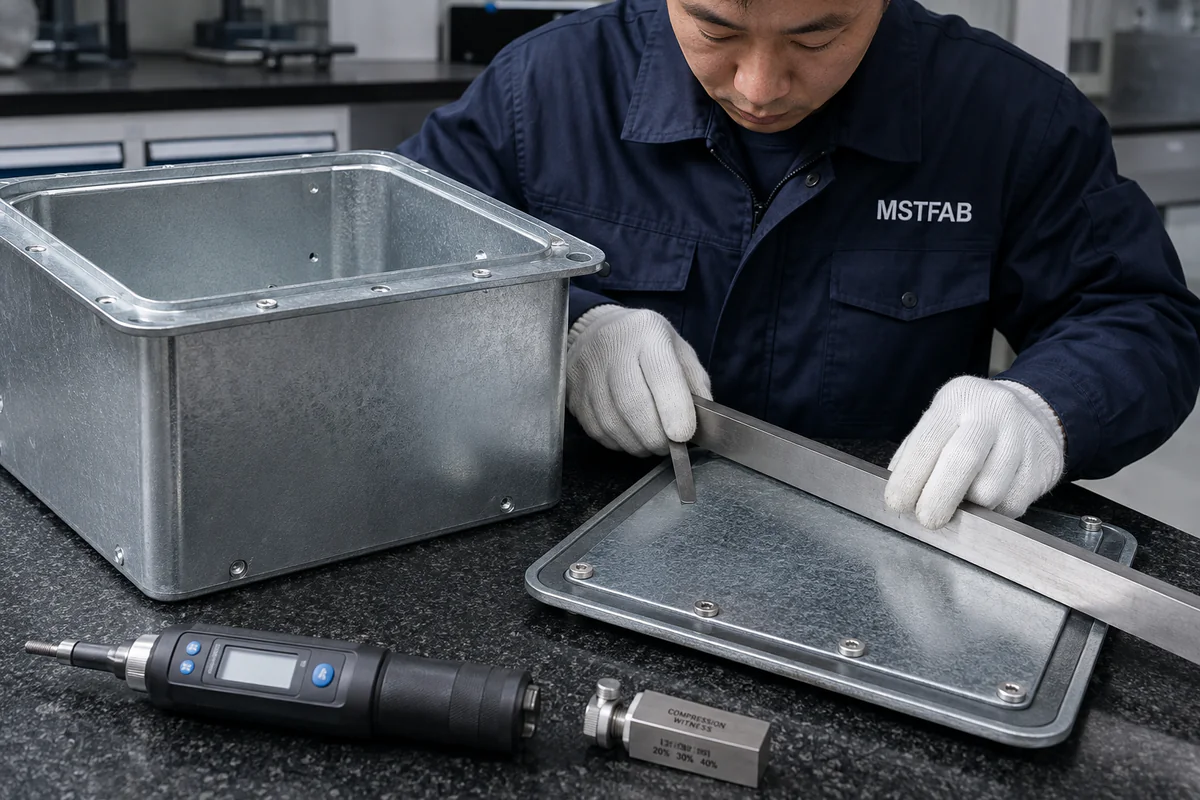
Make the quotation comparable
Send a STEP or STP model when available, plus the controlled DXF, DWG or PDF drawings that identify dimensions and revisions. Add the material grade and thickness, finish, prototype and production quantities, installation environment, destination, and any buyer-supplied hinges, latches, gaskets or glands. Mark the surfaces that people will see and the dimensions that would stop assembly if they moved.
Ask each supplier to return the same scope split. That makes a low piece price easier to understand: perhaps coating, a mounting plate, a gasket or protective packing has simply been left out.
| Scope item | Question to put on the RFQ | Evidence to agree before release |
|---|---|---|
| Mechanical shell | Which body, door, bracket and plate revisions are included? | Approved drawings and critical fit dimensions |
| Hardware and sealing | Who supplies hinges, latches, gasket and cable-entry parts? | Part numbers, assembly condition and inspection plan |
| Finish | What is the specified finish and who performs it? | Finish specification, partner route when applicable, masking and acceptance criteria |
| Electrical integration | Is the quote for an empty shell or a wired device? | A clear buyer/integrator responsibility boundary |
| Inspection and packing | Which first-article checks and export protection are required? | Agreed report features, packing method and release point |
Prototype, pilot and production are different decisions
A prototype may expose a door-swing problem or an inaccessible gland nut. A pilot batch tests whether the approved geometry and finish can be repeated. Production adds revision control, inspection frequency and packing consistency. Ask for the price and schedule at each intended quantity, including any setup or tooling charge. There is no honest site-wide MOQ or lead time for every material, finish and box design.
For a first article, prioritize the features that block installation: body and door fit, wall-mount hole locations, gasket land, cable-entry openings, hardware engagement, visible finish and drawing revision. If a water-ingress or corrosion test is required, define the test configuration, responsible party and acceptance criteria in the purchase documents. A photograph is not a test report.
Questions to ask before choosing a supplier
- Which operations are included in the quoted route, and which finishing steps use a partner?
- What drawing information is still missing for the door, gasket and wall-mount interfaces?
- Which dimensions will be checked on the first article, and who approves the result?
- How will a material, hardware or finish change be documented after approval?
- How will the quoted packing protect the specific surface finish on the way to our site?
For the commercial fabrication scope, see MSTFAB’s custom metal enclosure fabrication page. This guide is for comparing a small wall-box RFQ, not for treating every application as the same product.
Buyer questions
Does MSTFAB have one minimum order quantity for all small boxes?
No. Feasibility and price depend on the drawing, material, hardware, finish, inspection work and quantity. Include both the trial quantity and forecast volume in the RFQ so the quote can separate setup from repeat production.
Is 316L always required near the sea?
No fixed distance rule substitutes for the actual exposure and buyer specification. Chlorides can make 316L worth considering, but grade selection should also account for cleaning, crevices, welded details and the required evidence.
Can an empty wall box be quoted as IP65 or IP66?
A target may be included in the drawing package, but it must be tied to a defined shell, gasket, closure, entries and validation method. Do not infer a tested rating from a bare housing or an illustrative image.
Can we request a quote with only a PDF drawing?
A dimensioned PDF can start the review. STEP/STP and controlled DXF/DWG files help clarify complex bends, assemblies and openings. MSTFAB can flag missing details before the quotation is finalized.
Send the wall-box drawing package
Share the revision, material, installation conditions, quantities and critical interfaces. MSTFAB can review the mechanical scope and return the open questions before pricing.
 WeChat Contact
 WhatsApp Me Directly