
OEM laser cutting services for metal parts sound simple on paper. Send a drawing, receive parts, everyone smiles. That is the brochure version. In real industrial procurement, buyers care about a few less glamorous things: whether the holes line up, whether the edge is safe, whether the same part looks the same in batch two, and whether the supplier answers before the deadline becomes a personality test.
Manufacturers love talking about innovation. But what they really love is this: metal parts that arrive on time and actually fit. When a production line stops because a bracket is 0.5 mm off, nobody says, “At least we saved three cents.” Usually there are urgent calls, delayed schedules and one engineer staring at a drawing like it personally betrayed him.
What Are OEM Laser Cutting Services for Metal Parts?
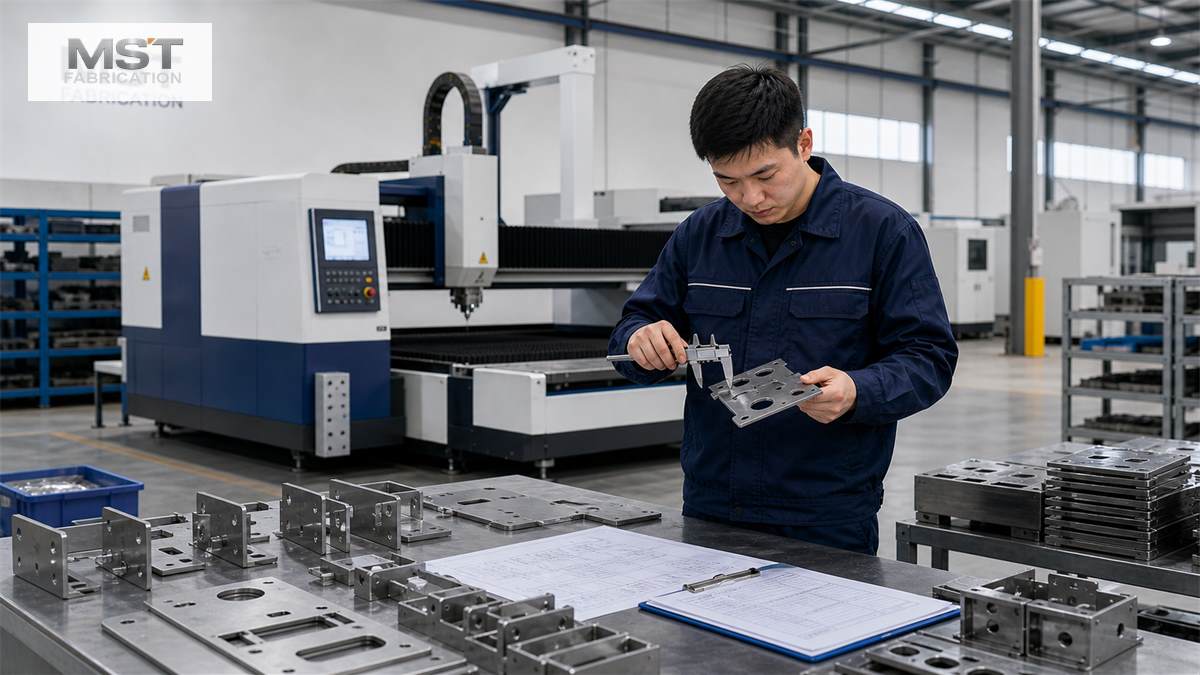
OEM laser cutting services produce custom metal parts based on the buyer’s drawings, specifications and production requirements. A professional supplier uses CNC-controlled fiber laser machines to cut sheet metal into brackets, panels, mounting plates, chassis parts, equipment covers, enclosure components and industrial assemblies.
You can review MSTFAB’s core capability here: Laser Cutting Services. This article focuses on the procurement side: what industrial buyers should check before a quote turns into a purchase order.
What Industrial Buyers Really Care About
Most buyers are not impressed by vague promises like “best quality” or “very competitive price.” They need parts that work in the real product, under real assembly conditions, with real delivery dates. That means the supplier must control more than the cutting path.
- Dimensional accuracy: Critical holes, slots and mating surfaces must match the drawing.
- Repeatability: Prototype quality should not disappear during batch production.
- Edge quality: Burrs, sharp corners and heat marks can affect safety and finishing.
- Material consistency: Stainless steel, aluminum and carbon steel are not interchangeable just because they are all shiny on a busy afternoon.
- Lead time honesty: A realistic delivery schedule beats a heroic promise that collapses later.
The Quote Must Include the Whole Job
A low quote can look wonderful until you realize it only covers cutting. Many OEM metal parts also need deburring, bending, welding, surface treatment, inspection, protective film, packaging and export handling. If those items are missing, the price may be cheap because the job is incomplete.
Before comparing suppliers, ask what is included. Is the quote for laser cutting only? Does it include CNC bending? Does the supplier check hole-to-bend distance? Can they support sheet metal bending, welding and assembly if the part becomes more complex? Buying only the first step can be fine, but only if you know it is only the first step.
Tolerance: Small Numbers, Large Consequences
Laser cutting is accurate, but tolerance still needs discussion. A hole that is decorative has a different risk level from a hole that locates an assembly pin. A slot hidden inside a cover is different from a visible front panel opening. Professional buyers should mark critical dimensions and explain the part’s function.
This is where an experienced supplier can help with DFM review. They may suggest changing a radius, adjusting a slot, improving nesting, or moving a feature away from a bend line. It is much easier to correct a drawing than to correct 3,000 parts that already look guilty in a carton.
Material Choice Changes the Result
OEM metal parts may use stainless steel, aluminum, carbon steel, galvanized steel or other materials. Each material behaves differently during cutting, bending, welding and finishing. Stainless steel may need surface protection. Aluminum may require attention to scratches and distortion. Carbon steel may need coating for corrosion resistance.
Buyers should confirm grade, thickness, surface condition and finishing requirements before production. For visible or outdoor parts, discuss surface treatment early. A part that is dimensionally correct but cosmetically poor can still create customer complaints, which are not usually listed as a desired deliverable.
Prototype Success Is Not Enough
One perfect sample is helpful. Ten thousand consistent parts are better. OEM buyers should ask how the supplier controls repeat production: nesting files, machine setup, inspection frequency, operator notes, packaging method and revision control.
- Confirm how drawing revisions are managed.
- Ask whether first article inspection is available.
- Define which dimensions are checked during production.
- Ask for batch photos or inspection reports when the project is critical.
- Make sure part protection is suitable for international shipping.
Industries That Use OEM Laser-Cut Metal Parts
OEM laser cutting supports many industrial markets, including machinery, electronics, electrical cabinets, automotive components, agricultural equipment, construction hardware, energy systems and custom enclosures. The common requirement is not just a shape. It is a part that supports the next production step without drama.
If your project also involves enclosures, housings or precision sheet metal assemblies, MSTFAB’s broader custom sheet metal cutting and bending guide may be useful.
How to Evaluate an OEM Laser Cutting Supplier
- Do they understand your drawing, material and end-use application?
- Can they provide DFM feedback before cutting?
- Do they support cutting, bending, welding, finishing and assembly under one workflow?
- Can they inspect critical dimensions and provide reports when required?
- Do they have export packaging experience for overseas buyers?
- Do they communicate clearly when a drawing has risk instead of simply saying yes to everything?
You can review MSTFAB’s real workshop environment on the Factory Photos page. For overseas buyers, that visibility matters. A supplier should be more than a nice email signature and a low number in a spreadsheet.
Final Thoughts
OEM laser cutting services for metal parts are valuable because they combine precision, speed, repeatability and design flexibility. But the real value comes from process control: correct materials, defined tolerances, clean edges, complete finishing, clear inspection and reliable delivery.
The cheapest cut is not always the lowest-cost part. The best supplier helps you avoid rework, assembly delays, warranty issues and those quiet meetings where everyone looks at the same wrong bracket.
Need OEM laser-cut metal parts?
MSTFAB can review your drawings, materials, tolerances and finishing requirements, then support laser cutting, bending, welding, surface treatment, inspection and export packaging.
MSTFAB provides precision sheet metal laser cutting services for OEM panels, brackets, enclosures and custom metal parts.
 WeChat Contact
 WhatsApp Me Directly