
⚡ Direct Answer: What Essential Clauses Must an Overseas Sheet Metal NDA Include?
An overseas manufacturing Non-Disclosure Agreement (NDA) must be structured as a China-Enforceable NNN Agreement (Non-Disclosure, Non-Use, Non-Circumvention) governed by Chinese law and the jurisdiction of Chinese courts or recognized regional arbitration bodies (e.g., CIETAC / HKIAC). A legally airtight checklist mandates 5 core provisions: 1) Bilingual Contract Execution: Executing Chinese-English parallel text with the Chinese version taking legal precedence in local court; 2) Clear Definition of “Golden Parts” & Tooling as Confidential Information: Explicitly protecting physical stamped prototypes, CNC nesting DXFs, and press brake punch/die setups alongside digital CAD drawings; 3) Pre-Agreed Liquidated Damages Clause: Setting fixed contractual damages (typically 150,000 to300,000 per confirmed breach) to bypass difficult burden-of-proof hurdles for lost profits; 4) Mandatory Sub-Tier Flow-Down: Binding external subcontractors (powder coaters, platers, heat treaters) to the exact same confidentiality covenants; and 5) Corporate Red Seal (Gongzhang) Verification: Ensuring the agreement is stamped with the manufacturer’s official round corporate seal, not merely signed by an unauthorized sales rep.
Handing an overseas fabricator your 3D CAD files under a generic US domestic NDA provides virtually zero practical protection. If an overseas workshop clones your sheet metal chassis or sells parts directly to your end-customers, US court judgments cannot be directly executed in mainland China. Structuring a localized, enforceable NNN contract establishes true legal deterrence.

The 6-Point Overseas Sheet Metal NNN Pre-Flight Checklist
Before sending proprietary CAD drawings or RFQ packages overseas, verify that your agreement satisfies every point in this legal audit table:
| Checklist Item | Standard Western Flaw | China-Enforceable Requirement (MSTFAB Standard) | Legal Protection Achieved |
|---|---|---|---|
| 1. Governing Law & Venue | Governed by US / UK state laws; US court jurisdiction | Governed by the laws of the PRC; jurisdiction in local People’s Court where factory is registered or CIETAC arbitration | Allows immediate freezing of supplier bank accounts upon evidence of breach. |
| 2. Non-Use Restriction | Restricts disclosing data to third parties only | Explicit covenant prohibiting the factory from using your CAD designs to manufacture competing products for their own account | Stops factory from selling your custom enclosure under a white-label brand. |
| 3. Non-Circumvention | Silent on customer circumvention | Strict prohibition against contacting, quoting, or supplying your downstream distributors, OEM partners, or end-users | Protects your commercial customer relationships from direct factory poaching. |
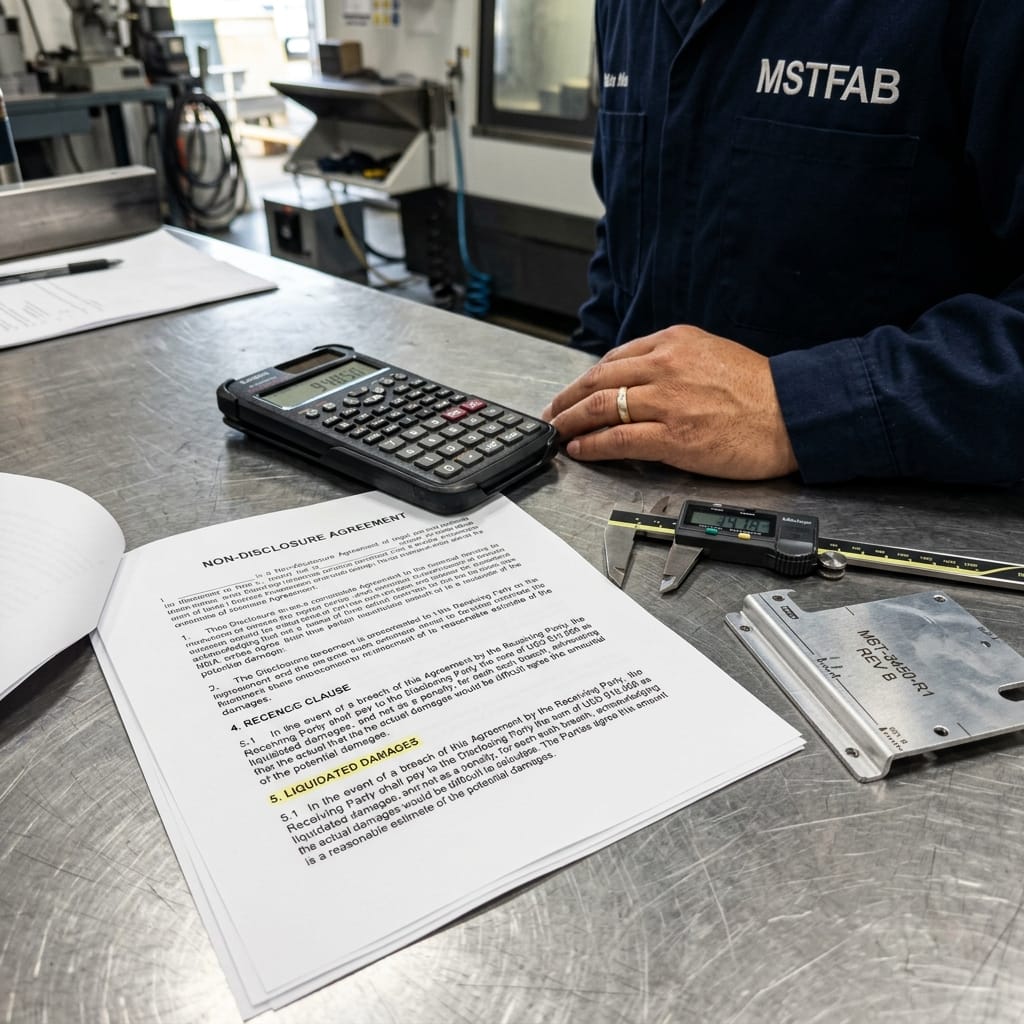
| 4. Liquidated Damages | Requires proving actual lost profits in court (almost impossible) | Pre-agreed liquidated damages sum (e.g., 150,000 to500,000) triggered upon proof of unauthorized manufacture or data leak | Creates immediate, calculable financial threat that deters unauthorized use. |
| 5. Physical Asset Scope | Covers “written and digital confidential information” | Explicitly encompasses physical prototypes, golden samples, press brake tools, stamping dies, check fixtures, and NC cutting files | Prevents reverse-engineering from physical parts or stolen stamping dies. |
| 6. Corporate Execution Seal | Signed by an English-speaking sales representative | Affixed with the company’s official registered red corporate seal (Gongzhang) and signed by the legal representative (Faren Daibiao) | Eliminates the “rogue employee” defense that the signature was unauthorized. |

Why Liquidated Damages Are Mandatory in China
Under the PRC Civil Code, a plaintiff claiming breach of contract must prove actual economic loss with rigorous documentary evidence. In intellectual property theft, proving exactly how much revenue you lost because a Chinese factory leaked a CAD file is notoriously difficult, time-consuming, and expensive.
By contrast, Chinese courts fully recognize and enforce reasonable Liquidated Damages (Weiyuejin) clauses. If you catch a factory producing parts outside your purchase order, you only need to prove the unauthorized production occurred—the court will award the pre-agreed contractual damages sum without requiring complex forensic accounting of lost sales.



Secure Scalable Confidential Overseas Sheet Metal Fabrication Sourcing With MSTFAB
MSTFAB operates high-capacity automated fiber laser towers, robotic press brakes, and in-house powder coating lines backed by China-enforceable NNN IP security and reserved capacity agreements. Accelerate your production with zero downtime.
Frequently Asked Questions (FAQ)
Can an NDA be signed via electronic signature (e.g. DocuSign) for Chinese enforcement?
While electronic signatures are gaining acceptance, Chinese courts still heavily prioritize physical, wet-ink signatures accompanied by the official red corporate seal (Gongzhang) registered with the local State Administration for Market Regulation (SAMR). For maximum legal security, MSTFAB always executes hard-copy agreements sealed with our registered corporate stamp.
What is the recommended liquidated damages amount for custom sheet metal parts?
Under PRC contract practice, a liquidated damages figure of 100,000 to250,000 (RMB 700,000 to 1,800,000) is standard. Setting the number too high (e.g. $50,000,000) invites the judge to strike it down as an unenforceable penalty, while setting it too low provides insufficient deterrence.
How does MSTFAB demonstrate adherence to client confidentiality?
MSTFAB signs enforceable bilingual Chinese-English NNN agreements, operates an air-gapped CAM programming network, shreds all physical engineering scrap blanks, and guarantees that client CAD data is never disclosed, reused, or shared with third parties.
 WeChat Contact
 WhatsApp Me Directly