
Metal fabrication services can look very similar on a supplier website. Everyone has machines, everyone promises precision, and somehow every quote is “best price.” Then the parts arrive, the holes do not line up, and suddenly the cheapest supplier has a very expensive personality.
If you are an overseas OEM equipment buyer, you are not simply buying metal parts. You are buying a manufacturing chain: drawing review, material selection, laser cutting, CNC bending, welding, surface finishing, inspection and export packaging. When that chain is controlled, your assembly team smiles. When it is not, your inbox begins making strange noises.
This guide explains how to evaluate metal fabrication services from a practical buyer perspective, especially when you source custom sheet metal parts, enclosures, panels, brackets or welded assemblies from China.
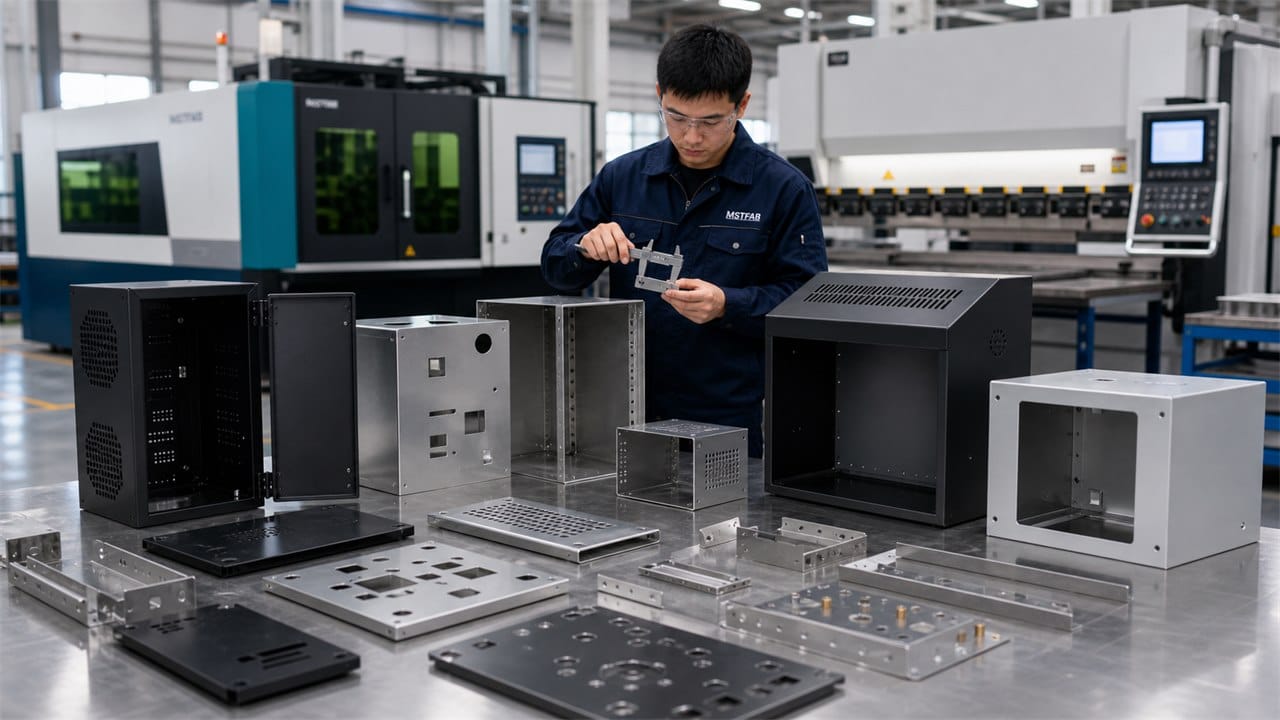
Why “Metal Fabrication Services” Is Not One Single Service
Metal fabrication services include the operations used to turn metal sheet, tube, plate or bar into finished parts made to your drawings. A typical project may involve cutting, punching, bending, welding, machining, hardware installation, powder coating and final inspection.
The risk is that many buyers compare suppliers only by unit price. That is understandable, but incomplete. A low price for cutting is not useful if the supplier cannot control bending. A clean weld is not useful if powder coating blocks the threaded holes. A nice sample is not useful if the second batch behaves like it has never met the first batch.
The real question is not “Can you make this part?” The better question is “Can you make this part consistently, inspect it clearly and ship it without creating extra work for my team?”
The Buyer Pain Points That Usually Hide Behind a Cheap Quote
Procurement teams often discover fabrication problems too late. By the time the shipment arrives, fixing the problem can involve sorting, rework, air freight, assembly delays and awkward meetings where everyone politely avoids saying what they are thinking.
- Unclear drawings: missing tolerances, finish notes or hardware details create guessing. Guessing is not engineering.
- Process mismatch: a supplier may cut accurately but struggle with bending, welding or finishing.
- Hidden finishing issues: powder coating thickness, masking and color consistency can affect assembly.
- Weak inspection: parts may pass visually but fail during installation because critical dimensions were not checked.
- Poor packaging: beautiful parts can become scratched, bent or dented before they reach your factory.
1. Engineering Review Comes Before the Machines Start
Good metal fabrication services begin with engineering review. The supplier should check CAD files, PDF drawings, material grade, sheet thickness, bend radius, hole positions, welding access, hardware locations, surface finish notes and packaging needs.
This review is where many expensive problems are prevented. If a bend is too close to a hole, the hole may distort. If a flange is too short, tooling may not hold it properly. If the finish note only says “black,” you may get ten different interpretations of black. Paint departments are creative like that.
2. Laser Cutting: The Start of Many Sheet Metal Projects
For custom sheet metal parts, laser cutting is often the first major process. It creates flat blanks, holes, slots, ventilation patterns and complex outlines with high speed and excellent accuracy. It is especially useful for equipment enclosures, control panels, brackets, machine covers and prototype parts.
If you want to review this capability in more detail, visit MSTFAB Laser Cutting Services. A strong laser cutting process helps reduce tooling cost, improve edge quality and keep prototype changes flexible.
However, laser cutting is not the whole story. It is the opening chapter. A beautifully cut blank still needs to bend, weld, finish and assemble correctly. This is why experienced buyers prefer fabrication suppliers that understand the complete workflow, not only the cutting machine.
3. CNC Bending: Where Flat Metal Learns Geometry
After cutting, many parts move to CNC press brake bending. Bending turns flat blanks into cabinets, chassis, covers, brackets and structural components. This is where bend allowance, material springback, tooling selection and bend sequence become important.
A drawing may show a perfect 90-degree angle. Metal has its own opinions. Different materials and thicknesses spring back differently. If the supplier does not control bending data, your enclosure may be slightly too wide, slightly too narrow or just annoying enough to ruin assembly time.
4. Welding and Assembly: Strength Needs Control
Welding joins fabricated parts into stronger structures such as frames, housings, cabinets and machine bases. Common methods include TIG welding, MIG welding and spot welding. Each has its place depending on material, thickness, appearance and strength requirements.
The common buyer risk is distortion. Heat can move metal. Without fixtures and a controlled weld sequence, a part can look acceptable but no longer match the drawing. For equipment buyers, this can affect doors, mounting points, rails, hinges and gasket surfaces.
5. Surface Finishing: The Part Buyers See First
Surface finishing protects the part and shapes the first impression. Powder coating, anodizing, brushing, polishing, plating and passivation all have different advantages. The best choice depends on environment, material, cosmetic standard and budget.
Finishing details should be specified early. Buyers should confirm color, gloss, texture, masking areas, corrosion expectations and acceptable appearance standards. If threads, grounding points or gasket surfaces need to stay clean, say it before coating. The coating team cannot read minds, even on Tuesdays.
6. Quality Inspection: Trust Is Better With Calipers
Reliable fabrication suppliers inspect the features that matter. For OEM parts, this usually means critical dimensions, hole positions, bend angles, weld quality, hardware installation, finish quality and assembly fit.
Photo evidence, first article reports and inspection notes help overseas buyers confirm quality before shipment. This is especially important when parts will go straight into production after arrival. Nobody wants a container full of “almost correct.”
What a Full-Service Fabrication Workflow Should Include
A practical metal fabrication services workflow should look like this:
- RFQ review: confirm drawings, materials, quantities, tolerances and delivery expectations.
- DFM feedback: identify cost, bending, welding, finishing and packaging risks before production.
- Prototype or first article: verify fit, finish and critical dimensions before batch work.
- Batch production: control cutting, bending, welding, machining, finishing and assembly.
- Inspection: check the features that affect function, assembly and appearance.
- Export packaging: protect finished parts from scratches, moisture and deformation.
How Overseas OEM Buyers Should Compare Suppliers
When choosing a metal fabrication services provider, compare more than price. Ask whether the supplier has in-house laser cutting, CNC bending, welding, hardware insertion and inspection. Ask how they handle drawing questions. Ask whether they can show similar products and explain process risks.
A good supplier will not say yes to everything immediately. Sometimes the most valuable supplier is the one who tells you, “This bend may distort the hole,” or “This coating needs masking,” before the order starts. That kind of early warning can save weeks.
Best-Fit Projects for a Full-Service Sheet Metal Factory
Full-service metal fabrication is especially useful for OEM equipment projects that need several processes under one roof. Typical products include electrical enclosures, industrial control cabinets, medical equipment housings, telecom cabinets, EV charger enclosures, battery storage cabinets, machine guards, brackets, panels and welded chassis.
These projects benefit from integrated production because each step affects the next. Cutting affects bending. Bending affects welding. Welding affects finishing. Finishing affects assembly. The parts are connected, so the process should be connected too.
Final Thoughts
Metal fabrication services are not just a list of machines. They are a controlled manufacturing system. For overseas OEM equipment buyers, the right partner helps turn drawings into parts that fit, look professional and arrive ready for assembly.
The wrong partner may still make something that looks like your part, but it may also bring hidden costs, rework, delays and a surprising amount of email. Choose the supplier who understands the whole process, asks the right questions and measures the details that matter.
Need custom metal fabrication support for OEM equipment?
MSTFAB supports overseas buyers with drawing review, laser cutting, CNC bending, welding, finishing, inspection and export-ready packaging for custom sheet metal parts.
MSTFAB provides TIG and MIG sheet metal welding services for structural assemblies, cabinets, frames and OEM metal components.
 WeChat Contact
 WhatsApp Me Directly