
Quick answer: Robotics companies should not choose a metal fabrication supplier based only on price, machine quantity, or a promised lead time. A robot is an assembly system. Its chassis, brackets, covers, sensor mounts, and structural supports must fit together consistently across prototypes, pilot builds, and repeat production. This guide helps hardware engineers and procurement teams build their own shortlist with hard manufacturing evidence instead of trusting generic sales pitches.
Scope boundary: What MSTFAB can support, and what stays with the OEM
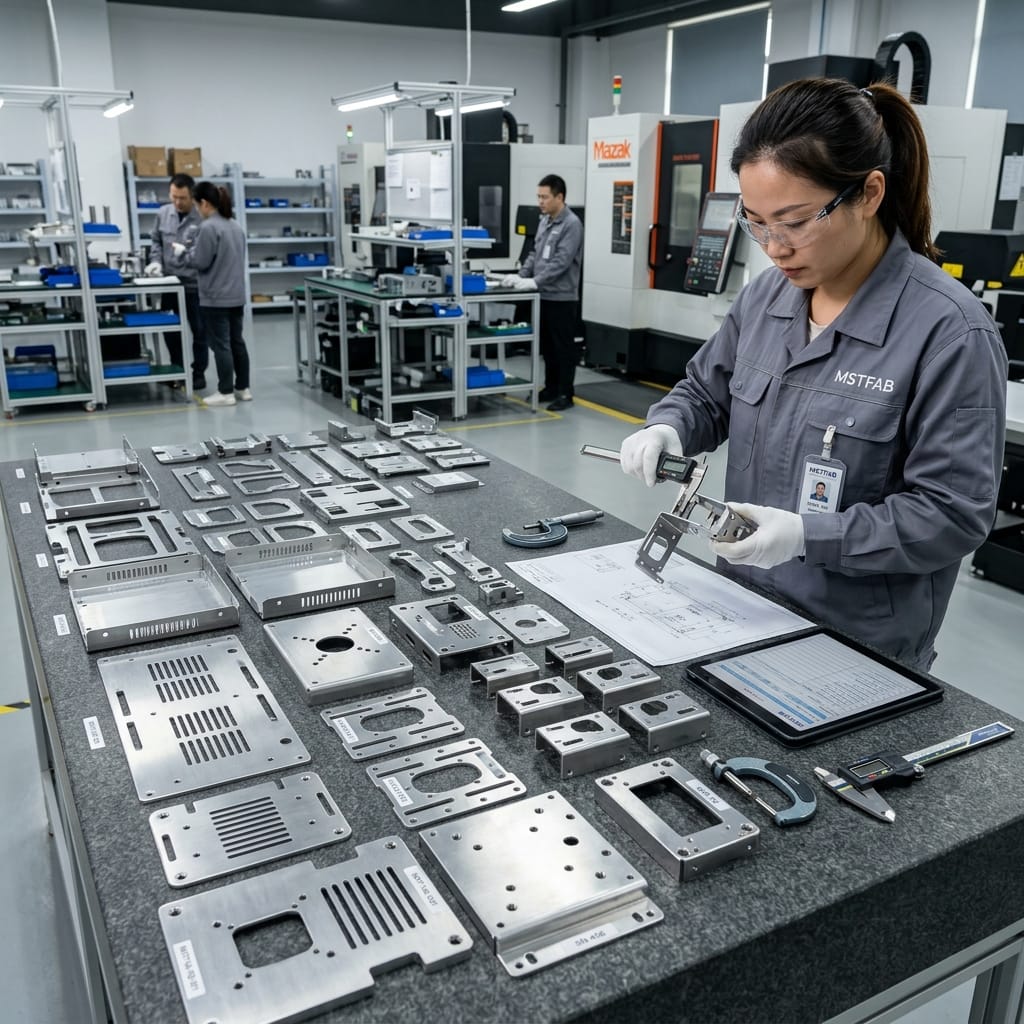
MSTFAB fabricates empty sheet metal shells, structural chassis, and precision mechanical parts for robotics applications based on buyer CAD models. Typical work includes precision laser cutting, CNC bending of motor brackets, TIG/MIG welding for rigid bases, dimensional inspection (including CMM when required), and surface finishing.
MSTFAB does not supply complete functional robots, electronics, software, kinematics validation, or final product certification. The buyer remains responsible for system integration, battery safety, and final market approvals.
What we do:
- Precision sheet metal fabrication of robotic chassis, frames, and mechanical components.
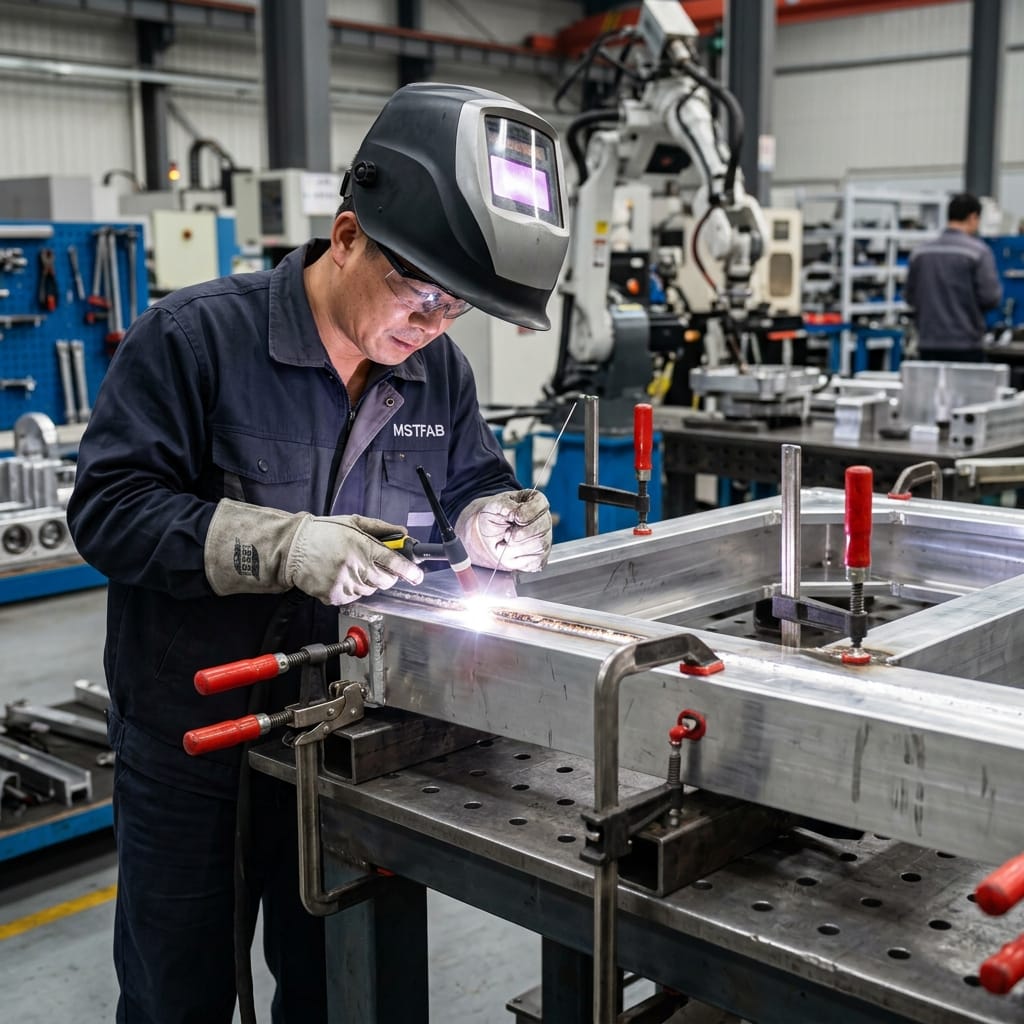
- TIG/MIG welding for structural bases with active distortion control.
- Fabrication of precision sensor mounts, cosmetic covers, and battery trays.
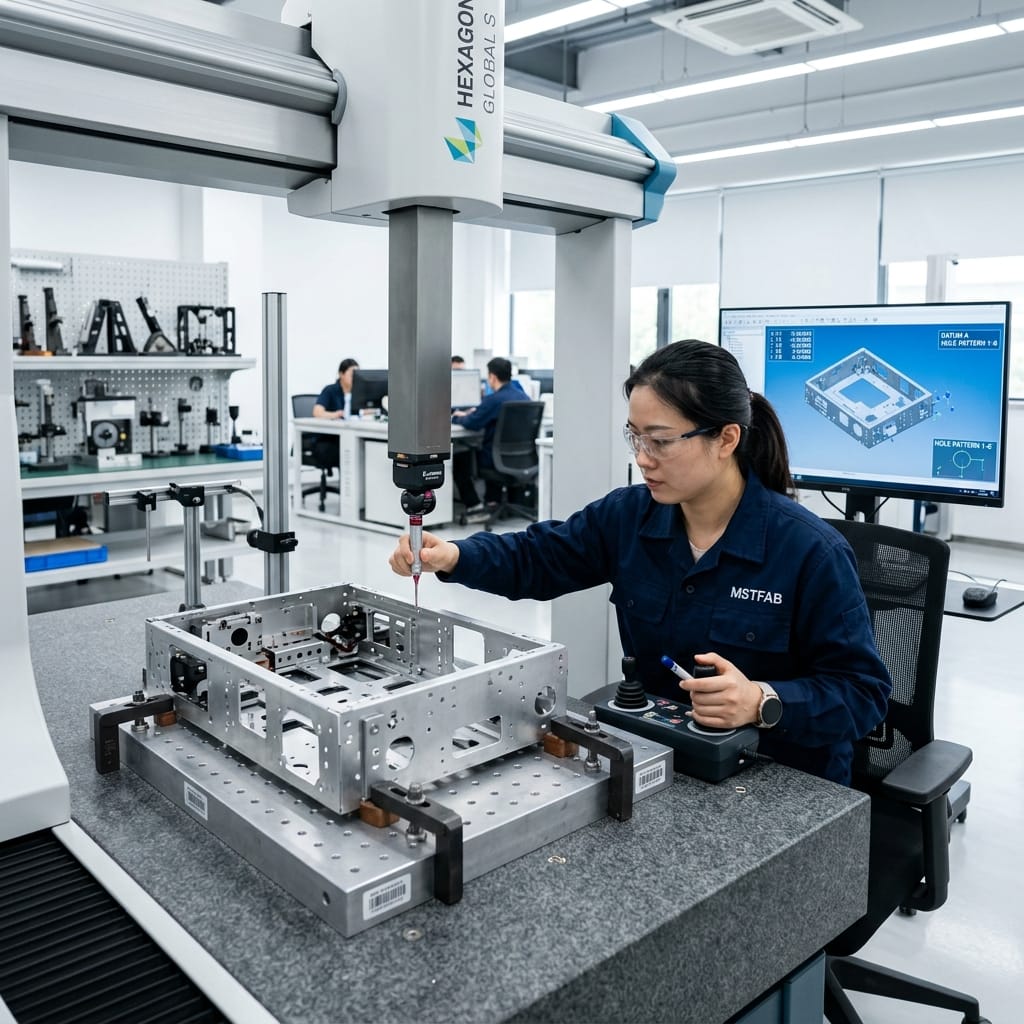
- Dimensional inspection using CMM, optical measurement, or custom fixtures.
- Powder coating, anodizing, and export packaging for mechanical assemblies.
What the OEM (Buyer) owns:
- System-level engineering, payload calculations, and robotics kinematic design.
- Electronics, PCBs, batteries, motors, and wiring integration.
- Final software programming, sensor calibration, and field validation.
- End-product safety certifications (e.g., CE, UL, ISO 10218).
Why Robotics Companies Need a Different Evaluation Method
A general sheet metal supplier may be able to cut and bend every individual component correctly while still producing an assembly that does not fit. Robotics projects contain multiple interacting parts: chassis frames, motor mounts, sensor references, and cosmetic covers. A small positional error in a motor bracket changes belt alignment. A distorted welded base affects wheel contact. Buyers get burned when they hire a supplier who treats every component as an isolated piece of metal, rather than understanding the datum structure of the entire robot.
The 7 Supplier Checks for Robotics Metal Fabrication
Before placing a pilot order, evaluate your supplier against these seven checks. A supplier that fails to understand assembly logic or revision control should be disqualified immediately.
D1: Evaluate Assembly and Datum Understanding (Hard Gate)
The first question is not, “What tolerance can you hold?” The better question is: “Which features control the fit and function of this assembly?” A capable supplier should identify primary assembly datums, locating-hole patterns, motor interfaces, and sensor reference surfaces. If they blindly apply one tight tolerance to the entire drawing without discussing critical-to-function vs. cosmetic features, they lack robotics experience.
D2: Confirm the Required Manufacturing Processes
Robotics projects frequently combine sheet metal bending with CNC machining (for sensor flats) and precision welding. Does the supplier have direct control over these processes? Ensure they have the correct segmented press brake tooling to form your specific chassis without colliding with adjacent flanges.
D3: Assess Robotics-Focused DFM Support
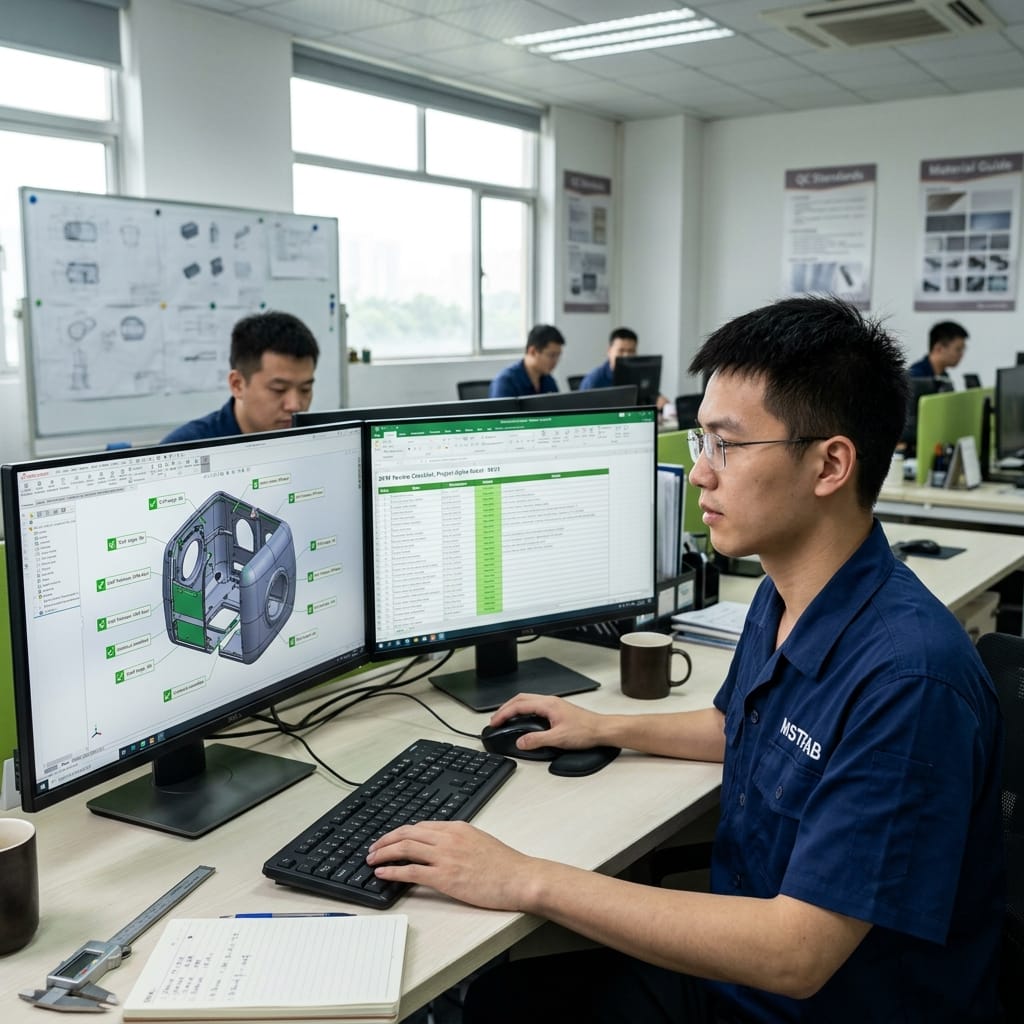
Design for Manufacturability (DFM) is crucial for robots moving from prototype to serial production. A strong partner will suggest adding tab-and-slot features for self-locating assembly, or moving a hole away from a bend radius to prevent distortion. They should help reduce assembly time on your floor.
D4: Define the First-Article and Inspection Plan
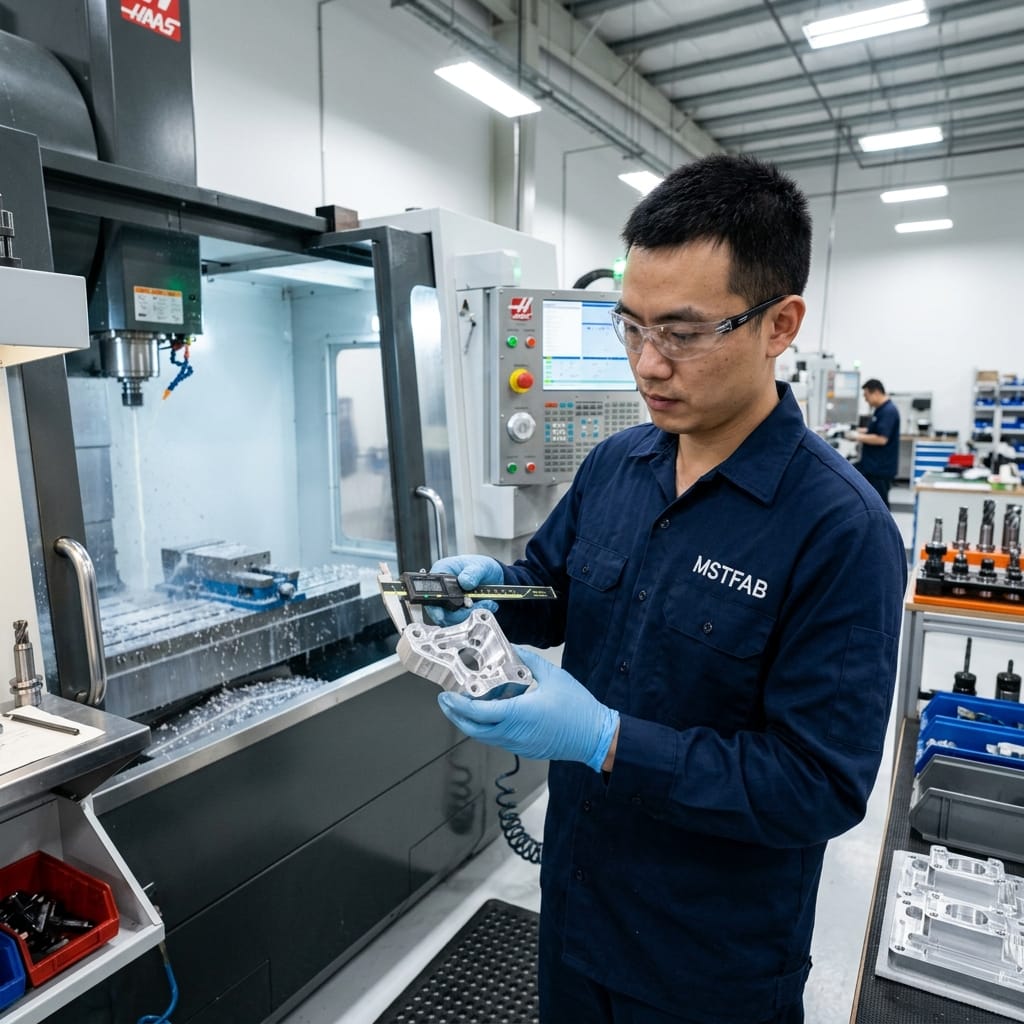
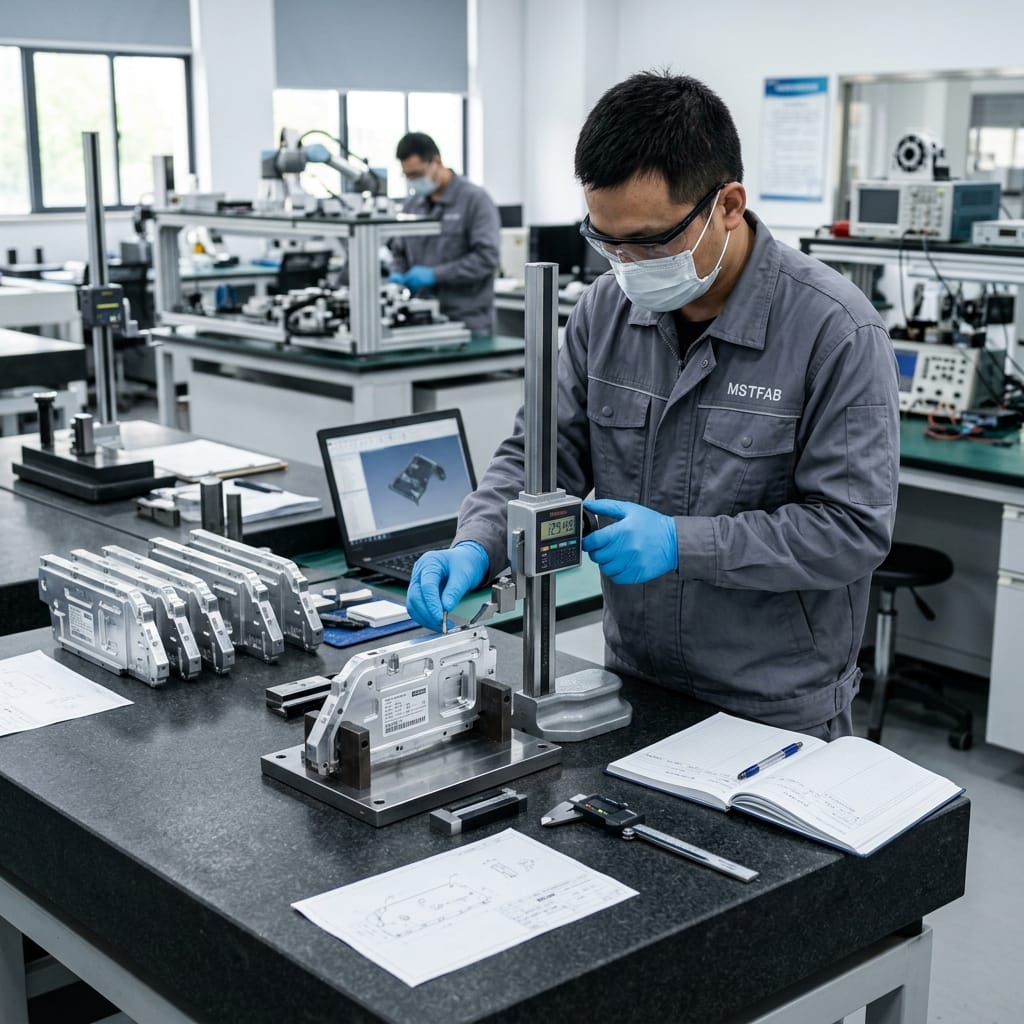
For early builds, “inspected before shipment” is not enough. You must agree on critical dimensions and the inspection method (e.g., CMM for sensor hole patterns, pin gauges for threaded inserts). The supplier should inspect the assembled sub-system or use physical checking fixtures, rather than just measuring flat blanks.
D5: Match Material Control to the Project Risk
Robot payload and structural integrity rely on correct material properties. 5052 aluminum acts very differently than 6061-T6. For load-bearing or welding-critical components, EN 10204 3.1 mill certificates should be a hard requirement to prevent catastrophic material substitution.
D6: Verify Revision Control and Batch Repeatability (Hard Gate)
Robotics companies change designs rapidly. Without strict revision control, an old bracket will be manufactured correctly according to the wrong drawing. A professional supplier must have a documented system to manage obsolete files and ensure repeat batches assemble consistently without manual shimming.
D7: Evaluate Confidentiality and Supply Transparency
Robotics drawings reveal mechanical architecture, sensor locations, and battery layouts. A supplier must demonstrate how they control file access internally and whether they send your CAD files to unvetted subcontractors. A signed NDA means nothing if their file-handling process is chaotic.
The Supplier Trust Table: Red Flags vs. Green Flags
| What You Ask For | The “Run Away” Red Flag | The “We Can Work With This” Green Flag |
|---|---|---|
| Datum Discussion | “We can hold +/- 0.1mm on the whole part, no problem.” | Asks which hole pattern is the primary datum for mounting the main drive motor. |
| DFM Feedback | Accepts a highly complex weldment without asking about distortion limits. | Suggests adding a tab-and-slot feature to guarantee alignment during welding. |
| Revision Control | Accepts CAD updates via informal WeChat/WhatsApp messages. | Requires an updated 2D PDF with a new revision block and quarantines the old files. |
| Inspection Plan | “We have a CMM, don’t worry.” | Provides a marked-up drawing showing exactly which critical features will be measured and how. |
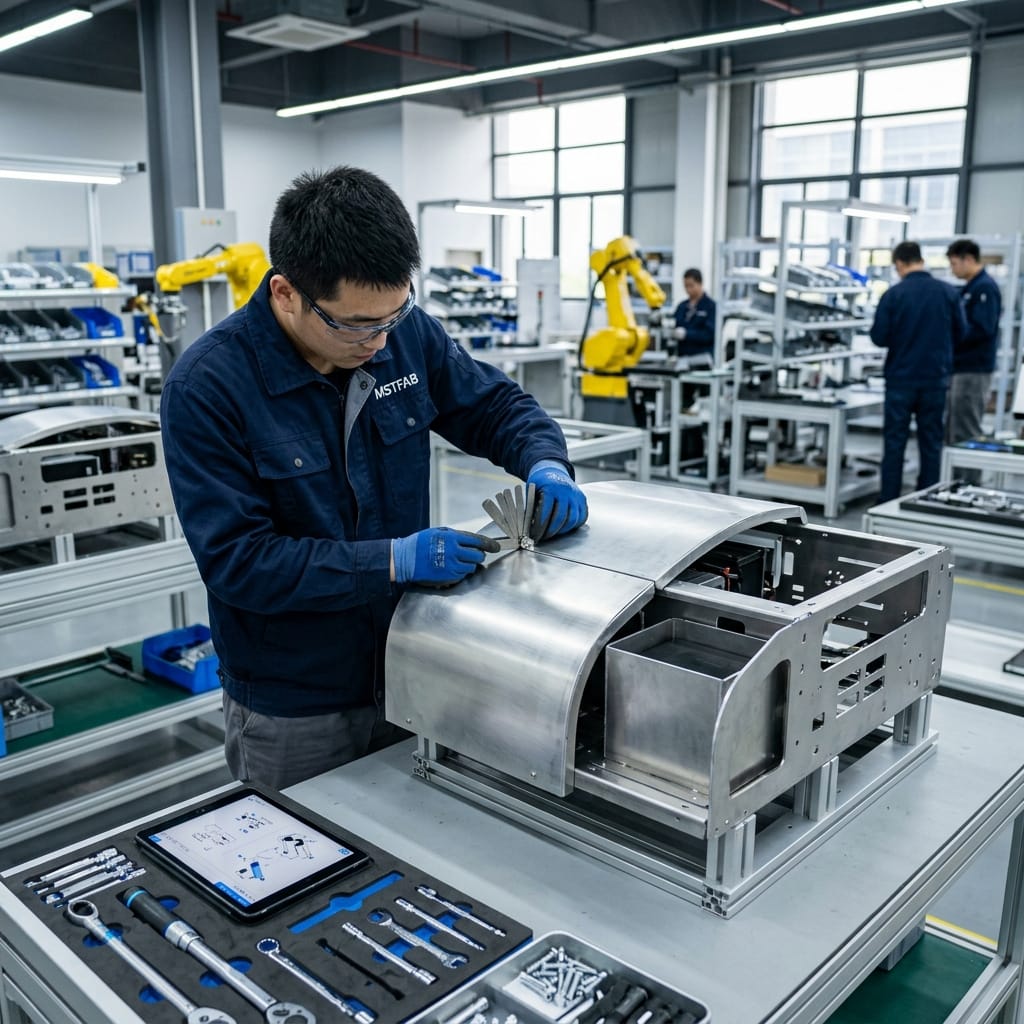
| Trial Assembly | Ships individual bent parts that you can’t bolt together. | Performs a physical trial fit-check of the covers on the chassis before shipment. |
How MSTFAB Approaches Robotics Projects
MSTFAB supports drawing-based custom sheet metal fabrication for robotics companies, from early prototypes to serial production. We evaluate every project based on assembly logic, not just isolated flat patterns. We provide DFM feedback to optimize structural integrity and reduce your final assembly time. Before a pilot run, we agree on critical datums, establish strict revision controls, and provide verifiable First-Article Inspection (FAI) reports, ensuring your chassis and covers fit perfectly on the assembly line.
Key Takeaways
- Robotics fabrication requires assembly-level datum understanding, not just basic sheet metal cutting.
- Revision control (D6) is a hard gate. Fast iteration demands strict CAD file management.
- DFM feedback should focus on reducing distortion during welding and ensuring consistent locating features.
- MSTFAB supplies precision mechanical metalwork only, allowing your engineering team to focus on integration, software, and validation.
FAQ
What tolerance should I specify for robotic sheet metal parts?
Do not apply an unnecessarily tight tolerance to every feature. Identify the locating, alignment, and functional dimensions that require strict control (e.g., motor mounts), and use practical general tolerances for cosmetic covers and ventilation holes.
Does every robot component need CMM inspection?
No. Use CMM inspection when the geometry or datum structure demands it (like sensor mounting plates). Simpler features can be inspected reliably using height gauges, pin gauges, or custom checking fixtures.
Aluminum or steel for a robot frame?
This depends on payload, weight targets, and center-of-gravity requirements. Steel offers high stiffness and ease of welding, while aluminum reduces mass. We can provide DFM feedback on manufacturability, but your structural engineer must define the final material choice.
 WeChat Contact
 WhatsApp Me Directly