
Buyer guide: This guide explains the design, process and quality checks OEM buyers should confirm before requesting production pricing for choosing a metal fabrication company for projects.
Finding a metal fabrication company for an OEM project should not feel like a gamble. You may already have a drawing, a target cost, a delivery date and someone asking for an update before lunch. What you need is not a supplier who only says, “Yes, we can make it.” You need a manufacturing partner that understands what happens after the drawing becomes real metal.
Will the holes align with the final assembly? Will the bend angle stay consistent? Will welding affect flatness? Will powder coating block threaded holes? Will the parts arrive protected, labeled and ready for your production line?
MSTFAB is a custom sheet metal fabrication company in China supporting overseas OEM buyers with drawing-based manufacturing for enclosures, cabinets, brackets, panels, covers, frames, chassis parts and welded metal assemblies. A drawing can look perfect on screen. The real test is whether the part fits when somebody on your assembly line picks up a screwdriver.
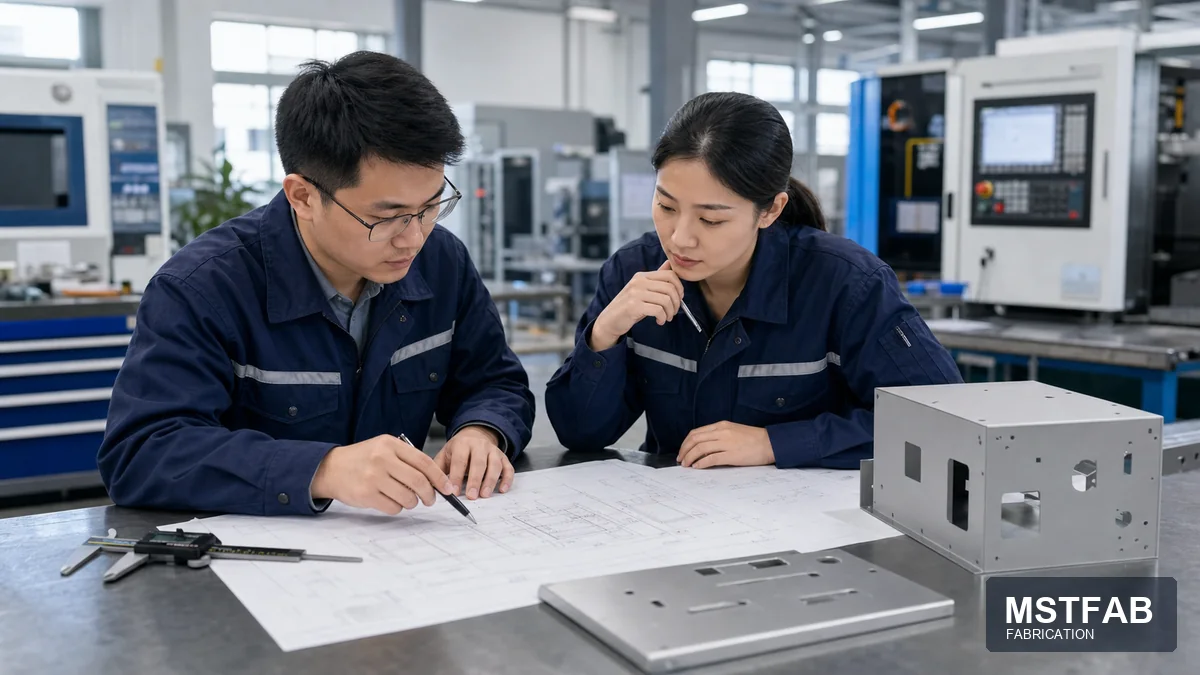
Reviewed by MSTFAB Manufacturing Engineering Team. Last updated: July 1, 2026. Focus: custom sheet metal fabrication, laser cutting, CNC bending, welding, surface finishing, inspection and export packaging for international OEM buyers.
Why OEM projects need more than a basic metal shop
A basic metal shop may cut a flat sheet. An OEM project usually needs much more: laser cutting, CNC bending, welding, deburring, hardware insertion, surface finishing, assembly checks, dimensional inspection and export packaging. Each stage affects the next one.
For example, a hole placed too close to a bend can deform during forming. A welded frame can shift because of heat. A beautiful black powder coating can become a problem when a mounting screw no longer enters the threaded hole. That is why the lowest quotation is not always the lowest-cost decision. A cheap part that does not fit is really a delayed shipment wearing a discount sticker.
For the wider capability view, start with our sheet metal fabrication service and our guide to custom sheet metal fabrication for OEM parts.
What an OEM metal fabrication company should control
DFM review
Material grade, thickness, bend direction, hole-to-bend clearance, tolerance and visible surfaces are reviewed before cutting.
Process route
Laser cutting, bending, welding, finishing and packing are planned together so one process does not quietly sabotage the next.
Assembly fit
Critical holes, slots, mounting faces, threads and hardware positions are checked against the real product function.
Welding distortion
Fixture setup, weld sequence and inspection points help reduce heat movement in frames, cabinets and structural parts.
Finish control
Powder coating, brushing, anodizing or plating requirements are connected to masking, grounding and cosmetic expectations.
Export delivery
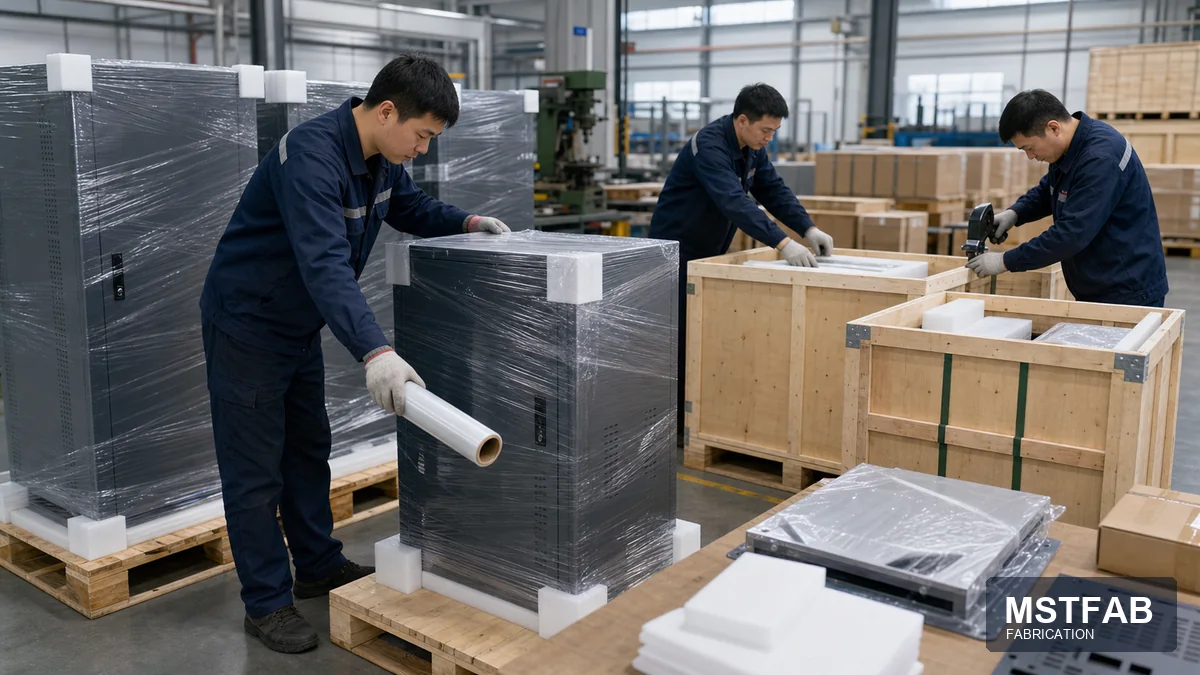
Packaging protects corners, coatings, hardware and assembly faces so finished parts arrive like parts, not like a mystery box.
Engineering and DFM review before production
DFM means Design for Manufacturing. It does not mean a supplier changes your design without permission. It means the fabrication team checks whether the design can be manufactured consistently before material is cut.
For sheet metal parts, this review may include material grade and thickness, critical dimensions, bend radius, bend direction, hole-to-bend clearance, welding risk, hardware installation, surface finish compatibility, assembly fit and packaging protection. A small drawing adjustment may take a few minutes. Finding the same issue after 500 parts are bent, welded and powder coated is much less relaxing.
Laser cutting that supports the next process
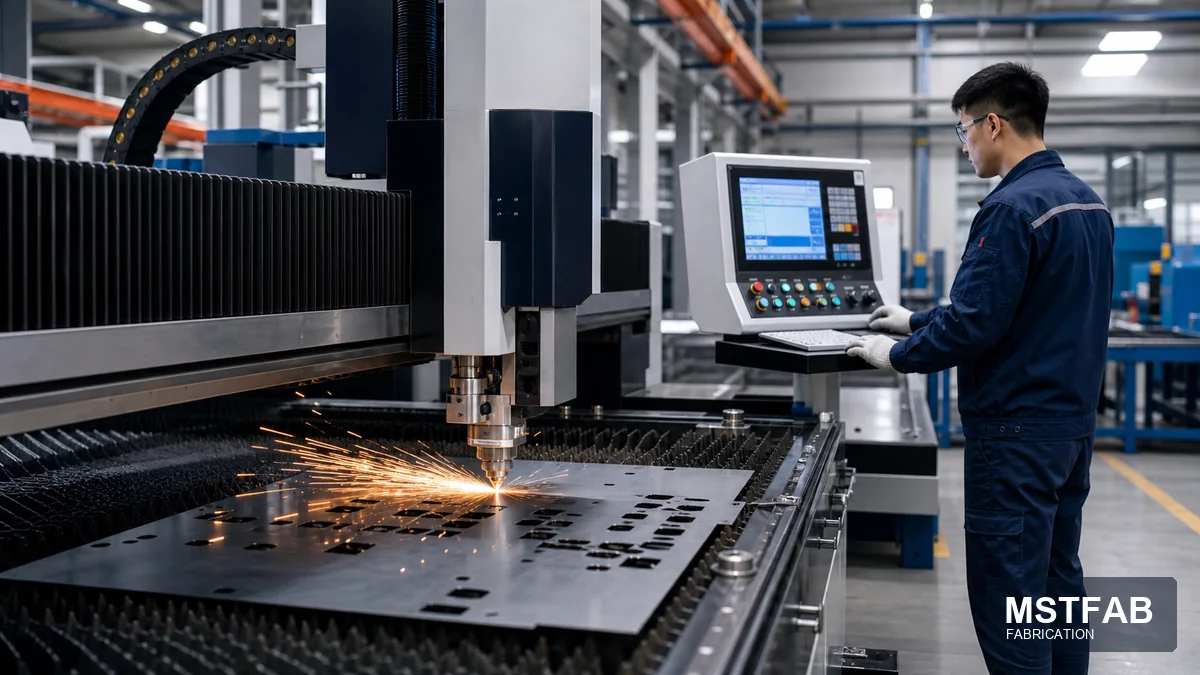
Laser cutting is usually the starting point for custom brackets, panels, enclosures, cabinets, chassis components, mounting plates and machine covers. But it is not only about cutting the outside shape.
The flat pattern may include mounting holes, cable openings, ventilation slots, tabs, locating features, display cutouts and fastener holes. These features need to work with bending, welding, hardware installation and final assembly. A good blank makes the next process easier. A bad blank makes the next process a metal escape room.
Review MSTFAB’s laser cutting service if your OEM parts need accurate cutouts before forming and assembly.
CNC bending for real assembly requirements
CNC press brake bending turns flat metal into useful products: L brackets, U channels, enclosure bodies, cabinet doors, trays, covers, flanges and machine guards. Bending looks simple in a drawing. In production, it depends on material thickness, alloy grade, tooling, bend radius, flange length, grain direction and springback.
Springback is the metal’s polite way of saying, “I heard your 90-degree requirement, but I have my own opinion.” Correct bend allowance, tool selection and feature placement help reduce fit problems and repeat-order variation. For formed parts, see our CNC sheet metal bending capability.
Welding without ignoring distortion
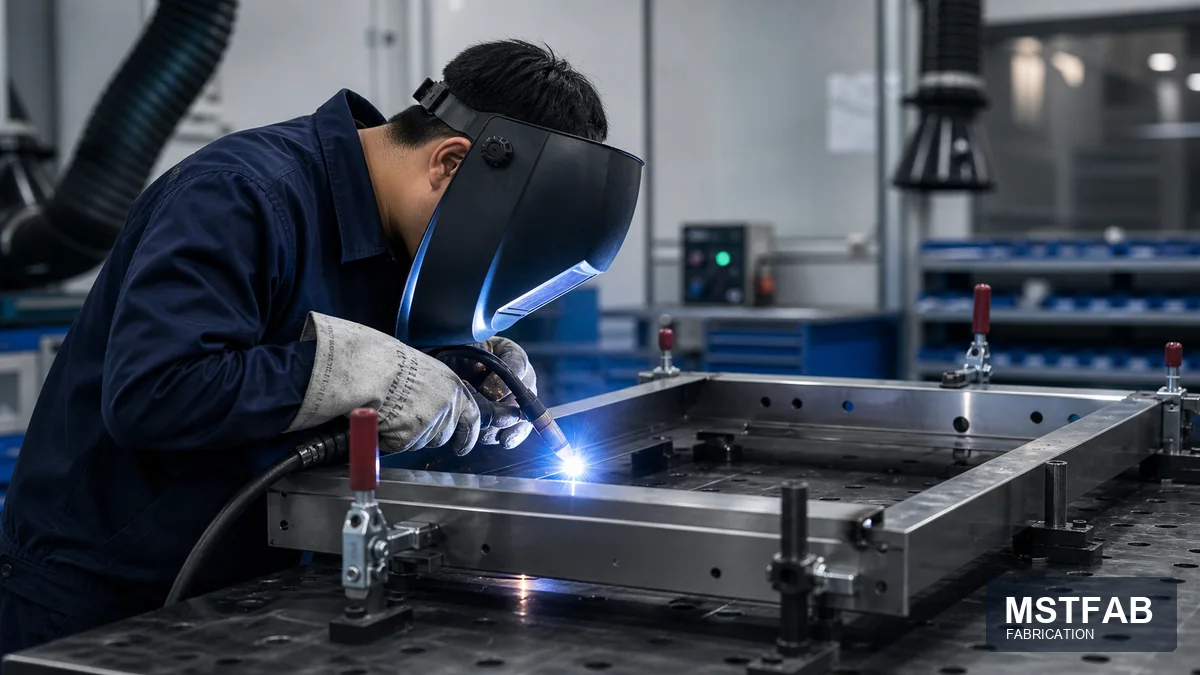
Welding is essential for many OEM projects, including machine frames, equipment bases, structural brackets, cabinet bodies, support frames and multi-part assemblies. Welding provides strength, but it also introduces heat. Heat can change flatness, squareness, visible surface quality and assembly alignment.
Before welding begins, a professional fabrication team should confirm weld location, weld length, structural or cosmetic requirements, continuous or intermittent welds, grinding expectations, dimensional control points, surface treatment after welding and packaging protection for finished surfaces. A welded part can be strong and still be wrong if it no longer fits.
Our sheet metal welding service supports welded brackets, frames, supports, cabinets and OEM subassemblies.
Materials for OEM metal fabrication projects
The right material should be selected for the application, not just for the quotation spreadsheet. The best material choice depends on load, environment, appearance, coating, assembly method and target cost.
| Material | Common OEM use | Buyer notes |
|---|---|---|
| Stainless steel | Medical equipment, food-related machinery, outdoor cabinets, industrial panels and corrosion-sensitive parts. | Define grade, thickness, brushing direction, visible surface, protective film and weld-finish standard. |
| Aluminum | Electronic housings, lightweight brackets, transport equipment, battery-related assemblies and panels. | Check alloy, bend radius, welding requirement and stiffness. Lightweight is useful; flimsy is not. |
| Mild steel | Frames, supports, brackets, guards, machine bases and powder-coated industrial products. | Cost-effective, but finish and packing must protect against corrosion. |
| Galvanized steel | Cabinets, panels, ducts, outdoor equipment parts and corrosion-conscious assemblies. | Confirm welding, coating compatibility and cut-edge protection. |
Surface finishing is part of the engineering plan
Surface treatment is not simply the final beauty step. It affects corrosion resistance, cosmetic quality, grounding, sealing, thread function, scratch protection, packing and customer perception.
Common finish options may include powder coating, wet painting, brushed stainless steel, polishing, sandblasting, aluminum anodizing, zinc plating, galvanizing and protective film for visible surfaces. For example, powder coating may need masking around threads, electrical grounding locations, sealing surfaces or precision assembly areas. “Black finish” is not a complete specification. There are many shades, textures, gloss levels and interpretations of black. It is better to define the finish clearly before production than to debate later why one black part is somehow not the right black part.
For coating and finish options, review our surface treatment services.
Quality control should follow the part function
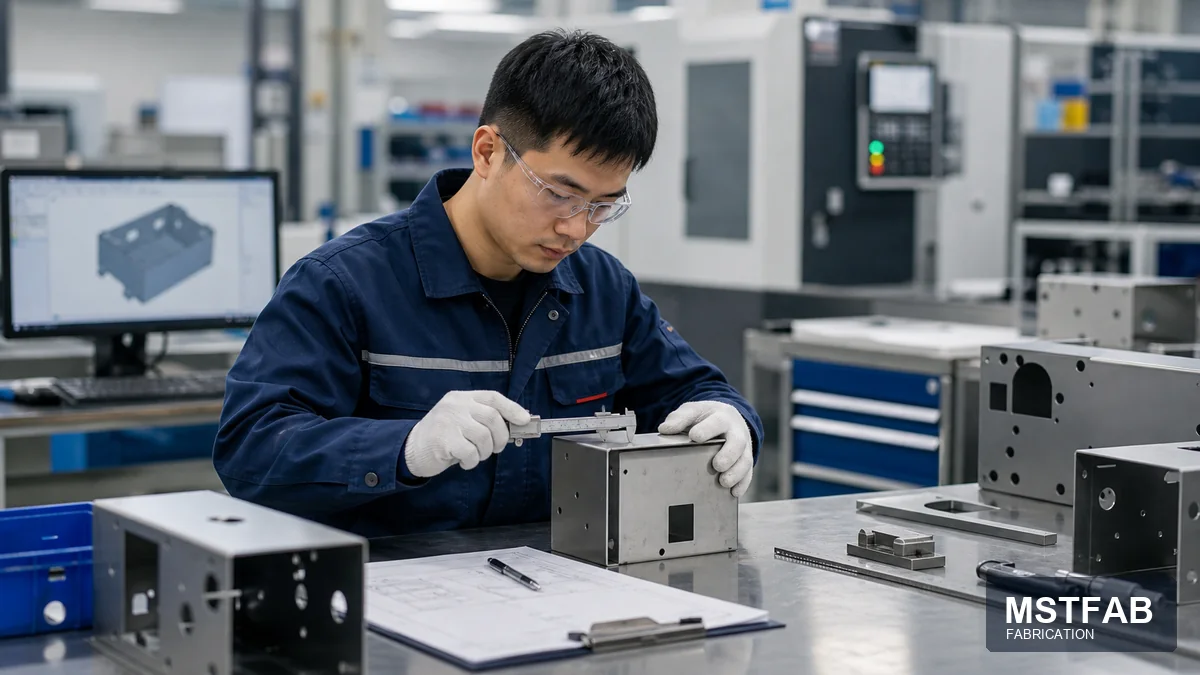
Not every dimension has the same importance. A hidden internal flange may not require the same inspection standard as a visible front panel. A cosmetic stainless steel cover and a welded mounting bracket should not be inspected in exactly the same way.
For OEM metal fabrication, quality control should focus on critical dimensions, hole and slot locations, bend angles, flatness, squareness, thread and hardware functionality, weld position, surface finish condition, assembly fit and packaging protection.
Why work with a direct fabrication company?
An OEM project often involves multiple linked processes. If cutting, bending, welding, coating and packing are managed by separate suppliers, communication gaps can become quality gaps.
Working with a direct fabrication company can help control drawing revision communication, material confirmation, production sequence, quality responsibility, hardware and finish coordination, assembly checks, export packing standards and batch-to-batch consistency.
MSTFAB supports custom projects from prototype validation to repeat production. Buyers can also review our factory photos and production evidence. Real process evidence is more useful than a random stock photo of somebody wearing safety glasses and pointing confidently at a machine.
What to send for an OEM fabrication quote
The best RFQ is not necessarily the longest email. It is the clearest one.
| Information to send | Why it helps |
|---|---|
| STEP file, PDF drawing, DXF or DWG file | Lets engineering review geometry, flat patterns, critical dimensions and bend direction. |
| Material grade and thickness | Prevents substitutions that affect strength, corrosion resistance, welding or forming. |
| Required quantity and target schedule | Separates prototype review from batch production planning. |
| Surface finish requirement | Defines color, texture, coating thickness, masking areas and visible-surface expectations. |
| Critical tolerance and inspection notes | Focuses QC on the dimensions that affect assembly, function and repeat orders. |
| Packaging and destination country | Helps protect corners, coatings, threads and assembled geometry during export shipping. |
Frequently asked questions
Can MSTFAB manufacture parts from our drawings?
Yes. MSTFAB supports drawing-based fabrication for custom enclosures, cabinets, brackets, panels, covers, chassis parts, machine guards and welded metal assemblies.
Can you support both prototypes and repeat production?
Yes. Projects can begin with a prototype or first article for fit verification before moving into repeat batch production.
Do you handle only laser cutting?
No. Our core work can include laser cutting, CNC bending, welding, deburring, hardware insertion, surface treatment, assembly checks, inspection and export packing.
Do you provide stamping?
This article focuses on custom fabrication through laser cutting, CNC bending, welding, finishing and assembly. It is not positioned as a high-volume stamping-die service.
Start your OEM metal fabrication project
The right metal fabrication company should help reduce avoidable risk before production, control the process across multiple fabrication stages, and deliver components that are ready for your assembly line.
Send your drawings, material requirement, quantity, tolerance notes, surface finish and application details. We will review the project from a practical manufacturing perspective before production begins.
 WeChat Contact
 WhatsApp Me Directly