
Direct Answer: How to Select & Specify a Custom Metal Box Manufacturer
Selecting a custom metal box manufacturer requires matching the fabrication route to annual volume—using soft-tooled CNC fiber laser cutting and press brake bending ( tooling cost) for 1–2,500 units/year vs. hard progressive stamping above 5,000 units—while specifying ISO 2768-m (±0.15 mm) tolerances, 5052-H32 Al / 304 SS / SGCC gauges, and NEMA 4X / IP65 sealing.
- Alloy & Bend Rules: Specify 5052-H32 aluminum (R ≥ 1.0t) instead of brittle 6061-T6 for formed sheet metal boxes to eliminate outer-fiber bend cracking.
- Corner Seam Architecture: Choose continuous TIG-welded and ground corners for IP65/IP66 outdoor washdown boxes, or hemmed tab-and-slot riveted corners for indoor NEMA 1 chassis.
- Turnkey Finishing & Hardware: Consolidate PEM self-clinching hardware insertion, chromate/phosphate pre-treatment, 60–90 μm powder coating, and silkscreen labeling under one ISO 9001 roof.
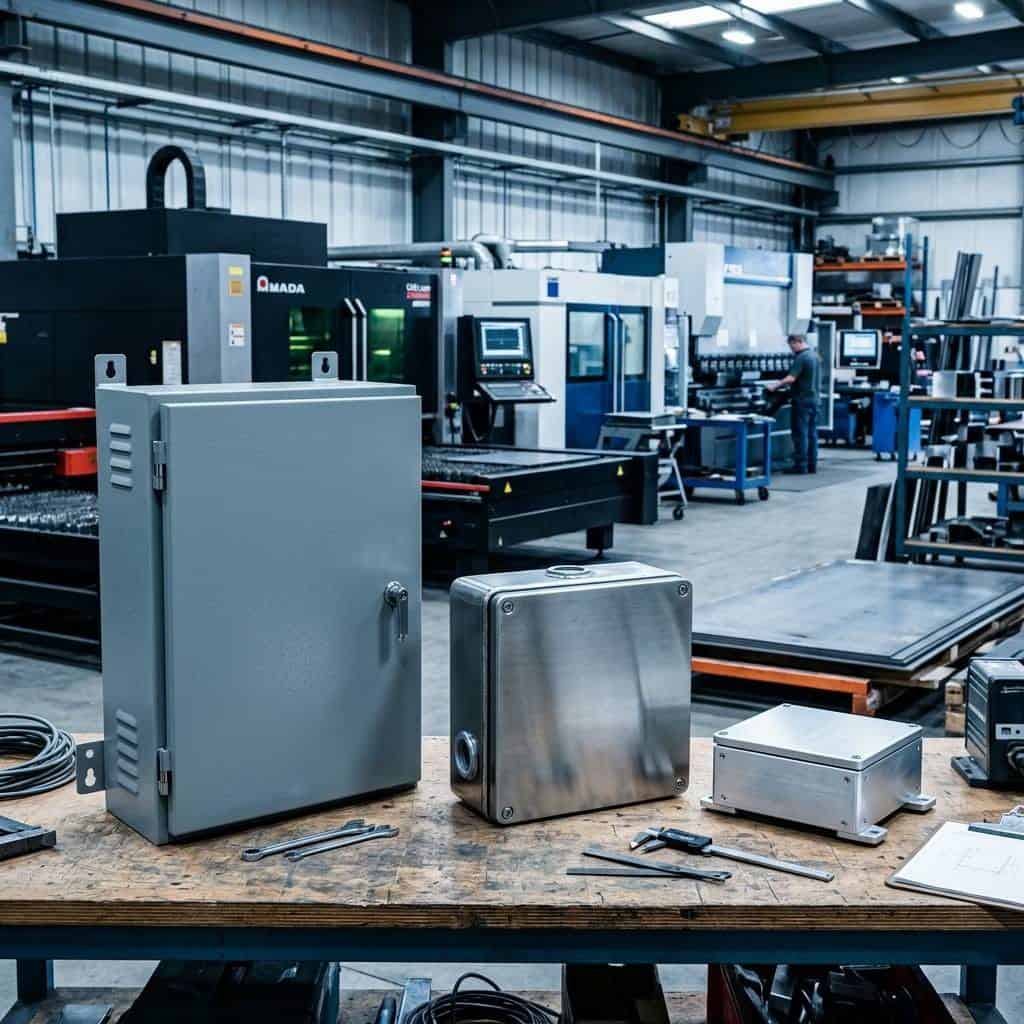
Metal enclosures are among the most significant and widely used types of fabricated metal products for industrial, commercial, and residential applications. From extremely large enclosures housing electrical substation equipment to compact enclosures for consumer light switch fixtures and electronics — metal boxes serve as the backbone of modern electrical infrastructure.
At MSTFAB, we bring 23+ years of precision sheet metal fabrication expertise to every metal box we manufacture. Our engineering team designs and produces custom enclosures that meet stringent international standards including NEMA, IP, UL, and ATEX certifications — delivering reliable protection for critical electrical and electronic components across diverse operating environments.
What Is a Metal Box? — Definition and Core Functions
A metal box is a fabricated enclosure constructed from sheet metal — typically steel, stainless steel, or aluminum — designed to house, protect, and organize electrical components, electronic systems, and mechanical assemblies. These enclosures range from simple junction boxes to complex multi-compartment control panels with integrated thermal management.
Metal boxes can be constructed in a wide range of shapes, including rounded, circular, cylindrical, and standard geometric designs like rectangles and squares. These versatile metal enclosures can be precisely stamped or pierced with holes to allow the secure passage of cords, wires, and cables — an essential feature for electrical equipment housing, data communication panels, and control panels.
Many metal boxes are equipped with robust doors or transparent glass panels, making it easy to inspect the enclosed machinery or electrical components without opening the box. This accessibility is critical for routine maintenance, safety checks, and troubleshooting in environments where uptime and reliability are paramount.
Manufacturing Processes for Metal Boxes
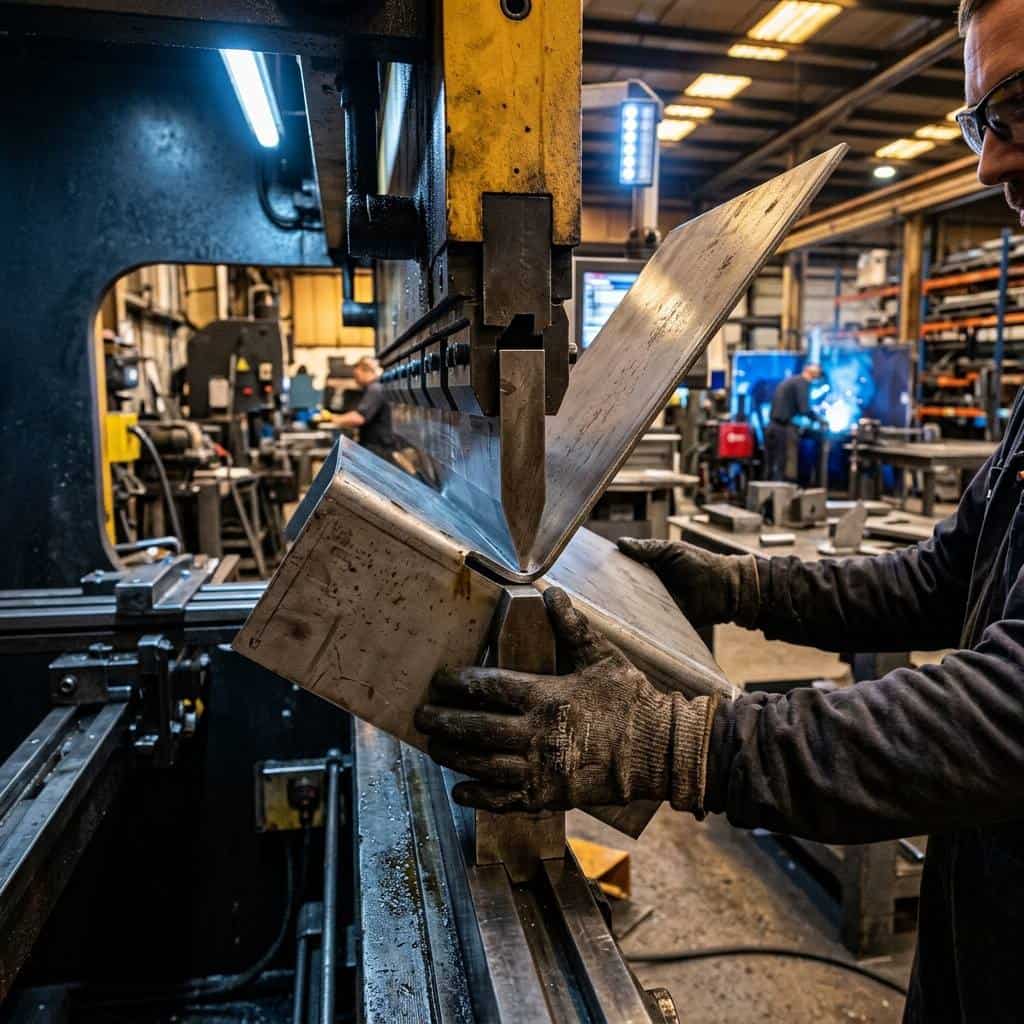
The manufacturing of metal boxes relies on advanced fabrication processes tailored to specific performance requirements. At MSTFAB, we employ a comprehensive range of precision manufacturing technologies to produce enclosures that meet exact dimensional tolerances and customer specifications.
| Manufacturing Process | Best For | Tolerance | Volume Suitability |
|---|---|---|---|
| Fiber Laser Cutting | Flat panel cutting, complex cutouts | ±0.05mm | Prototype to high volume |
| CNC Press Brake Bending | Forming enclosure bodies, flanges | ±0.1mm | All volumes |
| Metal Stamping | High-volume simple shapes, knockouts | ±0.1mm | High volume (10,000+) |
| Deep-Drawn Stamping | Seamless tall enclosures, cylindrical | ±0.15mm | Medium to high volume |
| Progressive Die Stamping | Complex multi-stage forming | ±0.05mm | High volume (50,000+) |
| TIG/MIG Welding | Structural joints, sealed enclosures | EN ISO 3834-2 | All volumes |
| Powder Coating | Corrosion protection, aesthetics | 60–80μm DFT | All volumes |
Deep-drawn stamping is particularly advantageous for producing enclosures that need to be taller than they are wide — delivering seamless, durable, and high-precision enclosures ideal for demanding industrial applications. By minimizing connected edges or seams, this process reduces the risk of component failure and eliminates the need for additional reinforcement at weak points.
After initial forming, metal enclosures undergo additional processing to enhance durability and environmental resistance. Common finishing techniques include annealing, hardening, powder coating, galvanizing, and other heat treatments — preparing metal boxes for corrosive industrial settings, outdoor installations, and extreme temperature environments.
Types of Metal Boxes: Complete Classification Guide
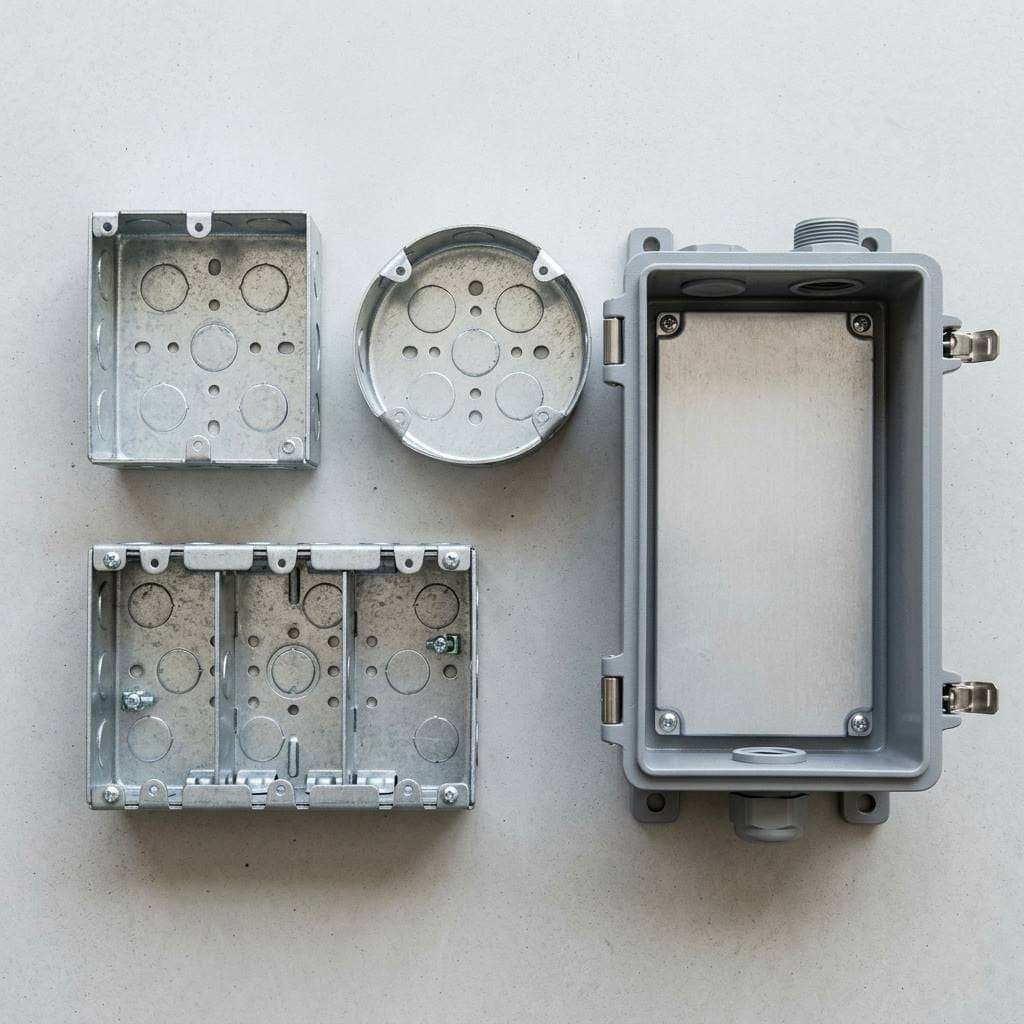
Understanding the different types of metal boxes is essential for selecting the right enclosure for your specific electrical, mechanical, or environmental requirements.
| Box Type | Typical Size | Primary Application | Key Feature |
|---|---|---|---|
| Standard Rectangular (1-Gang) | 2″ × 3″ × 2.5″ | Single switches, outlets, receptacles | Modular — expandable by removing sides |
| 2-Gang / 3-Gang / 4-Gang | 4″ × 3″ × 2.5″ (2G) | Multiple switches, dimmers, outlets | Gangable — joined side-by-side |
| Round Pan (Pancake) | 4″ diameter × 0.5″ | Ceiling/wall light fixtures | Low-profile, shallow depth |
| 4″ Square Junction Box | 4″ × 4″ × 1.5″–2.1″ | Wire splices, distribution points | Ample room for multi-cable connections |
| NEMA Weatherproof | Custom | Outdoor, hazardous environments | Gasketed seals, IP/NEMA rated |
| Explosion-Proof | Custom | Chemical plants, refineries | ATEX-certified, spark containment |
| Instrument Enclosure | Custom | OEM electronics, sensors, controls | EMI/RFI shielding, thermal management |
Why Steel Dominates Metal Enclosure Manufacturing
While metal boxes can be manufactured from aluminum, stainless steel, brass, and cast iron — steel enclosures are the most frequently specified for electrical and industrial applications. Here’s why industry professionals consistently choose steel:
| Advantage | Details | Impact |
|---|---|---|
| Fire & Explosion Safety | Non-combustible material; ATEX-rated options available | Prevents catastrophic fire spread in industrial facilities |
| Corrosion Resistance | Galvanized, powder-coated, or stainless variants | 20+ year service life in harsh environments |
| Environmental Sustainability | Steel is the world’s most recyclable material | Supports green building standards and ESG compliance |
| Long-Term Cost Savings | Minimal maintenance; impact/UV resistant | Lower total cost of ownership vs. plastic alternatives |
| EMI/RFI Shielding | Natural electromagnetic barrier | Protects sensitive electronics and communications |
| Customizability | CNC-fabricated cutouts, mounting, ventilation | Exact fit for any application requirement |
Applications of Metal Boxes Across Industries
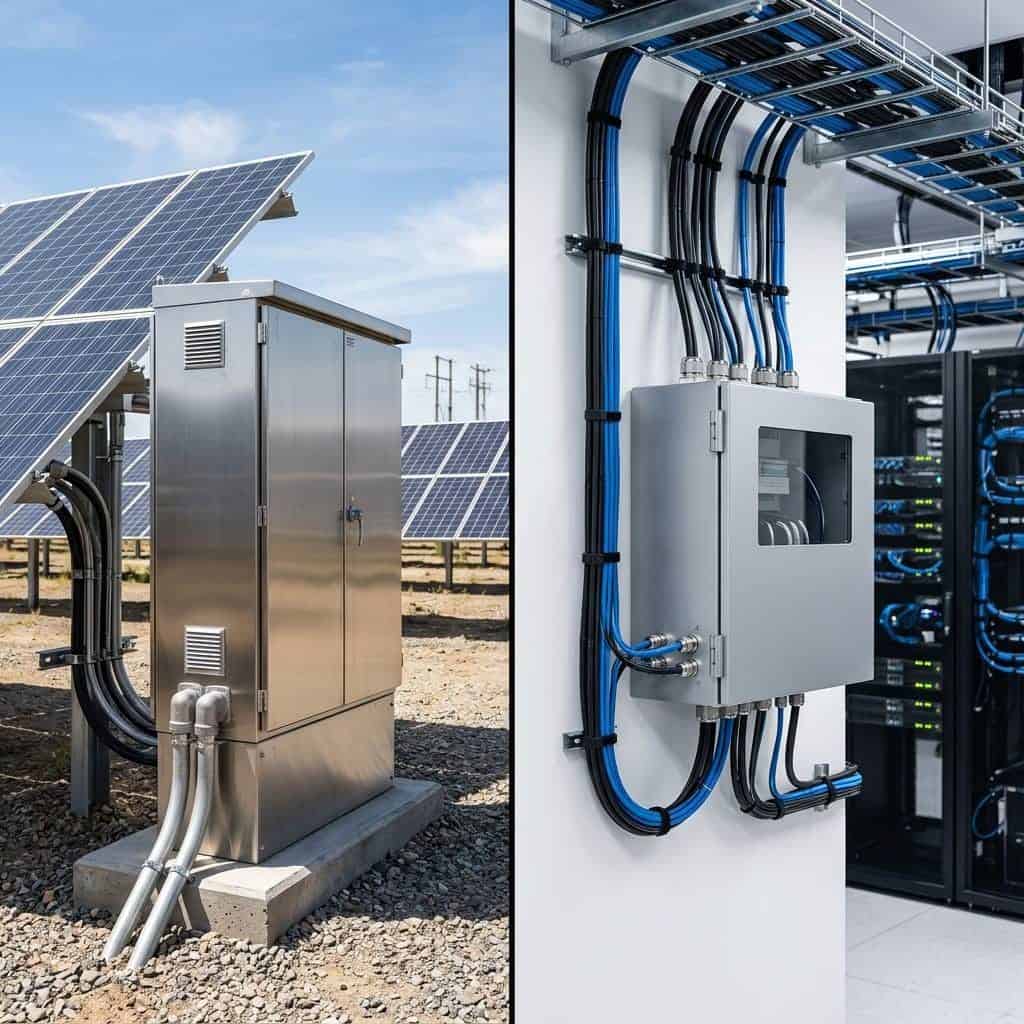
Metal boxes are indispensable across multiple industries. Their robust construction and protective features make them the enclosure of choice for demanding applications:
- Electrical Distribution: Fuse boxes, circuit breaker panels, outdoor meter enclosures — every building requires secure metal electrical enclosures for power regulation and fire prevention.
- Industrial Automation: PLCs, relays, sensors, and power supplies require protection from dust, debris, moisture, and impact in manufacturing and energy production facilities.
- Data & Telecom Infrastructure: Network cabinets, server racks, and distribution boxes fabricated from steel or aluminum shield electronics from EMI and physical damage.
- EV Charging Infrastructure: Custom EV charger enclosures demand IP65+ protection, thermal management, and aesthetic powder-coat finishes.
- Outdoor & Harsh Environments: Traffic control systems, remote monitoring stations, and security camera housings require weatherproof NEMA 4X/IP66 enclosures.
- Hazardous Locations: ATEX-certified explosion-proof enclosures are mandated for environments with flammable gases, dust, or explosive atmospheres.
- Medical & Scientific Equipment: Precision instrument enclosures with EMI shielding and hygienic-grade surface finishes.
Metal vs. Plastic vs. Composite Enclosures: Decision Matrix
Choosing between enclosure materials requires evaluating multiple performance criteria against your specific application. This comparison helps engineers and procurement teams make informed decisions:
| Criteria | Metal (Steel/Aluminum) | Plastic (ABS/PC) | Composite (Fiberglass) |
|---|---|---|---|
| Impact Resistance | ★★★★★ Excellent | ★★★☆☆ Moderate | ★★★★☆ Good |
| Fire Safety | ★★★★★ Non-combustible | ★★☆☆☆ Flammable (UL94) | ★★★☆☆ Self-extinguishing |
| EMI/RFI Shielding | ★★★★★ Inherent | ★☆☆☆☆ None | ★★☆☆☆ Limited |
| Corrosion Resistance | ★★★★☆ With coatings | ★★★★★ Inherent | ★★★★★ Inherent |
| Weight | ★★☆☆☆ Heavy | ★★★★★ Lightweight | ★★★★☆ Light-medium |
| UV Resistance | ★★★★★ Excellent | ★★☆☆☆ Degrades | ★★★★☆ Good |
| Cost (Initial) | ★★★☆☆ Higher | ★★★★★ Lowest | ★★★☆☆ Moderate |
| Cost (Lifetime) | ★★★★★ Lowest TCO | ★★★☆☆ Replacement costs | ★★★★☆ Good TCO |
| Customizability | ★★★★★ CNC fabricated | ★★★☆☆ Mold-dependent | ★★★☆☆ Limited |
How to Select the Right Metal Box for Your Project
Choosing the right metal enclosure is vital for ensuring safety, regulatory compliance, and reliable performance. MSTFAB’s engineering team recommends evaluating these critical factors:
- Operating Environment: Indoor, outdoor, coastal, chemical exposure? Select materials and finishes — stainless steel, powder-coated aluminum, or galvanized steel — that provide appropriate protection levels.
- Enclosure Rating: Verify NEMA, UL, IP, or ATEX certifications. See our NEMA 4X vs IP66 guide for detailed rating comparisons.
- Internal Capacity: Calculate total volume for all components, wiring, and airflow. Overcrowding compromises safety and complicates maintenance.
- Thermal Management: Assess heat dissipation requirements. Consider ventilation louvres, fans, or heat exchangers for high-power installations.
- Installation & Maintenance Access: Look for pre-punched knockouts, removable covers, hinged doors, and cable management provisions.
- Regulatory Compliance: Ensure the enclosure meets all applicable electrical codes (NEC, IEC) and industry-specific standards (OEM quality, RoHS, REACH).
Why Choose MSTFAB as Your Metal Box Manufacturer?
With 23+ years of precision sheet metal fabrication experience, MSTFAB has established itself as a trusted partner for OEMs, system integrators, and industrial equipment manufacturers worldwide. Here’s what sets us apart:
| Capability | MSTFAB Specification |
|---|---|
| Facility | 1,200m² ISO 9001-certified factory in Guangzhou, China |
| Equipment | Fiber laser cutters, CNC press brakes, TIG/MIG welding stations, powder coating line |
| Materials | SS304/316, SPCC, SECC, AL5052/6061, galvanized steel |
| Tolerances | Laser cutting ±0.05mm | Bending ±0.1mm | Welding EN ISO 3834-2 |
| Certifications | ISO 9001:2015, CE, RoHS, REACH compliant |
| MOQ | From 1 piece (prototyping) to 100,000+ units |
| Lead Time | Prototype: 5–7 days | Production: 15–25 days |
| DFM Review | Free Design for Manufacturability analysis on every RFQ |
Start Your Custom Metal Box Project
Submit your CAD drawings or technical requirements today. Our engineering team will provide a comprehensive DFM review and a competitive direct-from-factory quote within 24 hours.
Related MSTFAB Resources for Custom Metal Box Buyers
For OEM buyers, selecting a metal box manufacturer is not only about finding a shell with four walls. The real purchasing decision is whether the supplier can control the full manufacturing route: enclosure design, material selection, laser cutting, CNC bending, welding, surface treatment, inspection, packing and repeat production.
The following MSTFAB pages connect this guide with practical service and product resources, so engineering and procurement teams can move from research to a clear RFQ route.
Product and Enclosure Pages
Use these pages when comparing metal box types, cabinet structures and enclosure families.
- Custom metal enclosure box fabrication
- Industrial enclosure manufacturing
- Sheet metal enclosure products
- Fabricated metal boxes for electronics
- Metal equipment housing manufacturing
Manufacturing Process Pages
Use these pages to understand how geometry, surface quality and assembly fit are controlled.
- Sheet metal laser cutting services
- CNC sheet metal bending services
- Sheet metal welding services
- Surface treatment services
- Sheet metal material selection guide
Application and Trust Pages
Use these pages when the metal box must survive outdoor use, field service or industry-specific requirements.
- Custom EV charger enclosures
- Custom telecom sheet metal enclosures
- MSTFAB factory photos
- Contact MSTFAB for a quote
Internal Link Decision Table for Procurement Teams
| Buyer question | Best internal resource | Why it matters for custom metal boxes |
|---|---|---|
| Do we need a fabricated box for electronics? | Fabricated metal box manufacturer for electronics | Electronic boxes usually need clean cutouts, grounding, airflow, surface finish and repeatable assembly fit. |
| Do we need an industrial cabinet or equipment housing? | Industrial enclosure manufacturing | Industrial cabinets require stronger structure, service access, mounting points and durable coating. |
| How are openings, vents and mounting holes made? | Sheet metal laser cutting services | Laser cutting controls hole position, edge quality and repeatability before bending and assembly. |
| How should flanges, doors and returns be formed? | CNC sheet metal bending services | Bending affects enclosure squareness, door gaps, gasket contact and assembly clearance. |
| Does the box need welded strength? | Sheet metal welding services | Welding controls structural strength but must be planned to reduce heat distortion and finishing cost. |
| What finish should protect the metal box? | Surface treatment services | Powder coating, plating, anodizing and masking affect corrosion resistance, threads and appearance. |
| Which metal material is best? | Sheet metal material selection guide | Material choice affects corrosion resistance, strength, weight, cost and finishing route. |
| Can we review factory capability first? | MSTFAB factory photos | Factory evidence helps buyers verify real cutting, bending, welding, finishing and inspection capability. |
RFQ Checklist for a Faster Custom Metal Box Quote
A clear RFQ helps the manufacturer quote the real product instead of guessing around the edges. Before contacting a metal box manufacturer, prepare the following information where possible:
- 2D drawings, STEP files, DXF files or dimensioned sketches
- Material grade and thickness, such as stainless steel, aluminum, galvanized steel or cold rolled steel
- Required finish, color, corrosion target, IP/NEMA rating or outdoor exposure condition
- Critical dimensions, hole positions, threads, PEM hardware, hinges, locks and gasket areas
- Prototype quantity, batch quantity and expected annual demand
- Inspection report, packaging, labeling and export shipping requirements
Frequently Asked Questions
What is the best material for outdoor metal enclosures?
SUS304 stainless steel and powder-coated aluminum (AL5052) are top choices for outdoor applications due to their corrosion resistance and durability. For coastal or marine environments, SUS316 stainless steel is recommended. MSTFAB provides free material selection guidance with every RFQ.
What is the difference between NEMA and IP ratings?
NEMA ratings (used primarily in North America) cover dust, water, corrosion, and ice protection. IP ratings (internationally recognized per IEC 60529) focus on dust and water ingress. NEMA 4X ≈ IP66 in terms of protection level, but NEMA 4X additionally requires corrosion resistance. See our detailed comparison guide.
Can metal boxes be customized with cutouts and branding?
Yes. MSTFAB offers full customization including CNC-machined cutouts for connectors and displays, silk-screen or laser-engraved branding, custom RAL color powder coating, and integrated cable management systems. Submit your drawings for a free DFM review.
How do I determine the correct enclosure size?
Calculate the total volume required for all components, wiring, and airflow clearance. Comply with NEC fill capacity requirements and allow 20–30% extra space for future expansion and maintenance access. MSTFAB engineers can assist with sizing optimization during the DFM phase.
What should OEM buyers compare when selecting metal box manufacturers?
Compare manufacturing capability, not only unit price. Key points include material options, laser cutting accuracy, CNC bending capacity, welding control, coating quality, inspection documentation, export packing and communication speed.
Can MSTFAB manufacture custom metal boxes from cutting to finishing?
Yes. MSTFAB supports custom metal box manufacturing with laser cutting, CNC bending, TIG/MIG welding, hardware installation, surface treatment, inspection and assembly for OEM metal enclosure projects.
What information helps MSTFAB quote a custom metal box faster?
Send drawings or STEP/DXF files, material and thickness, finish requirements, target quantity, critical tolerances, hardware requirements and application environment. If you are still choosing a material, start with the sheet metal material selection guide.
custom sheet metal enclosure fabrication
MSTFAB manufactures custom sheet metal enclosures, electrical cabinets, control boxes and industrial metal housings for OEM buyers.
 WeChat Contact
 WhatsApp Me Directly