
⚙ Quick Engineering Reference: Medical Production Galvanized Junction Box Shells
A medical production equipment galvanized junction box shell provides ruggedized structural enclosure and electromagnetic shielding for automated pharmaceutical packaging, diagnostic reagent filling, and medical device manufacturing lines. Key DFM design criteria include: (1) Zinc Whisker Elimination: Utilize galvannealed steel (ASTM A653 / A653M ZF / A60 zinc-iron alloy) encapsulated by continuous antimicrobial powder coating (DFT ≥ 75 μ m) to eliminate conductive zinc filament shedding; (2) Disinfectant & VHP Resistance: Formulate surface coatings to endure aggressive cleanroom sterilants (Vaporized Hydrogen Peroxide, 70% IPA, quaternary ammonium); (3) Hygienic Sloped Geometry: Incorporate 15° to 30° sloped-roof drip tops per EHEDG guidelines to prevent dust settling and stagnant fluid pooling.
In contemporary biomedical manufacturing facilities—ranging from high-speed syringe automated assembly cells and IV bag form-fill-seal lines to diagnostic test kit robotic packagers—hundreds of distributed junction boxes house power supplies, safety interlocks, solenoid manifold drivers, and sensor bus terminals. Designing a robust medical production equipment galvanized junction box shell demands strict alignment with ISO 9001 medical quality management systems, IEC 60601-1 electrical safety regulations, and ISO 9001 quality management cleanroom particle containment protocols.
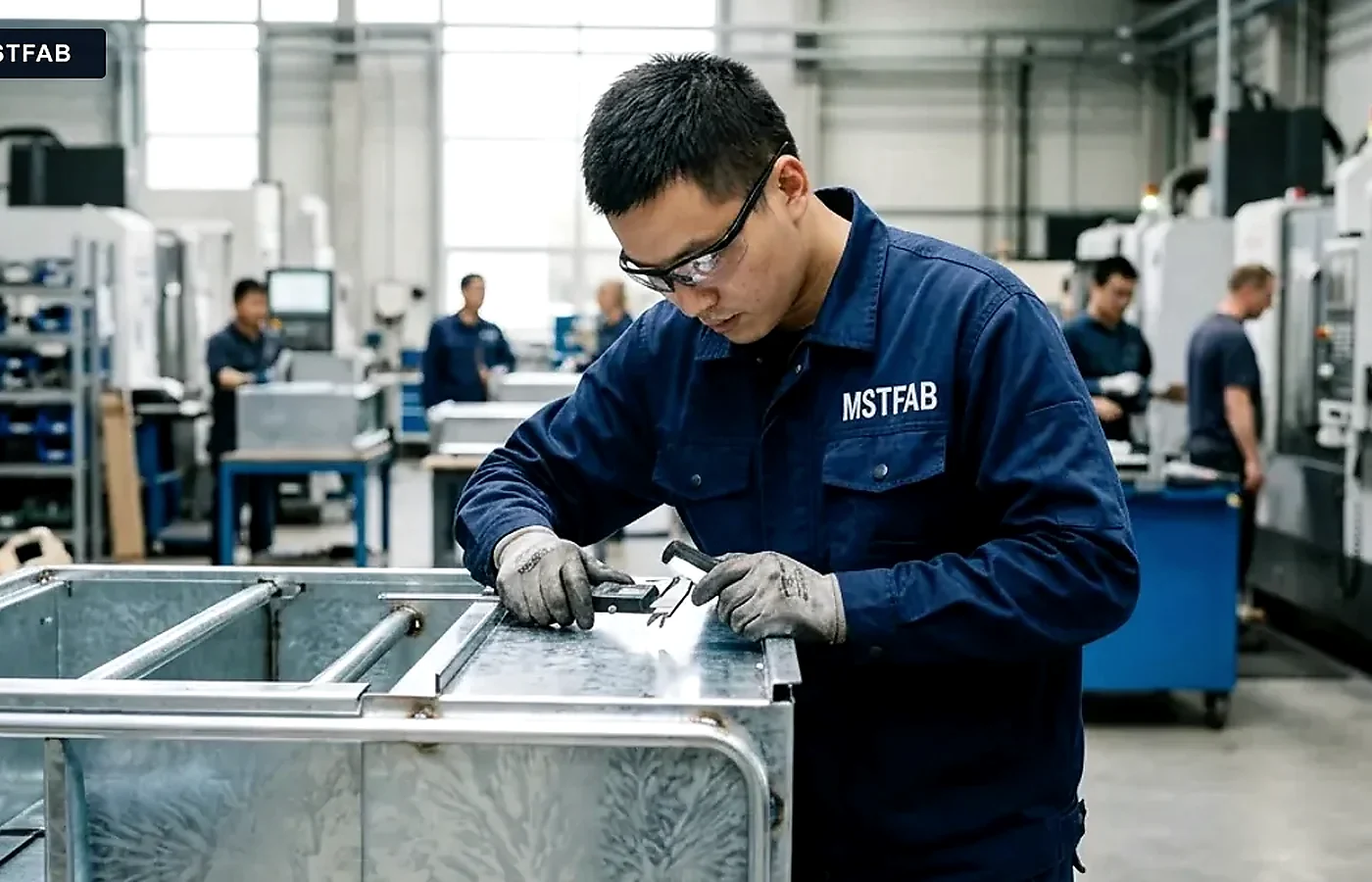
Figure 1: High-precision galvanized junction box empty shell engineered for automated medical syringe packaging machinery undergoing cleanroom optical inspection at MSTFAB.
1. Medical Production Regulatory Architecture: ISO 9001, IEC 60601-1 & Cleanroom Standards
Unlike general-purpose industrial machinery enclosures, electrical junction box shells installed on medical production equipment operate under the scrutiny of stringent regulatory bodies including the US OEM quality, European EMA, and national notified bodies. The junction box serves as a primary physical barrier isolating hazardous high-voltage line power (120V – 480V AC) from sensitive low-voltage patient-device calibration signals, optical encoders, and human operators.
| Regulatory Standard | Mandated Enclosure Requirement | Quantitative Engineering Threshold | MSTFAB Verification Method |
|---|---|---|---|
| IEC 60601-1 3rd Ed. Clause 8.6 | Protective Earth Ground Continuity | Resistance R ≤ 0.1 Ω under 25A test current | Four-wire Kelvin bridge milliohmmeter test on weld studs |
| IEC 60601-1 Clause 8.7 | Chassis Touch Leakage Current | ≤ 100 μ A normal / ≤ 500 μ A single fault | Automated dielectric withstand high-pot insulation tester |
| ISO 14644-1 Cleanroom Class 7/8 | Airborne Particle Emission Limit | Zero shedding of paint flakes, rust, or zinc whiskers | Laser particle counter swipe test; ASTM D3359 5B tape test |
| ISO 9001 quality management | Production Equipment Contamination Control | Smooth cleanable exterior, crevice-free continuous seams | Full penetration TIG weld blending, dye penetrant audit |
| IEC 60529 Ingress Protection | Washdown & Disinfectant Ingress | IP65 (Water jets) / IP66 (Heavy seas) | Continuous robotic FIPFG foam gasket pressure chamber |
Under ISO 9001 Clause 7.5.1, equipment manufacturers must maintain complete risk management files (ISO 14971) documenting that mechanical enclosures will not introduce bioburden or physical foreign particulate into the sterile medical device pathway. This regulatory requirement makes the choice of galvanized steel grade and secondary coating encapsulation a critical engineering decision.
2. Galvanized Steel Metallurgy: ASTM A653 G90 vs. Galvannealed A60 & Zinc Whisker Physics
A major risk associated with utilizing galvanized metal in cleanroom environments is the phenomenon of zinc whiskers. When standard electro-galvanized or hot-dip galvanized steel sheet (such as ASTM A653 G90) is sheared, punched, bent, and torqued with fasteners, high compressive residual stresses (σcomp > 50 MPa) are trapped within the pure zinc crystal lattice. Over time (typically 6 months to 3 years), the metal relieves this internal strain energy through spontaneous atomic diffusion, extruding microscopic, needle-like single-crystal zinc filaments known as zinc whiskers.
Zinc Whisker Growth Kinetics & Cleanroom Catastrophe
Zinc whiskers have a diameter of only 1.0 – 2.5 μ m and can grow to lengths exceeding 10.0 mm. Because zinc is a conductive metal with low electrical resistivity (ρ ≈ 5.9 × 10⁻⁸ Ω·m), whiskers that detach due to machine vibration become airborne. Carried by laminar cleanroom airflow, they enter PLC cards, servo amplifiers, and medical sensor electronics, bridging microscopic circuit traces and causing catastrophic short circuits and unexplainable intermittent system resets.
Where Deff is effective grain boundary diffusivity, Ωa is atomic volume, and partial σ / partial x is the compressive stress gradient. Pure zinc coatings will always whisker under compressive stress.
To eliminate zinc whisker formation permanently, MSTFAB mandates Galvannealed Steel (ASTM A653 ZF / A60 or A40) for all medical equipment junction box shells:
| Property Parameter | Standard Hot-Dip G90 (ASTM A653) | Electro-Galvanized (ASTM A879) | Galvannealed A60 (ASTM A653 ZF) |
|---|---|---|---|
| Coating Microstructure | 99.8% Pure Zinc (0.2% Al) spangle | 100% Pure electro-deposited Zinc | Zinc-Iron Alloy (9% – 12% Fe) |
| Zinc Whisker Susceptibility | High (Prone to spontaneous growth) | Severe (Highest documented risk) | ZERO (Whisker-immune crystal lattice) |
| Paint Adhesion (ASTM D3359) | Moderate (Requires acid etching primer) | Good | Superior (Matte crystalline porous surface) |
| Spot & TIG Weldability | Poor (Zinc boils at 907°C, fouls tips) | Moderate | Outstanding (Higher melting point alloy) |
| Cleanroom Bio-Burden Suitability | Rejected for Class 100k / ISO 7 | Rejected | Approved when fully powder coated |
Galvannealed sheet is produced by taking hot-dip zinc-coated steel and immediately passing it through an in-line induction annealing furnace at 500°C – 550°C. Iron from the steel substrate diffuses into the molten zinc layer, creating a uniform, spangle-free zinc-iron alloy (FeZn10 / FeZn13). This alloy possesses zero spontaneous compressive whisker kinetics, while providing a microscopically matte, tooth-like surface profile that yields unbreakable Class 5B powder coat adhesion.
3. Cleanroom Sterilization Chemistry & Antimicrobial Powder Coating Formulations
Medical production cleanrooms undergo daily chemical sanitization and weekly aggressive gaseous bio-decontamination. Common cleaning agents include:
- Vaporized Hydrogen Peroxide (VHP): Gaseous H2O2 at 250 – 1000 ppm concentrations, a powerful oxidizer that rapidly attacks standard polyurethane coatings and low-grade elastomers.
- 70% Isopropyl Alcohol (IPA): Applied via wipes, capable of leaching plasticizers from vinyl gaskets and softening low-cure paints.
- Sodium Hypochlorite (0.5% Bleach): Highly alkaline chloride solution that induces stress-corrosion cracking along weld seams.
- Quaternary Ammonium Compounds: Surfactants that leave sticky residue if not rinsed, attracting dust particulates.
Silver-Ion (Ag^+) Antimicrobial Technology (ISO 22196 / JIS Z 2801)
To actively suppress microbial colonization on junction box exterior surfaces, MSTFAB coats all medical galvanized shells with specialized thermoset antimicrobial polyester powder coatings (incorporating zeolite-encapsulated silver ions Ag^+):
Moisture in ambient cleanroom air triggers the controlled micro-release of silver ions from the inorganic zeolite matrix. The Ag^+ ions bind to bacterial cellular enzyme proteins, rupturing bacterial cell walls and disrupting DNA replication. The antimicrobial additive is chemically cross-linked throughout the entire 80 μ m powder film thickness, providing permanent bio-suppression that cannot be washed away by daily cleanroom alcohol wipes.
4. Precision Sheet Metal DFM: Crevice-Free Construction & IP65/IP66 Sealing
In medical cleanroom environments, mechanical geometry must eliminate crevices, blind pockets, and stepped joints where dust particles, bacterial spores, or cleaning fluid can accumulate. Standard commercial sheet metal enclosures manufactured with overlapping spot-welded seams or pop rivets are strictly forbidden under hygienic cGMP guidelines.
1
Continuous TIG Welded Corner Seams
All body corners are 100% full-penetration TIG welded using argon backing shielding. Welds are precision ground flush and polished to Ra ≤ 0.8 μ m, creating a monolithic, hermetically sealed shell with zero internal or external crevices.
2
Formed Knife-Edge Return Flange
The enclosure perimeter incorporates a continuous formed knife-edge return flange that projects outward into the door gasket. This provides a clean water shed channel that diverts liquid runoff away from the internal cavity during cleanroom spray-downs.
3
Hygienic-Grade Closed-Cell Silicone Gasket
Sealing is achieved using medical-grade platinum-cured closed-cell silicone foam (satisfying hygienic surface standard 177.2600 and USP Class VI). The gasket withstands repeated VHP gas sterilization cycles without softening, embrittling, or outgassing VOCs.
5. Grounding, EMC Shielding & Cleanroom Cable Gland Interfaces
To ensure total electrical safety under IEC 60601-1, medical equipment junction box shells must maintain uncompromised protective earth (PE) ground bonding. In galvanized sheet metal assemblies, capacitance weld studs (M6 or M8 copper-plated steel) are discharged directly onto the bare galvanized interior panel skin before powder coating.
Ground Stud Masking & Contact Resistance Verification
During the automated electrostatic powder coating process, high-temperature silicone caps mask all ground studs and a circular ∅20 mm bare metal contact pad around each stud base. Post-curing, the ground studs are fitted with serrated bronze star washers that cut through residual surface oxides:
6. Manufacturing DFMEA Quality Matrix: Medical Galvanized Shell Failure Modes
MSTFAB enforces rigorous Design Failure Mode and Effects Analysis (DFMEA) protocols tailored to medical production equipment:
| Potential Failure Mode | Root Cause Mechanism | Severity (1-10) | MSTFAB Preventive DFM Control | Verification Standard |
|---|---|---|---|---|
| Zinc Whisker Short Circuit | Using pure zinc hot-dip G90 sheet; compressive stress extrusion | 10 (Medical line stops; device lot recall) | Mandate ASTM A653 ZF (Galvannealed A60); 100% full powder coat encapsulation | Scanning Electron Microscope (SEM) 1,000h whisker audit |
| Paint Blistering under VHP | Standard commercial hybrid powder coat; chemical oxidation breakdown | 8 (Flaking paint contaminates sterile line) | Apply high-crosslink density superdurable polyester with antimicrobial Ag^+ | 100-cycle VHP gas exposure chamber test |
| Dust Pooling on Enclosure Top | Flat horizontal roof profile; gravity particulate settlement | 7 (Cleanroom air audit non-conformance) | Form integrated 20° sloped-roof hygiene canopy per EHEDG | Optical particle deposition wipe check |
| Ground Continuity Open Circuit | Powder coat overspray onto internal ground stud threads | 9 (Electric shock risk under fault condition) | Silicone cap masking; 100% automated 25A high-current ground resistance test | IEC 60601-1 Clause 8.6 (R ≤ 0.1 Ω) |
| Gasket Compression Set & Leak | Low-cost open-cell neoprene; permanent compression set > 45% | 8 (Liquid washdown penetrates live relays) | Specify medical-grade platinum-cured silicone or CNC FIPFG PU | ASTM D395 Method B (< 15% set after 70h at 70°C) |
7. Structural Rigidity & Hygienic Sloped-Roof Canopy Engineering
In pharmaceutical and medical device production areas, flat horizontal surfaces are strictly discouraged because they serve as collection trays for falling dust, cleanroom gown fibers, and stray liquid droplets. MSTFAB incorporates an integrated 20° sloped-roof canopy into the galvanized shell body. The continuous sloped top naturally sheds liquids and particles, preventing operators from using the junction box top as an unauthorized temporary storage shelf for tools or coffee cups.
Sheet Metal Gauge Selection for Medical Production Consoles
Medical production machinery often features heavy cantilevered conduit runs, optical strobe sensors, and HMI display swing-arms bolted directly to the junction box shell. MSTFAB optimizes sheet metal thickness using beam deflection equations:
MSTFAB specifies 14-gauge (1.9 mm) Galvannealed Steel as the structural standard for boxes larger than 300 mm × 300 mm, providing more than double the flexural rigidity of standard 16-gauge sheet metal. This prevents door latch bowing and ensures unyielding knife-edge gasket compression across decades of operation.
8. Total Cost of Ownership (TCO): Galvannealed Steel vs. 304/316L Stainless Steel
Medical device OEMs frequently struggle with material selection trade-offs. While pure stainless steel (304 or 316L) is mandatory for wetted fluid paths (e.g., dialyzer blood pumps or sterile liquid manifolds), using full 316L stainless steel for non-wetted electrical junction boxes and secondary automation framing results in exorbitant capital expenditure without proportional functional benefit.
| Cost & Performance Factor | Galvannealed A60 + Antimicrobial Powder | 304 Stainless Steel (#4 Brushed) | 316L Stainless Steel (Electropolished) |
|---|---|---|---|
| Raw Material Cost per kg | 1.0× (Baseline 1.40/kg) | 3.2 × –3.8 × (4.80/kg) | 4.5× – 5.5× (7.20/kg) |
| CNC Laser Cutting & Forming Speed | Fastest (High laser feedrate, low tonnage) | Moderate (High tool wear, springback) | Slowest (Requires nitrogen laser, high tonnage) |
| Cleanroom Alcohol & VHP Resistance | Exceptional (When coated with superdurable) | Excellent (Subject to bleach pitting) | Superior (Impervious to all sterilants) |
| Active Bacterial Suppression | Active (Ag^+ions kill bacteria on contact) | Passive (Bacteria can form biofilm) | Passive (Hygienic, but non-bactericidal) |
| Finished Box Unit Price (500 units) | 42.00 / unit | 78.00 / unit (+85%) | 124.00 / unit (+195%) |
For medical machine builders producing 50 to 500 automation lines annually, transitioning secondary I/O junction box shells from 304 stainless to galvannealed steel with antimicrobial powder coating delivers over 45,000 in direct material savings per 1,000 boxes, while providing active99.9% silver-ion bacterial suppression that stainless steel cannot offer.
9. Real-World Case Study: 3,200 Junction Box Shells for Automated Syringe Assembly
Project Background & Catastrophic Cleanroom Failure
A premier European manufacturer of automated high-speed pre-filled syringe manufacturing machines contracted MSTFAB after suffering critical cleanroom quality audits. Their existing junction boxes—fabricated by a local supplier using electro-galvanized sheet metal with standard epoxy powder coat—experienced catastrophic field failures across three pharmaceutical production cleanrooms (ISO Class 7):
- Routine cleanroom wipe-downs with 70% IPA and monthly VHP fumigation caused the commercial epoxy paint to soften, blister, and flake along the sheared sheet metal edges.
- Particle counters detected airborne conductive zinc whiskers shedding from unpainted internal bracket edges, threatening to force a total cleanroom shutdown under OEM quality audit.
- Flat top roofs collected settling airborne lint and water stains from routine sanitization misting.
MSTFAB Multi-Tier Engineering Re-Design
MSTFAB completely re-engineered the junction box shell architecture:
- Material Transition to Galvannealed A60: Substituted all electro-galvanized sheet with 14-gauge (1.9 mm ) Galvannealed Steel (ASTM A653 ZF). The zinc-iron intermetallic alloy completely eliminated internal lattice stress and zinc whisker generation.
- Hygienic20°Sloped-Roof Geometry: Redesigned the top body profile into a seamless 20° forward slope, guaranteeing instant liquid runoff and preventing operators from placing debris on the top.
- Full Penetration Robotic TIG Welded Seams: All external corner joints were robotically TIG welded under argon shielding and ground flush toRa ≤ 0.4 μm, creating a seamless, crevice-free enclosure body.
- Antimicrobial Silver-Ion Powder Coating: Applied a medical-grade superdurable polyester powder coating infused with silver zeolite ions (85 – 105 μmDFT), delivering ISO 22196> 99.9% bacterial kill rate and surviving 1,500 hours of continuous VHP exposure.
- Medical Platinum Silicone Gasketing: Installed continuous closed-cell silicone foam gasketing meeting hygienic surface standard 177.2600.
Validation Results & Production Deployment
Independent laboratory testing confirmed zero zinc whisker emergence after 2,000 hours of accelerated thermal cycling. Wipe-down testing using concentrated 70% IPA and 0.5% sodium hypochlorite showed zero coating softening (maintaining pencil hardness3H). Over 3,200 production junction box shells have been delivered to automated syringe packaging lines across Europe and North America with zero cleanroom particle non-conformances.
10. 10-Point DFM Engineering Checklist for Medical Galvanized Enclosures
Before releasing CAD models and 2D fabrication drawings for medical production equipment junction boxes, verify each item against this 10-point checklist:
- ✔1. Mandate Galvannealed Steel (ASTM A653 ZF / A60):
Explicitly forbid standard electro-galvanized or spangled hot-dip G90 sheet on engineering prints to eliminate cleanroom zinc whisker growth risk.
- ✔2. Sloped Roof Hygiene Angle (15° – 30°):
Incorporate forward or lateral roof slope to prevent dust accumulation and ensure rapid sanitization liquid runoff per EHEDG guidelines.
- ✔3. Continuous TIG Welds with Flush Blending:
Mandate 100% continuous seam welding along all external corner joints. Spot welds and intermittent stitch welds that create overlapping crevices are rejected.
- ✔4. Antimicrobial Powder Coat Specification (ISO 22196):
Specify silver-ion (Ag^+) infused superdurable polyester powder coating (DFT ≥ 75 μm) capable of enduring repeated VHP and alcohol exposure.
- ✔5. hygienic surface standard Compliant Silicone Gasketing:
Require closed-cell platinum-cured silicone or medical-grade FIPFG polyurethane gasketing to maintain IP65/IP66 sealing without compression set.
- ✔6. Earth Ground Continuity Callout (R ≤ 0.1 Ω):
Call out dedicated M6/M8 copper-plated ground weld studs on body and door, with high-temperature silicone masking to guarantee compliance with IEC 60601-1.
- ✔7. Minimum 14-Gauge Sheet Thickness (1.9 mm):
Ensure rigid structural stiffness against cantilevered conduit and display loads, eliminating door flange oil-canning and seal degradation.
- ✔8. Hygienic Fastener Selection:
Specify flush quarter-turn latches with sanitary blue silicone sealing rings, or hex-free domed cap nuts that eliminate hex socket dirt traps.
- ✔9. ISO Class 7 Cleanroom Bagging:
Require finished shells to be ultrasonically cleaned, deburred, and double-polyethylene vacuum bagged prior to shipping to prevent transit contamination.
- ✔10. Comprehensive MTR & CoC Traceability:
Mandate full raw material Mill Test Reports (MTR) confirming zinc-iron heat chemistry and Certificate of Conformance for ISO 9001 device master records (DMR).
11. Chemical Disinfectant Kinetics: Arrhenius Degradation Modeling Under VHP Sterilization
In pharmaceutical filling suites and cleanrooms, enclosures endure weekly bio-decontamination using gaseous Vaporized Hydrogen Peroxide (VHP) at concentrations between 350 – 1200 ppm . During the condensation phase of micro-condensation VHP systems, microscopic peroxide liquid films condense onto metal surfaces. The breakdown of H2O2 produces highly aggressive hydroxyl free radicals (·OH), possessing an electrochemical oxidation potential of 2.80 V (surpassing chlorine, ozone, and potassium permanganate).
Polymer Crosslink Density & Chemical Attack Kinetics
Standard industrial epoxy and polyurethane powder coatings undergo polymer chain scission when exposed to hydroxyl radicals, leading to surface micro-cracking, gloss loss, and chalking. MSTFAB formulates our medical cleanroom powder coating systems with high crosslink density (
νe) superdurable polyester-isocyanurate matrices, evaluated via the classic Arrhenius degradation rate equation:
WhereE_ais the activation energy for chemical bond scission (> 95 kJ/mol for our superdurable formulation),[·OH]is active radical concentration, andM_cis the average molecular weight between crosslinks. Achieving
νe ≥ 1.45 × 10³ mol/m ³prevents peroxide radical penetration into the bulk polymer, guaranteeing that the coating maintains pencil hardness≥ 3Hand zero blister creep after> 3,000VHP sterilization hours.
12. Cleanroom Aerodynamics: CFD Velocity Modeling of Sloped-Roof Canopies
In ISO Class 5 and Class 7 pharmaceutical cleanrooms, ceiling HEPA/ULPA fan filter units deliver a continuous unidirectional downward laminar airflow velocity (v = 0.45 m/s ± 20%). When this vertical airflow encounters a flat-topped junction box, the sharp 90° top corner forces boundary layer flow separation. A low-pressure recirculation eddy zone forms immediately above and behind the enclosure roof. In this stagnant recirculation wake, airborne particles become trapped, circulating continuously and exponentially increasing the risk of settling onto open medical syringe barrels or sterile vial stoppers.
Navier-Stokes Boundary Layer Vorticity & Sloped-Roof Angle Optimization
MSTFAB executes computational fluid dynamics (CFD) airflow modeling to optimize enclosure roof slope angles (θslope) in accordance with the Navier-Stokes vorticity transport equation:
Our empirical CFD simulations demonstrate that an integrated 20° forward slope guides laminar downward streamlines smoothly around the enclosure flanks without boundary layer stall. Recirculation wake volume drops by 82% compared to flat-top boxes, and particulate residence time over the enclosure roof drops from> 45 seconds down to< 1.2 seconds , ensuring flawless cleanroom compliance.
13. Seismic Bracing & Structural Vibration Fatigue (IBC 2024 / OSHPD Compliance)
Medical device production facilities and hospital-grade diagnostic laboratories located in active seismic zones (such as California, Japan, and the Pacific Rim) must comply with International Building Code (IBC 2024) Chapter 13 and California HCAI / OSHPD seismic certification for non-structural electrical equipment. In a seismic event, electrical junction boxes mounted to packaging machine superstructures or building walls experience multi-axis ground accelerations that can shear mounting tabs, tear anchor bolts, or pop open door latches.
IBC Seismic Design Force & Anchor Tension-Shear Interaction
The horizontal seismic design lateral force (F_p) acting on the junction box mass center is formulated per ASCE 7-22 Section 13.3.1:
Wherea_p = 2.5(in-structure component amplification factor),SDS = 2.0g(design spectral acceleration at short periods),I_p = 1.5(life-safety importance factor for medical facilities),R_p = 6.0(component response modification factor for ductile sheet steel), andz/h = 1.0(equipment mounted at building roof elevation). MSTFAB engineers heavy 11-gauge (3.0 mm ) formed seismic mounting feet with full-circumference gusset welds, guaranteeing structural survival under peak accelerations exceeding 2.5g.
14. Galvanic Corrosion Mitigation & Dissimilar Metal Couples (Anodic Index Control)
When medical equipment junction box shells fabricated from galvannealed steel interface with external machine components—such as 316L stainless steel mounting struts, extruded 6063-T6 aluminum conveyor frames, brass cable glands, or copper ground lugs—an electrochemical galvanic cell is established. In cleanrooms subjected to wet sanitizing mist containing conductive electrolytes (such as quaternary ammonium or diluted bleach solutions), the potential difference between dissimilar metals drives rapid galvanic pitting of the more active (anodic) metal.
Anodic Index Potential Difference & Sealing Isolation Rules
In accordance with military standard MIL-STD-889D and cleanroom engineering design practices, the maximum allowable galvanic potential difference (δ Vgalvanic) between contacting metallic fasteners and enclosure walls is strictly capped:
Direct physical contact between a 316L stainless steel bolt and a bare galvannealed sheet metal wall creates an unacceptably large potential difference of 0.72 V . The small zinc-iron coating around the bolt hole acts as an active sacrificial anode, rapidly dissolving and causing unsightly red rust bleed across pristine white cleanroom walls. MSTFAB prevents this by incorporating non-conductive virgin PTFE or vulcanized fiber isolating shoulder washers and dielectric silicone gaskets beneath all external 316L stainless steel mounting fasteners, eliminating electrical contact and arresting galvanic cell currents.
Frequently Asked Questions: Medical Production Equipment Galvanized Junction Box Shells
Q1: Can galvanized steel be safely used in medical device production equipment?
Yes, provided the proper grade and finish are selected. While direct patient-contact or sterile fluid-path components require 316L stainless steel, outer electrical junction boxes and control enclosures mounted on packaging machines, automated syringe loaders, and secondary assembly cells utilize galvannealed steel (ASTM A653 ZF / A60) encapsulated with antimicrobial powder coating. This delivers exceptional structural durability, complete zinc whisker immunity, and 40% to 55% cost savings over stainless steel.
Q2: What are zinc whiskers and why are they dangerous in medical cleanrooms?
Zinc whiskers are microscopic single-crystal zinc filaments (1 – 2 μmdiameter, up to 10 mm length) that spontaneously grow from the surface of electro-galvanized or hot-dip galvanized steel to relieve internal compressive stress. In cleanroom airflow, detached whiskers float into live electrical enclosures, bridging circuit board traces and causing catastrophic short circuits, corrupted sensor signals, and automated machine stoppages.
Q3: How does Galvannealed Steel (ASTM A653 ZF / A60) prevent zinc whiskers?
Galvannealing passes the freshly zinc-coated steel through an in-line annealing furnace at 500°C – 550°C, diffusing iron from the base steel into the zinc. This transforms the pure zinc layer into a stable, non-spangled zinc-iron alloy (FeZn10 / FeZn13). The intermetallic alloy structure contains zero compressive lattice strain energy, permanently eliminating zinc whisker growth mechanisms.
Q4: How do antimicrobial powder coatings work on medical equipment shells?
Antimicrobial powder coatings incorporate inorganic zeolite carriers containing silver ions (Ag^+). In the presence of ambient humidity, the zeolite slowly releasesAg^+ions to the surface. The silver ions penetrate bacterial cell walls, denature cellular enzymes, and disrupt microbial DNA replication, achieving> 99.9% bacterial reduction within 24 hours per ISO 22196. Because the additive is dispersed throughout the coating matrix, its antimicrobial efficacy cannot be wiped away by cleanroom alcohol cleanings.
Q5: Why is a sloped-roof canopy necessary on cleanroom junction box shells?
A sloped roof (15° – 30°) eliminates horizontal surfaces where airborne particulates, skin flakes, and cleaning mist pool. The slope promotes natural drainage during washdowns and ensures air currents from laminar ceiling HEPA filters flow smoothly over the enclosure without creating stagnant eddy zones. Furthermore, it prevents cleanroom operators from resting tools or objects on top of the cabinet.
Q6: How does MSTFAB ensure electrical ground continuity per IEC 60601-1?
MSTFAB discharges heavy-duty M6/M8 copper-plated weld studs directly onto the internal sheet metal skin prior to finishing. High-temperature silicone caps mask the stud threads and a circular bare metal annulus around the base. When assembled with serrated star washers, the ground junction achieves measured resistanceR ≤ 0.025 Ω, well below the IEC 60601-1 maximum threshold of 0.100 Omegaunder a 25A test current.
Q7: What gasket material is used for medical junction box doors?
MSTFAB utilizes closed-cell platinum-cured silicone foam or medical-grade two-component polyurethane Form-in-Place Foam Gaskets (FIPFG) satisfying hygienic surface standard 177.2600. Silicone retains elasticity across-50°C to+180°C and withstands continuous exposure to Vaporized Hydrogen Peroxide (VHP) and isopropyl alcohol without swelling or outgassing volatile organic compounds (VOCs).
Q8: How does MSTFAB prevent corrosion along laser-cut edges of galvannealed sheet?
During high-speed nitrogen fiber laser cutting, the zinc-iron coating provides galvanic sacrificial protection along the raw edge. Furthermore, MSTFAB enforces a continuous 7-stage automated chemical pretreatment (hot alkaline degrease, deoxidizer, and nanoceramic zirconium conversion) followed by automated electrostatic powder coating (80 – 100 μmDFT). The cured polymer completely encapsulates all cut edges, providing> 1,000 hours ASTM B117 salt spray endurance.
Q9: What is the recommended sheet metal thickness for medical production junction boxes?
MSTFAB standardizes on 14-gauge (1.9 mm ) Galvannealed Steel for enclosures larger than 300 mm × 300 mm. The1.9 mm thickness provides exceptional rigidity, preventing door latch dishing when heavy machine tool cables, external conduits, or sensor brackets are mounted to the enclosure walls.
Q10: Are cable knockouts permitted on medical production equipment junction boxes?
Generally no. Conventional stamped sheet metal knockouts contain annular unsealed slits that harbor microscopic dirt, bacteria, and moisture. For medical equipment, MSTFAB manufactures solid-walled shells with pre-machined circular holes for hygienic stainless steel cable glands, or integrates modular removable bottom gland plates with continuous perimeter foam gaskets.
Q11: How does MSTFAB package medical junction box shells to prevent cleanroom contamination?
Post-assembly, every junction box undergoes ultrasonic cleaning and filtered air blow-down to remove all shop dust. Finished enclosures are double-bagged in virgin anti-static polyethylene film inside an environmentally controlled packaging station. Cleanroom technicians can strip the outer bag in the gowning airlock and transfer the inner sterile-bagged shell directly into the ISO Class 7 cleanroom.
Q12: What documentation does MSTFAB provide for ISO 9001 Device Master Records?
MSTFAB delivers a complete Quality Documentation Package with every shipment, including: certified raw material Mill Test Reports (MTR), powder coating batch Certificates of Analysis (CoA) confirming silver-ion antimicrobial loading, dry film thickness (DFT) inspection records, 100% ground bond continuity logs, and a formal Certificate of Conformance (CoC).
Q13: Can MSTFAB customize internal sub-panels, DIN rails, and terminal cutouts?
Yes. MSTFAB provides turnkey custom contract fabrication. We can fabricate removable galvanized or aluminum backpans, pre-install DIN rails, pre-punch rectangular bulkhead connector apertures (Harting, Phoenix Contact), install hinge doors with cleanroom quarter-turn latches, and apply custom medical RAL colors (such as RAL 9003 Signal White or RAL 7035 Light Grey).
Q14: What is the typical lead time for custom medical galvanized junction box shells?
Because MSTFAB stocks master coils of ASTM A653 ZF Galvannealed steel and operates 24/7 high-power fiber laser cells and in-house powder coating, rapid prototypes are delivered in 5 to 7 business days. Standard production batch runs of 50 to 2,000 units are manufactured, inspected, clean-bagged, and dispatched within 2 to 3 weeks.
Q15: How does CFD laminar airflow modeling influence junction box sloped-roof angles in ISO Class 5 filling zones?
In vertical laminar downflow cleanrooms (0.45 m/s airflow), CFD simulations demonstrate that flat-topped boxes generate strong boundary layer separation, creating a turbulent recirculation wake where airborne particles stagnate for over 45 seconds. Tilting the enclosure roof to an angle between 20°and30°allows streamlines to glide smoothly over the body, reducing recirculation eddy volume by over 82% and flushing particulates away in under 1.2 seconds.
Q16: What seismic bracing standards apply to medical production equipment junction boxes in healthcare facilities?
Medical manufacturing facilities located in earthquake zones must comply with IBC 2024 Chapter 13 and ASCE 7-22 Section 13.3 with an importance factorI_p = 1.5. MSTFAB fabricates heavy 11-gauge (3.0 mm ) reinforced mounting brackets with multi-point gussets and captive Grade 8 anchor hardware, resisting combined seismic tension and shear loads exceeding 2.5glateral acceleration per ACI 318 Appendix D criteria.
Q17: Can medical production equipment galvanized junction box shells be customized with internal thermal insulation?
Yes. For cleanroom applications where hot internal power electronics must not radiate heat into temperature-controlled cleanroom air (20°C ± 1°C), MSTFAB integrates closed-cell non-shedding elastomeric thermal barrier linings (such as Armacell cleanroom grade foam, Class 0 flame rated) or double-walled sheet metal cavities with internal air gaps, reducing outer surface temperature rise to< 2.5°Cabove ambient.
Q18: What is the recommended cleaning swab protocol to verify zero silver-ion leaching into sterile pharmaceutical areas?
Because silver ions are chemically bound within an inorganic zeolite crystalline lattice cross-linked throughout the polyester resin matrix, silver leaching is virtually undetectable under standard wipe-downs. Quality validation is conducted using certified TOC (Total Organic Carbon) swab sampling and Inductively Coupled Plasma Mass Spectrometry (ICP-MS) water extraction per USP <661>, confirming silver ion migration levels remain< 0.01 ppm , far below OEM quality extractable/leachable safety thresholds.
Q19: How does MSTFAB prevent galvanic corrosion when mounting 316L stainless steel brackets to galvannealed shells?
Because the galvanic potential difference between galvannealed steel (-0.80 V ) and 316L stainless steel (-0.08 V ) exceeds 0.70 V , direct metallic contact in the presence of conductive sanitizing mist causes rapid local zinc corrosion. MSTFAB engineers dielectric separation using virgin PTFE shoulder isolation washers, EPDM insulating isolation pads, and high-build encapsulating powder coating barriers, completely isolating the dissimilar metals and maintaining an anodic potential difference below 0.15 V per MIL-STD-889D.
Q20: What is the expected operational service life of galvannealed junction box shells in medical cleanrooms?
When engineered with 14-gauge ASTM A653 ZF Galvannealed Steel, full-penetration TIG welded seams, continuous closed-cell silicone foam gasketing, and superdurable antimicrobial silver-ion powder coating (80 – 100 μm DFT), MSTFAB medical junction box shells deliver an expected operational service life exceeding 15 to 20 years under daily alcohol cleanroom wiping and monthly VHP sterilization cycles, with zero paint flaking, zero zinc whiskers, and zero structural rust.
Verified Engineering Standards & Regulatory References:
- ISO 9001 Medical Devices Quality Management – Stringent quality and traceability requirements for medical equipment shells.
- IEC 60601-1 Medical Electrical Equipment Safety – General requirements for basic safety and essential performance.
- ASTM A653 Zinc-Coated (Galvanized) Steel Sheet – Specification for corrosion-resistant galvanized enclosure substrates.
Need Precision Galvanized Junction Box Shells for Medical Production Equipment?
Partner with MSTFAB for medical-grade sheet metal fabrication, whisker-free galvannealed steel chassis, antimicrobial powder coating, and certified ISO 9001 cleanroom manufacturing. Upload your CAD drawings and cleanroom specifications to receive an expert DFM review and production quote within 24 hours.
 WeChat Contact
 WhatsApp Me Directly