
The Short Answer
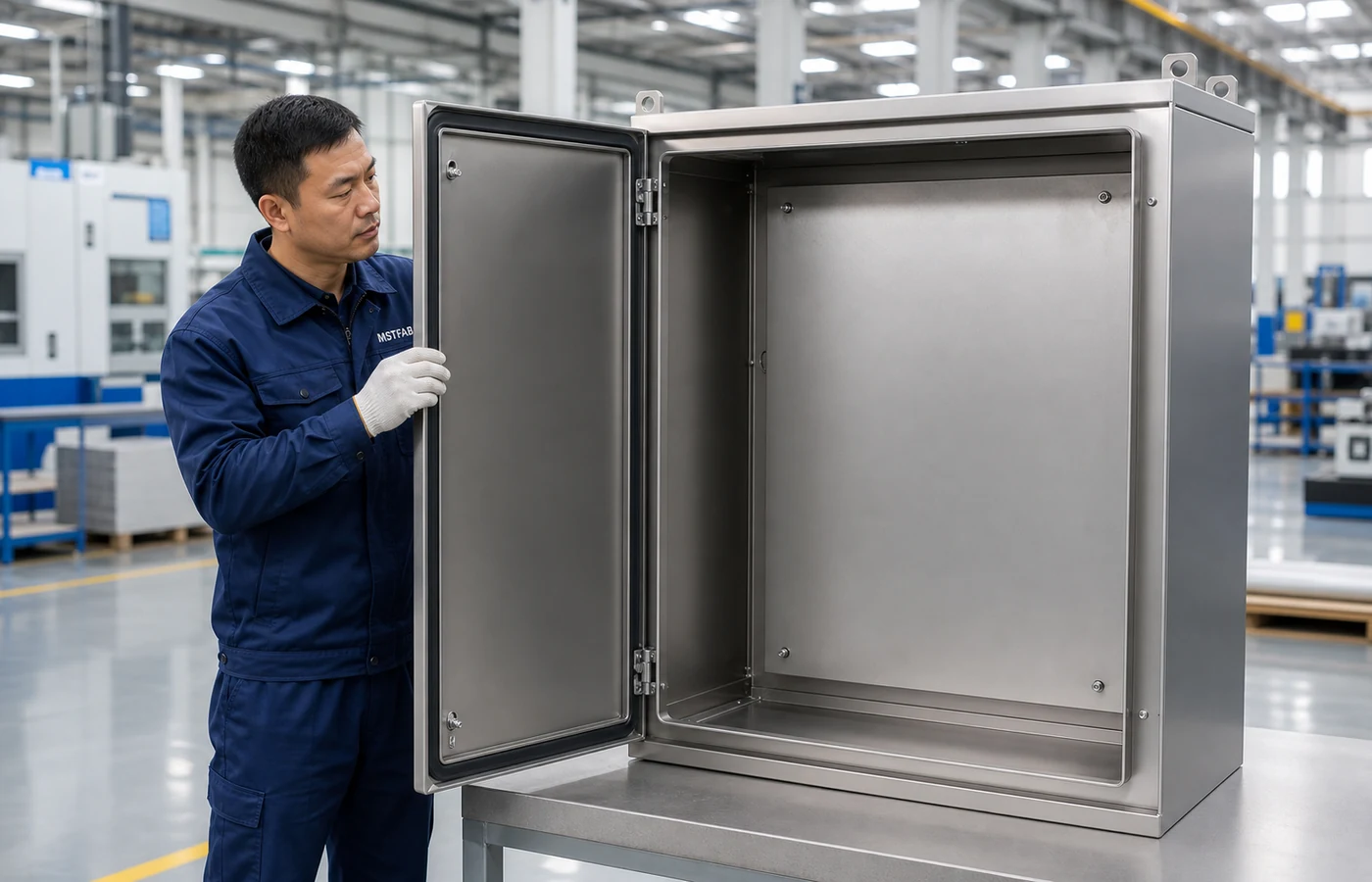
Designing an empty medical distribution enclosure shell for NEMA 4X-oriented washdown and cleanroom environments requires translating chemical sanitization and hose-down exposure into explicit sheet metal geometry on your released drawing. Rather than relying on a generic “NEMA 4X stainless” note, specify 304L or 316L alloy grades, a 15-to-30-degree sloped roof with drip overhang, continuous sealed TIG welds, knife-edge door gasket lands with positive compression stops, external mounting feet, and ASTM A967 passivation verified through First Article Inspection (FAI).
Explore this guide
01 / Washdown Exposure and Deliverable Boundary
Translate sanitization chemistry and spray pressure into mechanical drawing inputs.
Power and control distribution enclosures installed in pharmaceutical cleanrooms, sterile compounding suites, diagnostic reagent plants, and hospital sterilization corridors face far harsher chemistry than standard industrial rain. Daily decontamination routines expose the sheet metal shell to quaternary ammonium compounds, vaporized hydrogen peroxide (VHP), isopropyl alcohol, peracetic acid, and diluted sodium hypochlorite (bleach), often followed by directed hose-down rinses.
Because a custom sheet metal fabricator supplies the unpopulated mechanical housing to your print, achieving a NEMA 4X or IP66/IP69K-oriented barrier starts with locking down the alloy, joint seal continuity, and penetration rules before cutting metal.
Chemical and chloride profile
Identify whether routine wipe-down uses mild alcohols (suitable for 304L) or chlorinated/sporicidal oxidizers that demand 316L molybdenum-bearing stainless steel.
Spray direction and shedding
Eliminate flat horizontal top surfaces, recessed bolt pockets, and unsealed lap joints where washdown water or chemical condensate can stagnate.
External mounting isolation
Use welded external mounting lugs or sanitary wall-standoff bosses so installers never drill unsealed mounting holes through the back wall on site.
Responsibility boundary: MSTFAB manufactures custom empty sheet metal enclosure shells, sub-panels, and welded brackets to your controlled drawings under an ISO 9001 quality system. Final electrical integration, cord-grip sealing, and system-level NEMA 250 / IEC 60529 ingress testing remain with the OEM.
02 / Sloped Roofs and Crevice-Free Forming
Eliminate liquid traps with sloped hoods, drip shields, and continuous welds.
On a flat-topped electrical box, washdown spray and airborne disinfectant mist collect in puddles that slowly attack top seams and drip onto internal terminal blocks the moment a technician opens the door. Proper sanitary sheet metal DFM sheds liquid automatically by gravity.
- Integrated 15° to 30° sloped top: Form the enclosure hood with a forward or side-shedding pitch of at least 15 degrees (20°–30° preferred in cleanroom washdown zones) so liquids run off immediately and operators cannot place tools or sample vials on top of the box.
- Overhanging upper drip trough: Extend the sloped roof flange 12 mm to 20 mm past the upper door plane, or form an angled rain/washdown gutter above the door return lip to deflect direct overhead spray away from the top gasket line.
- Continuous crevice-free seam welds: Specify 100% continuous full-penetration TIG or fiber-laser seam welding along all corner joints and roof-to-body transitions. Intermittent stitch welds filled with cosmetic caulk will crack under thermal cycling and harbor microbial contamination.
Coordinating precision fiber laser cutting with multi-axis CNC press brake bending allows us to fold the back wall, side walls, and perimeter trough returns from fewer blanks—reducing total weld seam length across the housing.
03 / Knife-Edge Sealing and Compression Latches
Control gasket compression between 25% and 35% across the entire door perimeter.
Washdown leaks almost always trace back to uneven gasket compression: either the door bows outward between widely spaced latches, or over-tightened cams crush the elastomer past its compression-set limit until it splits. The metal shell and door must work together as a controlled mechanical spring-stop system.
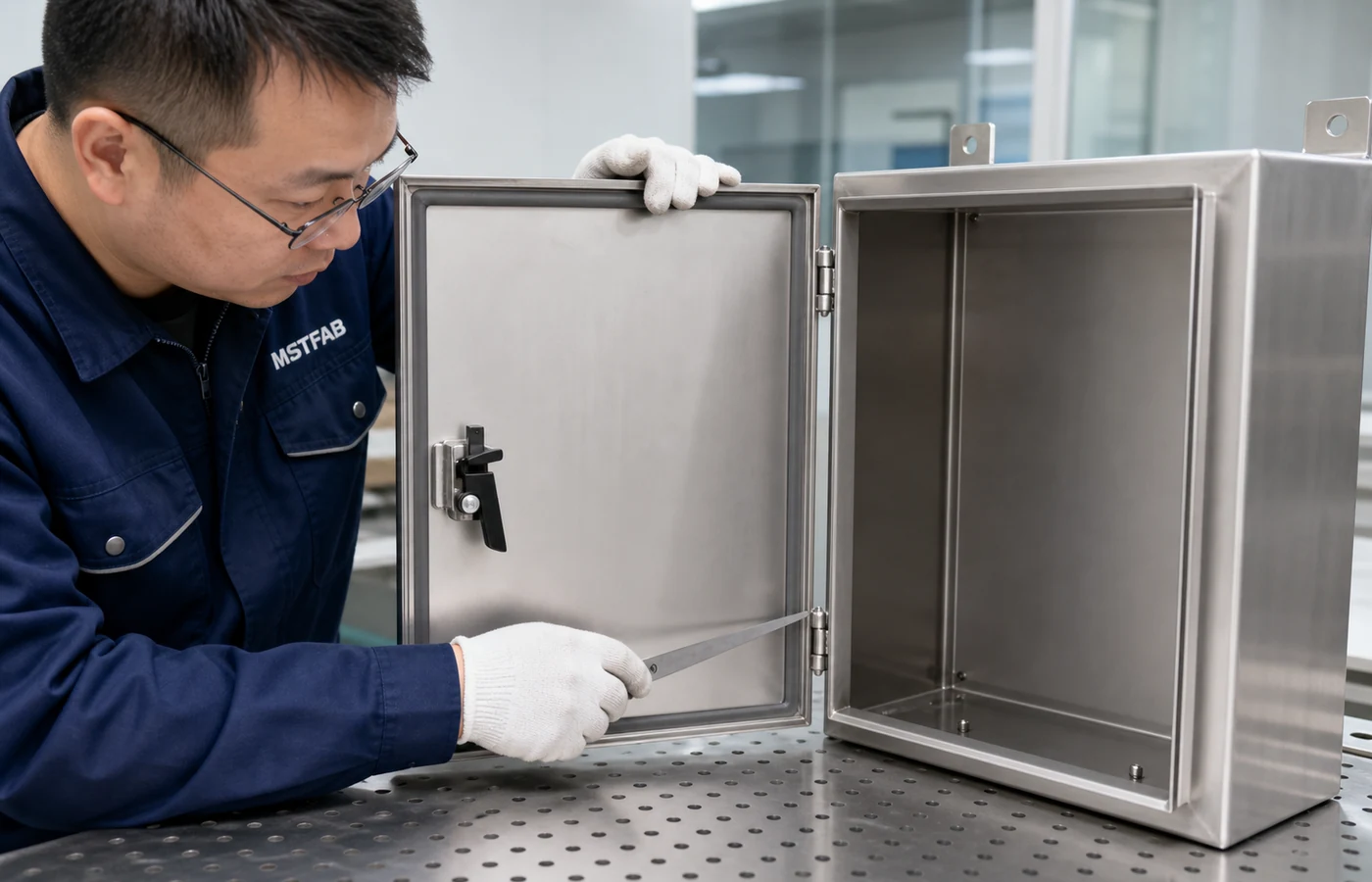
- Form a turned-back U-channel or hemmed “knife-edge” sealing rim around the cabinet opening with a smooth 1.5 mm to 3.0 mm radius so the metal lip indents the door gasket evenly without slicing the elastomer skin.
- Weld welded corner joints along the sealing lip flush and blend them smooth to the parent metal plane; even a 0.4 mm weld crown on a corner mitre creates a capillary leak path adjacent to the bead.
- Specify hygienic compression latches (with external O-ring shaft seals and mirror-polished stainless housings) spaced every 150 mm to 220 mm along tall doors, paired with internal metal-to-metal dead stops that prevent technicians from compressing the silicone or EPDM gasket beyond 35%.
- Use closed-cell platinum-cured silicone or peroxide-cured EPDM gasket profiles (either form-in-place dispensed foam or continuous vulcanized-corner picture-frame gaskets) rather than butt-spliced adhesive foam tape.
Reviewing hinge barrel offset and latch grip range during pre-production DFM ensures that the door pulls squarely against the perimeter knife-edge land without binding on the hinge side.
Explore precision stainless steel TIG and laser welding capabilities →
04 / Metallurgy, Surface Ra, and Passivation
Restore the chromium-oxide passive film after welding and mechanical blending.
Selecting 316L stainless steel sheet is only half of the corrosion defense. Welding heat tint, iron transfer from carbon-steel shop tools, or coarse grinding scratches create microscopic galvanic cells that rust and pit within weeks of bleach or saline washdown exposure.
- 304L vs. 316L low-carbon grades: Always specify low-carbon “L” grades (304L or 316L, carbon <= 0.03%) on welded washdown enclosures to prevent chromium carbide precipitation (sensitization) in the weld heat-affected zone.
- Controlled surface roughness (Ra <= 0.8 um): Specify a unidirectional #4 sanitary brushed finish or fine glass-bead blast with an explicit surface roughness limit (typically Ra <= 0.8 um / 32 uin) so disinfectants wipe clean without catching lint or biofilm.
- Dedicated stainless abrasive tooling: Grind and blend external weld seams using iron-free aluminum-oxide or zirconia abrasives reserved exclusively for austenitic stainless steel to prevent free-iron cross-contamination.
- Chemical passivation per ASTM A967: After all cutting, bending, stud welding, and grain blending are complete, subject the enclosure to nitric or citric acid passivation per ASTM A967 (or electropolishing per ASTM B912) to strip free surface iron and enrich the protective Cr2O3 passive layer.
See our surface treatment and passivation options to match grain direction, Ra targets, and chemical treatment records to your cleanroom specification.
05 / Washdown DFM Verification Matrix
Align engineering, quality, and purchasing on washdown shell acceptance.
Use this verification matrix during drawing release to confirm that every corrosion, sealing, and dimensional control is documented before batch fabrication begins.
06 / First Article Inspection (FAI) Handoff
Verify gasket seat geometry, door fit-up, and knockout accuracy during FAI.
A washdown distribution enclosure can pass basic outside-dimension checks and still fail wet testing if the door frame twists 1.5 mm diagonally during corner welding or if hygienic latch holes are slightly off-center.
During First Article Inspection under our ISO 9001 quality management system, MSTFAB measures diagonal frame squareness, knife-edge flange coplanarity, hinge-to-latch pitch, and internal DIN-rail / sub-panel mounting stud positions against your ballooned 2D drawing.
We also perform a physical mechanical fit-up of the hinged door, sanitary compression latches, and removable internal backplate—documenting reveal gaps and latch engagement before releasing the production lot.
07 / Cleanroom-Ready Packing and Scope
Protect passivated grain and sealing rims from transit damage.
Even minor dents along a knife-edge gasket lip or scratches across a #4 brushed 316L door will cause rejection at a medical OEM receiving dock. We apply low-tack laser/PVC protective film to brushed surfaces, fit high-density foam channels over sealing flanges, seal each shell in clean polyethylene bagging, and crate assemblies in ISPM-15 export plywood boxes.
When sourcing washdown distribution boxes alongside custom sheet metal fabrication machine frames and cleanroom carts, consolidating your stainless metalwork keeps grain finish and passivation documentation consistent across the whole system.
Manufacturing scope: MSTFAB manufactures custom drawing-based empty sheet metal enclosure shells, internal mounting panels, and welded stainless steel brackets under an ISO 9001 quality management system. Electrical switchgear installation, gasket certification, and final third-party NEMA 4X / IP66 / IP69K or regulated medical system certification remain the responsibility of the OEM.
08 / Ready-to-Quote Washdown RFQ Package
Include eight engineering inputs when quoting washdown distribution enclosures.
- 3D STEP assembly modelInclude the sloped-roof shell, hinged door, internal sub-panel, and external mounting lugs.
- 2D PDF drawing with CTQsCall out knife-edge land flatness, diagonal squareness, and knockout positional tolerances.
- Stainless steel grade and gaugeSpecify 304L or 316L thickness for the body, door, and galvanized or stainless sub-plate.
- Weld seam and blending mapIdentify continuous sealed seams, interior fillet rules, and exterior flush-grained corners.
- Surface Ra and passivation specState #4 brushed grain or bead blast, maximum Ra (e.g., <= 0.8 um), and ASTM A967 passivation.
- Gasket and latch specificationClarify whether MSTFAB supplies/installs the silicone/EPDM gasket and sanitary latches or builds to your hardware.
- Grounding and stud scheduleList M6/M8 protective-earth weld studs, door-to-body ground straps, and sub-panel standoffs.
- FAI and material cert scopeRequest EN 10204 3.1 mill certificates, profilometer Ra logs, and ballooned FAI reports up front.
Defining these eight washdown criteria in your initial RFQ eliminates quoting guesswork and ensures the first prototype shell seals cleanly on your test rig.
Engineering FAQ: NEMA 4X-oriented medical washdown enclosure shells
When should we upgrade from 304L to 316L stainless steel for a medical distribution enclosure?
Use 304L stainless steel for general cleanrooms and clinical areas wiped down with isopropyl alcohol or mild quaternary ammonium detergents. Upgrade to 316L stainless steel (which contains 2%–3% molybdenum) whenever the enclosure is exposed to sodium hypochlorite (bleach), peracetic acid, hydrogen peroxide vapor, saline solutions, or high-temperature sterile washdowns that cause chloride pitting.
Why is a sloped roof preferred over a flat top on cleanroom and medical washdown boxes?
A 15-to-30-degree sloped roof prevents washdown water and chemical disinfectants from pooling on top of the enclosure where liquid could seep past the upper door gasket upon opening. It also prevents cleanroom personnel from setting instruments, bottles, or clipboards on top of the electrical housing.
How should wall mounting be designed so installers do not compromise the washdown seal?
Never rely on open bolt holes drilled through the back wall of the enclosure cavity. Instead, specify heavy-gauge 316L external mounting feet welded to the outside rear corners, or welded blind tapped bosses with standoff spacers that leave a 10 mm to 15 mm cleanable air gap behind the enclosure.
What is a knife-edge gasket land and why does corner weld blending matter?
A knife-edge gasket land is a formed 90-degree or hemmed perimeter lip around the cabinet opening that presses into a soft foam or bulb gasket on the door. If the mitered corner welds on that lip are left proud or uneven, the gasket cannot seal the microscopic step beside the weld bead—so corners must be TIG-welded and dressed completely flush.
Does MSTFAB supply third-party NEMA 4X certified catalog boxes or custom empty shells to print?
MSTFAB is a custom contract manufacturer of build-to-print sheet metal parts and empty enclosure shells operating under an ISO 9001 quality management system. We fabricate the mechanical housing, sloped hood, knife-edge flanges, and passivated finishes to your engineering drawings so your team can integrate electrical components and complete system-level ingress testing.
What inspection records can MSTFAB provide with washdown enclosure shipments?
When specified in the PO, we provide EN 10204 3.1 stainless steel mill test certificates, XRF alloy verification records, surface roughness (Ra) measurements, ASTM A967 passivation batch certificates, and a ballooned First Article Inspection (FAI) dimensional report.
Technical references
Reference these industry standards for enclosure ingress protection, stainless steel chemical passivation, and hygienic surface design when preparing your drawings.
- NEMA 250 — Enclosures for Electrical Equipment (1000 Volts Maximum)
- IEC 60529 — Degrees of Protection Provided by Enclosures (IP Code)
- ASTM A967 / A967M — Standard Specification for Chemical Passivation Treatments for Stainless Steel Parts
- 3-A Sanitary Standards — Hygienic Equipment Design Principles for Cleanable Enclosures
Ready for a DFM review on your washdown medical enclosure drawings?
Send your 3D STEP assembly model, 2D PDF tolerances, stainless grade, and passivation requirements. Our engineering team will review seam geometry, gasket lands, and FAI controls before quoting.
Request NEMA 4X DFM Consultation →
Have a question first? caroline@mstfab.com
 WeChat Contact
 WhatsApp Me Directly