
From precision avionic wire harness retainers, heavy industrial motor mount cleats, and telecommunications rack chassis brackets to medical diagnostic console supports and structural battery tray cleats, custom sheet metal brackets represent the essential mechanical sinews connecting modern machines. When developing new capital equipment, industrial machinery, or pilot-run robotics, original equipment manufacturers (OEMs) frequently require production quantities ranging from 20 to 1,000 units. For these batch sizes, investing 15,000 to45,000 in dedicated progressive stamping dies is economically unviable and technically rigid. As an ISO 9001:2015 certified low-volume custom sheet metal brackets supplier, MSTFAB delivers precision soft-tooling fabrication—combining high-speed fiber laser cutting, precision multi-axis CNC press brake forming, automated hardware insertion, and certified surface finishing with zero hard-tooling NRE investments.
Table of Contents
- 1. The Economics of Low-Volume Brackets: Soft Tooling vs. Progressive Stamping Dies
- 2. Bracket Metallurgy & Material Selection: Mild Steel, HSLA, Aluminum, and Stainless Steel
- 3. Precision Thermal Blanking: High-Pressure Nitrogen Fiber Laser Cutting
- 4. CNC Press Brake Forming Mechanics: K-Factors, Gussets, and Stiffener Ribs
- 5. FEA Stress Simulation & Dynamic Vibration Optimization for Cantilever Brackets
- 6. Robotic Bending Automation for High-Mix / Low-Volume Bracket Batches
- 7. Fastening Technologies: Extruded Tapped Collars, Clinch Fasteners (PEM), and Weld Studs
- 8. Surface Pretreatment & Corrosion Protection: Zinc Plating, Anodizing, and Powder Coating
- 9. Critical DFM Engineering Rules for Sheet Metal Brackets
- 10. Quality Metrology: CMM Probing, Optical Vision Systems, and FAI Documentation
- 11. Comprehensive Engineering Data Matrices and Sourcing Benchmarks
- 12. Real-World OEM Case Studies: Precision Bracket Validations
- 13. Frequently Asked Technical Questions (44 Detailed Engineering Q&As)
1. The Economics of Low-Volume Brackets: Soft Tooling vs. Progressive Stamping Dies
In mechanical product engineering, mounting brackets are frequently perceived as simple hardware. In practice, however, they represent critical load-bearing interfaces that dictate structural rigidity, vibration damping, and assembly alignment. When annual production volumes range from 20 to 1,000 units, traditional manufacturing methods present a severe financial dilemma:
The Progressive Stamping Trap
Hard progressive stamping dies require substantial capital commitments—typically 18,000 to45,000 per die set—and 10 to 14 weeks of toolmaking lead time. If initial field testing reveals that a mounting hole pitch must shift by 3 mm or material gauge must increase from 2.0 mm to 2.5 mm to survive shock testing, the stamping die must undergo expensive EDM wire erosion rework or complete scrappage. The upfront amortization on a 250-piece pilot run adds over 100 per bracket in tooling burden alone!
The MSTFAB Agile Soft-Tooling Alternative
MSTFAB eliminates hard tooling through automated CNC soft-tooling fabrication:
- Zero Tooling NRE: Blanks are nested and cut directly from sheet coil or plate using high-power fiber lasers, and formed using multi-axis CNC press brakes with standard hardened segmented tooling. Digital CAD programming replaces physical dies.
- Total Engineering Revision Agility: Engineering Change Orders (ECOs) are executed in software in minutes with zero physical die alterations and zero scrap tooling costs.
- Rapid Lead Times: Production-intent First Article Inspection (FAI) prototypes ship within 5 to 7 working days, enabling fast validation cycles.
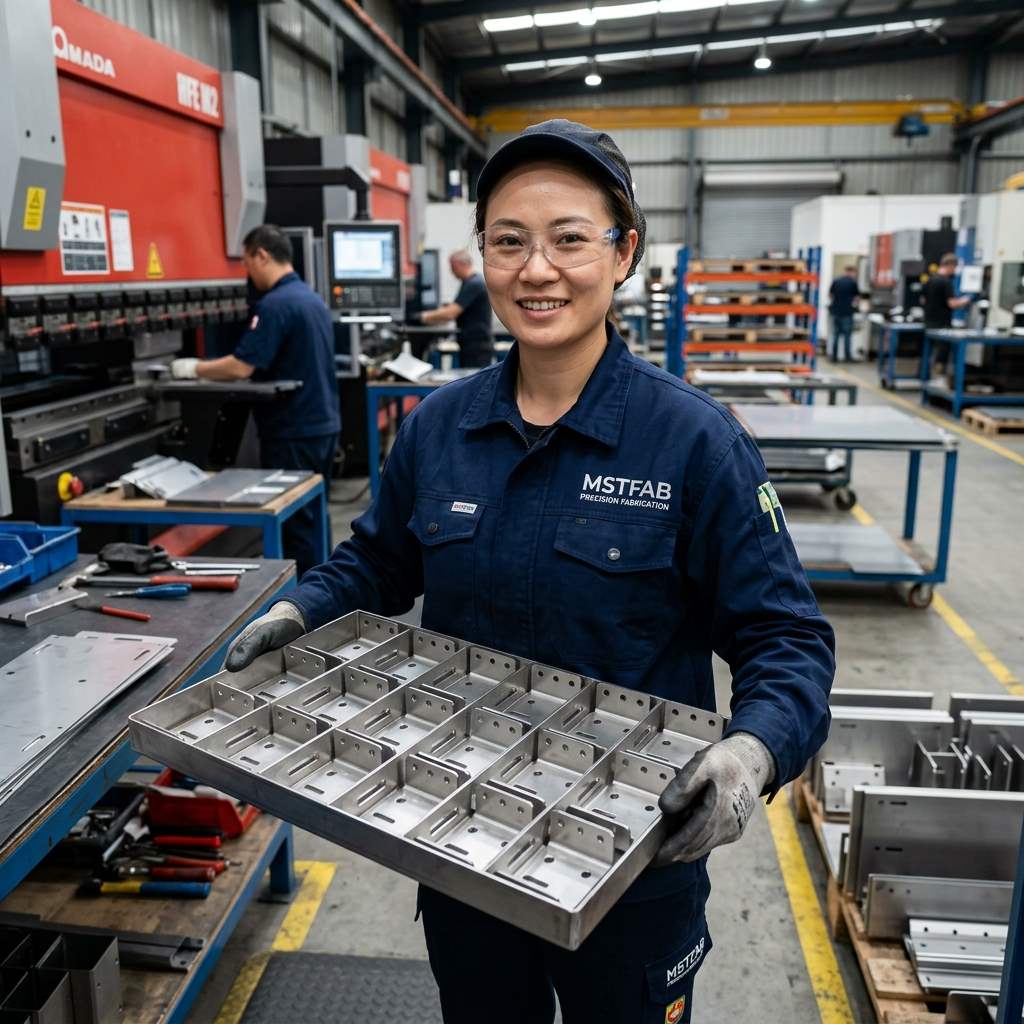
Figure 1: MSTFAB precision manufacturing: comprehensive batch inspection of low-volume custom sheet metal mounting brackets and cantilever structural cleats.
2. Bracket Metallurgy & Material Selection: Mild Steel, HSLA, Aluminum, and Stainless Steel
Selecting the optimal material dictates a bracket’s load-carrying capacity, fatigue endurance, weight, and environmental resistance:
1. Carbon & Mild Steel (SPCC / SPHC / ASTM A36)
Mild steel is the workhorse alloy for industrial mounting brackets, offering high modulus of elasticity (E = 205 GPa) and low raw material cost. Cold-rolled SPCC (T = 0.8 mm to 3.0 mm) provides smooth surfaces for precision electronics brackets, while hot-rolled pickled & oiled (SPHC / HRPO, T = 2.0 mm to 8.0 mm) is ideal for heavy industrial machinery mounts and engine brackets.
2. High-Strength Low-Alloy Steels (HSLA / Q345B / ASTM A572 Grade 50)
When mobile machinery, heavy commercial vehicles, or agricultural implements require maximum strength with minimum deadweight, HSLA steels deliver a minimum yield strength of 345 to 355 MPa (≈ 50% stronger than standard mild steel). This allows engineers to downgrade sheet thickness by 25% while maintaining identical structural deflection limits.
3. Aluminum Alloys (5052-H32 & 6061-T6)
For aerospace avionics, mobile robotics, medical devices, and electric vehicle battery enclosures where weight reduction is mandatory, aluminum provides one-third the density of steel (2.68 g/cm3). 5052-H32 offers superior ductility for tight-radius bends and excellent marine corrosion resistance, while 6061-T6 provides high yield strength (275 MPa) for rigid structural cleats.
4. Austenitic Stainless Steel (AISI 304 & 316L)
For food processing machinery, pharmaceutical cleanrooms, chemical processing skids, and marine washdown equipment, austenitic stainless steel provides impervious corrosion resistance. Alloy 316L with 2% molybdenum provides superior pitting defense in chloride environments.
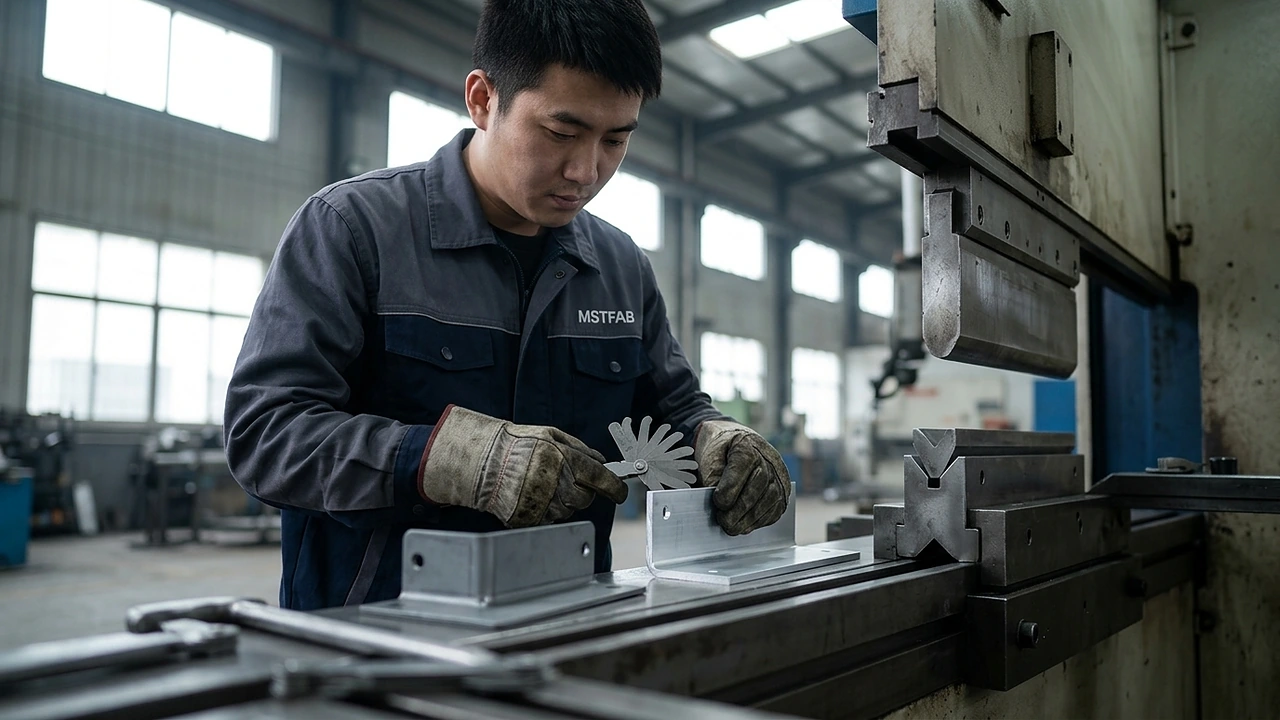
Figure 2: Forming verification: inspecting inside bend radii and flange perpendicularity on formed sheet metal brackets using calibrated precision radius gauges.
3. Precision Thermal Blanking: High-Pressure Nitrogen Fiber Laser Cutting
MSTFAB’s high-power CNC fiber lasers (6 kW to 20 kW) cut intricate bracket blanks with kerf tolerances of +/- 0.05 mm and razor-sharp geometric definition:
- High-Pressure Nitrogen Cutting (18 to 25 bar): Supersonic nitrogen assist gas mechanically blows molten metal from the kerf without exothermic combustion, leaving a 100% oxide-free, brilliant silver edge. Powder coating and electroplating adhere permanently without secondary edge descaling.
- Slotted Mounting Holes for Assembly Tolerance Absorption: To absorb tolerance stack-ups across mating weldments or structural frames, MSTFAB lasers precision elongated slotted holes (e.g. 9 mm x 18 mm slots for M8 bolts), allowing easy field adjustment during equipment installation.
- Structural Weight-Reduction Pocketing: Advanced laser cutting allows skeletonizing non-critical areas of brackets, reducing component weight by 30% to 45% while preserving cross-sectional moments of inertia along primary bending stress vectors.
- High-Density Nesting & Rapid Setup: Dynamic nesting software combines multiple bracket part numbers onto shared sheet blanks, optimizing raw material yield (> 82%) and slashing per-part material costs.
4. CNC Press Brake Forming Mechanics: K-Factors, Gussets, and Stiffener Ribs
Mounting brackets frequently support heavy cantilevered loads subject to dynamic shock and vibration. Ensuring structural performance requires mastering plastic deformation mechanics:
Beam Deflection and Bending Stress
A cantilevered mounting bracket of length L supporting a load P experiences maximum bending stress at the bend root:
sigma_max = (M * y) / I = (6 * P * L) / (b * T^2)
Where b is bracket width and T is sheet thickness. Maximum elastic deflection is given by delta = (P * L^3) / (3 * E * I). To prevent excessive deflection under heavy loads, engineers can either increase material thickness or incorporate stiffening geometry.
Gusset Forming and Triangular Stiffeners
Rather than jumping to a heavier sheet gauge (which increases material cost and press brake tonnage), MSTFAB incorporates formed gusset ribs directly into the 90-degree bend root. By deploying specialized punch tooling that cold-forms a triangular or radiused indention across the bend radius, the bracket’s section modulus (Z) increases by 200% to 300%. This allows a 2.0 mm bracket with a formed gusset to match the load-bearing capacity of an unreinforced 3.2 mm bracket, reducing part weight and raw material cost by nearly 40%!
K-Factor Calibration & Flange Accuracy
Accurate blank development ensures mounting holes align perfectly after forming. MSTFAB maintains empirical K-factors derived from tensile bend testing:
- Mild Steel (SPCC / HRPO): K = 0.42 (R = 1.0 * T)
- Aluminum 5052-H32: K = 0.44 (R = 1.0 * T to 1.5 * T)
- Stainless Steel 304: K = 0.38 (R = 1.0 * T to 1.5 * T, compensated for strain hardening)
- Minimum Flange Rule: To ensure the blank bridges both shoulders of the V-die without slipping, maintain minimum flange height: L_min >= 4 * T + R.
5. FEA Stress Simulation & Dynamic Vibration Optimization for Cantilever Brackets
In mobile machinery, aerospace electronics, and high-speed automated packaging, mounting brackets are subjected to severe cyclical vibration loads, shock pulses, and harmonic resonance. A bracket that holds static loads comfortably may fail catastrophically after several thousand operating hours due to high-cycle metal fatigue. MSTFAB integrates digital Finite Element Analysis (FEA) to validate and optimize bracket geometry during the DFM phase:
1. Von Mises Stress Distribution & Stress Concentrations
Sharp inside bend corners create intense notch stress concentrations (K_t > 2.5). Using non-linear FEA simulation, our engineers identify peak von Mises stress zones around mounting holes, cutout fillets, and bend roots. By expanding inside bend radii from R = 0.5 * T to R = 1.2 * T and increasing internal cutout corner blend radii from 1.0 mm to 3.5 mm, localized peak stresses drop by up to 45%, safely bringing operational stress below the material’s fatigue endurance limit (S_e).
2. Modal Frequency & Harmonic Resonance Avoidance
Every cantilever bracket has natural resonant frequencies (first bending mode, torsional mode, lateral swaying mode). If the bracket’s natural fundamental frequency (f_n) coincides with the excitation frequency of an adjacent electric motor, compressor, or engine (typically 20 Hz to 120 Hz), resonant amplification will multiply dynamic deflection by 10x to 50x, leading to rapid fatigue failure. MSTFAB performs modal FEA simulations to calculate fundamental natural frequencies:
f_n = (1 / 2*pi) * sqrt(k_stiffness / m_mass)
By adding formed stiffening ribs, perimeter return flanges, or swaged dimples, we increase bracket stiffness (k) with minimal addition of mass (m), driving the bracket’s resonant frequency well above the operational disturbance spectrum (f_n > 180 Hz) to eliminate vibration fatigue.
6. Robotic Bending Automation for High-Mix / Low-Volume Bracket Batches
As bracket batch sizes scale from a few dozen prototype pieces to recurring production orders of 250 to 1,000 units, manual press brake forming introduces operator fatigue, cycle time variance, and ergonomic risks when handling repetitive small brackets. MSTFAB bridges agility and efficiency by operating automated robotic bending cells tailored for high-mix / low-volume batches:
- Offline 3D Robotic Simulation: CAM software generates collision-free 6-axis robot kinematics, gripper suction cup positioning, and backgauge finger approach vectors directly from 3D CAD models. Complete programs are validated virtually before machine setup, slashing physical changeover downtime to under 20 minutes.
- Modular Multi-Zone Pneumatic & Magnetic Grippers: Small brackets often feature dense hole arrays that prevent standard vacuum cups from sealing. Our robotic end-effectors incorporate dynamic zone shut-off valves and auxiliary electro-permanent magnetic grippers that securely handle skeletonized blanks without suction drop.
- High-Speed Repeatability: Cycle time per bracket drops from 55 seconds (manual handling) to 18 seconds (continuous robotic cycle), maintaining angular consistency within +/- 0.15 degrees and linear flange accuracy within +/- 0.08 mm across thousands of consecutive parts.
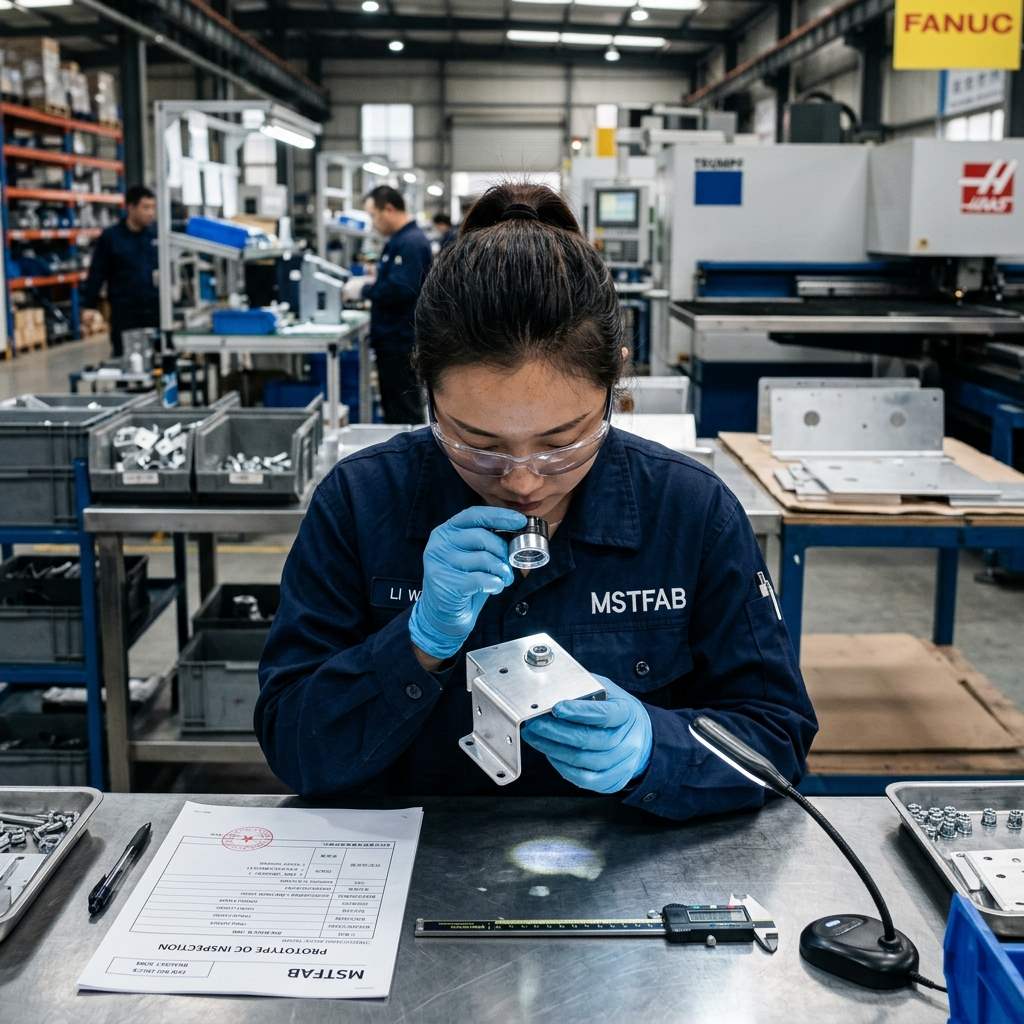
Figure 3: Hardware integration: automated Haeger hydraulic insertion press installing self-clinching threaded nuts and standoffs into precision brackets.
7. Fastening Technologies: Extruded Tapped Collars, Clinch Fasteners (PEM), and Weld Studs
Modern brackets must integrate reusable, high-torque threaded connections for rapid field maintenance:
1. CNC Formed Extruded Tapped Holes (Extrusion Tapping)
In thin sheet metal (1.2 mm to 2.5 mm), standard tapped holes provide only 1 to 2 threads, which strip easily under nominal bolt torque. MSTFAB utilizes CNC rotary friction-form or punch-draw tools to extrude a downward tubular collar before tapping:
- Thread Engagement Multiplier: Increases effective material thickness by 2.5x to 3.0x (e.g., a 1.5 mm steel bracket yields a 3.8 mm deep collar, providing 4 to 5 full pitches of M5 or M6 thread).
- Zero Hardware Cost: Completely eliminates loose nuts, lock washers, and secondary welding operations, reducing unit assembly costs by up to 35%.
2. Automated Self-Clinching Hardware (PEM Fasteners)
Self-clinching nuts, threaded studs, standoffs, and flush pins are pressed permanently into laser-cut holes using automated Haeger insertion presses. As the punch descends, sheet metal cold-flows into the fastener’s undercut annular groove and serrated knurl, achieving high push-out force (> 800 N) and torque-out resistance (> 5.5 N.m for M5 nuts).
3. Capacitor Discharge (CD) Weld Studs
When exterior cosmetic appearance is critical or blind mounting is required, CD stud welding attaches threaded steel or stainless steel studs to the bracket rear face in milliseconds without burning through or discoloring the opposing face.
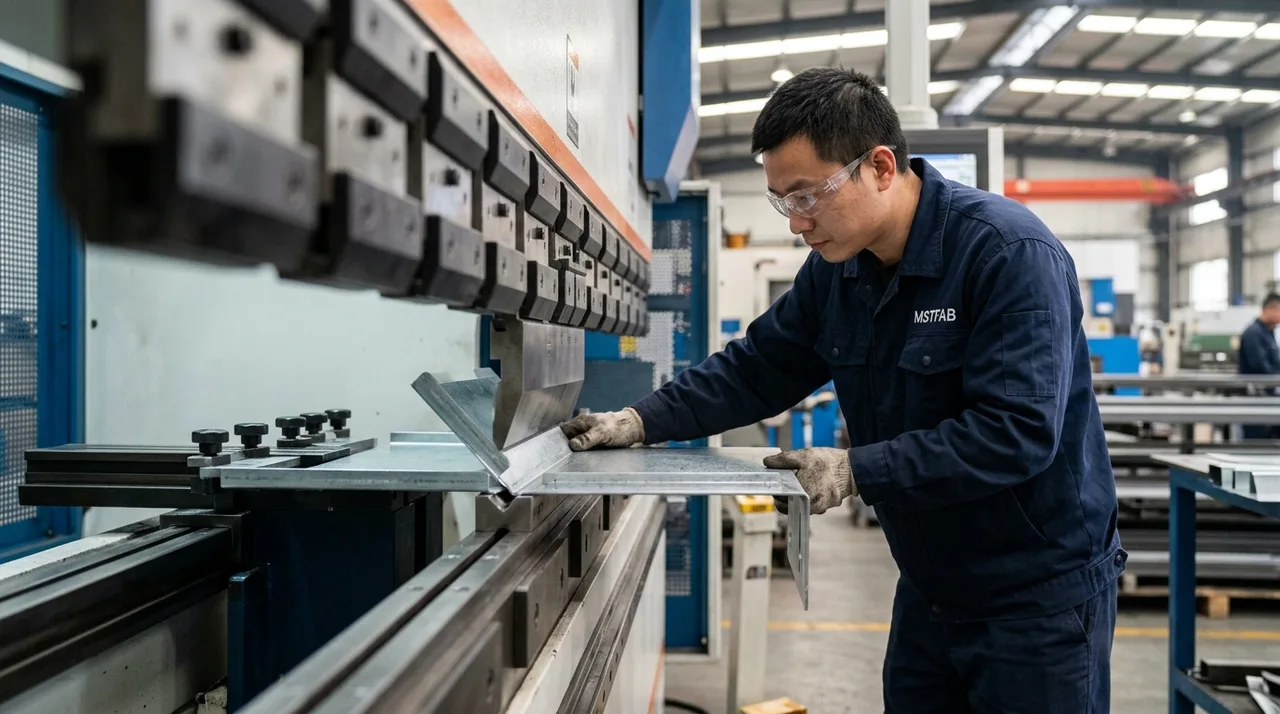
Figure 4: Tooling clearance engineering: verifying punch holder clearance on a complex Z-shaped bracket during multi-stage CNC press brake forming.
8. Surface Pretreatment & Corrosion Protection: Zinc Plating, Anodizing, and Powder Coating
Mounting brackets operate in demanding environments—from unheated machinery bays to outdoor utility poles. MSTFAB provides certified in-house surface finishing:
1. Electrolytic Zinc Plating per ASTM B633
The standard commercial finish for carbon steel brackets, providing sacrificial cathodic protection without excessive dimensional buildup:
- Coating Thickness: Fe/Zn 5 (5 microns) to Fe/Zn 13 (13 microns).
- Passivate Options: Trivalent clear/blue (96 hrs salt spray), trivalent iridescent yellow (168 hrs salt spray), or trivalent black (240 hrs salt spray).
- Hydrogen De-Embrittlement: High-strength steel brackets (> 1000 MPa) undergo post-plate baking at 200 deg C for 4 to 8 hours to eliminate hydrogen embrittlement.
2. Electrostatic Powder Coating
For severe outdoor UV exposure and chemical resistance, our automated powder coating lines apply 70 to 110 microns of TGIC-free polyester or epoxy-polyester hybrid powder over multi-stage iron-phosphate or zinc-phosphate conversion coatings, withstanding 1,000+ hours of ASTM B117 salt spray testing.
3. Anodizing (MIL-A-8625 Type II / III) & Chem-Film (MIL-DTL-5541)
Aluminum brackets receive decorative sulfuric anodizing (Type II clear/black) or ultra-hard Type III hardcoat (60+ HRC) for sliding wear resistance. For electrical grounding brackets, trivalent chemical conversion coating (Class 3) maintains low contact resistance (< 5000 micro-ohms).
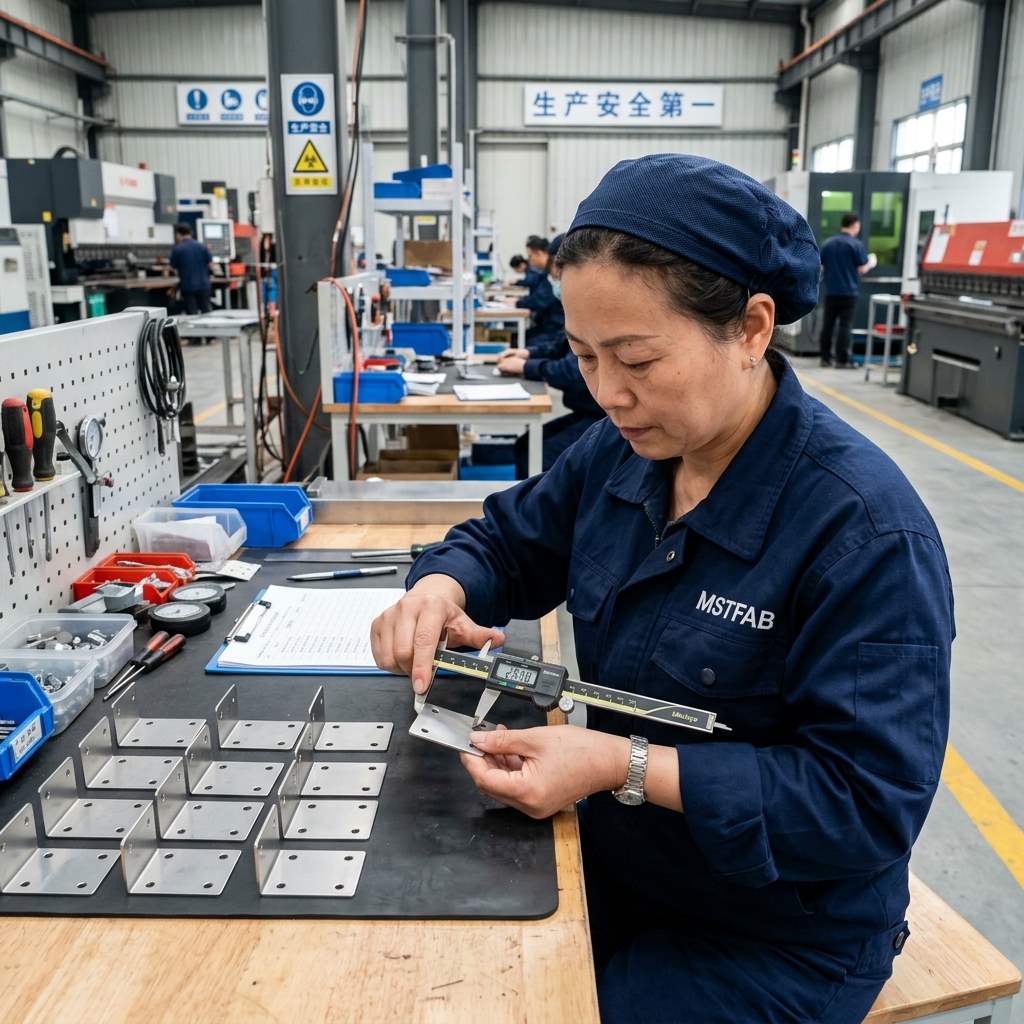
Figure 5: Precision metrology: inspecting hole-to-bend centerlines and flange squareness on a finished bracket using a digital height gauge on a Grade A granite table.
9. Critical DFM Engineering Rules for Sheet Metal Brackets
To ensure high production yields and lowest piece-part costs, design engineers should follow these fundamental DFM rules when modeling custom brackets:
Rule 1: Minimum Hole-to-Bend Distance (D_min)
Any hole located within the plastic deformation zone of a bend will stretch into an oval, preventing bolt insertion. Maintain:
D_min >= 2.5 * T + R
Where D_min is measured from the nearest edge of the hole to the inside bend tangent line. When holes must be placed closer to the bend, incorporate a tear-drop relief notch or laser-cut the hole post-bending.
Rule 2: Minimum Flange Length (L_min)
To ensure the bracket blank securely spans both shoulders of the press brake V-die opening:
L_min >= 4 * T + R
Rule 3: Corner Bend Reliefs
When two flanges bend along intersecting planes (such as a corner cleat or 3D mounting foot), rectangular or circular relief notches must be placed at the intersection to prevent uncontrolled sheet tearing and material bulging:
Relief Width (W) >= T + 0.5 mm, Relief Depth (D) >= R + T
10. Quality Metrology: CMM Probing, Optical Vision Systems, and FAI Documentation
MSTFAB enforces strict quality assurance protocols certified under ISO 9001:2015:
- First Article Inspection (FAI) per AS9102 / ISO 9001: Complete ballooned drawing inspection packages detailing 100% of blueprint dimensions, GD&T characteristics, plating thickness, and material mill test certificates.
- Zeiss Bridge Coordinate Measuring Machine (CMM): Automated touch-trigger probing measures hole-to-hole centerlines across multiple bent planes to +/- 0.025 mm.
- Optical Vision Measuring Systems: Non-contact 2D vision systems verify slot pitches, countersink diameters, and edge radii in seconds.
- Fastener Mechanical Testing: Calibrated push-out and torque-out testing to verify PEM clinch hardware retention meets or exceeds manufacturer specifications.
11. Comprehensive Engineering Data Matrices and Sourcing Benchmarks
The following engineering data matrices summarize tooling trade-offs, material properties, and manufacturing capabilities for low-volume sheet metal brackets:
Table 1: Soft Tooling (Laser + CNC Brake) vs. Hard Stamping Dies Comparison
| Manufacturing Parameter | MSTFAB Soft Tooling (Laser + CNC Brake) | Progressive Stamping Dies | OEM Economic Advantage |
|---|---|---|---|
| Tooling NRE Cost | 0 (Zero Hard Tooling) | 15,000 -45,000+ | Massive upfront capital savings for low-volume runs |
| Initial Prototype Lead Time | 5 to 7 Working Days | 10 to 14 Weeks | Compresses product introduction timeline by 85% |
| Economic Batch Size | 20 to 1,000 units | 10,000 to 500,000+ units | Lowest total unit cost for pilot and bridge production |
| Design Change Flexibility | Instant (Software CAD update) | Extremely Costly / Tool Scrapping | Zero-risk design evolution between batch revisions |
| Dimensional Precision | +/- 0.12 mm linear, +/- 0.25 deg angular | +/- 0.08 mm linear, +/- 0.20 deg angular | Easily satisfies high-precision mechanical GD&T |
Table 2: Bracket Material Selection & Mechanical Properties
| Material Grade | Density (g/cm3) | Yield Strength (MPa) | Elastic Modulus (E) | Corrosion Defense | Recommended Bracket Application |
|---|---|---|---|---|---|
| SPCC Cold Rolled Steel | 7.85 | 210 | 205 GPa | Zinc Plate / Powder Coat | IT server brackets, electrical enclosures, audio chassis |
| SPHC / HRPO Mild Steel | 7.85 | 235 | 205 GPa | Zinc Plate / Powder Coat | Heavy machinery brackets, motor mounts, structural cleats |
| Q345B / S355JR (HSLA) | 7.85 | 345 | 205 GPa | Zinc Plate / Powder Coat | High-stress mobile machinery, crane mounts, trailer cleats |
| Aluminum 5052-H32 | 2.68 | 195 | 70 GPa | Anodize / Chem-Film | Aerospace avionics, robotics, EV battery module brackets |
| Stainless Steel 304 | 8.00 | 240 | 193 GPa | Passivated (ASTM A967) | Food processing, pharmaceutical, marine washdown cleats |
12. Real-World OEM Case Studies: Precision Bracket Validations
Case Study 1: Aerospace Avionics Wire Harness Retaining Bracket
- Application: Ultra-lightweight avionics wire harness support bracket for an uncrewed aerial vehicle (UAV).
- Production Volume: 50 units per batch.
- Material: 1.5 mm Aluminum 5052-H32 with CNC fiber laser skeletonizing, precision CNC forming, MIL-DTL-5541 Class 3 chem-film, and two stainless steel PEM clinch nuts.
- Customer Problem: Previous vendor supplied brackets with micro-cracks along the bend line that failed flight vibration testing, and clinch nuts pulled out under wire harness harness tension.
- MSTFAB Solution: Aligned bend lines strictly perpendicular to sheet rolling grain and increased punch tip radius from 0.8 mm to 1.5 mm (1.0 * T). Installed PEM Type SP stainless clinch nuts with calibrated hydraulic load limits on an automated Haeger press.
- Results: 100% elimination of bend micro-fissures. Fastener push-out strength exceeded 850 N (40% above spec). Approved for flight production on the first FAI submission.
Case Study 2: Industrial High-Voltage Power Inverter Busbar Support Bracket
- Application: Heavy-gauge insulated support bracket isolating 1000V DC copper busbars within a commercial solar power inverter cabinet.
- Production Volume: 100 units per batch.
- Material: 3.0 mm SPHC / HRPO mild steel with formed triangular stiffener gusset ribs, zinc electroplating per ASTM B633 Type II Yellow, and four M6 extruded tapped holes.
- Customer Problem: Cantilevered busbars vibrated during transit, causing bracket fatigue cracking at the 90-degree bend root. Previous vendor used loose welded nuts that spattered weld slag onto mounting faces.
- MSTFAB Solution: Cold-formed dual triangular gussets directly into the bend root using custom press brake tooling, increasing bending stiffness by 280%. Replaced weld nuts with CNC extruded tapped collars providing 6.0 mm of full thread engagement.
- Results: Surpassed 50-hour random vibration testing with zero cracking or resonance deflection. Saved 3.20 per bracket by eliminating welded nuts.
Case Study 3: Off-Highway Construction Vehicle Hydraulic Tube Clamping Bracket
- Application: Heavy-duty multi-tube clamp bracket securing high-pressure (350 bar) hydraulic lines along an excavator boom arm.
- Production Volume: 250 units pilot run.
- Material: 4.0 mm Q345B High-Strength Low-Alloy (HSLA) steel with slotted mounting holes and heavy-duty architectural black powder coating.
- Customer Problem: The OEM faced a28,000 hard stamping die quote with a 14-week lead time, delaying prototype field testing.
- MSTFAB Solution: Fabricated all 250 brackets using high-pressure nitrogen laser cutting and multi-axis CNC press brake forming with standard V-dies.
- Results: Delivered the complete pilot lot of 250 brackets in just 10 working days, saving the OEM $28,000 in tooling capital and allowing field trials to proceed on schedule.
13. Frequently Asked Technical Questions (44 Detailed Engineering Q&As)
Q1: What defines “low-volume” sheet metal bracket manufacturing at MSTFAB?
Low-volume manufacturing spans batch sizes from 20 to 1,000 units. We utilize agile CNC soft tooling (fiber laser cutting and multi-axis press brake bending) that eliminates all hard-tooling stamping die investments while maintaining production-grade tolerances.
Q2: What is the typical lead time for custom sheet metal bracket prototypes?
Laser-cut, CNC-formed, hardware-installed, and plated or powder-coated bracket prototypes typically ship within 5 to 7 working days from CAD approval, complete with full First Article Inspection measurement logs.
Q3: How do formed gusset ribs increase bracket load-carrying capacity?
A formed gusset rib indents a triangular stiffener directly into the 90-degree bend root. This geometric deformation increases the section modulus (Z) and moment of inertia (I) by 200% to 300%, allowing thinner material to withstand higher cantilever loads without bending.
Q4: What is thread extrusion tapping and how does it save manufacturing costs?
Extrusion tapping draws sheet metal downward into a tubular collar before tapping, increasing effective material thickness by 2.5x to 3x. This allows strong M4-M8 threads in thin sheet (1.2-2.5 mm) without buying, positioning, or welding separate nuts.
Q5: What is the minimum recommended distance from a hole to a bracket bend line?
To prevent plastic hole stretching and oval distortion during bending, maintain a minimum distance of D_min >= 2.5 * T + R between the edge of the hole and the inside bend tangent line.
Q6: Why is high-pressure nitrogen assist gas used for laser cutting bracket blanks?
Nitrogen is chemically inert and mechanically expels molten metal from the kerf without oxidation. The resulting cut edge is 100% oxide-free, allowing electroplating and powder coating to adhere permanently without edge flaking.
Q7: What dimensional tolerances can be held on precision CNC-formed brackets?
MSTFAB maintains linear dimensions within +/- 0.12 mm and angular tolerances within +/- 0.25 degrees on multi-axis CNC press brakes equipped with laser angle measurement and dynamic crowning.
Q8: How does material grain direction affect bracket bending strength?
Bending perpendicular to the rolling grain direction places tensile stresses parallel to grain boundaries, providing maximum ductility and tightest radii. Bending parallel to the grain increases cracking risk by up to 40%.
Q9: What is the advantage of HSLA steels like Q345B for structural brackets?
HSLA steels provide 50% higher yield strength (345 MPa vs 235 MPa for mild steel), allowing engineers to reduce bracket gauge by 25% while maintaining identical structural deflection limits, cutting overall assembly weight.
Q10: Can self-clinching PEM nuts be installed in aluminum brackets?
Yes. We install hardened stainless steel self-clinching fasteners (PEM Type SP) into aluminum brackets on automated Haeger presses. The stainless fastener is harder than the aluminum, ensuring proper material cold-flow and retention.
Q11: What is the minimum flange length required when forming sheet metal brackets?
The standard DFM guideline is L_min >= 4 * T + R to ensure the sheet metal blank bridges securely across both shoulders of the press brake V-die opening.
Q12: What surface finishes are standard for carbon steel mounting brackets?
Electrolytic zinc plating per ASTM B633 with trivalent clear (blue), yellow, or black passivates is the standard finish. For heavy outdoor use, we apply electrostatic polyester powder coating.
Q13: Why are slotted mounting holes frequently specified on mounting brackets?
Slotted holes (e.g. 9 mm x 18 mm slots for M8 bolts) absorb dimensional tolerance stack-ups across mating structural frames and weldments, allowing easy alignment and adjustment during field assembly.
Q14: How does MSTFAB prevent hydrogen embrittlement on plated high-strength brackets?
High-strength steel brackets (> 1000 MPa) undergo post-plate hydrogen de-embrittlement baking at 200 deg C for 4 to 8 hours immediately after acid pickling and zinc electroplating.
Q15: What corner relief notch geometry is recommended for 3D brackets?
When adjacent flanges bend along intersecting planes, incorporate rectangular or circular relief notches with a minimum width and depth of W, D >= T + R + 0.5 mm to prevent material bulging and tearing.
Q16: Why is 5052-H32 aluminum preferred over 6061-T6 for formed brackets?
5052-H32 has superior elongation (12-18%) and allows tight inside bend radii (R = 1.0 * T) without cracking. 6061-T6 has lower ductility (~8%) and is prone to cracking along the bend line unless generous radii (R >= 2.5 * T) are used.
Q17: What is capacitor discharge (CD) stud welding and when is it used on brackets?
CD stud welding attaches threaded studs to the rear bracket face in milliseconds without burning through or discoloring the opposing face. It is ideal for blind electrical grounding studs and cosmetic assemblies.
Q18: What quality management certifications does MSTFAB hold for bracket fabrication?
MSTFAB is certified under ISO 9001:2015, operating with full raw material mill test report (MTR) heat lot traceability, calibrated measurement tools, and formal First Article Inspection (FAI) reporting.
Q19: How do you verify thread quality on extruded tapped holes?
We use calibrated thread plug go/no-go gauges to verify 100% compliance with ISO metric (6H) and Unified (2B) thread standards on all tapped holes and extruded collars.
Q20: What is the typical K-factor used for air bending mild steel brackets?
For standard air bending of mild steel with V = 6 * T to 8 * T, the empirical K-factor is K = 0.42. For bottom bending, K increases to approximately 0.45.
Q21: How do you package custom sheet metal brackets for international shipping?
Brackets receive corrosion-inhibiting VCI protective wrap, are packed into heavy-duty corrugated cartons with foam dividers, and secured on heat-treated ISPM-15 wooden pallets for export.
Q22: Can MSTFAB perform spot welding or projection welding on bracket assemblies?
Yes. We operate multi-head automated spot and projection welding machines for attaching sub-brackets, reinforcement plates, and heavy captive weld nuts.
Q23: How does MSTFAB ensure fastener retention strength on clinch hardware?
We perform destructive push-out and torque-out testing on sample brackets from each production run using digital force gauges to guarantee hardware exceeds rated shear limits.
Q24: What is the difference between SPHC and SPCC steel for brackets?
SPCC is cold-rolled with a smooth Class A finish and tight thickness tolerance, ideal for electronic brackets. SPHC is hot-rolled pickled & oiled, offering lower cost for heavy structural brackets from 2.0 to 8.0 mm.
Q25: Can MSTFAB fabricate copper busbar brackets for electrical switchgear?
Yes. We laser-cut, step-bend, and form solid ETP C11000 copper brackets and busbars up to 10 mm thick, ensuring smooth bend radii that eliminate micro-cracking and preserve 100% IACS conductivity.
Q26: What is chemical conversion coating (MIL-DTL-5541) and why is it used on aluminum brackets?
Chem-film passivates aluminum, providing corrosion resistance while maintaining low electrical contact resistance (< 5000 uOhm/in2) for electrical grounding continuity, and serving as a primer for powder coat.
Q27: How does MSTFAB prevent tooling scuffs on cosmetic or pre-anodized brackets?
We deploy polyurethane V-die inserts, 80-micron protective urethane die tapes, mirror-polished punch tips, and low-tack protective surface masking films that eliminate metal-to-metal contact during bending.
Q28: What is First Article Inspection (FAI) and what documentation does MSTFAB provide?
FAI is a formal verification confirming that initial production units meet all blueprint requirements. We provide AS9102/ISO 9001 ballooned drawings, CMM dimensional logs, coating thickness reports, and material mill test certificates.
Q29: How do you verify paint adhesion on powder-coated brackets?
We perform cross-hatch tape adhesion testing per ASTM D3359 Method B, cutting a 6×6 lattice grid through the paint and applying pressure-sensitive tape. Brackets must achieve a 5B rating (zero flaking or detachment).
Q30: Can MSTFAB perform secondary CNC milling on formed bracket flanges?
Yes. We mount formed brackets into custom vacuum or modular fixtures on our 4-axis and 5-axis CNC machining centers to mill precision O-ring grooves, chamfered connector ports, and tight-tolerance bores (+/- 0.012 mm).
Q31: How does springback in stainless steel compare to mild steel when forming brackets?
Austenitic stainless steel (304/316) has a high work-hardening rate, resulting in 2 to 3 times greater elastic springback (3 to 5 degrees) compared to low-carbon mild steel (1 to 1.5 degrees), requiring greater overbending compensation.
Q32: What is the maximum plate thickness MSTFAB can process for structural brackets?
Our fiber lasers cut carbon steel plate up to 25.0 mm thick, stainless steel up to 20.0 mm thick, and aluminum up to 16.0 mm thick, with CNC press brake forming up to 12.0 mm thick plate.
Q33: Can MSTFAB supply pre-assembled bracket kits with hardware and rubber grommets?
Yes. We provide complete electromechanical subassembly: installing vibration-damping rubber grommets, mounting bolts, lock washers, and wire harness clips, delivered as ready-to-install kits.
Q34: How do you prevent galvanic corrosion between aluminum brackets and steel mating structures?
Use zinc-nickel plated carbon steel hardware or 300-series stainless steel isolated with UV-stable nylon or EPDM non-conductive washers to prevent electrical bridging in humid environments.
Q35: What 3D CAD formats are preferred when requesting a quotation for custom brackets?
We accept 3D STEP (AP214/AP242), IGES, and SolidWorks CAD files, paired with 2D PDF engineering drawings specifying tolerances, alloy grade, grain direction, and surface finishing specifications.
Q36: How can global OEMs request a quotation for custom sheet metal brackets from MSTFAB?
Submit your CAD models and drawing packages through our secure RFQ portal. Our DFM engineering team will review your bracket geometries, optimize blank nesting and forming parameters, and return a comprehensive quotation within 24 to 48 hours.
Q37: How does MSTFAB handle engineering design revisions (ECNs) between low-volume bracket runs?
Because soft-tooling relies entirely on digital CAD/CAM programming (laser cutting and CNC press brake forming) rather than physical stamping dies, implementing engineering change notices (ECNs) requires zero tooling recuts. We update the digital nest, modify press brake backgauge programs, and update revision-controlled inspection drawings immediately. Old revisions are archived, and the updated revision enters production seamlessly with zero scrap tooling costs.
Q38: What are the best practices for grounding and EMI gasket landing surfaces on painted brackets?
Powder coating is a dielectric electrical insulator. For brackets requiring RF shielding or electrical grounding, MSTFAB applies precision high-temperature polyimide (Kapton) masking tape or silicone gaskets over ground stud landings and gasket perimeter flanges prior to powder coating. Alternatively, on aluminum brackets, we apply clear conductive trivalent chem-film (MIL-DTL-5541 Class 3) across the entire bracket and selectively powder coat only exterior cosmetic faces.
Q39: How does MSTFAB evaluate bending tool clearance on complex multi-flange Z-brackets?
During the DFM phase, our CAM software runs full 3D collision simulations of the press brake ram, punch holders, and backgauge fingers against the developing workpiece geometry across every sequential stroke. If an interference is detected, our engineers resequence the bend order, select gooseneck punch profiles, or segment tooling to guarantee collision-free forming.
Q40: What are the cost trade-offs between extruded tapped holes and weld nuts on production brackets?
Extruded tapped holes eliminate the purchasing, inventory handling, fixture locating, and welding labor of separate weld nuts, reducing per-hole hardware cost by up to 60%. Weld nuts are generally reserved for heavy plate (T > 4.0 mm) or thread sizes larger than M10 where cold-forming extrusion forces would exceed standard punch press tonnage limits.
Q41: How does FEA modal simulation prevent harmonic resonance failures in vibrating brackets?
Modal FEA calculates a bracket’s natural fundamental vibration modes. By introducing formed stiffener ribs or perimeter return flanges, we increase structural stiffness without adding mass, elevating the bracket’s resonant frequency well above equipment motor excitation frequencies (typically > 180 Hz) to eliminate resonance-induced fatigue cracking.
Q42: Can robotic bending cells handle small brackets with dense hole perforations?
Yes. Our robotic bending cells use modular end-effectors equipped with dynamic multi-zone vacuum shut-off valves and auxiliary electro-permanent magnets. This allows the robot to handle skeletonized, heavily perforated brackets securely without losing suction pressure.
Q43: What is the maximum cantilever load a 2.0 mm mild steel L-bracket can support?
A standard flat 2.0 mm mild steel L-bracket (50 mm wide, 75 mm cantilever length) has an allowable static load of approximately 45 kg before exceeding allowable bending stress. By incorporating a cold-formed triangular gusset rib into the bend root, the allowable static load capacity increases to over 120 kg without changing material gauge.
Q44: What are the inspection criteria for passivated stainless steel brackets?
Passivated stainless steel brackets undergo ASTM A967 verification: copper sulfate testing (verifying zero free iron deposits), high-humidity chamber testing (24 hours at 100 deg F / 95% RH with zero rust spotting), and dimensional CMM inspection of hole true positions.
Partner with MSTFAB for Precision Low-Volume Custom Sheet Metal Brackets
Eliminate hard-tooling die expenses, bend cracking, and assembly alignment bottlenecks. Partner with MSTFAB for ISO 9001 certified sheet metal bracket fabrication—backed by nitrogen laser cutting, non-marking CNC press brake forming, automated PEM hardware insertion, and certified surface finishing. Contact our engineering team today for a comprehensive DFM review and quotation.
 WeChat Contact
 WhatsApp Me Directly