
The Short Answer
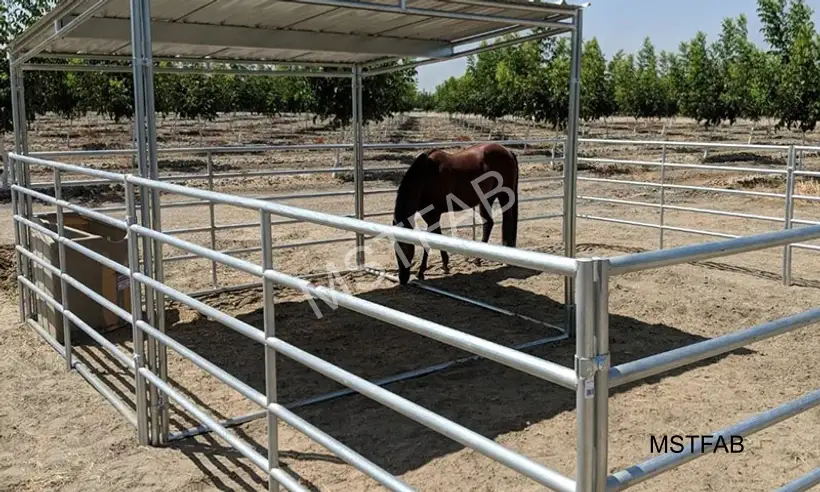
Durable livestock farm fence and cattle corral panels require 360-degree full-circumference miter or coped welds, animal-safe rotary edge conditioning, and true after-fabrication hot-dip galvanizing per ISO 1461 / ASTM A123. Low-cost yard panels fail prematurely in the field because suppliers substitute thin-wall pre-galvanized tubing, rely on tack welds that crack under 700 kg cattle impact loads, and mask bare weld zones with cold silver spray paint.
Explore this guide
01 / Tube Wall Thickness and Rail Geometry
Specify structural steel gauge and rail profiles for livestock crowding loads.
When agricultural distributors and ranch equipment brands receive field warranty claims on bent corral panels, the root cause is almost always down-gauged tubing. A supplier quoting suspiciously cheap field yard panels typically substitutes 1.2 mm wall commercial pipe where the application requires 2.0 mm to 3.0 mm structural Q235B or Q355B tubing.
Before releasing drawings for livestock fence panels and gates, lock the exact tube cross-section (round, square, or cattle-rail oval), actual wall thickness tolerance, and vertical stay reinforcement.
Heavy cattle and bull corrals
Specify 42 mm to 50 mm OD round tube or 40×80 mm / 50×100 mm oval rail in 2.0 mm to 3.2 mm wall thickness to withstand crowding chutes and sorting pens.
Horse arena and round-pen panels
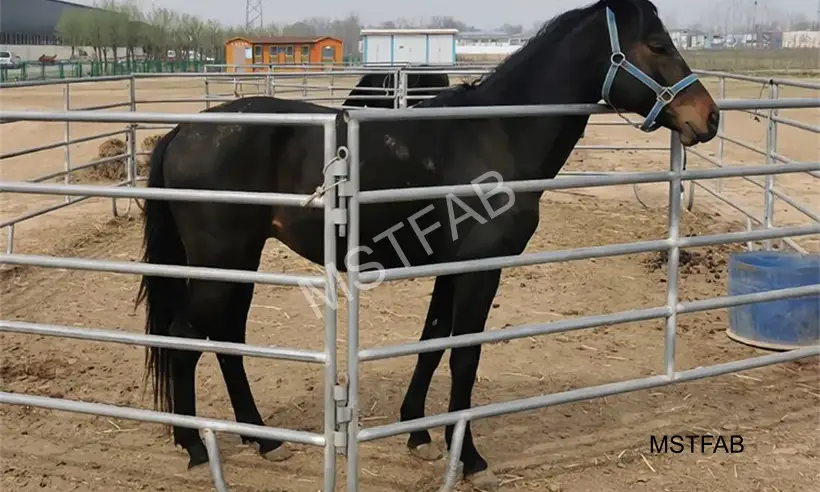
Use smooth oval or round rails with zero sharp corner transitions, 1.8 mm to 2.5 mm wall thickness, and anti-bow vertical Z-braces or tubular center stays.
Sheep, goat, and hog hurdles
Configure graduated lower rail spacing (100 mm to 150 mm bottom gaps) or laser-slotted vertical infill bars to prevent lambs and kids from getting heads trapped.
Wall-thickness verification rule: Never specify tubing on purchase orders as “standard medium gauge.” Always define minimum actual wall thickness in millimeters (for example, 2.5 mm +/-0.15 mm) so incoming coils are micrometer-verified before cutting.
02 / Full Seam Welding vs. Tack Welding
Require 360-degree coped or mitered seam welds at every rail-to-post intersection.
A mature steer or panicked horse leaning against a 3.6-meter corral panel generates severe torsional bending at the end posts. Cheap yard panels flatten the ends of horizontal rails in a punch press and attach them to vertical posts with two quick spot welds. Within one season of freeze-thaw moisture and animal impact, those spot welds fracture.
- Rotary laser tube coping and saddle cuts: Horizontal round and oval rails are CNC tube-laser coped to saddle tightly around the vertical post circumference, maximizing weld contact perimeter.
- 360-degree continuous MIG welding: Every rail-to-post joint is welded continuously around the full tube profile in rigid clamping jigs to prevent water entry and fatigue cracking.
- Laser-cut plate gussets and hinge lugs: Drop-pin cleats, chain latch brackets, and slam-latch strike plates are cut from 5 mm to 8 mm steel plate and welded on both faces for shear strength.
Our sheet metal welding services and structural jigging cells ensure panel diagonal squareness and consistent pin-lug center distances across thousands of units.
03 / Animal Safety and Connection Hardware
Eliminate weld spatter, sharp burrs, and hoof traps across the panel frame.
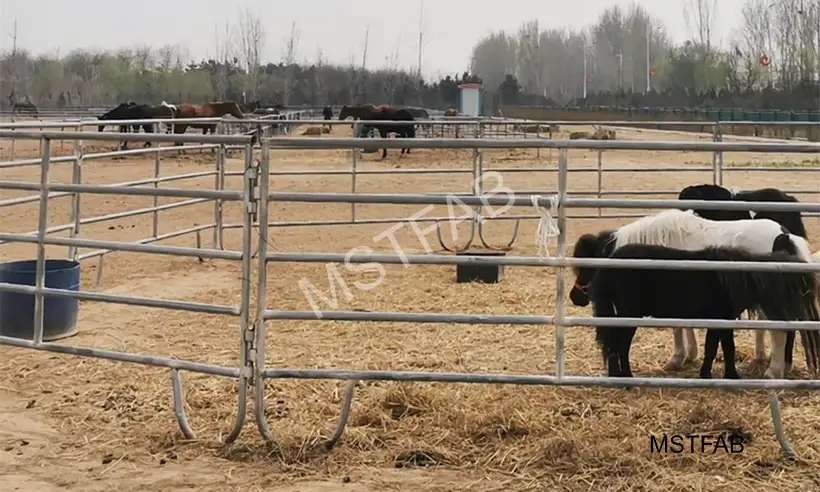
For equine facilities, dairy operations, and high-value breeding stock, a single sharp weld icicle or exposed sheet metal corner can cause expensive veterinary injuries and ruin a dealer’s reputation. Animal safety must be engineered into both the joint geometry and post-weld conditioning.
- Grind and rotary-brush all exterior rail welds, latch slots, and pin lugs smooth before surface coating so hides and manes never snag.
- Cap all vertical posts with fully welded domed steel caps and form bottom mud-shoes (skid feet) without sharp sheared edges that cut hooves.
- Maintain tight tolerances on male/female drop-pin lugs or butterfly clamps so adjacent panels articulate smoothly on uneven pasture terrain without wide leg-trap gaps.
Reviewing lug clearances, gate bow heights, and laser-cut bracket radii during pre-production DFM ensures every panel links together effortlessly in the field.
04 / True Hot-Dip Galvanizing vs. Cold Paint
Protect corrals against manure acids and ammonia with verified zinc coatings.
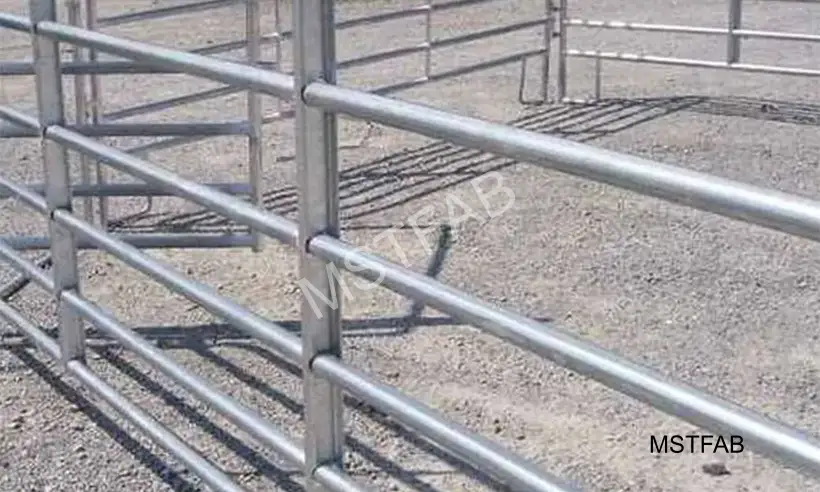
Livestock pens are among the most corrosive environments in agriculture: wet manure, uric acid, and constant hoof abrasion strip thin coatings rapidly. Many low-cost suppliers weld pre-galvanized pipes (burning off the zinc at every joint) and spray cheap silver aerosol paint over the raw weld seams—which rusts within 60 days outdoors.
- Post-fabrication hot-dip galvanizing (HDG per ISO 1461 / ASTM A123): The fully welded black-steel panel is pickled and immersed in a 450°C molten zinc kettle, forming a metallurgical zinc-iron alloy bond inside and outside the tube (typically 65 to 85+ microns thick).
- Pre-galvanized tube with zinc-rich thermal spray + architectural powder coat: For color-coded horse stalls or retail yard panels requiring lower unit weight, welded zones are grit-blasted, coated with high-zinc primer, and finished in UV-stable polyester powder.
- Post-galvanize fettling and passivation: After kettle dipping, every panel undergoes mandatory hand inspection and filing to remove sharp zinc drainage spikes before bundling.
Whether your product line requires heavy kettle hot-dip galvanizing or duplex zinc-primer plus powder coating, specifying coating thickness in microns on the drawing eliminates shortcuts.
05 / Buyer Control Matrix
Audit five manufacturing controls before ordering container loads of corral panels.
Use this technical verification matrix to compare agricultural fencing suppliers on actual steel weight, weld integrity, and corrosion life.
06 / Inspection Handoff
Verify panel weight, lug alignment, and zinc micron thickness before shipment.
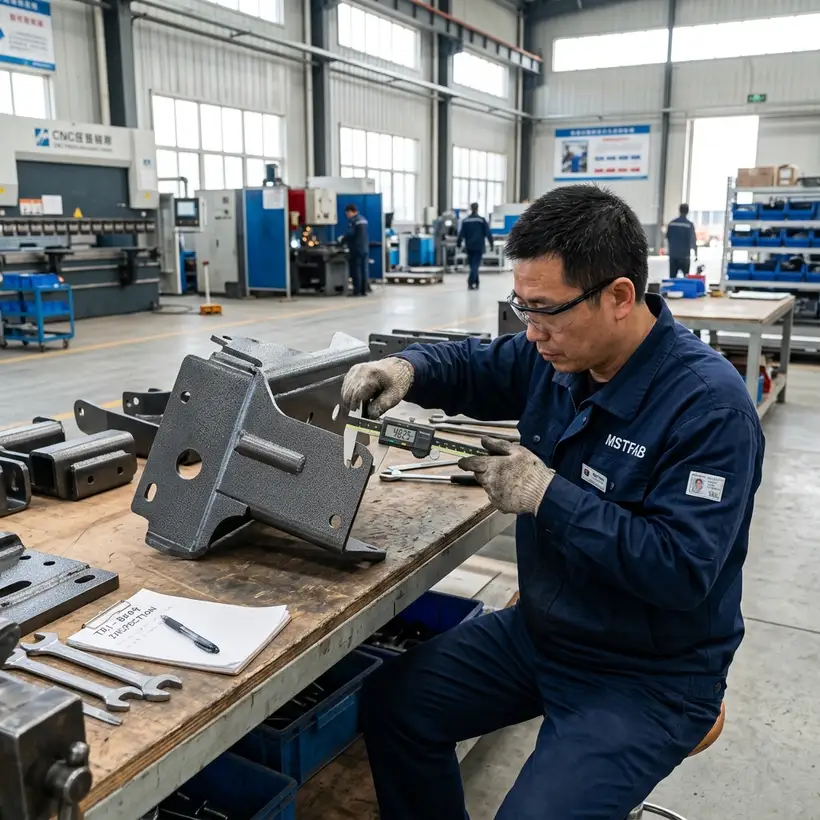
When ordering full 40HQ container loads of livestock panels, discovering misaligned drop-pin lugs or flaking zinc after ocean arrival is catastrophic. Quality verification must occur both in the black-steel welding stage and after galvanizing.
Our QC team inspects raw tube wall thickness at receiving, verifies rail spacing and lug coaxiality in master checking fixtures prior to coating, and takes multi-point magnetic coating thickness measurements across every production lot after hot-dip galvanizing or powder coating.
Under our ISO 9001 quality management system, we provide full First Article Inspection (FAI) documentation, scale weight records per panel model, and trial assembly photos before container loading.
Review our fabrication tolerance standards and inspection methods →
07 / Packing and Release
Maximize 40HQ container cube density while preventing transit abrasion.
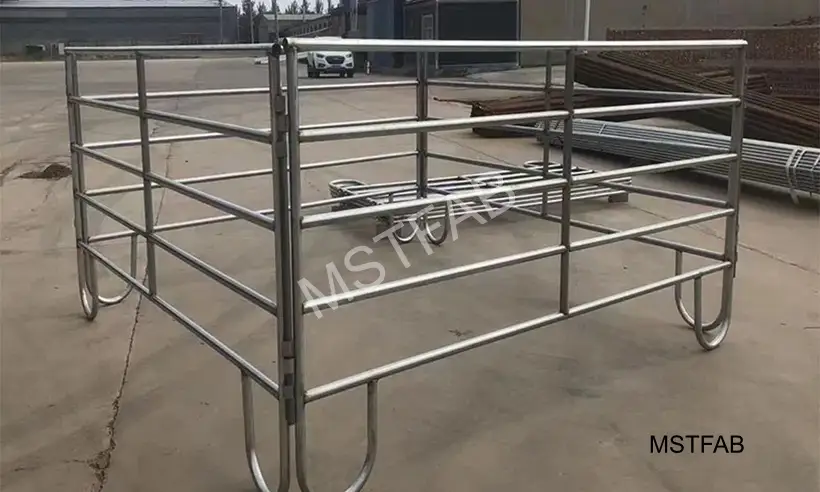
Corral panels and gates are bulky, high-volume weldments where ocean freight cost per panel depends directly on how tightly bundles nest inside a 40-foot High Cube (40HQ) container. Poorly strapped loose panels shift during sea transit, bending connection lugs and jamming container doors.
We engineer custom steel-framed transport cradles and interlocking stacking blocks that allow forklift unloading from the rear of the container while separating galvanized or powder-coated rails with protective spacers. Need custom brackets or laser-cut latches? Check our DFM review for laser cutting guidelines.
Manufacturing scope: MSTFAB manufactures custom drawing-based livestock corral panels, gates, headlocks, and agricultural sheet metal components under ISO 9001 quality management. Site installation, civil anchoring, and final facility safety compliance remain the responsibility of the buyer or OEM.
08 / Ready-to-Review RFQ
Include eight specifications in your livestock fence panel RFQ.
- Panel overall length and heightSpecify standard dimensions (such as 2.1m x 1.8m, 2.4m x 1.8m, or 3.6m x 1.6m) and gate walk-through heights.
- Tube profile and wall thicknessCall out round OD, square, or oval rail dimensions (e.g., 40×80 mm oval) and exact wall thickness in millimeters.
- Rail count and spacing mapProvide a 2D drawing or STEP file showing 5-rail, 6-rail, or 7-rail center-to-center pitches and vertical stay positions.
- Connection hardware typeDefine drop-pin and J-leg lugs, chain-and-slot latches, slam latches, or heavy-duty bolted clamps.
- Post top cap and foot styleSpecify welded dome caps, square caps, L-shaped mud skids, or U-loop base feet.
- Corrosion protection standardState full after-weld hot-dip galvanizing (minimum g/m2 or micron target) or pre-galvanized + RAL powder coat.
- Custom OEM branding platesInclude DXF/STEP artwork if laser-cut steel logo plates need to be welded onto the top rail or gate bow.
- Container quantity and portIndicate target mix of standard panels, gate panels, and posts per 20GP or 40HQ container and destination port.
Providing exact tube wall thickness, rail count, and galvanizing class upfront enables our engineering team to calculate net steel weight, container loading capacity, and accurate factory-direct pricing.
Livestock corral panel manufacturing questions from OEM and wholesale buyers
Why do cheap corral panels rust at the weld joints within a few months?
Low-cost workshops weld pre-galvanized pipes together and simply spray cold silver paint over the burned weld zones. Moisture and livestock manure quickly penetrate the thin paint film. For multi-decade outdoor durability, either specify full post-fabrication hot-dip galvanizing (where the entire welded frame is dipped in molten zinc) or a verified zinc-rich thermal primer under baked architectural powder coat.
What is the difference between cattle rail (oval tube) and round pipe panels?
Oval cattle rail (such as 40×80 mm or 50×100 mm) presents a wide, flat surface to the animal’s chest and shoulders, distributing impact forces without bruising hides or allowing hooves to slip easily between bars. Round pipe (such as 42 mm or 48 mm OD) offers omni-directional strength and can be rotary-coped for 360-degree saddle welds.
How do you prevent sharp zinc spikes on hot-dip galvanized horse and sheep panels?
After panels are lifted from the molten zinc kettle and cooled, our finishing team performs a dedicated fettling and dressing pass—filing and sanding away all zinc drainage droplets, burrs, and rough edges along every rail and post before inspection release.
Can you laser-cut and weld our brand logo plate onto every corral panel?
Yes. We fiber-laser cut custom steel nameplates with your brand name or dealer logo and weld them onto the upper rail gap or gate frame prior to galvanizing or powder coating so your brand is permanently embossed into the panel.
How do you ensure drop-pin lugs align when connecting hundreds of panels on uneven ground?
All vertical posts and hinge cleats are welded inside rigid, precision-machined master fixtures rather than laid out by hand with a tape measure. We also build controlled vertical play into the dual drop-pin brackets so adjacent panels can articulate across sloped pasture terrain.
Can we mix standard panels, bow gates, and feeder panels inside one 40HQ container?
Yes. Our logistics engineers create a 3D container-stuffing plan before production so mixed SKUs—such as 6-rail corral panels, walk-through bow gates, hay feeder panels, and spare drop pins—nest securely into steel transport pallets for easy forklift unloading.
Technical references
Reference these international standards when specifying hot-dip galvanized coatings, structural steel tubing, and general weldment tolerances for agricultural equipment.
- ISO 1461 — Hot Dip Galvanized Coatings on Fabricated Iron and Steel Articles: Specifications and Test Methods
- ASTM A123 / A123M — Standard Specification for Zinc (Hot-Dip Galvanized) Coatings on Iron and Steel Products
- ISO 13920 — Welding: General Tolerances for Welded Constructions (Lengths, Angles, Shape and Position)
Send your livestock corral panel drawings or specs for a factory quote.
Share your rail profile, tube wall thickness, galvanizing standard, and container volume. MSTFAB will verify structural specs and return an itemized OEM quotation.
Request a Livestock Panel Quote →
Have a question first? caroline@mstfab.com
 WeChat Contact
 WhatsApp Me Directly