
⚙ Quick Engineering Reference: What Defines an ISO 9001 Enclosure Manufacturer?
A genuine ISO 9001:2015 certified machinery electrical box enclosure manufacturer operates a closed-loop Quality Management System (QMS) governing the entire lifecycle from 3D CAD/CAM DFM analysis to serialized export delivery. Critical deliverables include EN 10204 Type 3.1 Mill Test Report (MTR) material traceability, Statistical Process Control (SPC) with Cpk ≥ 1.33 on critical mating datums, automated robotically dispensed Form-in-Place Foam Gasketing (FIPFG) for NEMA 4X / IP66 washdown protection, and certified NFPA 79 electrical grounding continuity (Rground < 0.05 Ω).
In modern industrial equipment manufacturing—encompassing high-speed CNC machine tools, semiconductor wafer processing platforms, automated packaging machinery, plastic injection molding centers, and renewable energy battery storage systems—the electrical control cabinet is not a passive decorative housing. It is a mission-critical structural sub-system that must safeguard sensitive programmable logic controllers (PLCs), variable frequency drives (VFDs), servo power electronics, and safety relays against oil mists, metal particulates, aggressive chemical washdowns, extreme temperature swings, and electromagnetic interference (EMI).
When machinery OEMs partner with second-rate custom sheet metal shops that lack certified quality management systems, the results in final assembly are disastrous: warped enclosure doors that bind against latches, out-of-square mounting datums that crack vibration fixtures, porous welds that leak under coolants, stripped PEM clinch studs that spin during field wiring, and uneven powder coating that chips during shipment.
As an internationally certified ISO 9001:2015 and IATF 16949 contract manufacturer, MSTFAB bridges advanced sheet metal DFM engineering with rigorous quality assurance. This comprehensive guide outlines the quality control architecture, metrology protocols, metallurgical standards, robotic automation processes, and testing frameworks that distinguish a world-class electrical enclosure manufacturing partner.

Figure 1: MSTFAB senior quality engineer verifying 4-point mounting datum coplanarity and dynamic resonant frequency response on an automated vibration shaker table.
1. ISO 9001:2015 Architecture: Translating Quality Clauses into Sheet Metal Execution
ISO 9001:2015 is not merely a wall plaque or a set of static administrative binders; it is a dynamic, risk-based operational framework that dictates how every raw steel sheet, laser cut path, press brake stroke, weld bead, and powder coat spray gun is controlled, measured, and continuously improved.
1.1 Clause-by-Clause Enclosure Manufacturing Mapping
| ISO 9001 Clause | Standard Requirement | MSTFAB Practical Shop Floor Execution | OEM Customer Benefit |
|---|---|---|---|
| Clause 8.2 | Requirements for Products & Services | Formal 3D CAD/CAM DFM contract review within 24 hours | Identifies tooling clashes, un-bendable flanges, and tolerance stack-ups before metal is cut |
| Clause 8.4 | Control of Externally Provided Processes | 100% raw material heat lot tracking with EN 10204 3.1 MTR validation | Guarantees certified chemical composition, zinc coating mass, and tensile yield strength |
| Clause 8.5.1 | Control of Production Provision | Standard Operating Procedures (SOP), digital traveler routing, CNC program revision locks | Eliminates unauthorized operator edits; guarantees identical part geometry across repeat lots |
| Clause 8.6 | Release of Products & Services | Multi-stage gate: In-process CMM inspection, coating DFT logs, final FAI release | Zero non-conforming parts escape to customer packaging lines (PPM < 50) |
| Clause 9.1.1 | Monitoring, Measurement & Analysis | Real-time SPC X-bar/R control charts on critical bending and laser tolerances | Predicts tooling wear and thermal drift before parts drift out of tolerance bounds |

Figure 2: Precision optical laser squareness audit on a heavy welded machinery enclosure frame, verifying diagonal tolerance within ± 0.4 mm at MSTFAB.
2. Statistical Process Control (SPC) & Process Capability (Cpk) in Sheet Metal
In high-precision electrical enclosure fabrication, producing a single prototype that meets print specifications is trivial; repeatedly manufacturing 5,000 units over three years with zero assembly line rejections requires rigorous Statistical Process Control (SPC).
2.1 Process Capability Indices Formulation
MSTFAB calculates both process capability (Cp) and centering capability index (Cpk) on all Critical-to-Quality (CTQ) dimensions (such as door diagonal squareness, gasket flange knife-edge depth, and quarter-turn latch cam hole spacing):
Where USL and LSL represent Upper and Lower Specification Limits, X̄ is the grand process mean, and σ is the sample standard deviation calculated from subgroup sampling (n = 5 parts sampled every 2 hours).
- Commercial Standard (Cpk < 1.00): Process spread exceeds tolerance; scrap and assembly rework exceed 2.7%. Completely unacceptable for automated machinery builders.
- MSTFAB Quality Baseline (Cpk ≥ 1.33): Process operates at a 4-sigma level (theoretical defect rate< 63 PPM). All standard enclosure dimensions are held to this benchmark.
- Critical Sealed Interfaces (Cpk ≥ 1.67): Applied to door perimeter gasket knife-edge profiles and robotically dispensed foam paths, achieving a 5-sigma level (defect rate< 0.6 PPM).
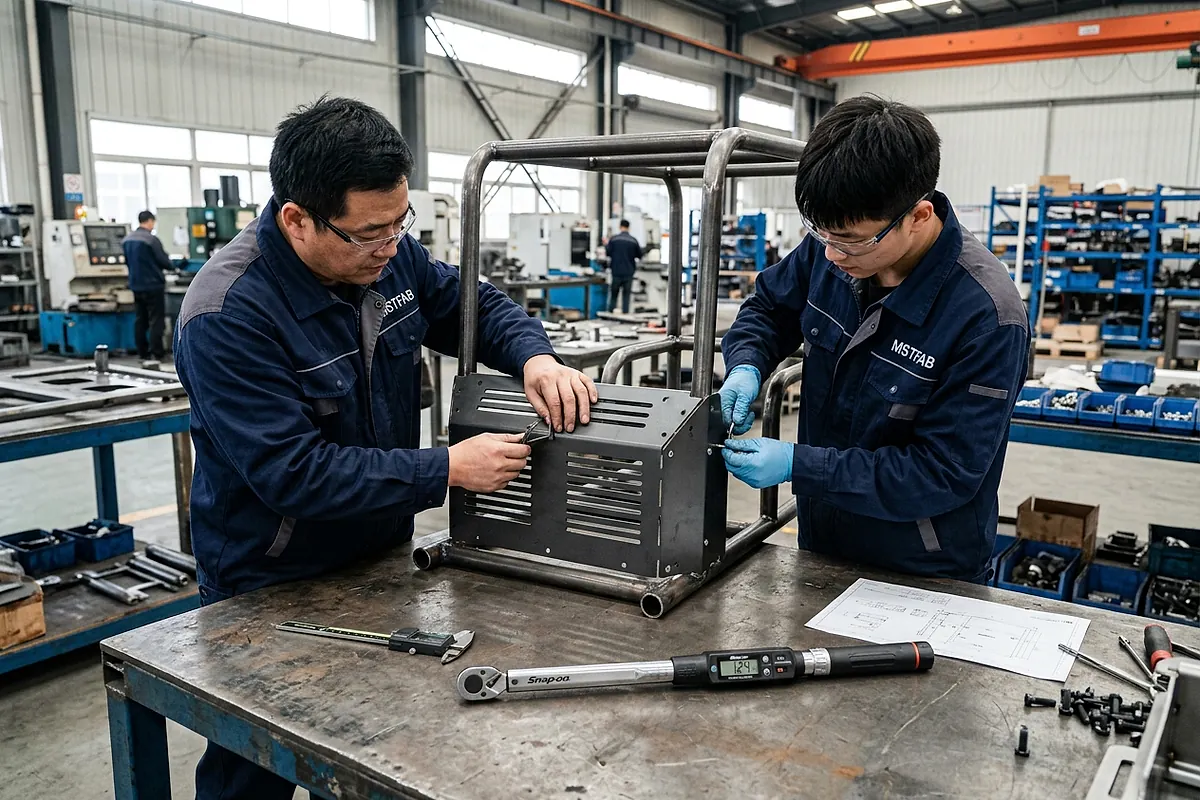
Figure 3: Full assembly mating trial verifying door latch engagement, gasket knife-edge compression, and 3-point cam alignment on a production control box at MSTFAB.
3. Raw Material Metallurgy & EN 10204 Type 3.1 Traceability
An electrical enclosure is only as resilient as the steel and aluminum alloy from which it is cut. Substandard sheet metal with excessive sulfur inclusions, poor zinc adhesion, or variable grain orientation causes unpredictable press brake springback, weld cracking, and early salt-spray corrosion failure.
3.1 Incoming Receiving Quality Inspection Protocols
- Certified Mill Test Reports (MTR): Every inbound steel coil and sheet bundle must be accompanied by an EN 10204 Type 3.1 inspection certificate issued by an accredited steel mill (such as Baosteel, POSCO, or Nippon Steel), certifying exact chemical heats (Carbon, Manganese, Phosphorus, Sulfur, Silicon, Chromium, Nickel, and Molybdenum) and mechanical properties (yield strengthRp0.2, tensile strengthR_m, and elongationA50).
- Optical Emission Spectrometry (OES) Verification: MSTFAB’s internal metallurgical laboratory performs random destructive spark emission spectrometry to independently verify alloy composition before materials are released to laser cutting.
- Zinc Coating Mass Triple-Spot Testing: For galvannealed (ASTM A653 / A653M ZF) and hot-dip galvanized (ASTM A653 G90) steels, magnetic eddy-current coating thickness gauges and gravimetric weigh-strip-weigh tests verify minimum zinc coating mass (≥ 90 g/m²to 275 g/m²).
| Alloy Grade | Nominal Yield StrengthRp0.2 | Corrosion Resistance Benchmark | Enclosure Application Domain |
|---|---|---|---|
| ASTM A653 ZF75 Galvannealed | 220 – 280 MPa | 1,500h ASTM B117 (with powder coat) | Automotive assembly machinery, general factory control boxes |
| 5052-H32 Marine Aluminum | 193 MPa | 3,000h ASTM B117 (Immune to salt fog) | Outdoor solar inverters, marine winches, lightweight automation |
| AISI 304 Stainless Steel | 240 – 290 MPa | 2,000h Salt Fog (Passivated ASTM A967 / A967M) | Packaging machinery, commercial food lines, indoor washdown |
| AISI 316L Stainless Steel | 220 – 270 MPa | > 5,000h CASS / Marine (PREN ≥ 25) | Aseptic pharma, chemical processing, offshore drilling |
4. Welding & Brazing Standards: AWS D1.1, AWS D1.6 & Water-Tight Integrity
Welding is the critical process where sheet metal parts transform from loose 2D blanks into an environmentally sealed 3D enclosure. Welds must provide both structural load-carrying capacity and liquid-tight hermetic isolation:
4.1 Robotic Welding Automation vs. Manual Variance
- Robotic Fiber Laser Seam Welding: For corner joints and gland plate collars, MSTFAB deploys 6-axis Fanuc robotic fiber laser welding systems. Laser welding concentrates high energy density into an ultra-narrow spot diameter (0.3 mm), producing continuous full-penetration hermetic seams with minimal heat input (80% lower than manual TIG). This eliminates heat-induced sheet metal warping and ensures zero leak paths.
- Fronius Cold Metal Transfer (CMT) Brazing: On galvanized and galvannealed steel enclosures, CMT robotic brazing with CuSi3 wire operates below the zinc vaporization boiling point (907°C), completely preventing zinc gas porosity while leaving a smooth, spatter-free cosmetic seam that requires zero manual grinding.
- Welder Qualification & WPS/PQR Records: All welding processes are governed by formal Welding Procedure Specifications (WPS) qualified per AWS D1.1 (Structural Steel) and AWS D1.6 (Stainless Steel), with Procedure Qualification Records (PQR) documenting tensile, bend, and macro-etch penetration results.
Zero-Leak Quality Verification Methods:
- Helium Mass Spectrometer Sniffer Testing: For hermetic cleanroom cabinets, enclosures are pressurized with a 10% helium trace gas mixture and sniffed with calibrated helium probes, detecting leak rates down to 1.0 × 10⁻⁶ mbar·L/s.
- Liquid Penetrant Inspection (PT per ASTM E165): High-sensitivity fluorescent dye penetrant applied to all corner welds to detect microscopic surface-breaking fissures, hot cracks, and pinholes.
- Low-Pressure Air Decay Pneumatic Testing: 100% of production enclosures are sealed, pressurized to 15 kPa(2.2 psi), and monitored with high-precision digital pressure transducers for 60 seconds; pressure drops exceeding 0.05 kPatrigger immediate leak isolation.
5. Robotically Dispensed Form-in-Place Foam Gasketing (FIPFG) Standards
The environmental rating of a NEMA 4X / IP66 enclosure depends entirely on the elastomeric perimeter door seal. Traditional manual cut-and-glued sponge rubber strip gaskets fail because the90°corner butt-splices pull apart under cyclic door compression, opening a direct conduit for washdown water ingress:
5.1 Two-Component Polyurethane & Silicone FIPFG Dynamics
- Continuous CNC Robotic Dispensing: MSTFAB utilizes SondorMotion 3-axis CNC mixing and dispensing robots. High-viscosity resin and isocyanate curing agents are dynamically mixed in a water-cooled head and robotically extruded at controlled flow rates directly into the enclosure door channel.
- Seamless Thixotropic Expansion: The chemical foam reacts, expanding by 250% – 350% into a perfectly uniform, closed-cell semicircular bead. The robotic path programmed with a tangentially overlapping joint eliminates the vulnerable corner butt-splice entirely.
- Compression Set Resistance (ASTM D395 Method B): MSTFAB foam formulations achieve permanent compression set values strictly below 12% after 70 hours at 70°C under 50% deflection, ensuring full elastomeric recovery over 20+ years of door latch cycling.
| Gasket Parameter | Target Quality Specification | Inspection Metrology | Sampling Frequency |
|---|---|---|---|
| Bead Height & Width | Height:3.8 ± 0.3 mm; Width:7.5 ± 0.5 mm | Laser triangulation optical profile sensor | 100% in-line automated continuous scan |
| Overlap Joint Quality | Height variation at joint≤ 0.4 mm | Digital micrometer + visual microscope | 1 part per setup / 1 per 25 parts |
| Substrate Adhesion | Cohesive failure mode (foam tears before adhesive peels) | 90° manual peel pull test per DIN EN ISO 2409 | 1 sacrificial coupon per shift |
| Hardness (Shore 00) | 40 – 55 Shore 00 | Calibrated digital Shore durometer | 1 per chemical resin batch change |
7. Environmental Stress Screening, Vibration Fatigue Analysis & Ingress Certification
Machinery electrical box enclosures operating in factory automation, stamping presses, and mobile agricultural machinery endure severe mechanical vibration harmonics, thermal thermal cycling, and aggressive chemical mist exposures. A premier ISO 9001 certified enclosure manufacturer goes beyond basic visual dimensional checks by validating physical survivability through finite element analysis (FEA), vibration shaker testing, and environmental stress screening.
7.1 Mechanical Resonant Frequency & Vibration Fatigue Analysis (IEC 60068-2-6 / MIL-STD-810H)
When an electrical enclosure is mechanically coupled to high-speed rotational machinery (e.g., spindle motors, hydraulic pump stations, or robotic indexing tables), cyclic harmonic excitation can align with the cabinet’s natural frequency, inducing resonant catastrophic failure. Uncontrolled resonance leads to hinge pin shear, PEM clinch stud dislodgement, weld throat fatigue fractures, and premature loosening of internal electrical busbars.
Structural Bending Stress & Resonance Equation Formulation:
The fundamental natural frequencyf_n(in Hz) of a cantilevered or simply supported enclosure panel is governed by plate flexural rigidityDand surface mass density ρ t:
fn = (λ²) / (2π W²) √((D) / (ρ t)) where D = (E t³) / (12(1 – ν²))
Here, E represents Young’s modulus (205 GPa for mild steel, 69 GPa for aluminum 5052), t is the sheet metal wall thickness, ν is Poisson’s ratio (0.29 for steel), ρ is material density, and W is the unsupported panel span. MSTFAB engineering DFM guidelines require the enclosure’s first natural resonant mode to remain strictly above 45 Hz—comfortably outside standard AC motor rotation frequencies (50 Hz/60 Hzexcitation bands)—achieved through CNC pressed stiffening ribs, perimeter returns, and welded corner gusset plates.
7.2 Accelerated Environmental Corrosion Kinetics: ASTM B117 & ISO 9227 Testing
To ensure outdoor and washdown electrical enclosures resist chemical attack and micro-pinhole oxidation over a 15- to 20-year service life, MSTFAB subjects representative production coupons and finished welded assemblies to cyclic neutral salt spray (NSS) chambers in accordance with ASTM B117 and ISO 9227. Test specimens operate continuously at 35°C ± 2°C with a 5% ± 1% sodium chloride solution atomized at 1.0 to 2.0 mL/hper80 cm²horizontal collection area.
| Substrate & Finish System | Pretreatment Specification | Dry Film Thickness (DFT) | ASTM B117 Salt Fog Resistance | Typical Industrial Machine Application |
|---|---|---|---|---|
| Cold Rolled Steel (SPCC/CRCA) | 7-Stage Nano-Ceramic Zirconium | 70 – 100 μ mPolyester Powder | 1,000 Hours (Scribe Creep < 1 mm) | Indoor CNC machining centers & factory automation cells |
| Hot-Dip Galvanized (G90 / Z275) | Zinc Phosphate + Acid Cleanse | 80 – 120 μ mHybrid Epoxy-Poly | 1,500 Hours (Blister Rating Class 10) | Wastewater treatment & humid chemical processing pumps |
| Aluminum 5052-H32 | Trivalent Chromate (MIL-DTL-5541 TCP) | 60 – 90 μ mSuper-Durable TGIC | 2,500 Hours (Zero Pitting Corrosion) | Outdoor utility equipment, solar inverters & maritime cranes |
| Stainless Steel 316L | ASTM A967 Citric Passivation + Electropolish | Bare Metal (Ra ≤ 0.4 μ m) | > 5,000 Hours (Zero Rust Staining) | Pharmaceutical compounding & dairy CIP washdown stations |
7.3 Thermal Modeling and Heat Dissipation in Sealed IP66 Enclosures
Sealing an enclosure against dust and high-pressure water jets per IP66 or NEMA 4X traps heat generated by power transformers, VFD inverters, switch-mode power supplies, and servo amplifiers. Internal air temperatures exceeding 50°Cdegrade solid-state capacitor lifespans by 50% for every10°Crise (Arrhenius degradation rule).
MSTFAB thermodynamic engineers calculate total surface heat transferQdissipatedthrough enclosure sheet metal skins using combined natural convection and radiation equations:
Qtotal = hc Aeff (Tinternal – Tambient) + σ ε Aeff (Tsurface4 – Tambient4)
Where hc is the natural convection heat transfer coefficient (4.5 – 5.5 W/(m²·K)for vertical steel surfaces), Aeff is the effective heat transfer surface area excluding mounting flanges, σ is the Stefan-Boltzmann constant (5.67 × 10⁻⁸ W/(m²·K4)), and ε is thermal emissivity (0.90 for polyester powder coat versus 0.15 for mill-finish stainless steel). By integrating extruded aluminum external heat sinks, CNC louvers with IP54 water baffles, or closed-loop thermoelectric air conditioners during DFM review, MSTFAB guarantees optimal operating temperatures for customer control electronics.
6. Surface Finishing & Powder Coating: Pre-Treatment & ASTM Testing
Paint failure in electrical enclosures is almost never caused by the powder paint itself; it is caused by inadequate surface chemical pre-treatment. Applying electrostatic powder over residual laser cutting scale, drawing oils, or un-passivated zinc results in catastrophic paint delamination within 6 months:
6.1 The 7-Stage Nano-Ceramic Zirconium Pre-Treatment Line
- Stage 1 & 2 (Heated Alkaline Degreasing): Immersion in potassium hydroxide alkaline wash at 55°C to dissolve organic stamping oils and cutting fluids.
- Stage 3 & 4 (Dual Reverse-Osmosis Rinsing): High-pressure DI water rinsing with conductivity maintained strictly below 25 μ S/cmto eliminate chemical cross-contamination.
- Stage 5 (Zirconium Silane Nano-Ceramic Conversion): Deposition of an ultra-thin (20 – 40 nm) organo-metallic zirconium dioxide conversion layer. Unlike obsolete iron phosphate, zirconium creates molecular covalent bonding sites for powder polymers while producing zero hazardous sludge.
- Stage 6 & 7 (Deionized Halo Rinse & Dry-Off Oven): Total dry-off in convection oven at 130°C, ensuring zero moisture is trapped beneath the powder film.
| Coating Test | Standard Procedure | Acceptance Criteria | MSTFAB Quality Result |
|---|---|---|---|
| Cross-Hatch Adhesion | ASTM D3359 Method B | Class 4B or 5B (Zero flaking at lattice intersections) | Class 5B (100% lattice intact) |
| Dry Film Thickness (DFT) | ASTM D7091 / ISO 2808 | 80 – 120 μ m(3.1 – 4.7 mils) | 92 ± 8 μ m(Ultrasonic eddy-current verified) |
| Direct / Reverse Impact | ASTM D2794 | ≥ 160 in-lbs(18 J) without cracking or flaking | Pass (Zero cracking at 160 in-lbs) |
| Pinhole Holiday Spark Test | ASTM D5162 Method B | 2,500V dielectric sweep; zero conductive spark discharges | 100% Pinhole-free continuous barrier |
7. Failure Modes & Effects Analysis (FMEA) for Electrical Box Manufacturing
MSTFAB maintains an active Process FMEA framework covering every workstation from laser blanking to robotic foam dispensing:
| Potential Failure Mode | Root Cause Mechanism | Severity × Occurrence × Detection | MSTFAB Poka-Yoke Prevention | Revised RPN |
|---|---|---|---|---|
| Door Frame Racking / Latch Binding | Uneven bending springback or welding thermal distortion | 8 × 5 × 5 = 200 | Adaptive real-time laser bend angle measurement + copper-cooled welding jigs | 8 × 1 × 2 = 16 |
| Gasket Leak under 65 GPM Spray | Foam height undersized or overlap joint void | 9 × 4 × 5 = 180 | In-line laser profile scanning + automatic vision camera inspection | 9 × 1 × 2 = 18 |
| PEM Clinch Stud Push-Out | Hole diameter punched oversize; insufficient insertion hydraulic tonnage | 8 × 4 × 4 = 128 | CNC laser micro-pierced holes (± 0.05 mm) + load-cell monitored insertion presses | 8 × 1 × 1 = 8 |
| Paint Chipping Around Hinge Bores | Laser cutting oxide edge not removed prior to powder coating | 7 × 5 × 4 = 140 | High-pressure nitrogen assist gas cutting (zero oxide) + dual-sided rotary deburring | 7 × 1 × 2 = 14 |
| Ground Continuity Failure (R > 0.1 Ω) | Non-conductive powder paint overspray on protective earth weld studs | 9 × 4 × 4 = 144 | Custom silicone masking caps + 100% 4-wire Kelvin micro-ohmmeter audit | 9 × 1 × 1 = 9 |
8. Industrial Case Study: German-American CNC Machine Tool OEM (2,200 Units/Year)
A premier manufacturer of 5-axis vertical machining centers with operations in Chicago and Stuttgart was experiencing severe production line bottlenecks due to quality defects in their main CNC electrical control cabinet shells:
Problem Definition & Incumbent Quality Crisis
- The incumbent supplier delivered cabinets with a staggering 7.8% factory floor rejection rate. The primary defects were door frame racking (diagonal deviation> 3.5 mm), preventing 3-point compression latches from engaging smoothly.
- In addition, the manual cut-and-glued sponge rubber door gaskets leaked under synthetic water-miscible flood coolants, causing coolant aerosols to enter the servo drive compartment and shorting high-frequency digital drives.
- Assembly technicians spent an average of 45 minutes per machine manually shimming hinges, tapping stripped clinch studs, and adjusting latch cams.
MSTFAB ISO 9001 Quality Intervention
- DFM & Tooling Overhaul: Redesigned the door blank with continuous internal formed hat-channel stiffeners and laser-pierced corner reliefs, increasing torsional rigidity by 450%.
- Robotic Fiber Laser Seam Welding: Eliminated manual TIG corner welding in favor of 6-axis robotic laser welding on copper-backed water-cooled clamping fixtures, holding door diagonal squareness strictly within± 0.4 mm(Cpk = 1.72).
- Automated Polyurethane FIPFG Gasketing: Dispensed a continuous closed-cell polyurethane foam bead directly into a CNC-formed door retaining channel, achieving certified NEMA 12 / IP55 coolant-tight sealing.
- SPC Control & 100% CMM Audits: Implemented real-time statistical process control charting on all 28 critical-to-quality dimensions with Level 3 PPAP qualification packages provided for each production lot.
Quantified Customer Results
9. 12-Point Quality Audit Checklist for Machinery Enclosure Manufacturers
When conducting on-site supplier quality audits or evaluating contract sheet metal fabricators, verify compliance against these 12 critical benchmarks:
- Valid ISO 9001:2015 & IATF 16949 Accreditation: Confirm certificates are issued by recognized accredited registrars (such as TUV, DNV, or SGS) with active audit scopes covering precision sheet metal fabrication and powder coating.
- Material Traceability per EN 10204 3.1: Audit mill test reports to verify chemical composition, tensile yield, and zinc coating mass for every production coil lot.
- Statistical Process Control (Cpk ≥ 1.33): Inspect live SPC X-bar/R control charts on CNC press brake and laser cutting operations for critical enclosure dimensions.
- Automated Robotic FIPFG Gasketing: Verify in-line laser triangulation height/width scanning and automated vision inspection of continuous foam gasket beads.
- 7-Stage Zirconium Nano-Ceramic Pre-Treatment: Review titration logs for pre-treatment wash stages and deionized water conductivity records (< 25 μ S/cm).
- Powder Coat Adhesion & Thickness Testing: Confirm daily cross-hatch tape adhesion tests (ASTM D3359 Class 5B) and dry film thickness logs (80 – 120 μ m).
- 100% Pinhole Holiday Spark Testing: Verify 2,500V dielectric spark testing on all NEMA 4X / washdown enclosure exterior surfaces.
- Protective Earth Ground Continuity (< 0.05 Ω): Audit 4-wire Kelvin micro-ohmmeter testing records verifying NFPA 79 grounding compliance on powder-coated chassis.
- Weld Procedure Qualification (WPS/PQR): Ensure all welding operators are certified under AWS D1.1 (steel) and AWS D1.6 (stainless steel) with macro-etch penetration records.
- Self-Clinching Fastener Push-Out / Torque Audits: Inspect daily push-out and torque-out destructive validation records for all PEM clinch studs and nuts.
- Calibrated Metrology Equipment Tracking: Confirm all calipers, height gauges, micrometers, pin gauges, and CMM arms carry valid NIST-traceable calibration stickers.
- Comprehensive First Article Inspection (FAI): Verify formal AS9102 / PPAP Level 3 documentation packages accompanying initial production deliveries.
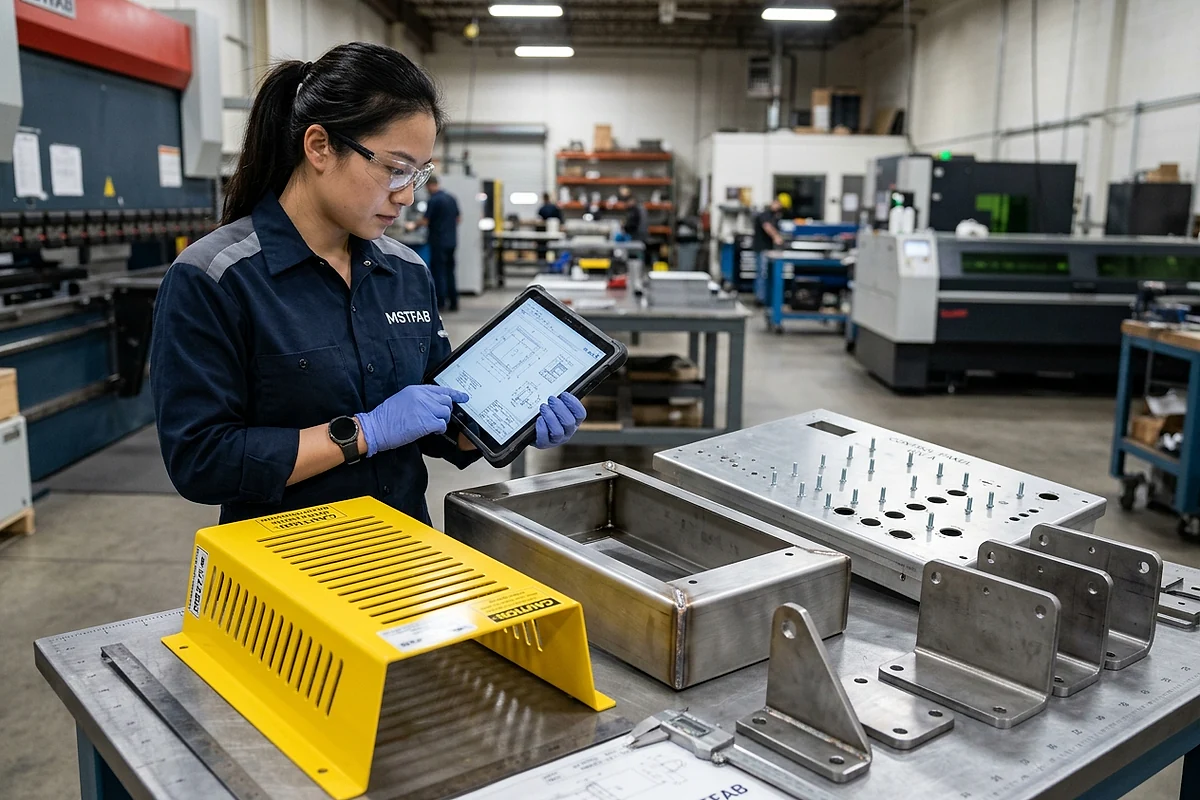
Figure 4: Finished high-precision machinery enclosure shells, covers, and structural brackets undergoing final visual quality audit and barcoded packing at MSTFAB.
10. Advanced Metrology: Coordinate Measuring Machines (CMM) & Laser Scanning
Verifying complex 3D sheet metal enclosures with multiple formed return flanges, internal sub-panel standoffs, and tight hinge hole patterns requires advanced metrology beyond manual tape measures and calipers:
10.1 Bridge CMM & 7-Axis Laser Scanning Arms
- High-Accuracy CNC Bridge CMM (Zeiss Accura): MSTFAB deploys temperature-controlled (20 ± 0.5°C) bridge coordinate measuring machines with volumetric length measurement accuracy of E0,MPE = 1.4 + L/333 μ m. CMM routines automatically probe critical datum hole patterns, hinge pin coaxiality, and backpan mounting standoff positions.
- Faro 7-Axis High-Definition Blue Laser Scanning: For large welded enclosures (> 1,500 mm), portable blue laser scanning arms capture millions of 3D cloud data points per second. The resulting 3D scan is overlaid directly onto the customer’s native CAD model in PolyWorks, generating full-field color deviation heat maps that instantly reveal localized sheet metal oil-canning, weld shrinkage, or bend angular errors within ± 0.025 mm.
- Hinge Coaxiality Verification: In dual or triple concealed hinge configurations, any non-coaxiality between hinge pin centerlines (> 0.35 mm) causes severe mechanical binding, accelerating hinge wear. CMM routines measure coaxiality to ASME Y14.5 position tolerance zones, ensuring buttery-smooth door operation.
11. Export Packaging, Humidity Control & Global Logistics Protection
An ISO 9001 quality system must protect precision sheet metal enclosures through weeks of maritime ocean freight, extreme temperature transitions through equatorial shipping lanes, and rough intermodal container transfers:
11.1 Vapor Corrosion Inhibitor (VCI) & Cushioning Standards
- Vapor Corrosion Inhibitor (VCI) Film Hermetic Enclosure: Every bare metal and powder-coated enclosure is heat-sealed inside heavy 100 μ m VCI polyethylene film along with calculated clay desiccant packs (MIL-D-3464E Type II). The volatile VCI molecules vaporize and condense onto all interior and exterior metallic surfaces, forming an invisible mono-molecular barrier that halts oxidation in 100% relative humidity marine containers.
- Custom Engineered EPE Foam Corner Protection: High-density expanded polyethylene (EPE) molded foam corner caps cradle all enclosure corners, offset flanges, and protruding mounting feet, completely isolating the cabinet from direct crate wall impacts.
- Heat-Treated ISPM-15 Certified Plywood Crating: Heavy multi-tier plywood export crates with reinforced timber base skids allow four-way forklift handling without crate flexing. Shockwatch impact indicators and WarmMark temperature loggers are mounted to exterior crate faces to monitor freight transit conditions.
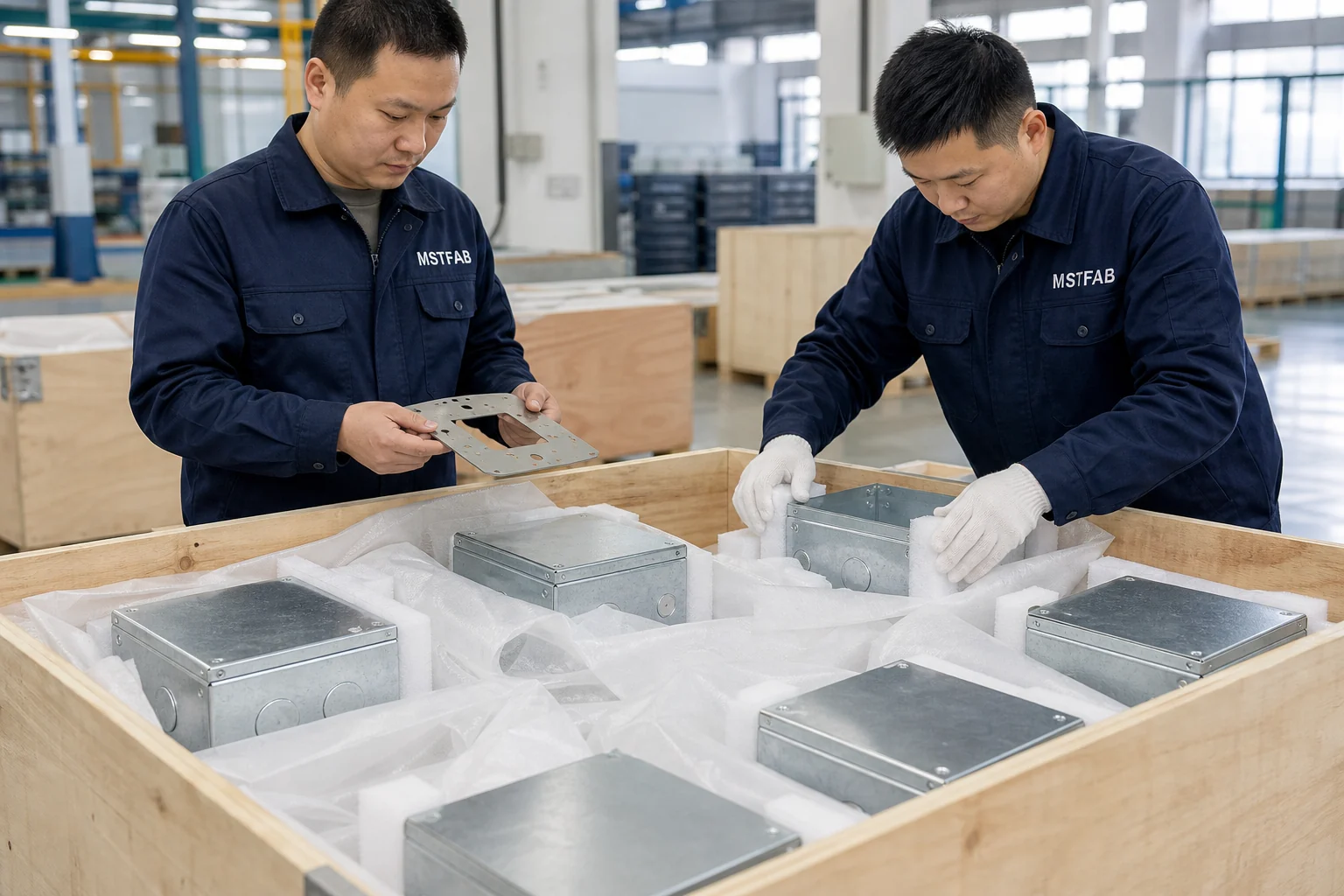
Figure 5: Precision export packaging utilizing heat-sealed VCI anti-corrosion barrier bags and custom molded high-density foam corner buffers at MSTFAB.
Frequently Asked Technical Questions: ISO 9001 Machinery Enclosure Manufacturing
Q1: What is the primary difference between a certified ISO 9001 enclosure manufacturer and a standard job shop?
A certified ISO 9001:2015 manufacturer operates under documented, audited quality control plans with full material traceability (EN 10204 3.1 MTRs), statistical process control (Cpk ≥ 1.33), calibrated metrology tracking, automated FIPFG gasketing, and formal PPAP/FAIR documentation, guaranteeing zero lot-to-lot dimensional variation across years of repeat production.
Q2: What is a Cpk capability index and why is Cpk >= 1.33 critical for enclosure OEMs?
Cpk measures how centered and narrow a manufacturing process is relative to engineering drawing tolerances. A Cpk ≥ 1.33 ensures a 4-sigma process with a theoretical defect rate below 63 parts per million (PPM), guaranteeing that every enclosure door, mounting hole pattern, and latch cutout fits perfectly on the customer’s assembly line without manual shimming or adjustment.
Q3: What material certification documentation is provided with every shipment?
MSTFAB provides EN 10204 Type 3.1 Mill Test Reports (MTR) detailing chemical heat analysis, tensile strength, yield strength, and zinc coating weight for all steel and aluminum lots, alongside RoHS/EU REACH Regulation compliance declarations and formal Certificates of Conformance (CoC).
Q4: How does robotically dispensed FIPFG foam compare to manual strip gasketing?
Robotically dispensed Form-in-Place Foam Gasketing (FIPFG) creates a seamless, continuous closed-cell polyurethane or silicone bead that molecularly bonds to the door channel. It completely eliminates cut-and-glued corner butt-splices—the #1 leak path in manual gasketing—and achieves superior compression set resistance (< 12%).
Q5: What pre-treatment chemistry does MSTFAB use before powder coating?
MSTFAB operates an automated 7-stage heated alkaline wash, reverse-osmosis halo rinse, and nano-ceramic zirconium silane conversion coating line. Zirconium creates a nano-scale (20 – 40 nm) organo-metallic barrier that ensures Class 5B cross-hatch paint adhesion (ASTM D3359) and over 1,500 hours of ASTM B117 salt-spray corrosion resistance.
Q6: How does MSTFAB ensure electrical ground continuity on powder-coated enclosures?
MSTFAB capacitor-discharge welds copper-plated or stainless steel grounding studs to the chassis and door frames, protecting the threads and circular contact landings with custom high-temperature silicone masking caps during powder coating. Every unit is audited with a 4-wire Kelvin micro-ohmmeter, verifying bonding resistance strictly below 0.05 Ω per NFPA 79.
Q7: What level of PPAP documentation can MSTFAB provide for automotive-grade projects?
Under our IATF 16949 quality system, MSTFAB routinely delivers full PPAP Level 3 documentation packages, including Design Records, Process Flow Diagrams, Process FMEA, Control Plans, Measurement System Analysis (Gage R&R < 10%), Dimensional Results (100% ballooned print FAI), Material/Performance Test Results, Initial Process Studies (Cpk ≥ 1.67), and Part Submission Warrants (PSW).
Q8: How does MSTFAB prevent self-clinching PEM hardware from stripping or pushing out?
All clinch mounting holes are laser-pierced within ± 0.05 mm hole diameter tolerances. Hardware is installed using Haeger automated insertion presses equipped with digital load-cell tonnage monitoring, ensuring the sheet metal fully cold-flows into the fastener’s undercut groove. Daily destructive push-out and torque-out tests verify adherence to PEM engineering standards.
Q9: What metrology equipment does MSTFAB utilize for geometric inspection?
Our quality laboratory features Zeiss CNC coordinate measuring machines (CMM), 7-axis Faro high-definition blue laser scanning arms with PolyWorks CAD comparison software, Keyence optical digital profile projectors, calibrated granite surface plates, digital height gauges, and ultrasonic coating thickness gauges.
Q10: What environmental enclosure tests can MSTFAB perform in-house?
MSTFAB conducts in-house NEMA 250 Clause 5.7 high-pressure 65 GPM water hose-down testing, pneumatic air-decay pressure leak testing, ASTM B117 neutral salt spray corrosion testing, ASTM D3359 cross-hatch adhesion, ASTM D2794 impact testing, and ASTM D5162 high-voltage holiday spark testing.
Q11: How does MSTFAB control CNC press brake bending accuracy across different steel heats?
MSTFAB utilizes Bystronic and Trumpf press brakes equipped with real-time optical laser angle measuring systems. The laser measures bend angle during the stroke, automatically adjusting ram penetration depth dynamically to compensate for sheet thickness variations and springback differences between material heats.
Q12: What packaging methods protect finished enclosures during international container shipping?
Every enclosure is wrapped in heat-sealed heavy VCI (Vapor Corrosion Inhibitor) anti-corrosion barrier film with clay desiccant bags, protected by custom molded high-density EPE foam corner buffers, and packed inside ISPM-15 heat-treated export plywood crates reinforced with steel strapping.
Q13: How are engineering change orders (ECO) managed under MSTFAB’s ISO 9001 system?
When an ECO is received, our PLM system locks the previous drawing revision, revokes active machine CNC programs, issues a formal Engineering Change Notice (ECN) to production leads, updates the digital traveler routing, and requires First Piece Inspection sign-off on the revised geometry before batch restart.
Q14: What welding certifications do MSTFAB operators and robots maintain?
All welding procedures and robotic programs are formally qualified under AWS D1.1 (Structural Steel) and AWS D1.6 (Structural Stainless Steel), supported by Procedure Qualification Records (PQR) with certified weld penetration, bend test, and tensile test verification.
Q15: What is the typical lead time for custom prototype enclosures versus series production?
Rapid prototype sample builds are completed within 5 to 7 business days, including full 3D DFM review and laser cutting. Volume series production runs (100 to 5,000 units) are delivered within 14 to 21 business days, supported by blanket purchase order releases and kanban stocking.
Q16: How does MSTFAB manage non-conforming material containment?
Any non-conforming part detected on the shop floor is immediately red-tagged, logged in the ERP system, and moved to a physical locked quarantine holding cage. A cross-functional 8D root-cause investigation (Ishikawa fishbone and 5-Why analysis) is initiated within 24 hours to prevent recurrence.
Q17: Can MSTFAB apply custom silk screening, UV printing, or laser engraving on enclosures?
Yes. We offer high-durability two-component epoxy silk screening, multi-color UV flatbed printing, and fiber laser surface annealing for schematic terminal labeling, UL 508A warning placards, and OEM corporate branding.
Q18: What is First Article Inspection (FAIR per AS9102) and what does it include?
A First Article Inspection Report verifies every single ballooned engineering drawing feature on the first production unit. It includes Form 1 (Part Number Accountability), Form 2 (Product Accountability – materials, finishes, special processes), and Form 3 (Characteristic Accountability – 100% measured actual dimensions vs print tolerances).
Q19: How does MSTFAB ensure door squareness and eliminate door latch binding?
We utilize precision corner-relief geometry on 2D laser blanks, automated robotic laser corner welding, and precision hinge pin reaming. Formed door diagonals are inspected to ± 0.4 mm, ensuring equal perimeter clearance and smooth 3-point latch cam engagement.
Q20: What CAD formats does MSTFAB accept for automated DFM quoting and analysis?
We accept native SolidWorks (.sldprt, .sldasm), Autodesk Inventor (.ipt), PTC Creo, Siemens NX, standard STEP (.stp), IGES (.igs), and Parasolid (.x_t) 3D files, accompanied by 2D PDF engineering drawings specifying tolerances, weld symbols, and powder coat callouts.
Q21: How are sub-tier plating and coating suppliers audited under ISO 9001 Clause 8.4?
All approved outside process suppliers undergo formal annual on-site quality audits, including titration bath control logs, cross-hatch adhesion verification, salt fog chamber certifications, and thickness measurement calibration records. Any supplier with a quality score below 95% is immediately put on probation.
Q22: How does MSTFAB perform Gage R&R measurement system analysis?
Gage Repeatability and Reproducibility (Gage R&R) studies are conducted using 10 parts, 3 operators, and 3 trials per AIAG MSA guidelines. The Total Gage R&R must not exceed 10% of process tolerance, ensuring measurement variation does not mask actual manufacturing drift.
Q23: How are stainless steel enclosures passivated and tested for free iron contamination?
Stainless steel enclosures are fully submerged in heated citric or nitric acid passivation baths per ASTM A967. Surface passivation is verified using water immersion testing (ASTM A967 Practice F) and copper sulfate surface screening (ASTM A380), confirming zero free iron surface contamination.
Q24: What customer communication and project tracking tools does MSTFAB provide?
Every OEM client is paired with a dedicated bilingual sheet metal project engineer and receives real-time production portal access showing live order progress, digital inspection reports, CMM data sheets, and barcoded freight tracking information.
Q25: How does MSTFAB perform seismic qualification testing (IEEE 693 / IBC) for machinery control boxes?
For heavy industrial and power infrastructure applications, MSTFAB validates structural integrity using Triaxial Shake Table testing in accordance with IEEE 693 High Seismic Performance Level and International Building Code (IBC) Chapter 16 requirements. Finite element analysis (FEA) modal simulations are conducted prior to testing to calculate natural resonant frequencies and optimize internal corner gussets, stiffening channels, and anchor bolt pattern geometry, ensuring total spectral acceleration capacity up to 2.5g zero period acceleration (ZPA) without weld cracking or latch disengagement.
Q26: What are the primary differences between ISO 9001 and IATF 16949 in sheet metal enclosure fabrication?
While ISO 9001:2015 establishes universal quality management fundamentals focused on customer satisfaction and procedural control, IATF 16949 imposes rigorous automotive-grade defect prevention, process capability requirements, and reduction of variation throughout the supply chain. In practical enclosure fabrication, IATF 16949 mandates formal Advanced Product Quality Planning (APQP), Process Failure Mode and Effects Analysis (PFMEA), Control Plans for every single machine operation, Measurement System Analysis (Gage R&R under 10%), and strict Production Part Approval Process (PPAP Level 3) submittals with Cpk values exceeding 1.67 for critical safety-related features.
Q27: How does MSTFAB prevent galvanic corrosion between dissimilar metals in hybrid assemblies?
When machinery enclosures incorporate mixed metallurgical components—such as aluminum 5052 mounting plates fastened inside cold-rolled carbon steel cabinets, or 316 stainless steel quarter-turn latch studs mounted through electro-galvanized doors—an electrochemical potential difference can induce rapid galvanic cell attack in moist or washdown environments. MSTFAB engineers eliminate direct galvanic coupling by maintaining the anodic-to-cathodic potential difference below 0.15 V in harsh outdoor or marine environments (and below 0.25 V in controlled indoor industrial spaces per MIL-STD-889). We utilize non-conductive virgin PTFE or EPDM isolation washers, specialized zinc-nickel alloy fasteners with high-performance sacrificial passivations, and automated dielectric e-coat barriers on all contacting interfaces.
Q28: What is MSTFAB’s warranty, containment, and root-cause turnaround under ISO 9001 Clause 10 Continuous Improvement?
Under our ISO 9001:2015 Clause 10 Corrective Action protocol, MSTFAB enforces a strict 8D Problem Solving Methodology with a 24-hour containment guarantee, a 48-hour root cause identification milestone (employing Ishikawa fishbone diagrams and 5-Why root-cause trees), and a 5-day formal corrective action implementation and verification plan. Every standard enclosure delivered by MSTFAB carries a comprehensive 3-year structural integrity and finish warranty against weld failure, mechanical delamination, and premature corrosion, backed by complete historical digital traveler records and retained raw material coupon traceability.
Partner with an ISO 9001 & IATF 16949 Certified Machinery Enclosure Manufacturer
Elevate your machinery build quality with MSTFAB’s precision sheet metal fabrication, Cpk >= 1.33 statistical process control, automated robotic FIPFG foam gasketing, and certified NEMA 4X / IP66 enclosure manufacturing. Upload your CAD drawings today for an expert engineering DFM review and production quote within 24 hours.
 WeChat Contact
 WhatsApp Me Directly