
Quick answer: An IP65 battery storage cabinet project needs a defined enclosure configuration and validation plan, not just thicker sheet or a gasket. Agree the door, seams, cable entries, cooling openings and sealing hardware before releasing the metalwork. MSTFAB fabricates drawing-defined mechanical shells and mounting provisions; the responsible OEM or integrator owns the complete BESS design and validation.
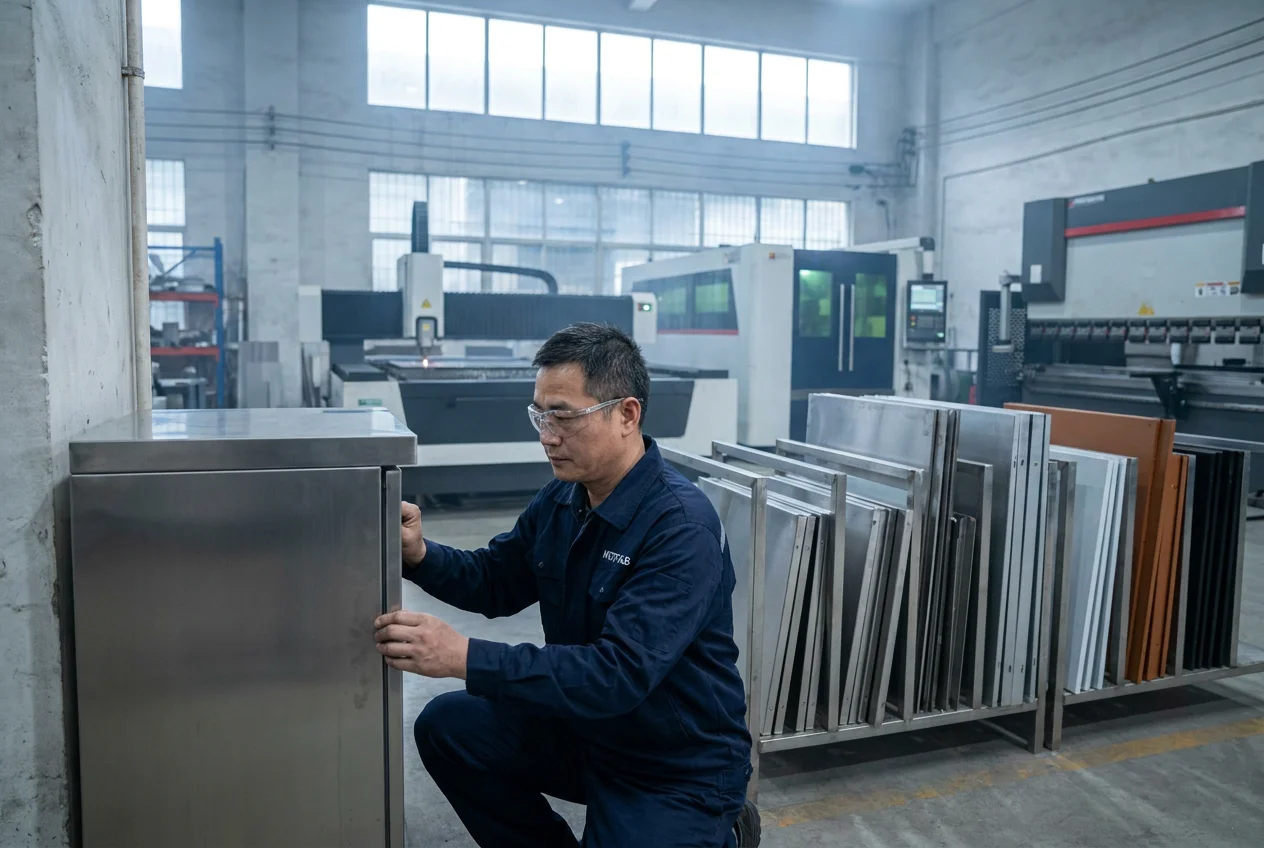
What the IP requirement does and does not establish
IEC 60529 addresses degrees of protection provided by enclosures. The required classification should come from the application specification. Do not treat IP65 as a universal minimum for all outdoor battery systems or assume that it establishes corrosion resistance, structural capacity, thermal performance or battery fire safety.
An IP designation is not equivalent to a NEMA enclosure type. If a project requires NEMA Type 4X, request the applicable evidence rather than substituting an IP66 statement or selecting stainless steel and assuming compliance.
Freeze the configuration that will be evaluated
Identify the drawing revision, door arrangement, hinges, latches, gasket, cable-entry hardware and cooling interfaces. A report for a different configuration may not support the proposed cabinet. Record which openings are populated, sealed or blanked during evaluation and how that state relates to the delivered shell and final installation.
A water-jet demonstration is not evidence of the complete IP65 classification by itself. Agree the applicable evaluation scope, acceptance criteria and reporting responsibility with the responsible engineer or test provider. Do not substitute photographs for an identified report.
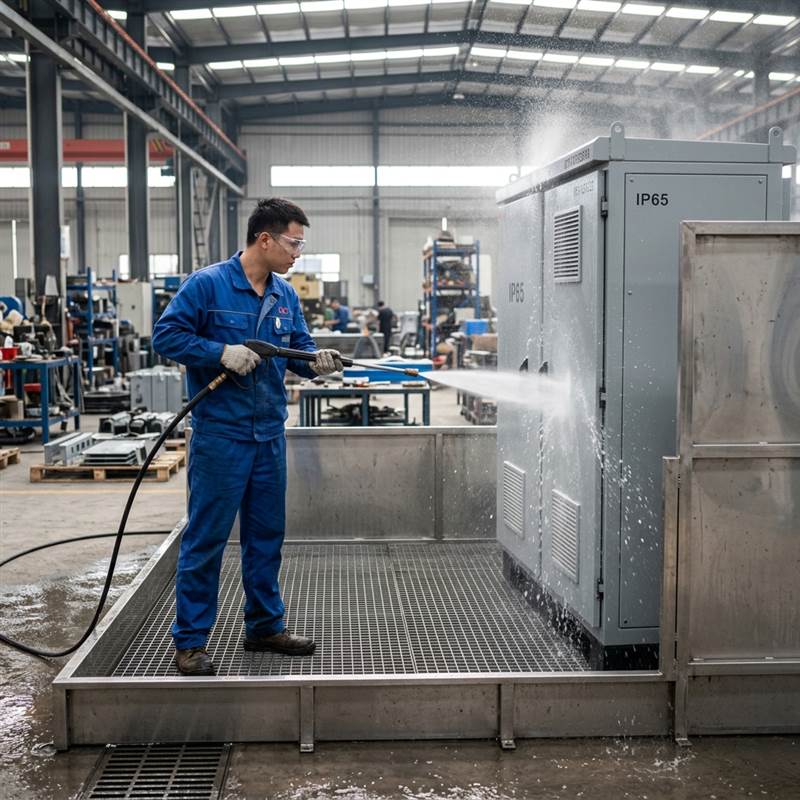
Control the mechanical sealing interfaces
| Interface | Drawing information | Acceptance question |
|---|---|---|
| Door perimeter | Gasket path, mating surfaces and controlled gap requirements | Does the finished assembly match the approved geometry? |
| Hinges and latches | Hardware references, locations and adjustment provisions | Is operation consistent with the specified assembly condition? |
| Seams and corners | Joining details and permitted discontinuities | Have the agreed seam and dimensional checks been completed? |
| Cable entries | Cutout pattern, removable plates and selected sealing components | Does the evaluated configuration include these interfaces? |
| Cooling equipment | Mounting pattern, opening, mass and sealing details | Has the OEM approved the complete interface? |
| Drains and breathers | Buyer-selected components, orientation and installation requirements | Are they included in the system’s validation plan? |
The table defines questions to resolve, not a claim that MSTFAB routinely supplies all testing or components. Confirm each deliverable in the quotation.

Choose gasket geometry from the selected product
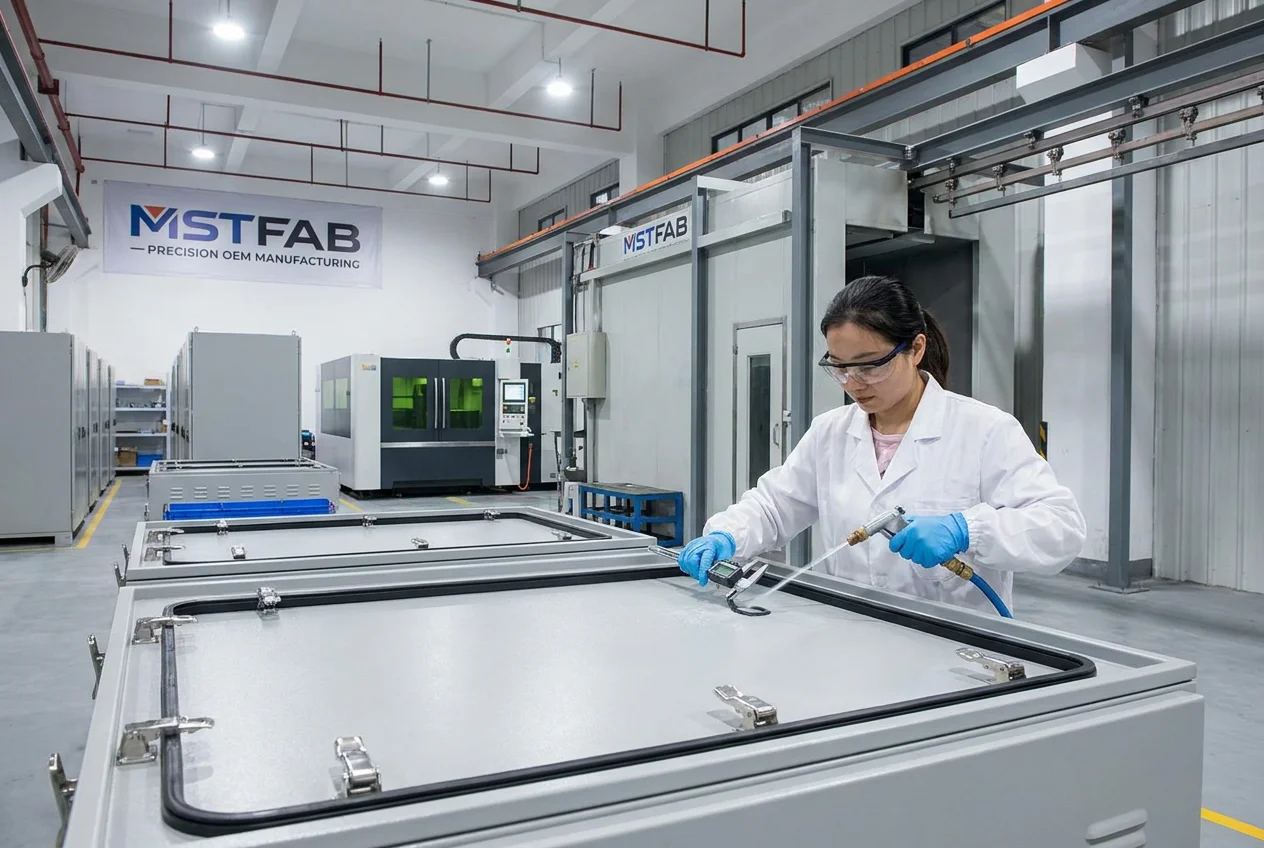
Specify the gasket reference, profile, joint treatment, attachment and relevant installation instructions. Compression and sealing-land requirements depend on the selected product and door design. Avoid prescribing one compression percentage, rebate width or latch count for every enclosure.
Review the complete tolerance path through the frame, door, hinges, latch and finish. A dimensionally acceptable bare door may fit differently after coating. Define the inspection condition and identify any gasket or hardware supplied by the buyer.
Keep material and structural approval separate from ingress claims
Metal grade and thickness must follow the actual geometry, loading, joining and exposure requirements. Supply battery and equipment masses, support locations, handling cases and buyer-approved structural requirements. A generic sheet-gauge table does not establish load capacity.
Similarly, a stainless grade or powder-coating thickness does not establish a service life. Define preparation, finish, visible faces, masking and required corrosion evidence for the particular project. Do not use an ingress classification as a coating specification.
Do not solve condensation by adding an unreviewed opening
Thermal and moisture management require system-level review. A sealed cabinet can still face internal moisture concerns. The OEM should select any heater, breather, drain or cooling equipment using the operating conditions and equipment requirements.
MSTFAB can fabricate approved mounting brackets and openings. This does not include selecting heater power, wiring controls or validating thermal performance. Any new penetration should trigger review of the sealing boundary and relevant validation evidence.

Ask for a traceable validation handoff
- Identify the required classification, applicable documents and responsible approval party.
- Freeze the assembly configuration and drawing revision.
- Agree specimen selection, test provider, method and acceptance criteria.
- Record the evaluated configuration and results in the required report.
- Review deviations and later hardware or opening changes before reusing the evidence.
Confirm whether testing is qualification work, production sampling or another agreed inspection. Do not assume every delivered cabinet is tested individually. A conformity statement should identify its scope and basis; it does not automatically replace a test report.
Questions to settle before ordering
Can an empty metal shell be described as a complete battery system?
No. Batteries, BMS, electrical integration, controls and completed-system validation are separate from the drawing-defined shell supply.
Can a rated cable gland guarantee the whole cabinet rating?
No. Its selection and installation are only part of the assembled enclosure boundary. Review the door, seams and all other penetrations as well.
What changes require review?
Changes to doors, gaskets, latches, seams, entries or cooling hardware should be assessed against the approved configuration and evidence. The responsible engineer or test provider determines the necessary further validation.
Send the enclosure interface package
Send the controlled model and drawings, material, quantity, hardware schedule, load inputs and required records. List unresolved sealing interfaces rather than assuming they are included. See our battery storage enclosure shell service for fabrication scope, or send the drawings for review.
 WeChat Contact
 WhatsApp Me Directly