
Use this page for industrial application requirements
This article is not a basic definition. It helps buyers turn an industrial application into a useful RFQ: where the part lives, what it supports, what it must survive and how it will be inspected.
This page has been separated from the basic definition guide so Google and buyers can see the job of this article clearly. The useful question here is not “can someone make metal parts?” It is: what should a buyer check before sending drawings, approving a quote or moving into production?
- Name the application: enclosure, guard, bracket, frame, cover or panel.
- State environment: indoor, outdoor, washdown, vibration or heat.
- Choose material and finish based on that environment.
- Mark critical mounting and fit-up points.
- Ask for QC evidence that matches the part's job.
| 1 | Name the application: enclosure, guard, bracket, frame, cover or panel. |
| 2 | State environment: indoor, outdoor, washdown, vibration or heat. |
| 3 | Choose material and finish based on that environment. |
| 4 | Mark critical mounting and fit-up points. |
| 5 | Ask for QC evidence that matches the part's job. |
Industrial sheet metal fabrication is where flat metal becomes the parts that keep real equipment protected, mounted, covered, organized, and serviceable.
That sounds simple until the mounting holes do not line up, the guard rubs the belt, the cabinet door looks crooked, the powder coating chips in transit, or the installer reaches for a drill and suddenly becomes your most expensive quality inspector.
This guide is a practical entry page for buyers who need industrial enclosures, control cabinets, machine guards, belt guards, equipment covers, brackets, welded frames, and other drawing-based sheet metal parts. No fancy fog machine. Just what matters before you send an RFQ.
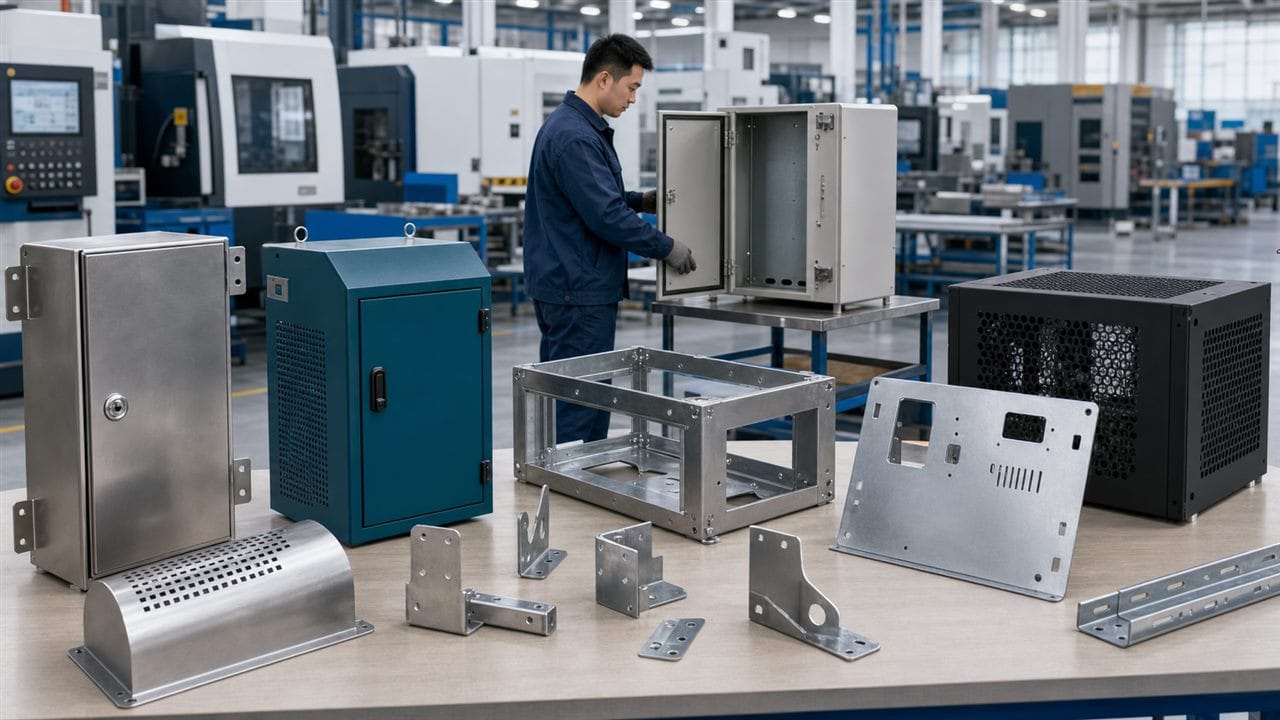
What Industrial Sheet Metal Fabrication Means
Industrial sheet metal fabrication is the manufacturing of custom metal parts for industrial machinery, electrical systems, automation equipment, control systems, production lines, material handling equipment, and OEM products.
The work may include laser cutting, CNC bending, welding, grinding, deburring, hardware insertion, powder coating, inspection, assembly, and export packaging. If you want the full step-by-step workflow, this related guide explains the sheet metal fabrication process from drawing review to shipment.
The big idea is this: industrial parts are not just metal shapes. They have jobs. They protect operators, hold components, route cables, keep dust out, allow maintenance access, resist vibration, and make the finished machine look like somebody cared.
Where Industrial Buyers Usually Need It
Industrial buyers normally come to custom fabrication because standard parts are close but not close enough. Close enough is fine for a lunch recommendation. It is less fine when your control board needs four holes to match exactly.
- Industrial enclosures for equipment, electronics, and outdoor devices.
- Control cabinets for automation, electrical, and production-line systems.
- Machine guards for moving parts, service areas, and operator protection.
- Belt guards for motors, pulleys, conveyors, and drive systems.
- Equipment covers and access panels for maintenance and dust protection.
- Mounting brackets and support plates for sensors, cabinets, panels, and frames.
- Welded frames and chassis structures for machinery and cabinet assemblies.
- Ventilation panels, cable covers, internal plates, and powder-coated assemblies.
Industrial Parts Have Different Risks Than Pretty Panels
A decorative panel has to look good. An industrial part has to look good while surviving vibration, dust, heat, oil, tool contact, cable movement, forklift moods, and maintenance technicians who are not paid to be gentle.
- Mounting accuracy: wrong holes turn your assembly team into a drilling department.
- Guard clearance: a guard that rubs a belt is not a guard. It is a problem with paint.
- Door and hinge fit: poor gaps make a whole machine look cheap.
- Edge safety: sharp edges cut hands, wires, packaging, and trust.
- Welding distortion: a strong welded frame that is crooked is still a heavy problem.
- Finish durability: coating must match indoor, outdoor, washdown, or corrosion exposure.
- Packaging: perfect parts that arrive scratched are no longer perfect.
Common Materials for Industrial Sheet Metal Parts
| Material | Typical Use | Buyer Check |
| Carbon steel | Guards, cabinets, frames, brackets, covers | Usually needs coating or plating for corrosion control. |
| Galvanized steel | Outdoor covers, guards, mounting plates | Cut edges and welded areas still need protection review. |
| Stainless steel 304/316 | Washdown, premium, medical, food-adjacent, corrosion-sensitive parts | Surface class and weld cleanup should be defined. |
| Aluminum 5052/6061 | Lightweight panels, equipment covers, brackets, housings | Bend radius, scratch protection, and galvanic corrosion may matter. |
Material selection is not just a price choice. It affects bending, welding, coating, weight, field durability, and how many emails your team sends after installation.
Key Manufacturing Processes Buyers Should Understand
Laser Cutting
Laser cutting creates accurate profiles, holes, slots, ventilation openings, cable entries, and flat blanks. It is flexible and precise, but it does not rescue a bad bend design or unclear drawing notes.
CNC Bending
CNC bending forms covers, brackets, channels, doors, panels, and enclosure bodies. Hole-to-bend clearance, bend radius, tooling, springback, and bend sequence should be reviewed before production. For more detail, see our CNC sheet metal bending buyer guide.
Welding and Frame Assembly
Welding is used for frames, cabinets, guards, bases, brackets, and chassis assemblies. Heat moves metal, so fixture support, weld sequence, grinding requirements, and final squareness need attention.
Powder Coating and Surface Finish
Powder coating protects industrial parts and improves appearance. The buyer should define color, gloss, texture, coating thickness, outdoor requirement, masking areas, grounding contact, and packaging after coating.
The RFQ Package That Saves Everyone Time
A good RFQ does not need a novel. It needs the right facts. Send these and you immediately reduce guessing:
- 3D STEP file and 2D PDF drawing.
- DXF or DWG file when flat cutting data is available.
- Material grade, thickness, and finish requirement.
- Quantity, prototype quantity, and expected batch demand.
- Critical dimensions, tolerance, and inspection points.
- Welding, hardware, hinge, lock, gasket, and assembly notes.
- Outdoor, vibration, corrosion, washdown, or service-access requirements.
- Packaging and destination country.
If the project is OEM and repeat orders matter, our OEM sheet metal fabrication guide explains how drawing ownership, confidentiality, prototypes, and batch repeatability fit together.
Buyer Mistakes That Create Pain Later
- Sending only photos: photos are useful, but they are not dimensions.
- Comparing quotes with different scopes: one quote may include finishing, hardware, inspection, and packing; another may include optimism.
- Ignoring coating thickness: threads, holes, grounding points, and mating surfaces may need masking.
- Skipping prototypes: first articles catch fit and finish issues before the batch order becomes a group project.
- Not defining packaging: export shipping is not a spa day for metal parts.
- Poor revision control: “latest version” is not a drawing revision system.
How MSTFAB Fits This Work
MSTFAB is a drawing-based custom sheet metal manufacturer in Guangzhou, China. We support industrial buyers with laser cutting, CNC bending, welding, hardware insertion, powder coating, inspection, assembly, and export packaging.
We focus on the physical metal parts: enclosures, cabinets, guards, covers, brackets, panels, frames, and welded assemblies. We do not need your private software, control logic, machine program, charging technology, telecom system design, or full product secrets unless they directly affect the metal structure.
For buyers comparing factories, this page on a sheet metal enclosure factory explains why assembly, final QC, and export packaging are part of the real buying decision, not extras sprinkled on at the end.
Quick Decision Map
| If You Need… | Start Here |
| Outdoor or equipment housings | Custom sheet metal enclosures |
| Automation or electrical cabinets | Control cabinet enclosure fabrication |
| Moving part protection | Machine guards or belt guards |
| Small structural mounting parts | Custom sheet metal brackets |
| Laser-cut panels and blanks | Laser cutting services |
| Formed panels and brackets | Sheet metal bending |
| Welded frames and assemblies | Welding services |
| Durable finish and color control | Powder coating for sheet metal enclosures |
Final Thought
Industrial sheet metal fabrication is not about buying metal by the kilogram. It is about buying fit, protection, access, repeatability, finish, inspection, and fewer surprises on the production floor.
If a supplier only talks about unit price, ask about drawing review, bend risks, welding distortion, coating thickness, inspection points, and packaging. The quiet details are usually where the expensive problems hide.
Related RFQ resource: Industrial parts often involve material, coating, tolerance and packing details that change the final cost. Before requesting supplier pricing, use this sheet metal fabrication quote checklist to make the RFQ easier to price accurately.
FAQ
What is industrial sheet metal fabrication?
It is the manufacturing of custom sheet metal enclosures, cabinets, guards, covers, brackets, panels, frames, and welded assemblies for industrial equipment, machinery, control systems, and OEM products.
What parts are commonly made this way?
Common parts include industrial enclosures, control cabinets, machine guards, belt guards, access panels, equipment covers, mounting brackets, support plates, chassis parts, welded frames, and ventilation panels.
What should I send for a quote?
Send a STEP file, PDF drawing, material, thickness, quantity, finish notes, tolerance requirements, welding or hardware notes, inspection requirements, and packaging details.
Can MSTFAB support prototypes and batch production?
Yes. Prototype or first-article production helps confirm fit, finish, assembly, and packaging before larger batch production begins.
MSTFAB provides TIG and MIG sheet metal welding services for structural assemblies, cabinets, frames and OEM metal components.
 WeChat Contact
 WhatsApp Me Directly