
The Short Answer
Industrial enclosure nameplate mounting must balance regulatory permanence with environmental ingress sealing. Punching open through-holes into a NEMA 4, 4X, or IP66 door for standard open-end pop rivets creates an immediate capillary leak path right into the control cabinet, while slapping acrylic foam tape onto low-surface-energy powder coat without edge protection leads to high-pressure washdown peel failure. Specify the exact fastening method—closed-end sealed blind rivets, welded backside studs, or recessed adhesive pockets—along with hole diameters, backside stiffener clearance, and galvanic isolation directly on the 2D sheet metal drawing.
Explore this guide
01 / Regulatory & Environmental Scope
Align nameplate permanence with cabinet ingress protection from the first CAD release.
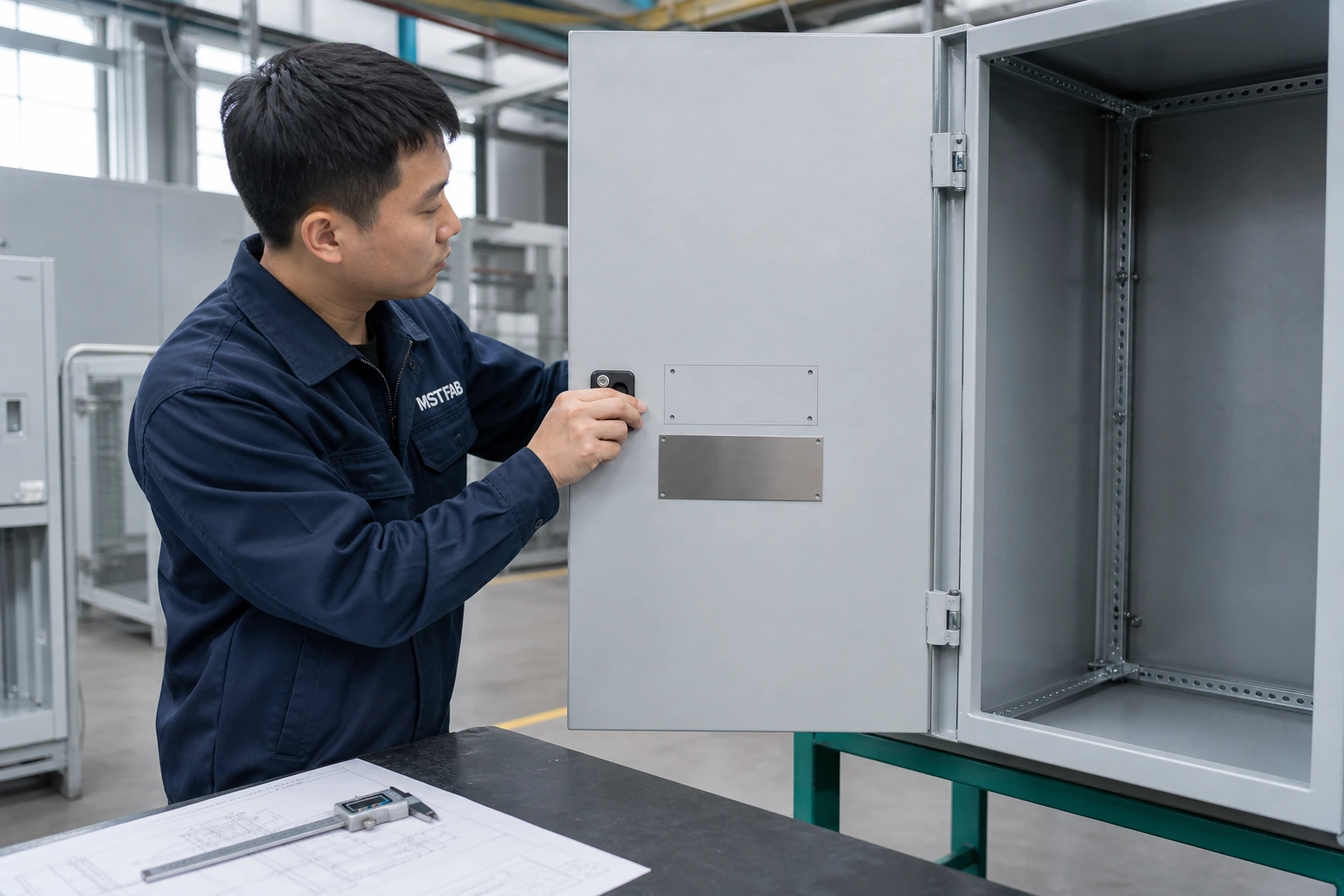
On industrial control panels and outdoor utility cabinets, the ratings nameplate carries legally required electrical identification—supply voltage, phase count, full-load amperes, short-circuit current rating (SCCR), and enclosure environmental type under UL 508A Section 52 and NFPA 79. However, when the mechanical drawing simply notes “Mount nameplate per assembly” without defining hole geometry or sealing method, shop-floor improvisations often drill unsealed holes straight through a weather-tight door.
Treat the nameplate interface as a controlled mechanical feature on the empty enclosure shell drawing. Decide before laser cutting whether the placard attaches mechanically through the skin, mounts onto blind internal weld studs, bonds into a shallow coined pocket, or is fiber-laser annealed directly onto the stainless door.
UL 508A & NFPA 79 visibility
Locate the main rating plate where it remains clearly legible after installation without requiring tools or opening hinged interior dead-front panels.
UL 50E & NEMA 4X sealing integrity
Any fastener penetrating the enclosure boundary outside the perimeter gasket line must maintain the same water-jet and corrosion resistance as the parent shell.
UL 969 adhesive permanence
Pressure-sensitive adhesive systems must be matched to the exact powder-coat resin chemistry, texture profile, and maximum ambient operating temperature.
Engineering rule of thumb: Never allow field drilling of nameplate holes after powder coating on carbon steel or galvanized doors—exposed raw hole edges become the first site of under-film rust creep.
02 / Mechanical Fastening & Sealing Physics
Prevent capillary water ingress when riveting metal data plates to enclosure doors.
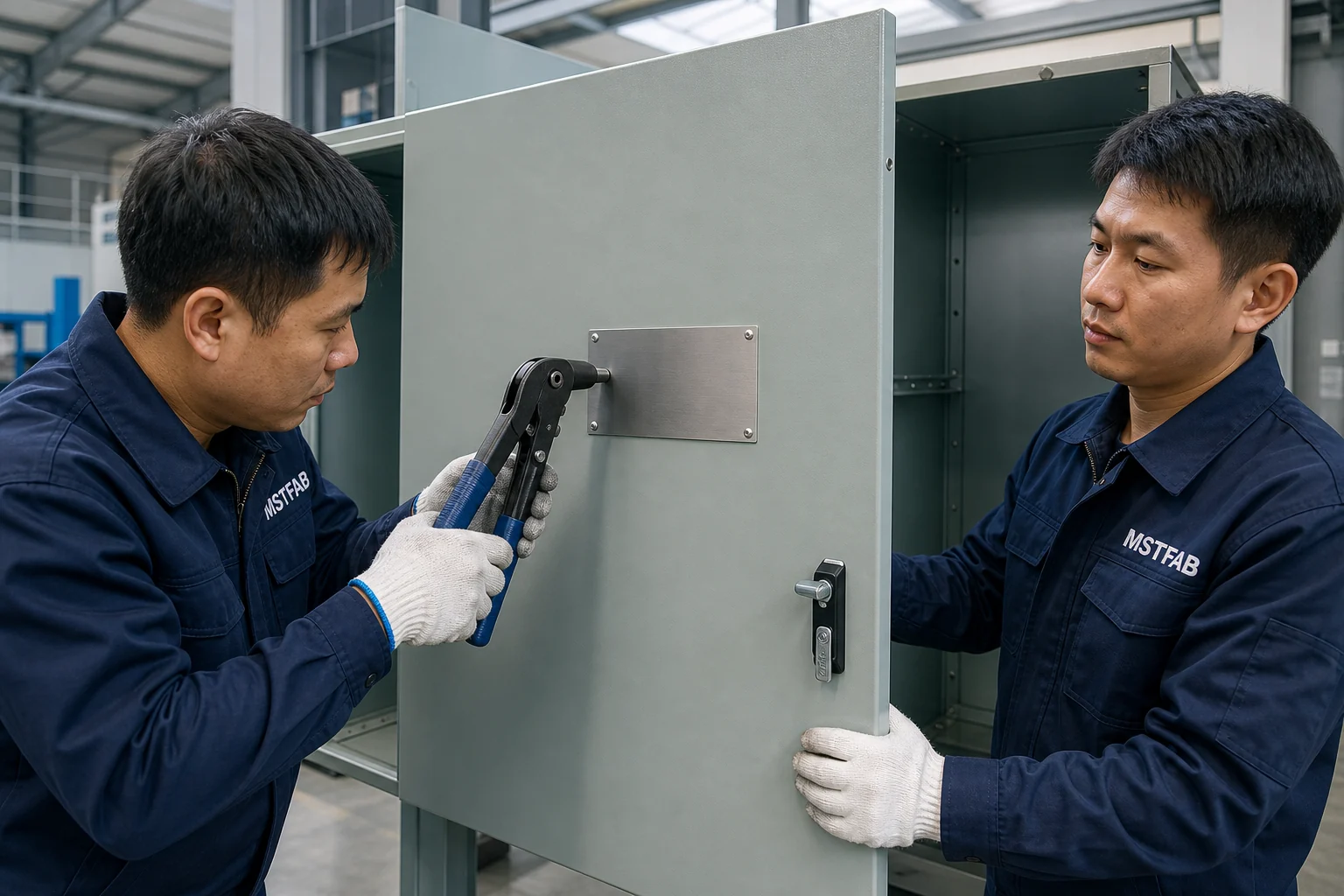
Standard open-end blind rivets (“pop rivets”) are hollow tubes whose broken mandrel stem is held only by radial interference. Under 65 psi hose-down testing or day-night thermal pressure cycling, water wicks past both the rivet flange and the central mandrel core. If mechanical fastening is required by customer specification or hazardous-location standards, engineer the joint so the enclosure wall stays hermetically sealed.
- Closed-end (sealed) blind rivets with EPDM/silicone washers: A cup-shaped blind sleeve completely encapsulates the mandrel head on the interior side, while an integrated under-head elastomer washer seals the laser-cut hole face.
- Capacitor-discharge (CD) internal or external weld studs: Welding threaded studs or blind standoffs before pretreatment eliminates through-holes entirely, preserving a 100% continuous exterior metal barrier.
- Hole-to-hole pitch and clearance budgeting: Laser-cut mounting holes in the door skin with +0.15 mm to +0.25 mm radial clearance over the nominal rivet body diameter, accounting for 60–100 µm per side of powder coat build-up.
During precision fiber laser cutting of the flat door blank, cutting the nameplate mounting pattern in the same single setup as the hinge and latch cutouts guarantees true position without secondary drill jigs.

03 / Structural Adhesives, Pockets & Laser Marking
Eliminate high-pressure washdown peel failure with recessed pockets or direct laser annealing.
Acrylic foam tapes such as 3M VHB 4952 or 5952 eliminate door penetrations, but they are vulnerable to two failure mechanisms: low surface free energy (SFE) on PTFE-modified or heavy-wrinkle powder coats, and hydrodynamic water-jet wedging under exposed 1.0–1.5 mm nameplate edges during food or pharmaceutical washdown.
- Specify high-surface-energy smooth or fine-matte polyester TGIC powder coats (or 3M Primer 94 surface promotion) where structural acrylic tapes are used.
- Stamp or form a shallow 0.8 mm to 1.2 mm recessed emboss pocket on thin-gauge doors so the nameplate edges sit below the surrounding sheet surface and cannot catch washdown jets or cleaning cloths.
- Maintain a minimum 35–50% wet-out compression roller pass at room temperature above 20 °C so viscoelastic acrylic adhesive flows into micro-valleys before curing.
- For hygienic 304L/316L stainless steel cabinets, evaluate direct fiber-laser annealing—creating a dark, passive chromium-oxide mark with zero surface crevice, zero consumable hardware, and permanent washdown durability.
Combining a shallow formed locating recess or subtle laser-etched alignment ticks with our CNC press brake and stamping tooling removes manual measuring tape errors on the assembly line.
Explore enclosure powder coating and surface preparation options →
04 / Backside Clearance & Galvanic Compatibility
Protect interior stiffeners, gasket channels, and dissimilar metals from assembly clashes.
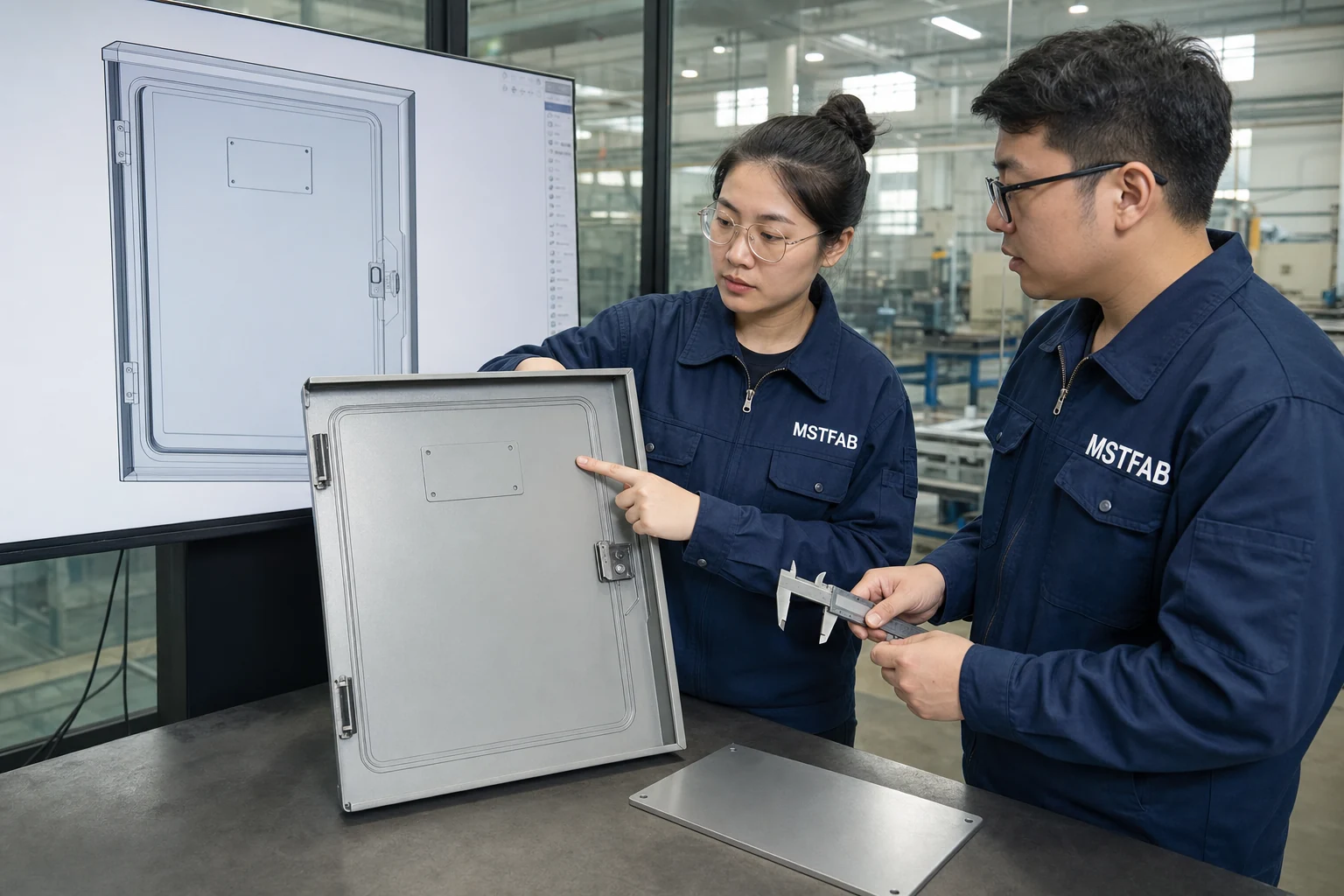
Nameplates are frequently added late in the CAD cycle by electrical engineers who only view the exterior door face. On the shop floor, those four corner rivet holes often land directly on top of an interior hat-section door stiffener, a grounding stud, a drawing pocket, or the polyurethane foam-in-place gasket track.
- Pneumatic rivet gun and mandrel tail envelope: Keep through-holes at least 25 mm clear of interior hat-channel welds, window clamp frames, and return flanges so the tool nosepiece sits dead perpendicular and the expanded blind bulb (~1.5× hole diameter) does not foul internal wiring.
- Perimeter gasket keep-out zone: Never place nameplate fasteners inside or across the door sealing land; keep all penetrations clearly positioned inside the dry zone or use blind external pockets.
- Galvanic corrosion isolation on outdoor cabinets: Avoid fastening a 316 stainless steel nameplate onto an anodized or bare 5052 aluminum enclosure using carbon steel or copper-alloy rivets. Match 316 stainless plates with 316 stainless closed-end rivets and an EPDM or Mylar isolation barrier.
- Crevice prevention in sanitary environments: Where metal data plates must be mechanically attached in washdown rooms, apply a continuous food-grade silicone perimeter fillet seal or stand the plate off on hygienic spacers.
Our engineering team cross-checks both sides of every custom electrical enclosure door model before nesting to catch hidden interference between exterior markings and interior structural ribs.
05 / Buyer Control Matrix
Verify five nameplate mounting decisions before releasing enclosure production.
Use this engineering matrix during drawing sign-off to align mechanical design, regulatory compliance, and sheet metal fabrication teams.
06 / Inspection & First-Article Verification
Inspect mounting pitch, perpendicularity, and seal seating during first-article build.
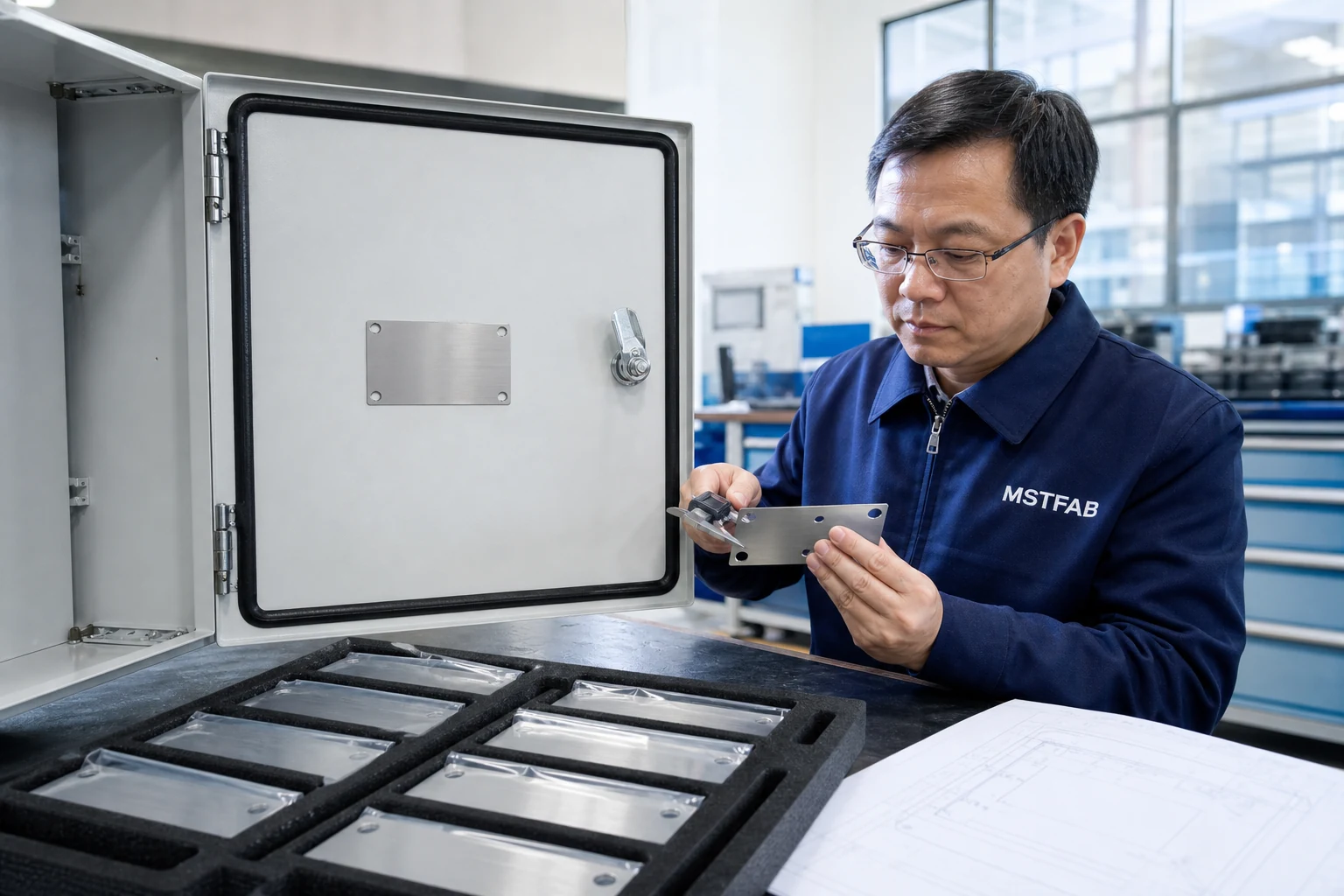
A crooked nameplate or a bulged rivet corner immediately degrades the perceived build quality of a high-value automation cabinet. During First Article Inspection (FAI), we verify nameplate mounting hole coordinates from the primary door edges, check post-coating hole clearance with pin gauges, and confirm that closed-end rivets pull flush without cracking the surrounding powder coat.
For adhesive-mounted plates without recessed pockets, using a simple laser-cut Delrin or aluminum slip-over locating template pinned to the door edge ensures every cabinet in a 200-unit production batch has identical horizontal level and margin spacing.
Where enclosures undergo factory spray or hose-down verification, any mechanically fastened nameplate ports are inspected on the interior door face for zero moisture weeping.
Review sheet metal quality control and FAI inspection workflows →
07 / Packing, Kitting & Scope Boundary
Protect etched faceplates and pre-mounted markings during export transit.
Screen-printed, anodized, or chemically etched stainless nameplates scratch easily if rubbed against cardboard dividers. We apply low-tack UV-stable protective polyethylene film over the nameplate face and use foam corner blocks so stacked enclosure doors never rest on raised placard edges or rivet heads.
If your panel shop serializes each cabinet after electrical wiring, we can pre-punch the sealed mounting holes—or weld the internal studs—on the custom sheet metal door and ship the blank or pre-etched nameplates in a labeled hardware kit bag inside the enclosure.
Manufacturing scope: MSTFAB operates under an ISO 9001 quality management system and manufactures custom drawing-based sheet metal parts, empty enclosure shells, and etched or laser-marked plates to buyer specifications. Determining mandatory regulatory text (such as SCCR calculations, electrical ratings, and final UL 508A or NRTL system certification of the powered assembly) remains the responsibility of the OEM or panel builder.
08 / Ready-to-Review RFQ
Include eight engineering details in your enclosure nameplate DFM package.
- 3D STEP door and plate modelInclude the enclosure door, interior stiffeners, and the nameplate positioned in 3D space.
- 2D PDF drawing with hole tolerancesCall out hole diameter, center-to-center pitch, and edge datums explicitly.
- Fastening or bonding specificationSpecify closed-end sealed rivets, CD weld studs, 3M VHB grade, or fiber-laser marking.
- Target environmental ratingState whether the cabinet targets indoor dust protection or outdoor/washdown sealing (e.g., IP66 / Type 4X).
- Door material and coating calloutIdentify substrate alloy, powder-coat chemistry, texture, and dry film thickness.
- Nameplate artwork and materialProvide vector DXF/AI artwork, plate thickness, alloy (304/316 SS or anodized Al), and etching depth.
- Galvanic & washer requirementsList rivet body/mandrel materials and EPDM/silicone sealing washer specs.
- Installation & kitting instructionIndicate whether MSTFAB installs the plate at the factory or ships it loose for post-wiring serialization.
Defining these eight details before cutting metal prevents last-minute hand drilling on finished doors and keeps your enclosure sealing boundary intact.
Enclosure nameplate mounting questions from control panel OEMs
Can standard open-end blind rivets be used on a NEMA 4X or IP66 enclosure door?
No. Standard open-end blind rivets leave a hollow through-passage around the broken mandrel stem that allows water and washdown chemicals to wick inside the cabinet. If rivets penetrate the sealed boundary, specify closed-end (sealed) blind rivets with an integrated EPDM or silicone under-head sealing washer.
Why do adhesive-backed nameplates sometimes peel off powder-coated doors?
Peel failures usually happen for three reasons: applying tape to a heavy wrinkle/textured or low-surface-energy powder coat without primer, failing to apply firm roller pressure above 20 °C during installation, or exposing unprotected square plate edges to angled high-pressure washdown jets.
How much hole clearance should we add on a powder-coated door for nameplate rivets?
Add 0.15 mm to 0.25 mm over the nominal rivet body diameter on the bare-metal laser-cut blank. Because electrostatic powder coating builds 60–100 µm per side inside small holes, zero-clearance holes will bind during rivet insertion or chip the paint around the rim.
How close can nameplate rivet holes be to an interior door stiffener or flange?
Keep through-holes at least 20 mm to 25 mm away from interior hat-section stiffeners, window frames, and 90-degree return flanges. This ensures the pneumatic rivet gun nosepiece can approach dead perpendicular and gives the interior blind bulb room to expand.
When is direct fiber-laser marking better than a separate riveted nameplate?
On brushed or passivated 304L/316L stainless steel enclosures used in food, beverage, or cleanroom washdown zones, fiber-laser annealing creates a high-contrast permanent mark directly on the door skin with zero holes, zero crevices, and zero hardware cost.
Does MSTFAB supply UL certification labels for electrical cabinets?
MSTFAB manufactures custom empty enclosure shells and mechanical data plates strictly to customer drawings under our ISO 9001 quality system. Official NRTL certification marks and electrical system rating approvals must be applied by the authorized panel shop or OEM.
Technical references
These industry standards govern industrial control panel markings, adhesive label permanence, and environmental enclosure boundaries.
Send your enclosure door and nameplate drawings for a DFM review.
Share your 3D STEP assembly and 2D PDF drawings. MSTFAB will verify hole clearances, backside stiffener envelopes, and sealing hardware before production.
Request an Enclosure DFM Review & Manufacturing Quote →
Have a question first? caroline@mstfab.com
 WeChat Contact
 WhatsApp Me Directly