
Precision laser cutting improves industrial manufacturing because modern factories have very little patience for parts that are “almost right.” A hole that is 1 mm off does not politely apologize during assembly. It usually waits until your team is already busy, then turns into rework, delays and a procurement meeting nobody wanted.
For overseas OEM buyers, precision is not a fancy brochure word. It affects lead time, assembly fit, welding quality, material cost and whether the production line keeps moving or starts producing creative excuses.
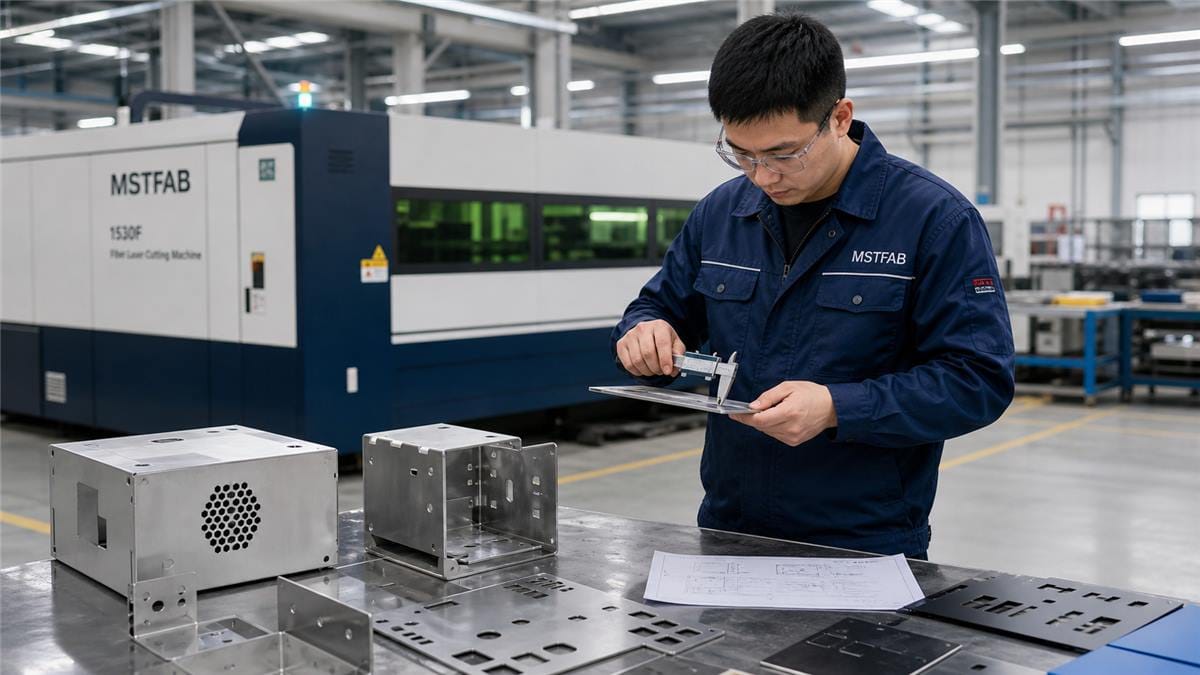
What Precision Laser Cutting Means for Industrial Buyers
Precision laser cutting uses a focused fiber laser beam controlled by CNC programming to cut sheet metal parts with accurate geometry, repeatable dimensions and clean edges. It is widely used for stainless steel, carbon steel, aluminum, galvanized steel and other industrial materials.
You can review MSTFAB’s core capability here: Laser Cutting Services. This article explains why precision laser cutting matters to industrial manufacturing buyers, especially when parts must fit the first time and scale from prototype to production.
The Real Buyer Pain Point: Parts That Do Not Fit
Industrial manufacturing depends on alignment. A laser-cut panel may need to match a bent flange, welded frame, mounting bracket, hinge, gasket surface or assembly fixture. If the cut profile is unstable, the problem does not stay inside the cutting department. It travels through the entire project like an uninvited guest with a clipboard.
- Mounting holes may not align with hardware.
- Tabs and slots may need manual filing.
- Weld fixtures may require adjustment.
- Assembly teams may lose hours correcting parts.
- Delivery schedules may slip because rework eats capacity.
That is why serious OEM buyers care about precision laser cutting services, not just the cheapest cutting quote. Low unit price is less charming when the parts arrive and immediately ask for extra labor.
How Precision Laser Cutting Improves Manufacturing Quality
1. Better Dimensional Accuracy
CNC laser cutting makes it possible to hold consistent profiles across repeated batches. For industrial equipment, electrical enclosures, automotive brackets and machinery panels, this accuracy helps downstream assembly work smoothly.
Accurate parts improve hole position, slot width, tab fit, edge alignment and overall assembly performance. Your assembly technician should not need to become a part-time sculptor with a hand grinder.
2. Faster Production and Shorter Lead Times
Fiber laser cutting is fast, especially for sheet metal production that involves repeated profiles or mixed-part nesting. Compared with many traditional cutting methods, it reduces setup time, tool changes and manual processing.
For buyers searching for fast turnaround laser cutting services, speed matters most when prototype changes, urgent replacement parts or production ramps appear. And yes, urgent production ramps usually appear right after everyone thought the schedule looked calm.
3. Lower Material Waste
Material costs are not getting friendlier. Stainless steel, aluminum and specialty alloys can quickly make scrap feel expensive. Modern nesting software allows manufacturers to arrange parts efficiently on each sheet, reducing waste and improving material yield.
For high-volume industrial manufacturing, even small material savings can become meaningful. Scrap metal may look shiny, but it rarely improves your margin.
4. Cleaner Edges and Less Secondary Work
Good laser cutting produces smoother edges, controlled heat impact and cleaner details. That can reduce deburring, grinding and hand finishing before parts move to bending, welding, powder coating or assembly.
Cleaner edges also improve worker safety, cosmetic appearance and welding preparation. In simple terms: fewer sharp surprises, fewer finish complaints, fewer awkward emails.
5. Greater Design Flexibility
Industrial products are becoming more compact, more integrated and more customized. Laser cutting supports complex profiles, ventilation patterns, cable openings, mounting slots, small holes and prototype revisions without expensive hard tooling.
This is especially useful for OEM projects where engineers revise the design multiple times before launch. Laser cutting will not complain. Your purchasing team might, but the machine will not.
Industrial Applications for Precision Laser Cutting
| Industry | Common laser-cut parts | Buyer concern |
|---|---|---|
| Industrial equipment | Machine panels, frames, brackets, guards | Fit, strength and repeat production |
| Electrical enclosures | Cabinet panels, doors, vents, mounting plates | Hole alignment, finish quality and assembly speed |
| Automotive | Brackets, trays, reinforcements, stainless parts | Tolerance, repeatability and welding consistency |
| Agricultural equipment | Heavy-duty plates, covers, supports, wear parts | Durability and cost control |
| Medical and electronics | Housings, chassis, covers, precision panels | Appearance, burr control and stable dimensions |
What to Send for a Better Laser Cutting Quote
If you want a quote that is accurate instead of “we will find out later,” send enough technical information at the start. A professional CNC laser cutting manufacturer can only price and plan correctly when the project requirements are clear.
- 2D drawings or DXF files with clear dimensions.
- 3D STEP files if the part later requires bending or assembly.
- Material grade and thickness.
- Critical tolerances and inspection points.
- Surface finish requirements such as powder coating, brushing or plating.
- Prototype and production quantities.
- Packaging and export requirements.
Clear RFQ information helps suppliers check manufacturability, reduce back-and-forth emails and avoid surprises. It also helps identify whether laser cutting should be combined with CNC bending, welding, hardware insertion, finishing or assembly.
How to Choose a Precision Laser Cutting Supplier
A good supplier is not just a machine owner. For OEM buyers, the better choice is usually a sheet metal fabrication factory that understands the whole production path: cutting, bending, welding, finishing, inspection and export packing.
- Equipment capability: fiber laser cutting machines, CNC bending and supporting fabrication equipment.
- DFM review: engineering feedback before production starts.
- Quality control: material checks, dimensional inspection and surface review.
- Process integration: cutting plus bending, welding, finishing and assembly when required.
- Export experience: stable packaging and communication for USA, Europe and Australia buyers.
MSTFAB supports overseas buyers with laser cutting, CNC bending, welding, surface finishing and assembly for custom industrial sheet metal parts. The goal is simple: make parts that fit, ship on time and do not create surprise homework for your receiving team.
Final Thoughts
Precision laser cutting improves industrial manufacturing by increasing accuracy, reducing waste, shortening production time and helping downstream processes run smoothly. For OEM buyers, the value is not only in the cut edge. It is in fewer delays, fewer assembly headaches and more predictable production.
Old manufacturing sometimes relied on “cut it first and hope it works later.” Modern industrial buyers deserve a better plan. Precision laser cutting is one of the reasons that plan now exists.
Need laser-cut industrial metal parts, enclosure panels or OEM sheet metal components? Start with MSTFAB’s Laser Cutting Services and send drawings for a practical manufacturing review.
FAQ: Precision Laser Cutting for Industrial Manufacturing
What materials can be used for precision laser cutting?
Common materials include stainless steel, carbon steel, aluminum, galvanized steel, copper and brass. The best option depends on strength, corrosion resistance, appearance, cost and downstream processes.
Is laser cutting suitable for prototype parts?
Yes. Laser cutting is very useful for prototypes because it supports quick design changes without expensive tooling. It is also suitable for moving from prototype to batch production when the design is confirmed.
Does laser cutting replace CNC bending?
No. Laser cutting creates the flat blank profile. CNC bending forms the part into its final shape. For enclosures, brackets and panels, both processes often need to be planned together.
Why do overseas OEM buyers use Chinese laser cutting suppliers?
Many buyers choose Chinese sheet metal factories for cost efficiency, production capacity, process integration and export experience. The key is choosing a supplier with engineering communication, quality control and stable delivery systems.
MSTFAB provides precision sheet metal laser cutting services for OEM panels, brackets, enclosures and custom metal parts.
 WeChat Contact
 WhatsApp Me Directly