
Direct Engineering Answer — Preventing Fatigue Cracking on Heavy-Duty Agricultural Metal Parts
Heavy-duty agricultural metal parts—such as tractor implement hitches, harvester auger troughs, PTO driveline guards, and sprayer boom brackets—operate under severe multi-axis field shock, torsional frame twist, and corrosive fertilizer exposure. The two leading causes of premature field fatigue cracking are bending thick HSLA steel (4.0–12.0 mm Q355B / S355MC / ASTM A572 Gr.50) parallel to the coil rolling grain with a tight V-die radius, and starting/stopping structural fillet welds directly on high-stress corner radii. MSTFAB fabricates heavy-gauge agricultural components from 2.0–20.0 mm carbon, HSLA, and wear-resistant steels using grain-controlled fiber laser nesting, large-radius (R ≥ 1.5t–2.5t) press-brake forming, deep-penetration pulsed MAG welding, and duplex zinc-primer + agricultural polyester powder coating.

01 / Engineering Specifications & Comparison Matrix
Steel Grade, Thickness & Minimum Bend Radius Matrix for Agricultural Machinery
Upgrading an agricultural bracket from mild steel (Q235B / A36, ~235 MPa yield) to high-strength low-alloy (HSLA) steel (Q355B / S355MC / A572 Gr.50, ~355+ MPa yield) increases load capacity by 50% without adding machine weight—provided the press-brake internal bend radius and laser nesting grain direction are adjusted accordingly.
Reference this engineering matrix when specifying sheet and plate thicknesses from 2.0 mm engine hoods up to 16.0 mm implement hitch plates:
| Ag Component Category | Recommended Steel Grade & Thickness | Min Internal Bend Radius (Transverse / Parallel to Grain) | Critical Weld & Inspection Requirement |
|---|---|---|---|
| Engine Hoods, Cab Skins & Fan Shrouds | 1.5–2.5 mm SPCC / SGCC Z275 or AL5052-H32 | R = 1.0t (Transverse) / 1.2t (Parallel) | Vibration-isolated mounting slots; Class A UV-stable powder coat |
| PTO Guards, Belt Shields & Auger Covers | 2.5–4.0 mm Q235B / SPHC or SS304 (fertilizer zones) | R = 1.0t (Transverse) / 1.5t (Parallel) | 180° hemmed safety edges; captive quick-release latch brackets |
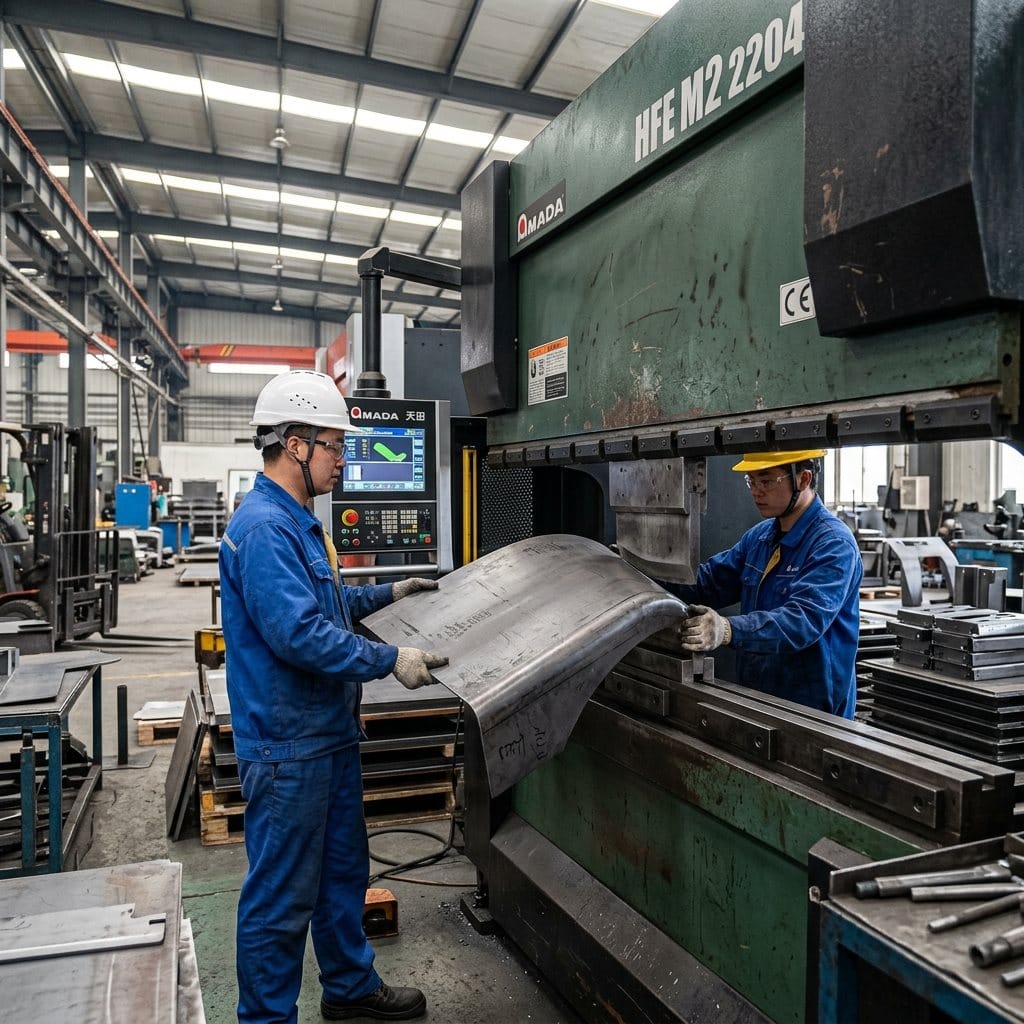
| Load-Bearing Implement Brackets & Arms | 5.0–10.0 mm Q355B / S355J2 / ASTM A572 Gr.50 | R = 1.5t (Transverse) / 2.5t (Parallel) | Mandatory transverse grain nesting; ISO 5817 Class B fillet welds (a ≥ 0.7t) |
| Heavy Hitch Plates, Sub-Frames & Skids | 10.0–20.0 mm Q355B / S355MC or NM400 wear plate | R = 2.0t–3.0t (heavy V-die) | Beveled K/V-groove multi-pass MAG welds + macro-etch / MPI crack check |
| Fertilizer Spreader Hoppers & Chemical Tanks | 2.0–4.0 mm SS304 / SS316L stainless steel | R = 1.0t–1.5t | 100% continuous TIG/MIG seam welds + full acid pickling & passivation |
02 / Sheet Metal DFM & Structural Controls
Three DFM Rules to Prevent Field Fatigue Failure on Farm Equipment Parts
Agricultural equipment endures millions of high-amplitude vibration cycles over uneven terrain. Apply these three structural DFM rules to prevent cracking in the field:
1. Lock Transverse Rolling Grain on High-Stress Bends
When 6.0–10.0 mm plate is bent parallel to the steel mill rolling direction, micro-fissures open along the outer tensile bend line and propagate into fatigue cracks under field vibration. We lock laser nesting rotation so critical load bends run 90° (transverse) to the coil grain.
2. Replace Sharp Square Bend Reliefs with Tear-Drop Radii
A square laser-cut bend relief notch acts as a 3× stress riser at the base of a heavy flange. We program R3.0–R6.0 mm round or tear-drop bend relief cutouts on all structural brackets ≥4.0 mm thick.
3. Wrap Fillet Welds Around Gusset Corners (Boxing)
Starting or stopping a MIG/MAG weld right at the end corner of a load-bearing gusset leaves a crater crack right at the peak bending stress point. Specify a 15–20 mm continuous “boxed” wrap-around weld around gusset toes.
Manufacturing Scope Boundary: MSTFAB manufactures build-to-print heavy-duty sheet metal and plate components, welded structural brackets, and machine guards for agricultural OEMs. Hydraulic cylinders, gearboxes, and final tractor integration remain with the equipment manufacturer.

03 / Real Production Case Study & Process Control
Case Study: 8.0 mm Q355B Seeder Toolbar Arm Brackets (1,500 Shipsets/Year)
A North American seeding equipment OEM suffered field warranty claims when 8.0 mm formed toolbar brackets cracked along the 90° bend line after 200 hours of rocky field operation.
- Root Cause Analysis: Macro-etching revealed the prior supplier had nested the parts randomly on the laser bed (placing 40% of brackets parallel to the rolling grain) and formed them in a narrow 40 mm V-die (resulting in an overly tight R5.0 mm internal radius).
- Grain & Tooling Correction: MSTFAB locked the laser CAM nesting orientation strictly transverse to the Q355B plate rolling direction and switched to a 64 mm V-die producing a smooth R12.0 mm (1.5t) internal bend radius.
- Shot-Blasting & Duplex Coating: Added Sa 2.5 abrasive shot-blasting to remove laser oxide scale and induce beneficial compressive surface stress, followed by zinc-rich epoxy primer + UV-stable Ag Green polyester topcoat.
- Field Outcome: Passed a 500,000-cycle hydraulic bench fatigue test and achieved zero field cracking across 3,000+ deployed brackets over two planting seasons.
Every heavy-duty production batch includes EN 10204 3.1 mill certificates (verifying yield strength, tensile strength, and Charpy impact energy), weld macro-section photos, and CMM/fixture FAI reports.
04 / Quality Verification, Traceability & Surface Finishing
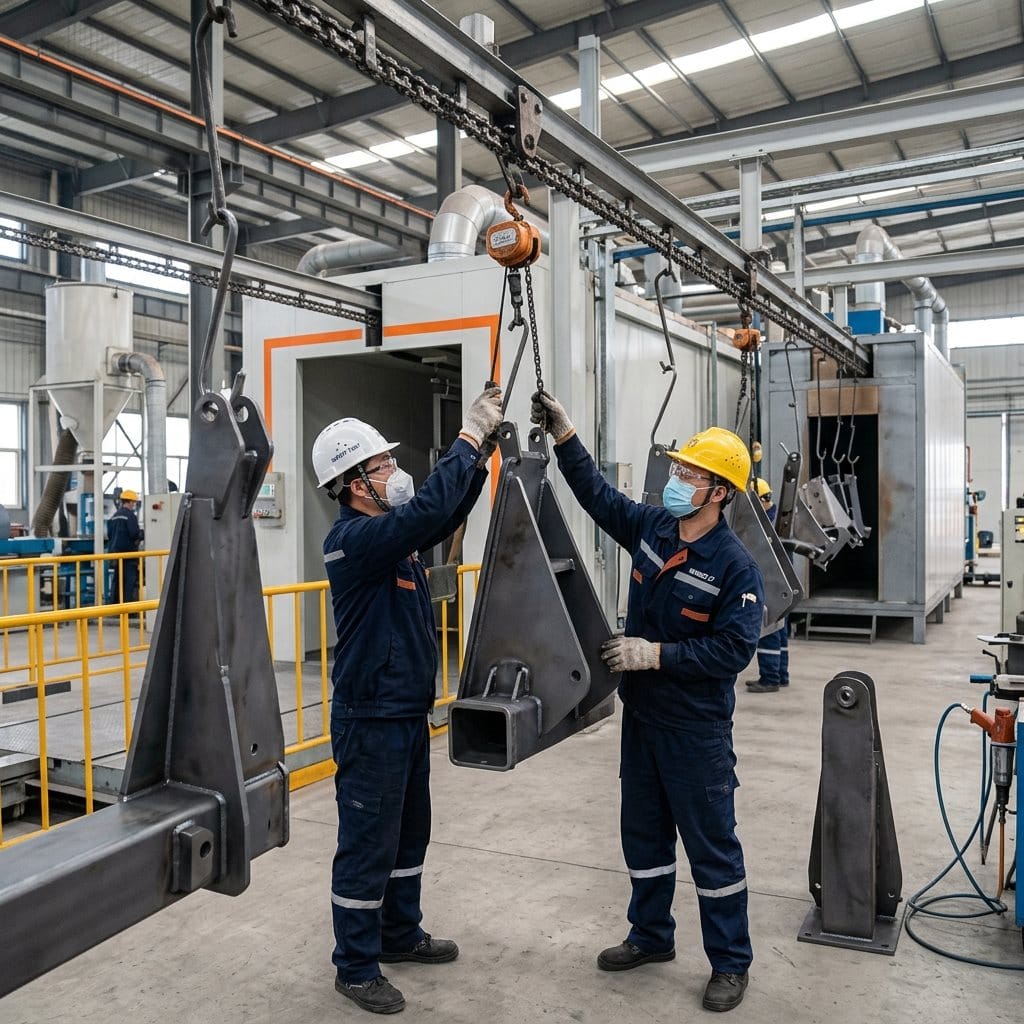
Scale Removal (Shot-Blasting), Weld Penetration & Agricultural Duplex Finishing
Hot-rolled steel plate (SPHC, Q235B, Q355B) carries a dark mill-scale layer and laser-cut oxide edge. If powder coating is sprayed directly over unblasted mill scale or laser oxide, stone chips and moisture cause sheets of paint to flake off within months.
At MSTFAB, heavy hot-rolled agricultural weldments undergo mechanical shot-blasting or acid pickling to remove 100% of mill scale and laser oxide before entering our zinc-phosphate + epoxy primer + super-durable outdoor polyester powder line.
05 / 8-Point OEM RFQ Checklist & Topic Cluster Hub
8-Point OEM RFQ Checklist for Heavy-Duty Agricultural Metal Parts
Include these eight drawing and specification controls in your RFQ package so our engineering team can lock down tooling, material traceability, and inspection fixtures on day one:
- 3D STEP + 2D PDF with Yield Strength SpecCall out exact structural grade (e.g., Q355B / S355J2 / ASTM A572 Gr.50, ReH ≥ 355 MPa) rather than generic “mild steel.”
- Mandate Bend Grain Direction on Load FlangesAdd a grain-direction arrow on your 2D drawing requiring primary load-bearing bends to run perpendicular to the mill rolling direction.
- Specify Generous Internal Bend Radii (R ≥ 1.5t)Use R = 1.5t to 2.5t on 5.0–12.0 mm high-strength steel and allow tear-drop bend relief cutouts at flange intersections.
- Call Out Weld Throat Size & Corner BoxingSpecify fillet leg/throat size (e.g., a5 / z7), ISO 5817 Class B/C quality, and wrap-around corner terminations on gussets.
- Require Mill-Scale & Laser-Oxide RemovalSpecify Sa 2.5 shot-blasting or pickling on hot-rolled plate prior to primer and powder coating to prevent edge delamination.
- Duplex Coating for Fertilizer & UV ResistanceCall out zinc-rich epoxy primer (60 μm) + UV-resistant outdoor polyester topcoat (70–90 μm) or hot-dip galvanizing (ISO 1461).
- Bushing Bore & Pivoting Hole TolerancesMark pivot pin bores and bearing housings that require post-weld CNC boring/reaming (e.g., H7/H8 fit) vs. as-laser-cut clearance holes.
- Heavy-Duty Palletizing & Rust ProtectionSpecify returnable steel racks or reinforced ISPM-15 export crates with VCI oil/paper on unpainted machined pivot bores.
Explore Connected Sheet Metal Fabrication Services & Enclosure Hubs
CNC Press Brake Sheet Metal Bending & Forming
TIG / MIG / Robotic Sheet Metal Welding Services
Powder Coating, Passivation & Anodizing Finishes
Precision CNC Machining & Hybrid Metal Assemblies
Custom Electrical Enclosures & OEM Equipment Shells
Upload 3D STEP + 2D PDF for 24-Hour DFM & Price Quote
ISO 9001 & IATF 16949 Certified Factory Fact Sheet
06 / OEM Buyer & Engineer FAQ
Frequently Asked Questions: Heavy-Duty Agricultural Metal Parts Fabrication
Why does powder coating peel off the laser-cut edges of thick agricultural steel brackets?
When thick carbon steel (4–15 mm) is cut with oxygen-assist laser gas, a hard, brittle iron-oxide layer forms on the cut edge that has poor thermal expansion matching with steel. If painted over directly, the oxide scale delaminates under impact. MSTFAB removes laser edge oxide via mechanical grinding/rotary brushing and shot-blasting before pre-treatment.
When should a welded agricultural bracket be CNC-machined after welding?
For general bolt-on mounting plates, laser-cut slots (±0.25 mm in a weld fixture) are cost-effective. However, for hydraulic cylinder clevis pins, pivot bushings, or gearbox mounting faces requiring ±0.05 mm coaxiality or flatness, we weld oversized stock and perform post-weld CNC milling/boring in-house.
What is the maximum plate thickness MSTFAB can laser cut and CNC bend for farm machinery?
Our 6 kW fiber lasers cut carbon and HSLA steel up to 20 mm thick, stainless steel up to 12 mm, and aluminum up to 10 mm. Our heavy-tonnage CNC press brakes form plate up to 10–12 mm thick depending on bend length and V-die opening.
How do you verify weld penetration on load-bearing tractor and implement parts?
During First Article approval and regular production patrols, we cross-section, polish, and acid-etch sacrificial weld coupons (macro-etch testing per ISO 17639) to verify root fusion and throat thickness, supplemented by magnetic particle or dye-penetrant inspection on critical seams.
Should fertilizer hopper and sprayer components be made from painted carbon steel or stainless steel?
Liquid and granular NPK fertilizers are highly corrosive to carbon steel once stones chip the paint. For direct fertilizer contact hoppers, spinner discs, and chemical boom brackets, we strongly recommend SS304 or SS316L stainless steel with passivated welds.
Can you match John Deere Green, Case IH Red, Kubota Orange, or custom OEM agricultural RAL colors?
Yes. We stock and custom-match agricultural OEM powder-coating colors using UV-stabilized super-durable polyester resins and verify color delta (ΔE ≤ 1.0) and 60° gloss units with digital spectrophotometers.
International Standards & Engineering References
- ISO 2768-1 / 2768-2 — General Linear, Angular and Geometrical Tolerances for Sheet Metal Fabrication
- IEC 60529 / NEMA 250 — Degrees of Protection Provided by Enclosures (IP Code & Environmental Sealing)
- ISO 9001:2015 & IATF 16949:2016 — Quality Management Systems & Production Part Approval Process (PPAP)
Ready to Quote Your Custom Sheet Metal Enclosure or Fabrication Project?
Upload your 3D STEP models and 2D PDF drawings. MSTFAB will review your tolerances, material specs, and DFM details to deliver a transparent factory quote within 24 hours.
Request Your 24-Hour DFM & Custom Quote →
Direct engineering desk: caroline@mstfab.com | ISO 9001 & IATF 16949 Certified Factory in Guangzhou, China
 WeChat Contact
 WhatsApp Me Directly