
Fiber vs CO2 Laser Cutting for Stainless Steel Parts
Both industrial fiber and CO2 laser systems can cut stainless steel. The useful buying question is which proposed machine and production route will deliver your particular part with the required cut quality, geometry and cost. Comparing a modern fiber production system with an unspecified CO2 engraver does not answer that question.
Quick answer: fiber laser cutting is often a strong candidate for productive stainless sheet processing because its beam characteristics and delivery differ from CO2. That does not make every fiber-cut edge better or every quotation cheaper. Compare the actual grade, thickness, feature layout, assist gas and required finished condition; qualify the proposed route against the drawing.
See the fiber vs CO2 comparison table or review stainless steel cut quality.
Fiber vs CO2: What Actually Differs?
| Comparison | Fiber laser | CO2 laser |
|---|---|---|
| Source and beam delivery | Solid-state source with fiber-optic beam delivery; shorter wavelength than CO2. | Gas laser source; conventional industrial systems use a mirror-based beam path. |
| Productivity potential | Beam characteristics can support high cutting productivity, particularly for suitable sheet applications. | Assess the actual system’s cycle and handling time; the process label alone is not a production-rate figure. |
| Cut-edge acceptance | Check the proposed settings and samples for roughness, dross, small features and the required edge condition. | Use the same drawing and inspection criteria; do not accept or reject the edge solely by source type. |
| Quoted part cost | Operating advantages may influence price, but setup, nesting and downstream work still matter. | Compare the complete delivered scope, not a presumed surcharge or discount for the machine name. |
Bystronic’s technology comparison explains the shorter wavelength, absorption characteristics and fiber-optic delivery behind fiber’s productivity potential. Its equipment examples are not universal speed ratios or MSTFAB capacity specifications. Specify the actual production system when a machine comparison matters.
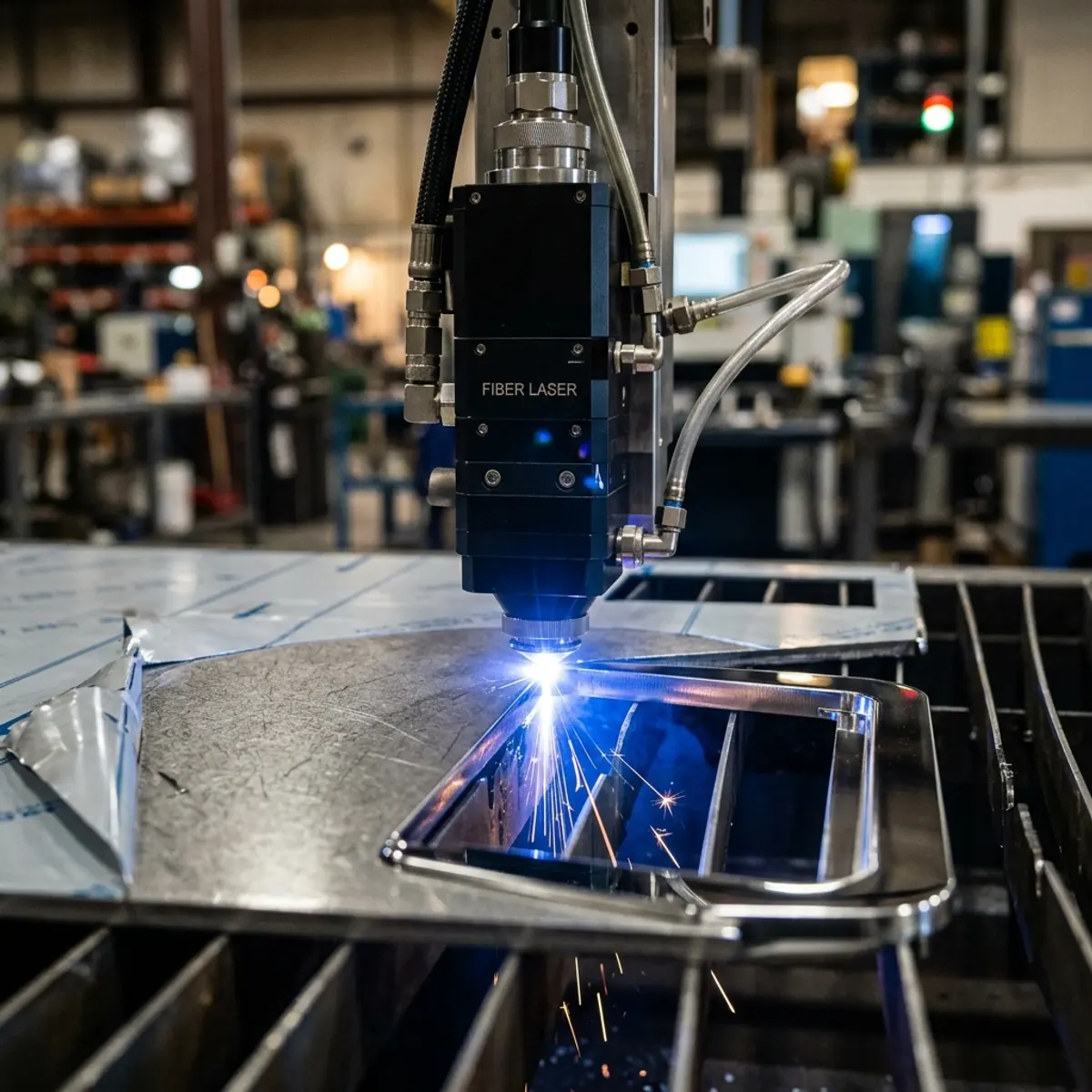
Which Laser Produces a Better Stainless Steel Edge?
There is no defensible single answer without the material, thickness, machine configuration and acceptance criteria. A smooth-looking straight edge does not prove that a small hole, internal corner or narrow web also meets its requirement. Request evidence from representative features, not only a convenient demonstration coupon.
TRUMPF identifies focus, nozzle selection, cutting speed and gas conditions as process variables. Incorrect speed can increase roughness and burr formation. The source type is therefore only part of the explanation for the delivered edge.
- Roughness: identify the functional cut faces and state a measurable requirement when needed. Do not infer a measured roughness value from a photograph.
- Burr and dross: define whether cleanup is included and which edges need treatment for handling or assembly.
- Critical features: separate an as-cut hole from one requiring drilling, reaming or tapping. Check feature position and final condition against the drawing.
Assist Gas Is a Separate Decision from Laser Type
Do not use “fiber” as shorthand for “nitrogen cut” or “oxide-free.” Ask which assist gas and cutting condition are proposed. TRUMPF describes nitrogen and argon as non-reactive gases that shield the cutting area in the relevant process; gas selection and pressure influence the result.
State any restrictions on oxidation, heat tint or subsequent surface treatment explicitly. A proposed nitrogen-cut route is not, by itself, proof of corrosion performance or permission to omit welding preparation. The complete part still needs the specified cleaning, joining and finishing operations.
Does Stainless Thickness Determine Fiber or CO2?
Thickness matters, but an arbitrary crossover such as “always use CO2 above this thickness” is not a reliable purchasing rule. Compare the particular systems offered for the specified stainless grade and section. Power, beam configuration, feature density and required edge condition can change the result.
If a supplier proposes a machine change after sample approval, review whether the change affects the agreed acceptance evidence or contractual process requirements. A different machine may produce acceptable parts, but equivalence should be demonstrated where the project requires it.
Speed, Cost and Lead Time Are Different Measures
A cutting-speed advantage does not establish the same percentage reduction in part price or delivery time. A profile with many pierces, short moves and small features is not equivalent to a long straight cut. Loading, sorting, deburring, forming and inspection can also constrain the production route.
For a useful quote comparison, hold the drawing revision, quantity, stainless grade, thickness and finishing scope constant. Ask whether edge cleanup and secondary feature machining are included. Do not pay for an unnecessary process restriction, but do not remove a validated restriction without engineering approval.
Qualify the Route on a Representative Stainless Part
For an illustrative enclosure panel with mounting holes, ventilation slots and a visible face, the comparison should include those features and the face condition. Cutting a plain rectangle quickly is not equivalent evidence. This is a selection example, not a claimed MSTFAB production result.
- Identify the controlled drawing and cut-file revision; resolve any disagreement before cutting.
- Confirm grade, thickness, cosmetic face and protective-film requirements with the fabricator.
- Record the proposed laser route, assist gas and included post-cut operations where relevant to approval.
- Inspect the specified critical features, edges and surfaces in the agreed production condition.
- Approve the result or document corrective action before releasing the affected production scope.
Frequently Asked Questions
Can an industrial CO2 laser cut stainless steel?
Yes, an appropriately configured industrial CO2 system can cut stainless steel. Do not generalize from a low-power engraver to an industrial metal-cutting system; confirm the actual machine, material and required result.
Is fiber laser cutting always cheaper for stainless parts?
No. Fiber systems can offer productivity and operating advantages, but the quoted part price also depends on geometry, setup, quantity, material use and required secondary operations. Compare the same delivered scope.
Should the drawing require fiber rather than CO2?
Specify a laser type when the contract or validated production route requires it. Otherwise, define measurable part requirements and ask the fabricator to confirm a suitable route; do not silently replace an approved process requirement.
Sources and Related Reading
Technical background: Bystronic’s CO2 vs fiber technology comparison (revised January 2023) and TRUMPF’s laser cutting process guidance. Manufacturer examples do not establish MSTFAB’s installed equipment or guaranteed performance.
Comparing laser with other blanking processes? See the separate laser, waterjet and plasma selection guide.
Review Your Stainless Steel Cutting Project
For MSTFAB laser cutting services, provide the drawing revision, stainless grade, thickness, quantity, critical features and edge requirements. Request confirmation of the proposed process and quoted finishing scope.
 WeChat Contact
 WhatsApp Me Directly