
The Short Answer
When specifying an empty sheet metal DIN rail enclosure shell for a regulated medical device, Quality Management System Regulation (QMSR) purchasing controls require translating functional electrical and safety requirements into verifiable mechanical drawing specifications. Define the 35 mm DIN rail mounting datum and standoff coplanarity, IEC 60601-1 protective-earth stud torque limits, tool-secured access covers, disinfectant-resistant coatings, EN 10204 3.1 material traceability, and ballooned First Article Inspection (FAI) before releasing production.
Explore this guide
01 / QMSR Purchasing Scope and Deliverable
Define the empty DIN rail enclosure shell as a controlled specification component.
Diagnostic laboratory instruments, automated liquid handlers, patient care beds, sterilization equipment, and medical imaging systems frequently house their low-voltage power supplies, safety relays, PLC controllers, and terminal blocks inside custom sheet metal DIN rail enclosures. Under harmonized Quality Management System Regulation (QMSR) purchasing controls, the medical OEM is responsible for ensuring that purchased mechanical housings conform to specified Device Master Record (DMR) inputs.
Because MSTFAB manufactures the empty metal enclosure shell, removable sub-plate, and mechanical DIN rail mounting provisions to your released drawings under an ISO 9001 quality system, clear drawing callouts bridge your regulatory file and our shop floor.
Controlled mechanical print
Establishes the binding specification for sheet metal alloy, thickness, bend tolerances, PEM hardware, DIN rail positions, and coating chemistry.
Lot-traceable verification
Links EN 10204 3.1 raw material mill certificates, finishing batch logs, and ballooned First Article Inspection reports directly to your receiving lot.
Locked process baseline
Freezes laser flat patterns, press-brake tooling, welding fixtures, and sub-tier coaters post-FAI so recurring shipments never drift without written ECN sign-off.
Clear role separation: MSTFAB supplies custom drawing-based empty sheet metal enclosure shells and mechanical hardware provisions under ISO 9001. Electrical component selection, terminal wiring, creepage/clearance layout, and final regulated medical device validation remain with the OEM.
02 / DIN Rail Mounting Datums and Coplanarity
Keep 35 mm DIN rail standoffs coplanar and referenced to window cutouts.
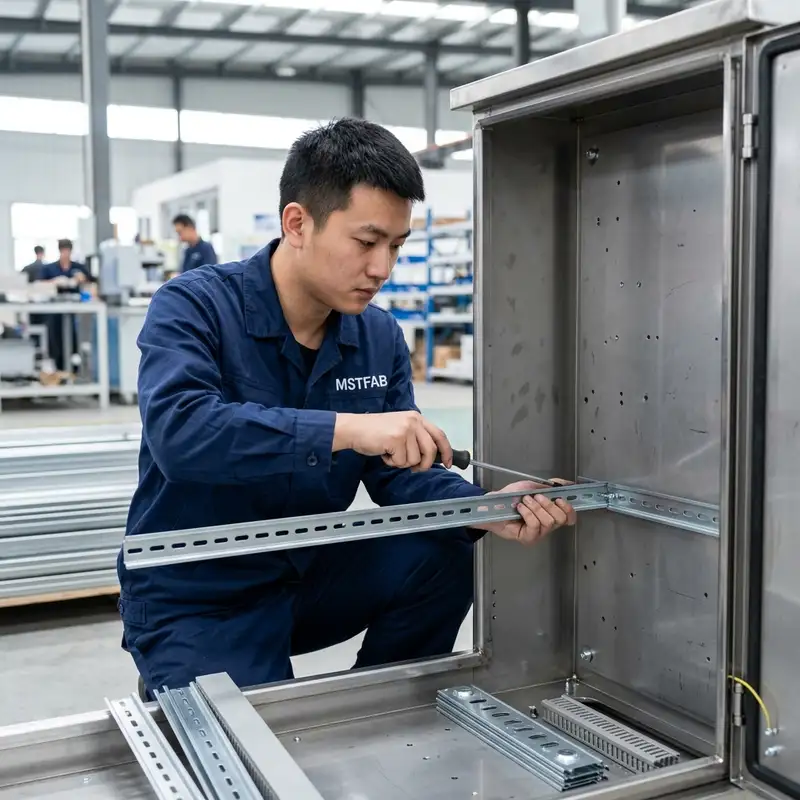
Standard EN 60715 top-hat DIN rails (35 mm x 7.5 mm or 35 mm x 15 mm) are relatively flexible in torsion before mounting. If the welded studs, clinched standoffs, or embossed mounting pads inside the sheet metal enclosure are out of plane or skewed relative to front-panel circuit-breaker windows, snap-on modules will bind, tilt, or pop off the rail during transport shock.
- Coplanarity across rail support bosses: Specify a flatness/coplanarity tolerance (typically within 0.3 mm to 0.5 mm across the rail span) across all self-clinching standoffs or formed mounting ribs that support a single DIN rail.
- Datum linkage to front-cover cutouts: When modular breakers, status LEDs, or Ethernet ports on the DIN rail protrude through a hinged door or dead-front bezel, reference both the rail mounting holes and the cover cutout from the same primary chassis datum.
- Wire-duct and bend-radius clearance: Maintain accurate pitch between parallel DIN rails and enclosure side walls so slotted wiring ducts, end brackets, and ferrule-terminated cables fit without crushing against return flanges.
By punching or cutting all rail mounting holes in a single fiber laser setup on a removable galvanized sub-panel—or using precision self-clinching standoffs prior to CNC press brake forming—we eliminate manual layout error inside the box.
03 / Protective Earth and Mechanical Safety Provisions
Build IEC 60601-1 grounding and tool-only access rules directly into the sheet metal.
Medical electrical enclosures face stringent mechanical safety scrutiny during third-party laboratory testing: enclosures must resist mechanical deflection under push/impact forces, accessible conductive parts must connect reliably to the protective earth (PE) star point, and live DIN-rail terminals must require a tool to access.
- Specify dedicated M5, M6, or M8 protective-earth weld studs or heavy-duty clinched studs on the main housing body, internal DIN-rail sub-panel, and hinged access door, complete with masked bare-metal contact rings.
- Include mechanical push-out and torsional torque test targets on the drawing for grounding studs so weld parameters are verified on destructive setup coupons each batch.
- Design hinged covers or lift-off service lids with tool-operated quarter-turn locks, captive socket-head screws, or key interlocks so clinical operators cannot open live DIN-rail bays bare-handed.
- Form rigid perimeter return flanges and hemmed lips around cable-entry knockouts or gland openings so power cords and sensor harnesses never chafe against raw sheet edges.
Reviewing weld joint design and grounding stud placement with our sheet metal welding engineering team ensures your enclosure shell passes mechanical rigidity and earth-bond checks on the first test submission.
04 / Cleanability, Glove-Safe Edges, and Finishes
Specify burr-free internal edges and disinfectant-resistant surface treatments.
Technicians wiring dense DIN-rail terminal blocks reach deep inside the enclosure housing, while field service and clinical staff wipe down the exterior surfaces with hospital-grade disinfectants. Both inside and outside surfaces require deliberate finishing specs.
- Glove- and wire-safe edge conditioning: Call out complete mechanical deburring, rotary brush edge-rounding, or 180-degree flattened safety hems on all internal cable pass-throughs, sub-panel edges, and access openings.
- Conductive internal sub-plates: Use unpainted electro-galvanized steel (SECC), trivalent-chromated 5052 aluminum, or brushed 304 stainless steel for internal DIN-rail backplates so grounding terminal blocks bond directly through the rail.
- Disinfectant-resistant exterior powder coat: For carbon steel or aluminum exterior shells, specify smooth or fine-texture polyester/epoxy-polyester powder coating engineered to resist alcohol, quaternary ammonium, and diluted bleach wipe-downs without blistering.
- Passivated 304L / 316L stainless shells: For sterile processing or wet laboratory zones, specify 304L or 316L stainless steel passivated per ASTM A967 with smooth continuous TIG corner welds.
Explore our surface treatment and masking options to pair conductive internal rail plates with cleanable exterior medical finishes.
05 / QMSR Supplier Verification Matrix
Document five purchasing control checkpoints for your Device Master Record.
Use this verification matrix to align your mechanical drawing, supplier quality agreement, and incoming receiving inspection plan.
06 / Receiving Inspection Alignment and FAI
Streamline OEM incoming inspection with ballooned FAI and pre-shipment records.
Medical OEM receiving inspection teams lose valuable days when enclosure shipments arrive without organized quality records or when supplier measurement methods differ from the OEM’s incoming QC setup.
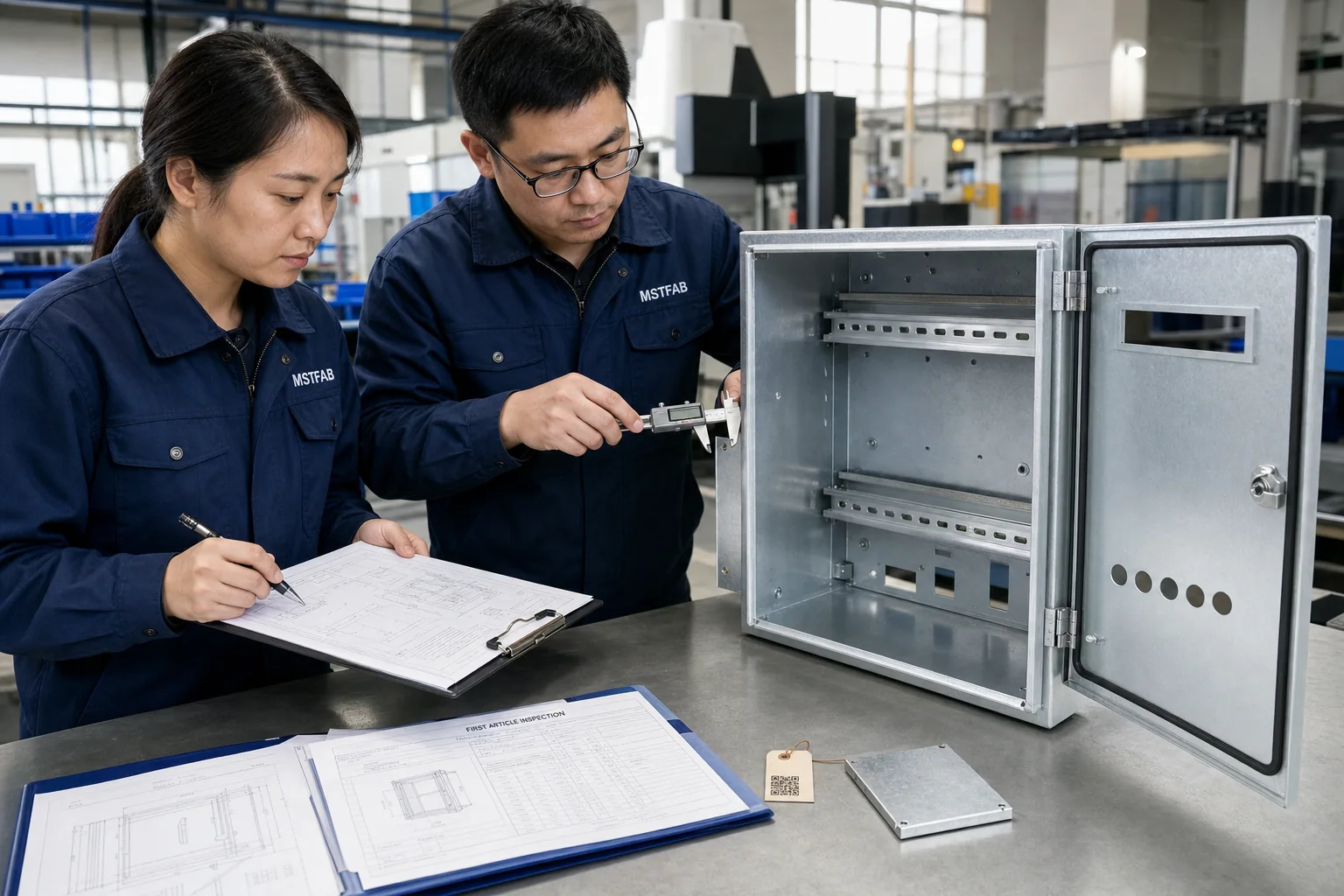
Before running volume batches, MSTFAB submits a complete First Article Inspection package indexed directly to your ballooned 2D print. We agree on the exact datum clamping setup, thread/pin gauge sizes, coating dry-film thickness (DFT) test zones, and cosmetic viewing distances.
For every subsequent production lot, we supply a batch Certificate of Conformance, raw material mill certs, and in-process dimensional inspection records so your receiving dock can verify lot traceability and release shells straight to electrical integration.
Explore custom medical and industrial sheet metal fabrication at MSTFAB →
07 / Kitting, Packaging, and Manufacturing Scope
Protect finished DIN rail housings and sub-panels through global transit.
Whether we ship compact wall-mount DIN rail controller boxes or large floor-standing power distribution sub-cabinets, each unit is individually wrapped in clean PE film, cushioned with closed-cell EPE foam corner blocks, and packed in ISPM-15 export plywood crates with clear part-number, revision, and lot labels.
Sub-panels, captive screws, ground straps, and pre-cut DIN rails can be pre-assembled inside the shell or kitted in labeled inner cartons to match your assembly line flow. Contact our team via our online RFQ portal to review your packaging specification.
Manufacturing scope: MSTFAB manufactures custom drawing-based empty sheet metal DIN rail enclosure shells, internal mounting plates, and welded brackets under an ISO 9001 quality management system. Electrical DIN rail components, wiring, software, QMSR Device Master Record ownership, and final medical device regulatory submissions remain the responsibility of the OEM.
08 / Ready-to-Review DIN Rail Enclosure RFQ
Include eight engineering details when quoting medical DIN rail enclosure shells.
- 3D STEP assembly modelInclude the outer shell, door/cover, removable sub-plate, and DIN rail positions.
- 2D PDF drawing with CTQsMark rail mounting pitch, standoff coplanarity, window alignment, and datum references.
- Sheet metal alloy and gaugeSpecify CRS, SECC galvanized, 304L/316L stainless, or 5052 aluminum thicknesses.
- DIN rail & hardware scopeClarify whether MSTFAB installs PEM standoffs only or also cuts and mounts the 35 mm DIN rails.
- Protective-earth & masking mapIdentify M5/M6/M8 earth studs and shade all unpainted conductive grounding pads.
- Edge & deburring standardSpecify hemmed edges or radiused deburring on internal wire-routing cutouts.
- Surface finish & color codeState powder coat RAL number, gloss/texture, disinfectant resistance, or stainless passivation.
- Quality pack & batch scheduleNote ballooned FAI requirements, EN 10204 3.1 certs, prototype quantity, and annual volume.
Providing a complete drawing and quality specification up front allows our engineers to return a thorough DFM analysis and firm production quote.
Buyer questions about medical DIN rail enclosure shells
How do QMSR purchasing controls apply to an empty sheet metal DIN rail enclosure?
Under Quality Management System Regulation (QMSR) purchasing controls, an empty sheet metal enclosure shell is a custom build-to-print component defined by the OEM’s Device Master Record (DMR). The OEM qualifies the sheet metal fabricator based on ISO 9001 process controls, documented raw-material traceability (EN 10204 3.1), ballooned First Article Inspection (FAI) against the drawing, and a formal agreement preventing unapproved material or process changes.
Should we mount DIN rails directly to the enclosure back wall or on a removable sub-panel?
Mounting DIN rails, wire ducts, and terminal blocks onto a removable internal sub-panel (typically 2.0 mm to 3.0 mm electro-galvanized steel or chromated aluminum) allows your electrical technicians to wire and test the entire DIN-rail harness flat on an ergonomic bench before dropping the completed sub-panel onto four studs inside the painted enclosure shell.
How do you ensure DIN rail grounding terminal blocks make reliable electrical contact?
Green/yellow PE grounding terminal blocks clamp mechanically onto the 35 mm DIN rail to bond with the chassis. We ensure low-impedance continuity by mounting a conductive steel or aluminum DIN rail onto unpainted electro-galvanized (SECC) or trivalent-chromated sub-plates, or by masking circular bare-metal pads at every DIN-rail standoff on powder-coated panels.
Can MSTFAB supply and pre-install the 35 mm DIN rails and slotted wire-duct studs?
Yes. We can either install the self-clinching nuts and standoffs at your exact drawing coordinates so you mount your own rails, or we can precision-cut, deburr, and bolt RoHS-compliant 35 mm x 7.5 mm or 35 mm x 15 mm slotted DIN rails directly into the shell prior to shipment.
How do you prevent front dead-front breaker windows from misaligning with DIN rail modules?
We dimension both the DIN rail mounting holes and the dead-front window cutout from the same primary datum edge, calibrate press-brake bend deductions using the actual production material lot, and perform a physical trial assembly of the sub-panel, rail, and cover during First Article Inspection.
What documentation ships with each batch of medical DIN rail enclosure shells?
Every shipment can include a Certificate of Conformance (CoC) referencing your PO and drawing revision, EN 10204 3.1 raw material mill certificates, surface treatment and coating thickness logs, and dimensional inspection records—plus a full ballooned FAI report on first-time or revised builds.
Technical references
Reference these international standards when specifying DIN rail mounting geometry, medical electrical enclosure safety provisions, and supplier quality controls.
- IEC 60715 — Dimensions of Low-Voltage Switchgear and Controlgear: Standardized Mounting on Rails (DIN Rail Profiles)
- IEC 60601-1 — Medical Electrical Equipment: General Requirements for Basic Safety and Essential Performance
- ISO 9001 — Quality Management Systems: Requirements for Traceable Manufacturing
- ISO 2768-1 — General Tolerances for Formed Sheet Metal Parts
Request a drawing review for your medical DIN rail enclosure shell.
Upload your 3D STEP model, 2D PDF drawings, DIN rail layout, and quality requirements. Our engineering team will review tolerances, grounding provisions, and FAI controls.
Have a question first? caroline@mstfab.com
 WeChat Contact
 WhatsApp Me Directly