
PRECISION STAMPING, LASER CUTTING & CNC FORMING — EXECUTIVE TECHNICAL BRIEF
High-volume automotive, trailer, solar, and industrial brackets often combine progressive or stage stamping, CNC press brake forming, zinc galvanizing, and matte/satin RAL 9005 black powder coating. Managing all four steps under one roof at MSTFAB eliminates multi-vendor freight markups, thread-clogging overspray, and inter-coat peeling.
- Volume-Matched Tooling Strategy ($0 Soft Tooling vs Progressive Dies): MSTFAB optimizes custom stamping metal part carbon steel aluminum bending black powder coating by using fiber laser + CNC press brakes for 1–1,000 pcs and hardened SKD11/DC53 progressive/deep-draw dies for 2,000–100,000+ pcs.
- Calibrated Bend Deductions & Springback Compensation: Shop-floor K-factor tables and optical laser-angle sensors hold ±0.15 mm single-bend tolerances and ±0.3° angular repeatability.
- Burr-Free Edges & High-Pressure Nitrogen Blanking: High-pressure N2 laser cutting and ceramic vibratory tumbling deliver oxide-free, burr-free edges (burr ≤ 0.02–0.03 mm) ready for welding or powder coating.
- Turnkey Secondary Operations & Surface Finishing: In-house PEM fastener insertion, tapping, countersinking, spot/laser welding, anodizing, passivation, and powder coating eliminate multi-vendor handoffs.
Every project at MSTFAB includes a complimentary 24-hour CAD Design-for-Manufacturing (DFM) audit, heat-number-traceable EN 10204 3.1 mill certificates, and a ballooned First Article Inspection (FAI) report prior to volume release.
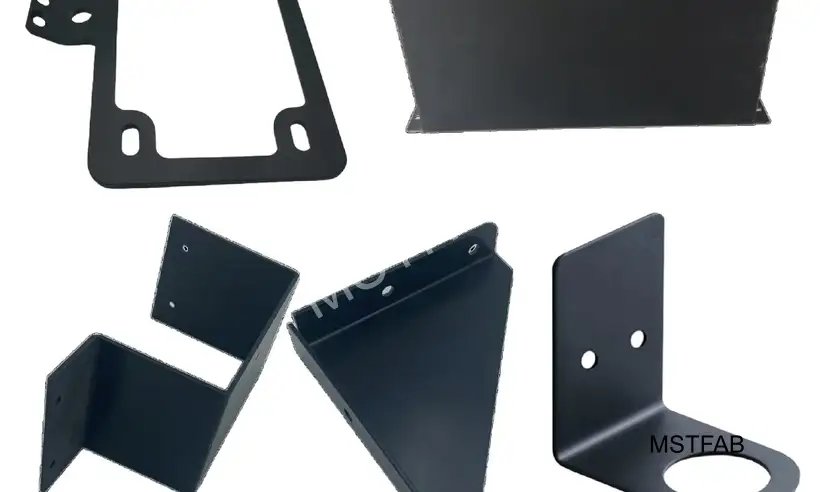
01 / Engineering Specifications & Comparison Matrix
Engineering Specifications, Tolerances & Verification Matrix: Custom Stamping Metal Parts
High-volume automotive, trailer, solar, and industrial brackets often combine progressive or stage stamping, CNC press brake forming, zinc galvanizing, and matte/satin RAL 9005 black powder coating. Managing all four steps under one roof at MSTFAB eliminates multi-vendor freight markups, thread-clogging overspray, and inter-coat peeling. When sourcing custom sheet metal components and enclosures at industrial OEM scale, verbal assurances cannot substitute for drawing-locked process controls. Below is the engineering specification matrix governing raw material selection, dimensional tolerances (per ISO 2768-mK / fH), surface treatment durability, and metrology verification at MSTFAB.
Each parameter is verified during incoming raw material quarantine, in-process CNC stage checks, and final First Article Inspection (FAI) before shipment release:
| Engineering Parameter / Zone | Material & Process Specification | Target Tolerance / Performance Standard | Inspection Method & OEM Value |
|---|---|---|---|
| Blanking & Piercing Accuracy | 0.8mm–6.0mm SPCC/Q235B/Q355B Carbon Steel, SGCC Galvanized, 5052/6061 Aluminum | Laser: ±0.10 mm; Stamping Die: ±0.03–0.05 mm | 2D Optical Vision CMM + Pin Gauges: Guarantees interchangeable hole patterns and burr-free mating edges |
| Forming & Channel Bending | 6-Axis CNC Press Brake / Progressive Forming Stations | Single bend ±0.15 mm; Channel width ±0.25 mm; Angle ±0.3° | CMM + Digital Bevel Protractor + Go/No-Go: Prevents assembly stack-up binding in U, C, Z, and hat channels |
| Deep Draw & Progressive Dies | SKD11 / DC53 Tool Steel (HRC 60–62) with TiCN PVD Coating | 8%–10% shear clearance; controlled draw-bead blankholder force | Cpk ≥ 1.67 Capability Study + Optical CMM: Eliminates sidewall wrinkling, tearing, and galling on high-volume runs |
| Edge Condition & Flatness | Nitrogen Laser + Wide-Belt Rotary Deburring / Vibratory Honing | Max burr ≤ 0.03 mm; Sheet flatness ≤ 0.5–1.0 mm/m | Surface Plate Feeler Gauge + Edge Audit: Protects wire harnesses and ensures flush seating on mating sub-assemblies |
| Surface Treatment & Coating | Powder Coating, Zinc/Nickel Plating, Anodizing, Passivation | 60–90 μm DFT (Powder); ASTM B117 500–1,000h salt spray | Elcometer DFT + Cross-Hatch 5B + XRF: Delivers corrosion-proof, cosmetic Class-A finishes with masked threads |
02 / Sheet Metal DFM & Structural Controls
Critical Sheet Metal DFM Rules & Field Failure Prevention
Most cost overruns, assembly fit-up delays, and field corrosion failures originate from subtle CAD geometry details or ambiguous drawing notes. Implementing these Design-for-Manufacturing (DFM) controls before releasing your files eliminates tool collisions, thermal warpage, and rework:
Unrealistic ±0.01mm Machining Tolerances on Stamped/Bent Sheet
Failure Mechanism: Elastic springback and coil thickness tolerances (±0.04 mm) make ±0.01 mm impossible on formed sheet walls without post-CNC milling
Engineering Solution: Apply tight ±0.03–0.05 mm tolerances to pierced hole-to-hole pitches on the same flat face, and allow ±0.15–0.25 mm across formed bends
Verified Outcome: Slashes tooling and piece-part cost by 40% while ensuring 100% functional fit
Holes Placed Closer Than 2.5t + R to a Bend Line
Failure Mechanism: Bending tension pulls nearby round holes into teardrops, preventing bolt or PEM installation
Engineering Solution: Move holes ≥ 2.5t + R away from the bend tangent, or add a laser-cut bend relief slot between the hole and bend
Verified Outcome: Preserves true hole circularity without secondary reaming
Sharp R = 0 Inside Bend Radius Cracking High-Strength Alloys
Failure Mechanism: Zero-radius punches crease the inner grain and crack 6061 aluminum, brass, or work-hardened stainless steel
Engineering Solution: Standardize inside bend radii to R = 1.0t (or R = 1.5t–2.0t for harder tempers) perpendicular to coil rolling grain
Verified Outcome: Eliminates outer-fiber micro-cracking and stabilizes bend angles
Manufacturing Scope Boundary: Investing in Hard Stamping Dies Before EVT/DVT Design Freeze: A minor PCB or connector layout change scraps a $8,000 stamping die — Engineering Fix: Build your first 20–500 pilot units using MSTFAB’s fiber laser + CNC press brake bridge cell before releasing hard progressive tooling (Validates market demand and fit-up with $0 upfront tooling risk). MSTFAB manufactures custom sheet metal parts and empty mechanical enclosure shells strictly to your 3D STEP and 2D PDF drawings.
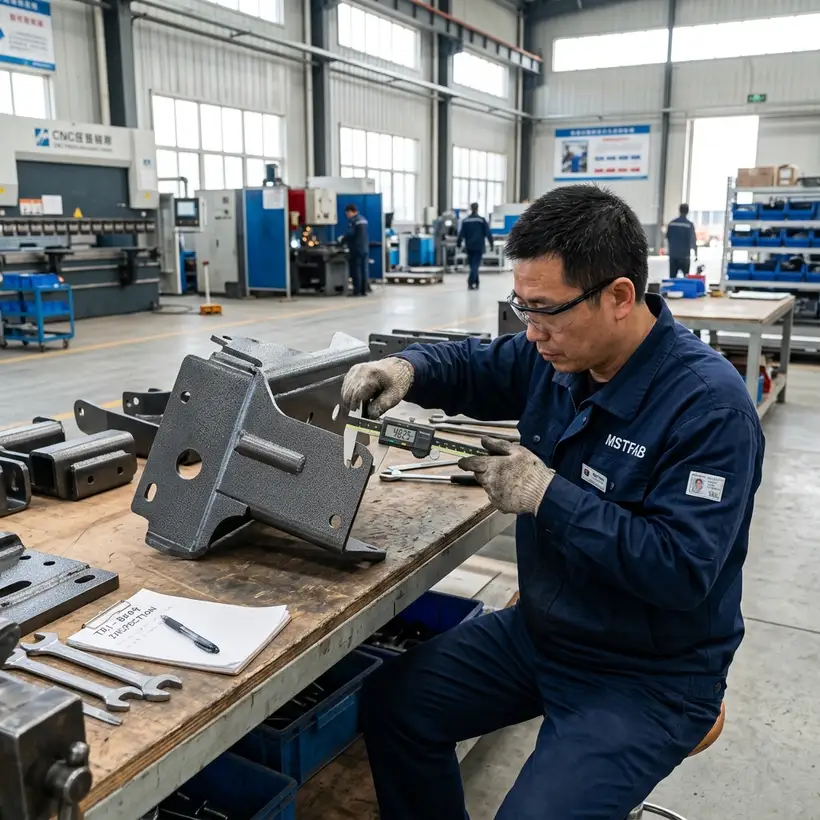
03 / Real Production Case Study & Process Control
Real Production Case Study: Commercial Utility Trailer & Off-Road Lighting Bracket Family (10 SKUs, 8,000 Pcs/Quarter)
Project Profile: Material: 3.0mm Q355B Steel + Zinc Pre-Treatment + RAL 9005 Black Fine-Texture Powder Coat
OEM Engineering Challenge: An off-road accessory OEM experienced rock-chip rust within 6 months and stripped M8 mounting threads because their previous supplier sprayed single-coat black powder directly onto un-primed, oxygen-cut carbon steel brackets.
MSTFAB Manufacturing Solution: MSTFAB stamped and formed the brackets using stage tooling, rotary-tumbled all edges to R = 0.4 mm, applied trivalent zinc plating + zinc-phosphate conversion beneath a 75 μm UV-stable RAL 9005 black fine-texture polyester powder coat, and masked all M8 weld nuts.
- Salt-Spray Corrosion Life: 1,000 hrs ASTM B117 with < 1.0 mm scribe creep
- Gravelometer Stone-Chip Test: Passed SAE J400 Class 8B impact resistance
- Thread Go/No-Go Pass Rate: 100% clean M8 threads (zero line-side re-tapping)
- Unit Cost Reduction at 8k Volume: 26% savings via stage-stamping automation
Every production lot is archived with locked CNC laser nests, press-brake bend programs, weld fixture setups, and signed golden samples to guarantee identical repeatability across multi-year reorders.
04 / Quality Verification, Traceability & Surface Finishing
4-Stage Manufacturing Workflow, Surface Treatment & Metrology Control
To maintain Cpk ≥ 1.33 on critical-to-quality (CTQ) dimensions from prototype through series production, MSTFAB executes a closed-loop four-stage fabrication protocol:
Step 01 — CAM Flat-Pattern Unfold, FEA Simulation & Nesting: Engineers import your 3D STEP model, verify bend radii and hole-to-bend distances (≥ 2.5t + R), and simulate forming springback or draw ratios.
Step 02 — High-Pressure Nitrogen Laser Blanking or Precision Die Stamping: Parts are cut with oxide-free nitrogen assist gas (for low/mid volume) or stamped on high-tonnage servo/mechanical presses (for high volume).
Step 03 — CNC Press Brake Forming, Tapping & Hardware Insertion: Urethane-protected press brakes form precision channels and flanges, followed by automated tapping and force-monitored PEM fastener pressing.
Step 04 — Surface Finishing, 100% Go/No-Go Gauge Check & Export Packing: Finished parts undergo powder coating, plating, or passivation, pass optical CMM First Article Inspection, and ship in VCI-protected cartons/crates.
All raw sheets (SPCC, SGCC, SECC, SUS304/316L, Al 5052-H32/6061-T6) are verified via optical emission spectrometry (OES) or XRF upon arrival and linked by barcode to your purchase order.
Prior to export crating in ISPM-15 fumigated plywood boxes, our quality lab conducts ballooned dimensional FAI checks, dry-film thickness (DFT) mapping, ASTM D3359 cross-hatch adhesion testing, and ground-continuity verification.
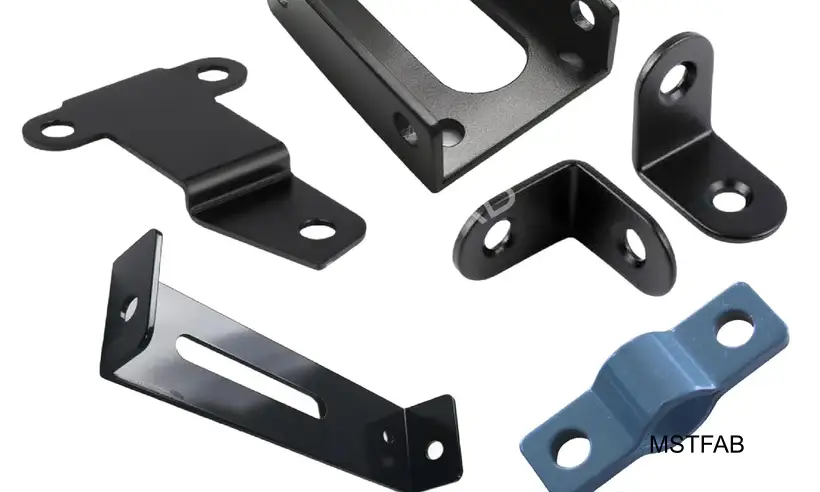
05 / 8-Point OEM RFQ Checklist & Topic Cluster Hub
OEM Engineering RFQ Checklist & Connected Fabrication Hubs
Include these eight drawing and specification controls in your RFQ package so our engineering team can lock down tooling, material traceability, and inspection fixtures on day one:
- RFQ Requirement 013D STEP model and 2D PDF drawing with flat hole tolerances and bend angle callouts
- RFQ Requirement 02Substrate choice: Cold-rolled SPCC (≤2.5mm), Hot-rolled pickled SPHC/Q355B (≥3.0mm), or Al 5052-H32
- RFQ Requirement 03Corrosion under-layer: Zinc phosphate, E-coat, Electro-zinc plating, or Hot-dip galvanizing before black powder
- RFQ Requirement 04Black powder specification: RAL 9005 Matte (10–20 GU), Satin (30–45 GU), Fine Sand Texture, or Wrinkle Black
- RFQ Requirement 05Masking diagram for weld nuts, PEM fasteners, ground pads, and precision dowel holes
- RFQ Requirement 06Volume tiering: 50–500 pcs (Laser + CNC Brake) vs 1,000–50,000+ pcs (Hard Stamping + Forming Dies)
- RFQ Requirement 07Required testing logs (Elcometer DFT, ASTM D3359 5B cross-hatch adhesion, ASTM B117 salt spray)
- RFQ Requirement 08Packaging spec (foam-divided egg-crate cartons to prevent black cosmetic rub marks in transit)
Explore Connected Sheet Metal Fabrication Services & Enclosure Hubs
CNC Press Brake Sheet Metal Bending & Forming
TIG / MIG / Robotic Sheet Metal Welding Services
Powder Coating, Passivation & Anodizing Finishes
Precision CNC Machining & Hybrid Metal Assemblies
Custom Electrical Enclosures & OEM Equipment Shells
Upload 3D STEP + 2D PDF for 24-Hour DFM & Price Quote
ISO 9001 & IATF 16949 Certified Factory Fact Sheet
06 / OEM Buyer & Engineer FAQ
Frequently Asked Questions: Custom Stamping Metal Parts
Can you apply black powder coating over galvanized or zinc-plated steel for double rust protection?
Yes! Combining a sacrificial zinc layer (either pre-galvanized SGCC, electro-zinc plating, or e-coat/zinc-rich primer) with a topcoat of UV-stable RAL 9005 black polyester powder creates a “duplex coating” that lasts 2x to 3x longer in outdoor salt spray than powder coat alone.
How do you prevent black powder coating from peeling off aluminum or galvanized steel?
For 5052/6061 aluminum, we apply a RoHS-compliant MIL-DTL-5541 Type II trivalent chromate conversion film before powder coating. For galvanized steel, we use nano-zirconium conversion plus an outgassing-forgiving (OGF) primer so the black topcoat achieves 5B cross-hatch adhesion.
At what quantity should we use stamping dies versus laser cutting and CNC press brake bending?
For quantities under 500–1,000 pieces per year, fiber laser cutting + CNC press brake bending has zero tooling cost and faster 7-day lead times. Once annual volume exceeds 2,000–3,000 pieces, compound blanking or progressive stamping dies cut piece-part prices by 35%–60%.
What is the difference between Smooth Matte Black and Fine-Texture Black powder coating?
Smooth Matte Black (RAL 9005, 10–15 gloss units) has a sleek architectural appearance but shows fingerprints and assembly scuff marks more easily. Fine-Texture (or Micro-Texture) Black has a subtle satin grain that resists scratches, hides fingerprints, and improves edge coverage.
How do you pack black powder-coated brackets so they don’t rub against each other during shipping?
We never bulk-dump cosmetic black parts into a bag. Each bracket is either sleeved in an individual PE foam pouch or placed in custom EPE/corrugated egg-crate partition cells inside reinforced export cartons.
Is MSTFAB certified to automotive IATF 16949 quality standards for stamped brackets?
Yes. MSTFAB holds both ISO 9001:2015 and IATF 16949:2016 certifications and provides full PPAP Level 3, Cpk capability studies, and IMDS/RoHS material reporting for automotive and industrial OEMs.
International Standards & Engineering References
- ISO 2768-1 / 2768-2 — General Linear, Angular and Geometrical Tolerances for Sheet Metal Fabrication
- IEC 60529 / NEMA 250 — Degrees of Protection Provided by Enclosures (IP Code & Environmental Sealing)
- ISO 9001:2015 & IATF 16949:2016 — Quality Management Systems & Production Part Approval Process (PPAP)
Ready to Quote Your Custom Sheet Metal Enclosure or Fabrication Project?
Upload your 3D STEP models and 2D PDF drawings. MSTFAB will review your tolerances, material specs, and DFM details to deliver a transparent factory quote within 24 hours.
Request Your 24-Hour DFM & Custom Quote →
Direct engineering desk: caroline@mstfab.com | ISO 9001 & IATF 16949 Certified Factory in Guangzhou, China
 WeChat Contact
 WhatsApp Me Directly