
Standard vs Custom Sheet Metal Enclosures: How to Choose
A standard enclosure is not automatically a compromise, and a custom enclosure is not automatically the better purchase. OEM buyers should compare three routes: a catalog product, a modified catalog product and a drawing-defined custom shell. The right choice depends on the actual interfaces, required evidence, quantity and complete delivered scope.
Quick answer: start with a standard enclosure when its documented dimensions, construction and available accessories meet the project. Evaluate factory modification when an existing design works but needs defined changes. Evaluate custom sheet metal fabrication when the required geometry or manufacturing scope cannot be met satisfactorily by those routes. Compare finished, integration-ready deliverables rather than bare-box prices.
Compare the three enclosure routes.
Standard, Modified Standard and Custom Enclosures
| Route | When to evaluate it | What to confirm |
|---|---|---|
| Standard catalog enclosure | The available size, mounting arrangement, closure and accessories meet the application without unplanned work. | Exact model, usable space, device access, documentation, availability and any remaining integration operations. |
| Modified standard enclosure | An existing base design is suitable but requires specified holes, cutouts, hardware, finish or other supported changes. | Modification drawing, responsible supplier, finishing route, applicable rating documentation and repeat-order identity. |
| Custom fabricated enclosure | The project needs drawing-defined geometry, interfaces or construction not satisfactorily supported by catalog options. | Released design, DFM decisions, manufacturing scope, first-article acceptance, change control and required validation. |
These are procurement routes, not quality rankings. Hammond Manufacturing explicitly distinguishes standard, modified and unique custom designs in its own product offering. That distinction demonstrates why “standard means manual rework” is an incomplete comparison; it does not establish which supplier or route fits a particular MSTFAB project.
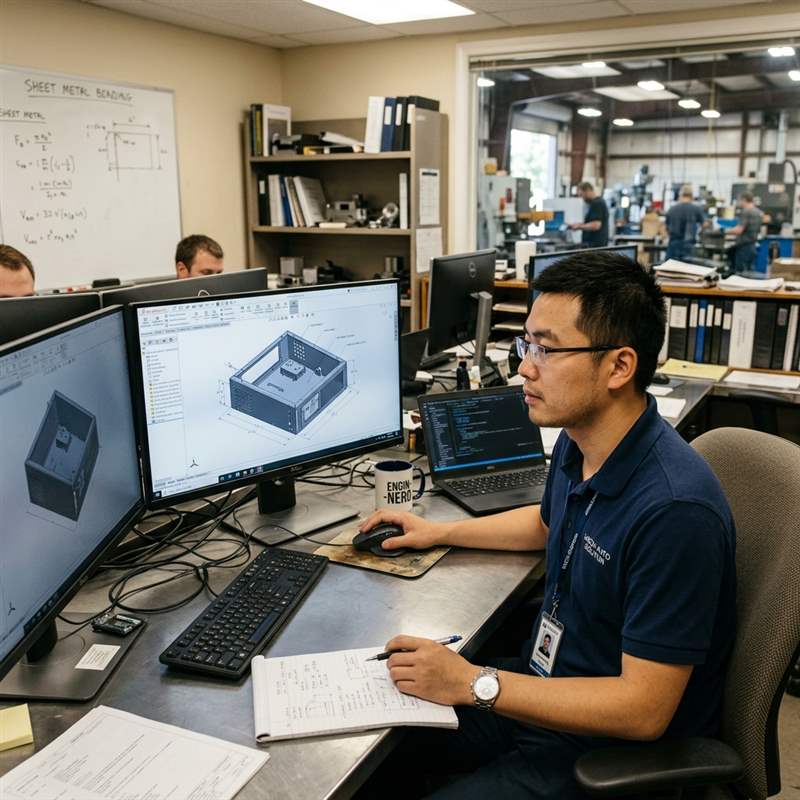
When a Standard Enclosure Is a Sensible Starting Point
Check the actual internal equipment envelope, mounting plate, cable entry, service access and door movement against the catalog documentation. External dimensions alone do not establish usable space. Include the accessories and the installation requirements that turn the selected model into a usable assembly.
If it meets the requirements with an acceptable supply and integration plan, there is no reason to reject it merely because it is standard. Conversely, a box that fits the overall volume may still need significant changes at mounting, cooling-device or connector interfaces. Make those changes visible before choosing the purchasing route.
When Factory Modification May Be Enough
Modification can be an intermediate route between buying an untouched catalog box and developing a unique shell. Ask the original manufacturer or qualified provider which changes are supported and how they will be documented. A modified model must be specified clearly enough to order and inspect again.
Identify whether cutouts are made before finishing, what happens at exposed edges, which hardware is installed and who verifies the resulting configuration. Do not assume every modification requires field drilling, or that any modified enclosure remains suitable without review. The quotation should distinguish included operations from work left to the integrator.
When Custom Sheet Metal Fabrication Deserves Evaluation
A unique envelope, mounting arrangement, removable panel system or equipment interface may justify a custom shell. The benefit must be tied to an actual requirement: for example, an otherwise incompatible insertion path or a mounting arrangement that catalog options cannot support.
Customization also creates design decisions that need ownership. Agree the material, thickness, finish, hardware and critical relationships; resolve manufacturability questions before release. Do not replace a controlled requirement with a supplier’s generic precision claim. A successful sample demonstrates only the scope actually inspected and approved, not every possible product performance requirement.
Compare Complete Cost, Not Just the Empty Box
Use the same quantity, material/finish requirements, delivery condition and inspection scope for the comparison. Include relevant engineering work, modifications, tooling or setup, hardware, finishing, incoming checks and integration labor. Identify what is one-time and what repeats with each unit or batch.
There is no universal break-even quantity. A custom route does not automatically eliminate assembly labor; a standard route does not automatically create hidden cost. Compare the actual quotations and operations. Obtain current schedules for the specific scope instead of relying on a fixed prototype or production lead-time promise.
Neither Route Automatically Guarantees IP or NEMA Performance
IEC 60529 classifies degrees of protection provided by enclosures. A material grade, custom cutout or nominal bending tolerance is not an ingress-test result. For either route, identify the required configuration and supporting evidence.
The original article’s claim that any modification instantly voids every rating was too broad. Equally, custom fabrication does not inherently guarantee IP65, IP66 or NEMA 4X. Ask the responsible manufacturer or assessment body what the actual change means for the applicable evidence. Do not infer the answer from a generic comparison table.
Frequently Asked Questions
Are custom enclosures always better than standard enclosures?
No. Compare the actual interfaces, manufacturing and integration scope, documentation, cost and supply requirements. A standard or modified standard product may meet the project without a unique design.
Is a modified standard enclosure the same as a fully custom shell?
No. A modified standard enclosure starts from an existing base design. A fully custom shell is defined by the project’s design rather than merely a catalog model with supported changes.
Does a custom enclosure automatically retain a required protection rating?
No. The applicable configuration, requirements and supporting evidence must be established. The same review is needed when making relevant changes to a standard enclosure.
References and Next Step
References: Hammond Manufacturing: standard and modified enclosure routes; IEC 60529: enclosure protection classification. These sources do not certify an MSTFAB product or guarantee project cost savings.
Compare Your Enclosure Options Against the Same Requirements
For MSTFAB custom enclosure fabrication, provide the controlled drawings, quantity, material, finish and critical interfaces. If comparing with a catalog option, identify the exact model and remaining changes so that the scope comparison is meaningful.
 WeChat Contact
 WhatsApp Me Directly