
The Short Answer
An effective Guangzhou sheet metal factory audit traces one active production job from the customer 2D PDF/3D STEP drawing all the way through raw sheet storage, fiber laser cutting, CNC press brake forming, masking, First Article Inspection (FAI), and export crating. Rather than walking through a rehearsed showroom tour, verify how revision locks, K-factor flat-pattern rules, and thread masking instructions actually reach the machine operator.
Explore this guide
01 / Pre-Visit Scope Alignment
Define your part families, material grades, and volume profile before arriving in Guangzhou.
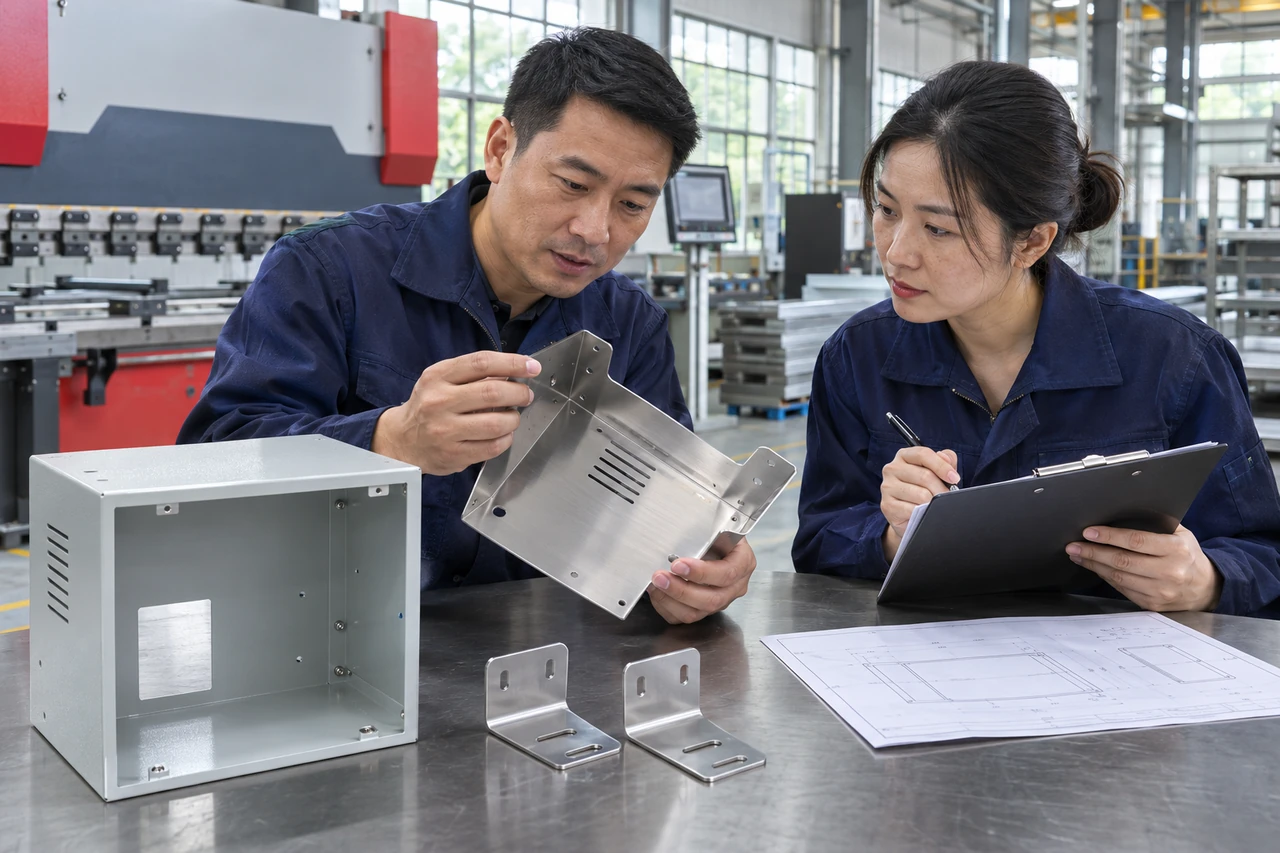
Walking into a Pearl River Delta sheet metal plant without a defined part profile wastes half the audit on irrelevant machinery. A shop optimized for high-speed progressive stamping will not manage low-to-medium volume welded equipment housings or multi-bend chassis the same way a build-to-print precision fabrication facility does.
Share a representative drawing package and review our sheet metal supplier audit evidence checklist before your visit so engineering, quality, and production leads can walk your team through live work-in-progress.
Part geometry and family fit
Confirm the factory routinely builds your mix of formed brackets, control panels, cover plates, and welded enclosure shells across 0.8 mm to 10.0 mm gauges.
Material grade segregation
Verify separate storage racks and deburring tools for cold-rolled steel, SS304, SS316, and 5052/6061 aluminum to prevent iron cross-contamination.
Prototype-to-batch scalability
Check how the production schedule accommodates 5-piece first-article builds alongside recurring 100 to 2,000-piece batch releases without losing setup data.
Audit preparation rule: Send one representative 3D STEP and 2D PDF drawing ahead of the audit and ask the engineering team to walk you through how they unfold, nest, tool, and inspect that exact part on the shop floor.
02 / Drawing-to-Floor Traceability
Trace a single active work order from engineering release to machine setup.
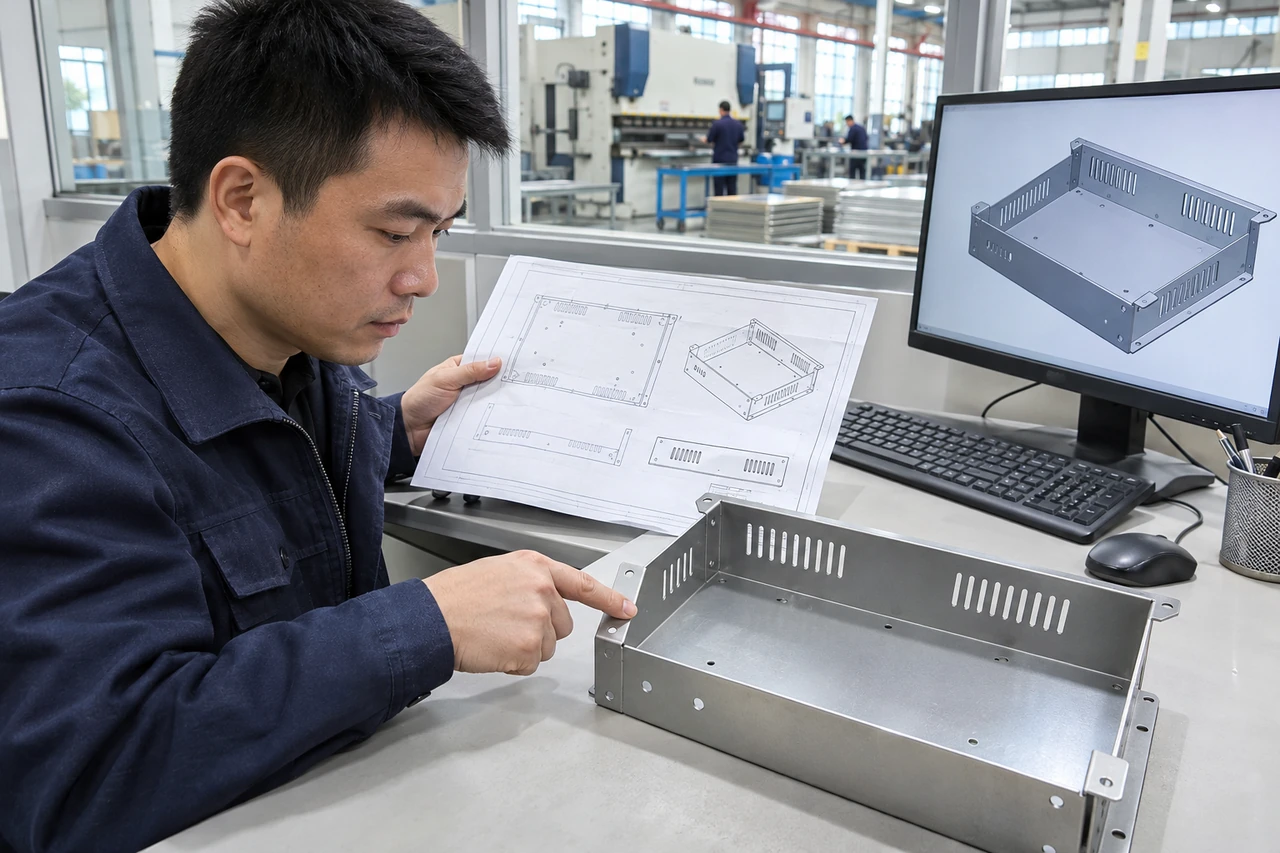
Equipment lists never explain why a mounting hole shifts by 1.5 mm after bending. During your Guangzhou factory walk, pick one active sheet metal job on the shop floor and trace how engineering converts the customer drawing into controlled shop instructions.
- Revision-locked shop travelers: Confirm that every pallet carries a printed or barcode-linked route card showing the exact customer drawing revision, material grade, and required quantity.
- Controlled 3D unfolding and K-factors: Verify that programming engineers unfold customer 3D STEP models using press-brake-specific bend deduction tables rather than letting operators guess flat lengths at the machine.
- Heat-lot and gauge verification: Check that raw sheets pulled for the job are micrometer-verified for actual thickness and linked to an EN 10204 3.1 mill certificate.
Our custom sheet metal fabrication services enforce revision-locked CAD unfolding under ISO 9001 and IATF 16949 quality controls so obsolete DXF files never reach the laser bed.
03 / Cutting, Forming and Fastening
Inspect how laser cutting, CNC bending, and hardware insertion are controlled in-house.
When evaluating a Guangzhou fabricator, verify which primary mechanical operations happen under the factory roof and how setups are verified between stations—whether you are sourcing precision brackets, panels, or cover plates.
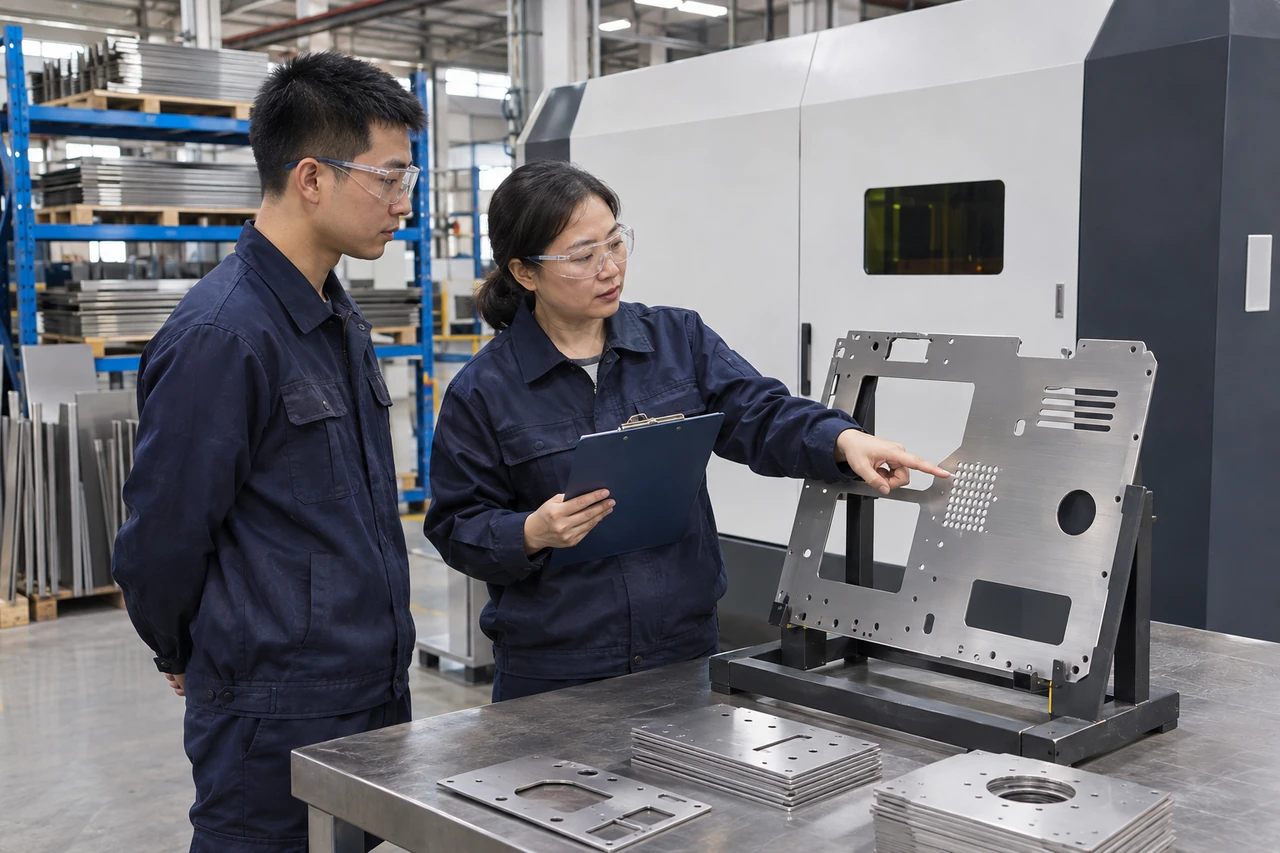
- Inspect laser-cut blanks right off the shuttle table for bottom-edge dross, nitrogen vs. oxygen edge oxidation, and dedicated rotary-brush deburring.
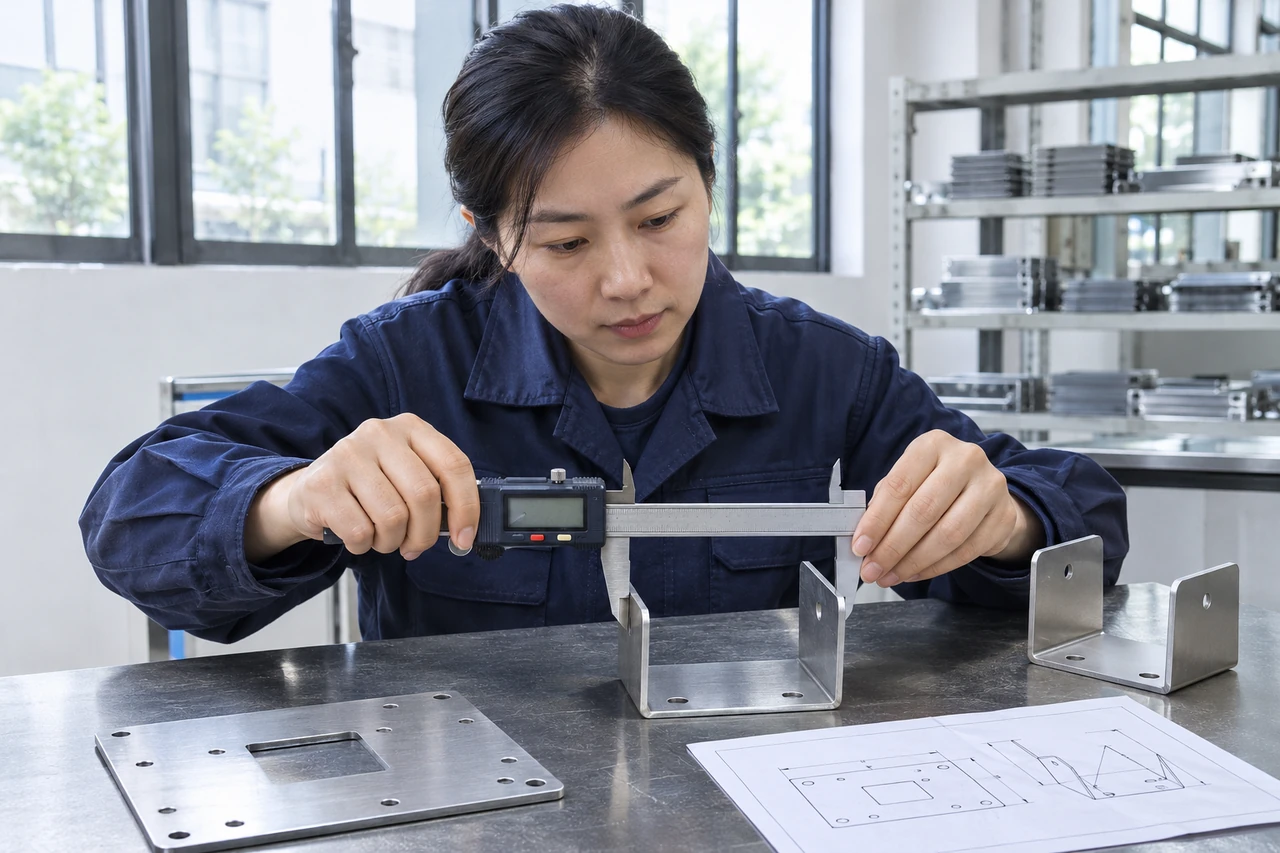
- Watch a CNC press brake setup to confirm operators check first-piece flange lengths and hole-to-bend datums with calipers and angle gauges before running the stack.
- Check hydropneumatic hardware presses to see how PEM nuts, standoffs, and studs are installed flush without deforming thin SS304, SS316, or 6061 aluminum parts.
- Review welding fixtures and copper heat-sink clamping blocks used to hold squareness and control thermal distortion on welded frames.
Observing first-piece sign-off at each workstation tells you immediately whether quality is built into the process or left to a final sorting table.
Explore our fiber laser cutting and sheet metal processing controls →
04 / Finishing and Masking Handoffs
Verify how powder coating, anodizing, and thread masking are specified and checked.
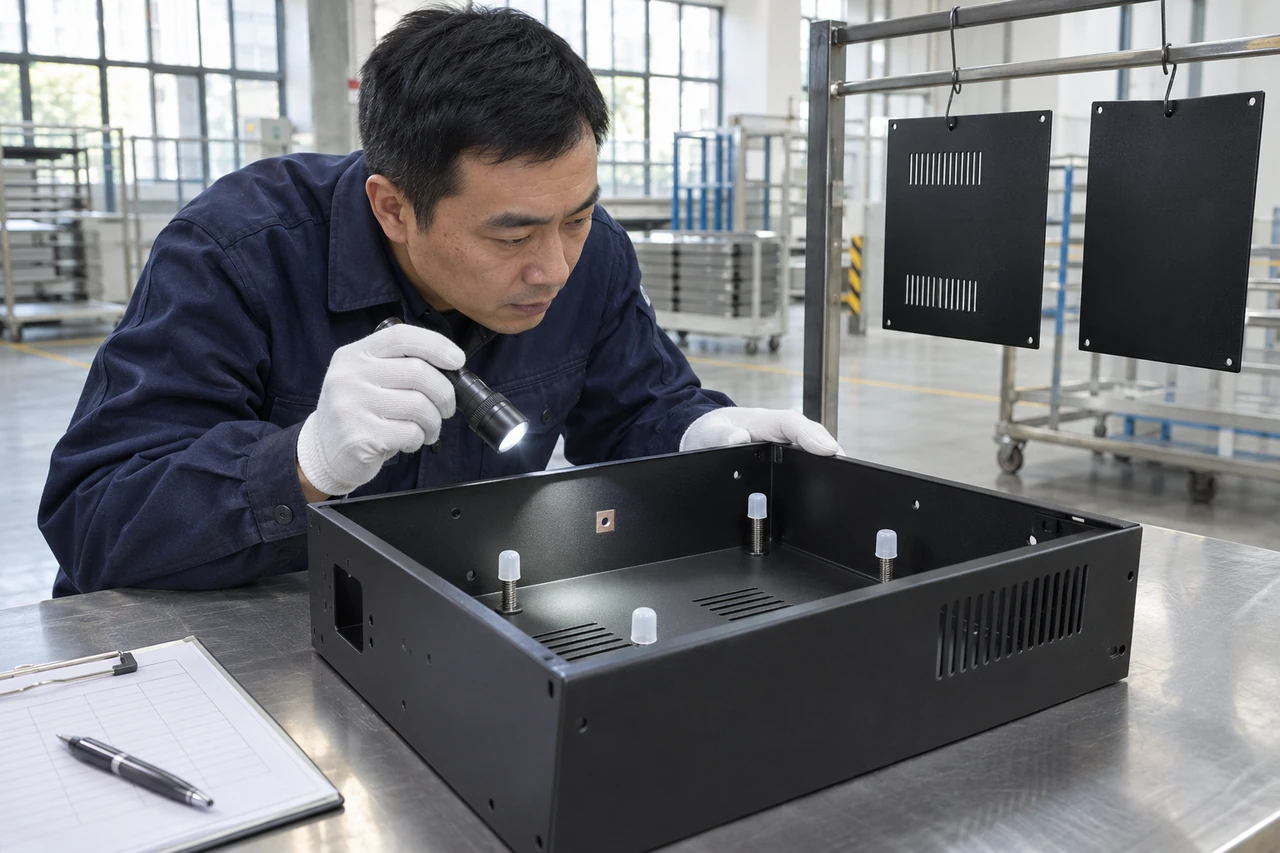
Surface finishing is the most common failure point in cross-border sheet metal sourcing when masking instructions are communicated only verbally. Paint inside M4 PEM nuts or insulated grounding studs will halt your assembly line upon arrival.
- Visual masking maps on travelers: Check that coating stations use graphic work instructions calling out high-temperature silicone plugs for every threaded insert and die-cut masking tape for earth bonding pads.
- Pre-treatment and adhesion testing: Confirm degreasing, phosphating, or conversion pre-treatment stages are logged, and inspect cross-hatch adhesion and dry-film thickness gauge records.
- Post-coat thread and continuity verification: Verify that inspectors run go/no-go thread plugs into masked fasteners and check bare-metal continuity on grounding zones before parts move to packing.
Whether finishing happens on an in-house line or through a qualified surface-treatment partner, the sheet metal manufacturer must own incoming and outgoing coating inspection.
05 / Factory Audit Matrix
Score five operational checkpoints during your Guangzhou supplier assessment.
Use this practical verification table on your clipboard during the plant walk to record objective evidence before issuing your RFQ or initial purchase order.
06 / Prototype vs. Repeat Production
Compare first-article records against repeat batch inspection reports.
Many factories can hand-craft three acceptable prototype samples with a senior technician nursing every bend. During your audit, ask to see the documentation bridging a past First Article Inspection (FAI) to its third or fourth repeat production batch.
Look for ballooned 2D drawings paired with measured dimensional tables, recorded press-brake die combinations, and in-process patrol inspection sheets logged across the batch.
Operating under ISO 9001, IATF 16949, and ISO 14001 management systems, MSTFAB archives every approved flat pattern, tooling setup, and inspection record so repeat orders assemble without surprise adjustments.
Download and review our complete supplier audit evidence checklist →
07 / Packing and Dispatch Review
End your factory walk at the export packing and crating station.
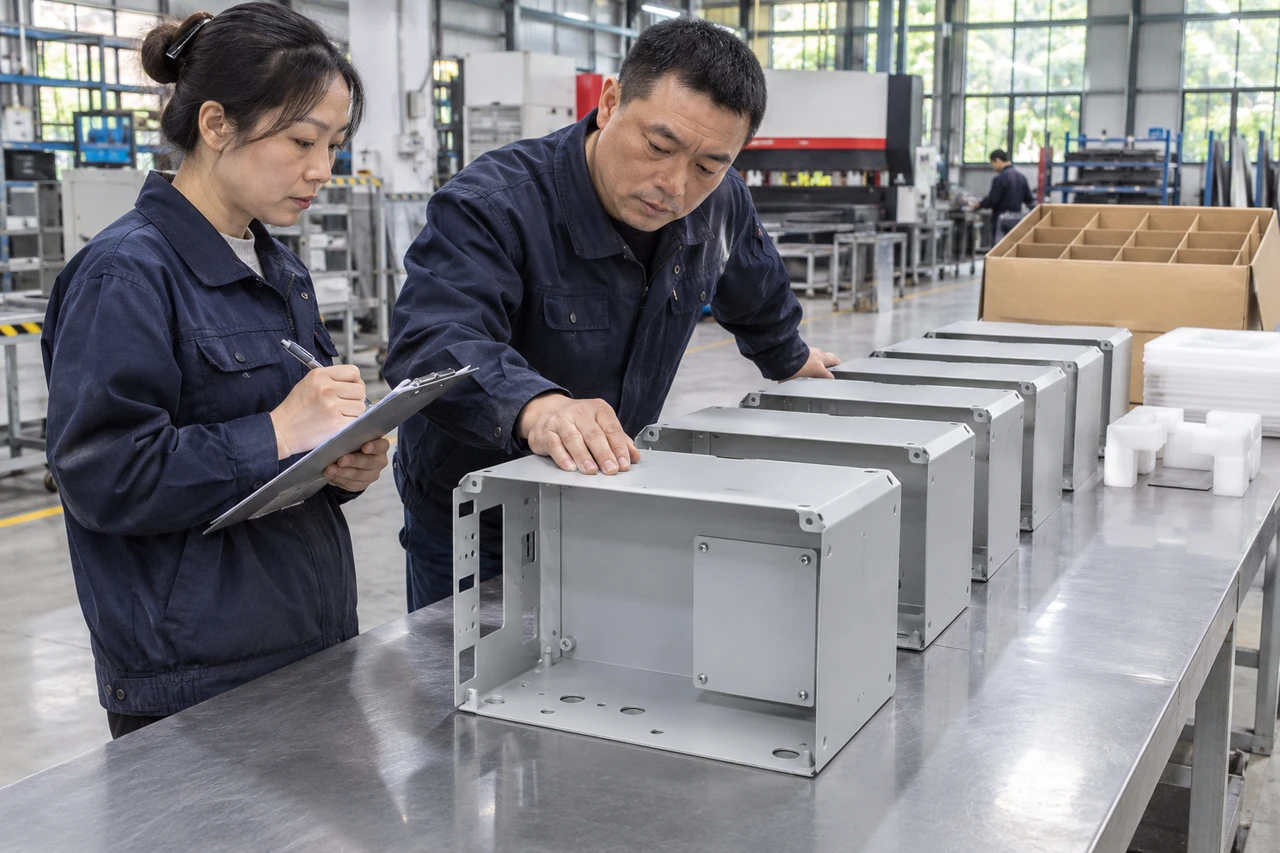
A precision enclosure or brushed stainless panel can pass every dimensional gauge and still arrive damaged if stacked metal-on-metal inside a weak carton. Always inspect the shipping bay where finished orders are being packed for ocean or air freight.
Verify that coated panels are separated with EPE foam or pearl-cotton sleeves, bare steel parts include VCI anti-rust protection, and export pallets use fumigation-free plywood crates with clear part-number and PO labeling. You can discuss your drawing and review scope with our Guangzhou engineering team before scheduling an on-site or remote video audit.
Manufacturing scope: MSTFAB manufactures custom drawing-based sheet metal parts, brackets, chassis, and empty enclosure shells under ISO 9001, IATF 16949, and ISO 14001 systems. Final electrical wiring, powered equipment integration, and end-product regulatory certification belong to the OEM.
08 / Ready-to-Review RFQ
Send eight engineering details before your Guangzhou factory review or RFQ.
- 3D STEP and 2D PDF drawingsProvide native 3D STEP models for formed parts and dimensioned 2D PDF prints showing critical tolerances.
- Material grade and gauge listSpecify CRS/SPCC, SGCC, SS304, SS316, or 5052/6061 aluminum along with sheet thickness.
- Hardware and thread calloutsList all PEM nuts, standoffs, studs, or tapped holes so installation tooling can be reviewed.
- Welding and cosmetic zonesDefine stitch vs. continuous welds, corner grind finish, and A-surface cosmetic faces.
- Surface finish and masking mapDetail RAL powder coat color, anodizing, brushing, or plating plus masked grounding/thread areas.
- Prototype and batch volumesState initial sample quantity and expected recurring release quantities per order.
- Inspection and FAI requirementsNote required ballooned FAI reports, material certs, or specific gauge/fixture checks.
- Export packing and IncotermsSpecify EXW, FOB Guangzhou/Shenzhen, or CIF/DDP terms along with pallet height or kitting rules.
Sending a representative drawing package before your audit lets our engineers prepare a real DFM walk-through and itemized quotation tailored to your parts.
Guangzhou sheet metal factory audit and sourcing questions from OEM buyers
Can we audit MSTFAB in Guangzhou before placing a production order?
Yes. We welcome OEM engineering, quality, and procurement teams to visit our Guangzhou facility in person—or conduct a live, structured video shop-floor walkthrough—to review our fiber laser cells, CNC press brakes, welding bays, inspection lab, and active quality travelers.
Why should we trace a live work order during a sheet metal factory audit?
Following one live job from the ERP drawing release through raw material verification, laser cutting, bending, coating masking, and final QC reveals whether the factory actually follows its documented ISO 9001 procedures on the shop floor.
Can we run a trial First Article sample before traveling to Guangzhou?
Yes. Many overseas buyers send a representative bracket, chassis, or enclosure drawing for DFM review and First Article prototyping first, or review the completed sample and FAI data package on-site during their factory visit.
How do you control outsourced or specialized surface treatments?
Every surface treatment—whether powder coating, anodizing, electroplating, or passivation—is governed by revision-controlled masking diagrams, incoming dry-film thickness checks, cross-hatch adhesion testing, and 100% thread plug verification before packing.
What quality certifications does MSTFAB maintain?
MSTFAB operates under ISO 9001 quality management, IATF 16949 automotive process controls, and ISO 14001 environmental management systems. We manufacture build-to-print mechanical sheet metal parts and empty enclosure shells, while final powered system certification remains with the OEM.
Which ports do you ship from for export orders out of Guangzhou?
Our Guangzhou location provides direct logistics access to Nansha (Guangzhou), Yantian/Shekou (Shenzhen), and Hong Kong ports for ocean freight, as well as Guangzhou Baiyun and Hong Kong international airports for air express shipments.
Technical references
Reference these international quality, auditing, and geometrical tolerance standards when qualifying a custom sheet metal fabrication supplier.
Send a representative drawing to plan your Guangzhou factory review or RFQ.
Share your 3D STEP and 2D PDF files along with target quantities. MSTFAB will prepare a DFM review, itemized quote, and transparent shop-floor audit agenda.
Discuss Your Drawing and Review Scope →
Have a question first? caroline@mstfab.com
 WeChat Contact
 WhatsApp Me Directly