
The Short Answer
Custom replacement sheet metal panels for existing industrial equipment must mate cleanly with frames, hinges and threaded inserts that are already bolted down in the field—not merely match the outer length and width of an archived print or worn sample. Before releasing a spare-part batch, OEM buyers should verify the exact equipment serial revision, reference mounting-hole patterns and return flanges to functional installation datums, separate service wear from nominal geometry when reconstructing missing drawings, account for aged finish differences, and validate a first-article panel on representative equipment.
Explore this guide
01 / Replacement vs. New Build Scope
Design replacement panels around fixed field interfaces that cannot be adjusted.
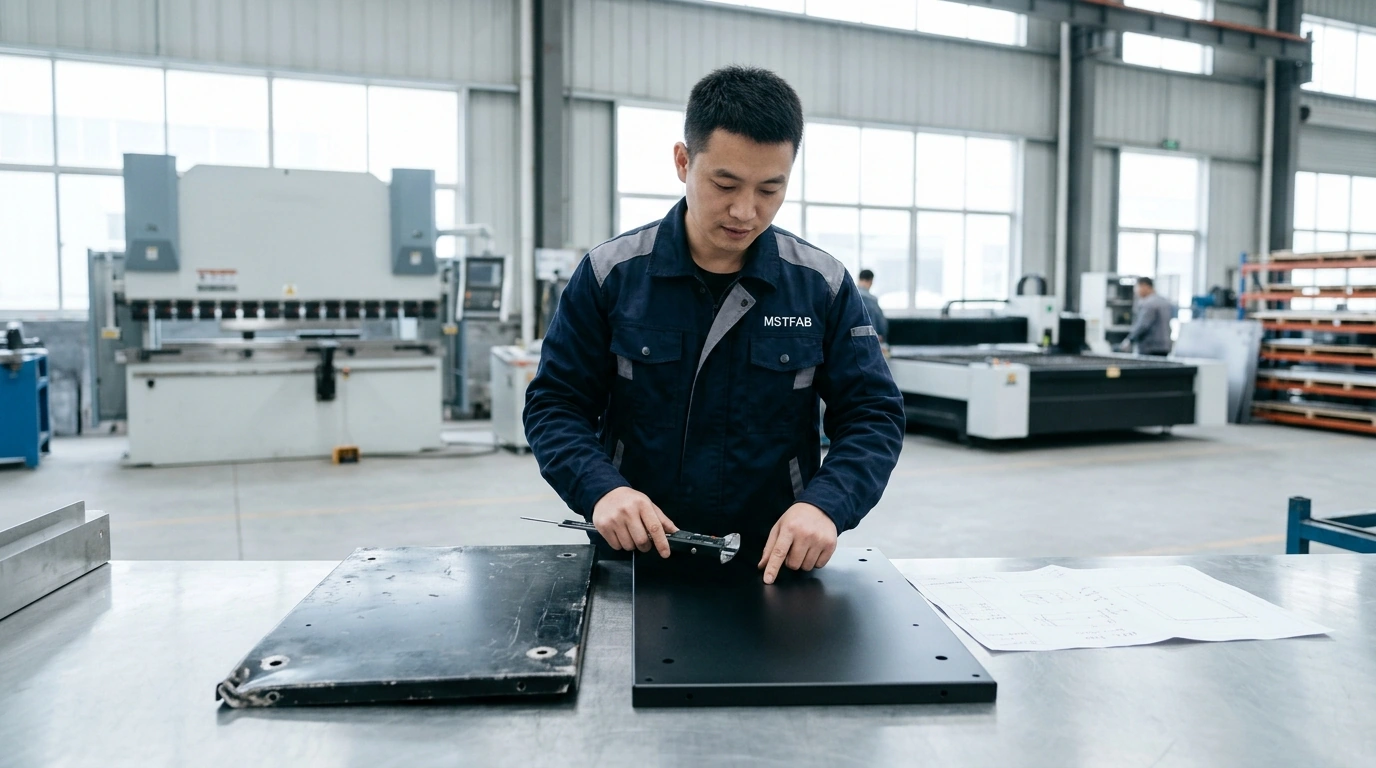
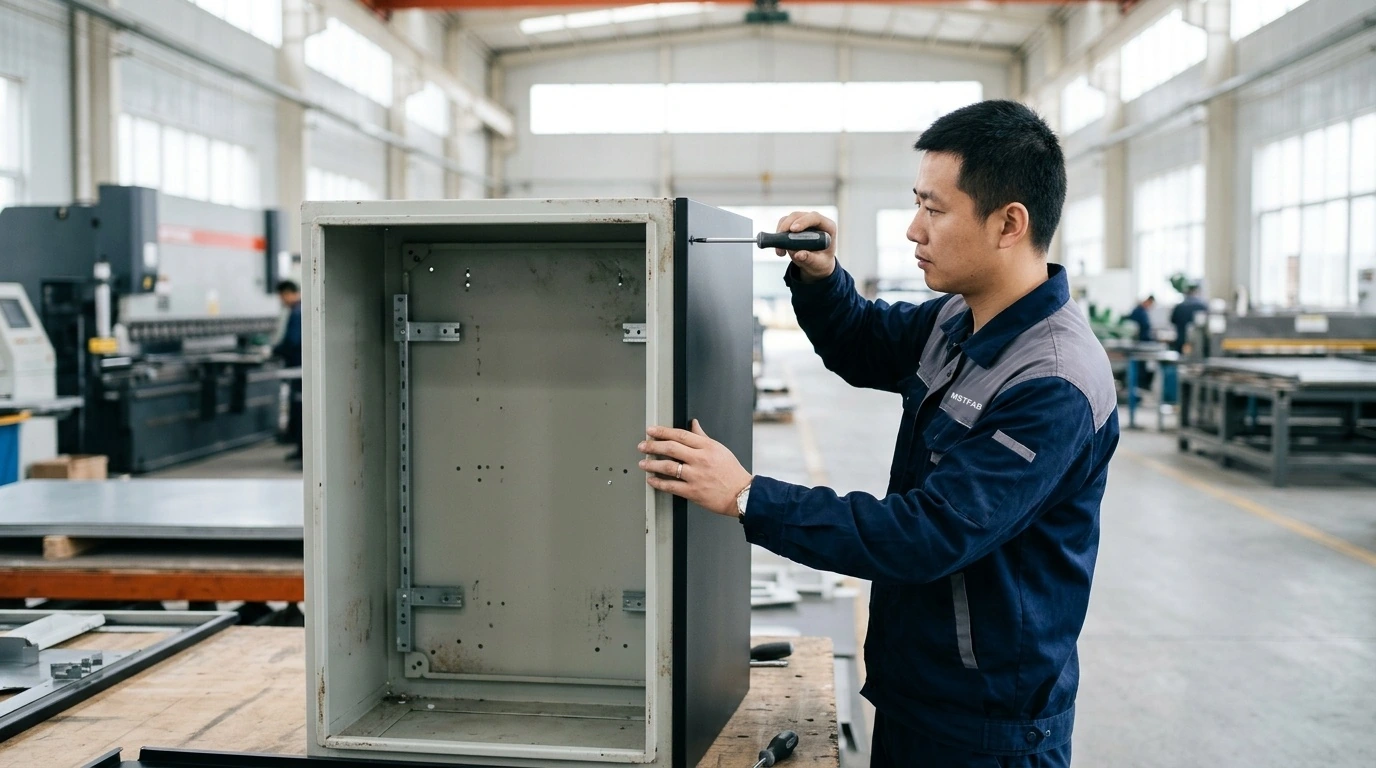
When manufacturing a brand-new cabinet, the frame, doors and access panels are cut, bent and fitted together in the same factory. If a minor revision is needed, mating parts can be updated simultaneously. In a replacement panel order, the host machine has been operating at a customer site for years—the new cover or door must bolt directly onto existing fixed inserts without field drilling or filing.
Programmable custom sheet metal fabrication allows OEMs and service teams to order 5, 20 or 100 replacement doors, ventilation louvers, safety guards or custom metal access panels without dedicated stamping dies, provided the interface geometry is locked down before cutting.
Fixed Mating Frame
The installed cabinet frame, hinge barrels, quarter-turn latch cams and threaded inserts are fixed in the field and dictate every panel datum.
Historical Revision Drift
Equipment built five years ago may use a different hole pitch or hinge style than the latest production CAD revision on your server.
Service-Ready Packaging
Unlike bulk line-side parts, replacement panels often ship individually to regional service depots and require standalone protection and clear SKU labels.
Transferring legacy tooling: if you are moving an entire discontinued or active product family rather than ordering individual spares, review our guide on how to transfer sheet metal production to a new manufacturer.

02 / Revision Audit and Mounting Datums
Match the drawing revision to the installed serial range and dimension from mounting datums.
The most frequent cause of replacement panel rejection is building accurately to the wrong revision. An equipment manufacturer may have shifted mounting holes by 6 mm or switched hinge suppliers between Rev A and Rev C without changing the panel’s outer width and height. Always verify the target machine serial number and follow disciplined practices for managing drawing revisions from prototype to production.
- Reference holes to functional datums: dimension mounting holes, slots and latch cutouts from the primary locating hinge edge or datum hole rather than chaining measurements from raw outer shear edges.
- Control return-flange depth and bend radius: verify that perimeter return flanges clear existing frame gaskets and internal wiring channels after forming.
- Evaluate universal spares carefully: before combining Rev A, B and C hole patterns into one ‘universal’ slotted service panel, verify that extra slots do not compromise ingress sealing, panel stiffness or appearance.
Applying sound sheet metal fabrication tolerances that avoid assembly problems ensures replacement doors and covers drop onto existing studs without binding.
03 / Missing Drawings and Damaged Samples
Separate service wear and field modifications from nominal geometry when reverse engineering.
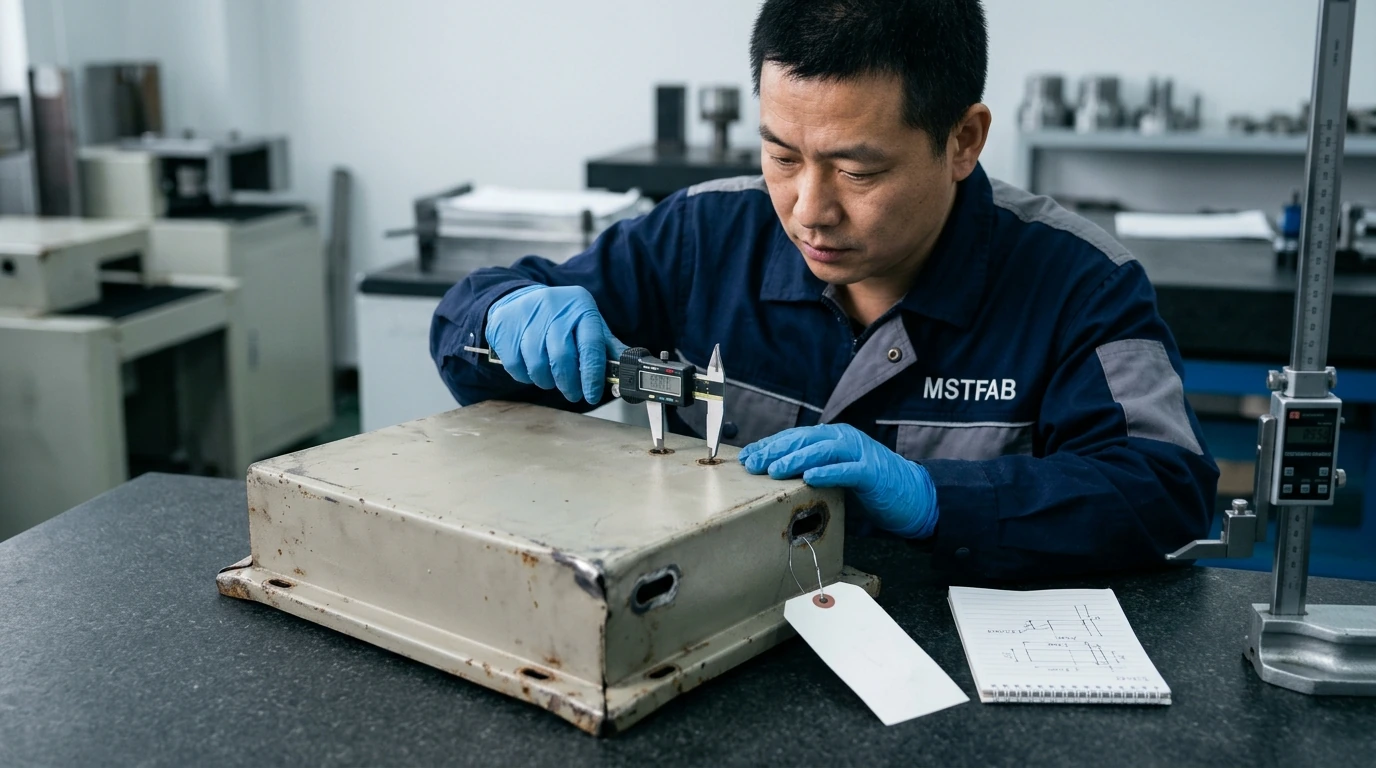
When legacy equipment outlives its original 3D CAD files, buyers sometimes send a worn or damaged panel removed from the machine as a physical sample. Blindly copying a used sample on a CMM or optical scanner copies every dent, rusted edge and field-drilled hole straight into the new production drawing.
- Identify and normalize elongated mounting holes, sprung return flanges, missing PEM hardware and pried latch cutouts back to their intended nominal engineering dimensions.
- Measure the mating opening, hinge pitch and stud centerlines on the host machine frame alongside the removed sample whenever possible.
- Generate and sign off a clean, revision-controlled 3D STEP model and 2D PDF manufacturing print before cutting any metal—never release production from annotated photos alone.
Treat sample reconstruction as a distinct engineering step with explicit buyer sign-off before the job enters fabrication.
See how STEP models and 2D PDF drawings control fabrication →
04 / Material Equivalence and Aged Finishes
Preserve original gauge stiffness and set realistic expectations for matching aged coatings.
Replacing an outdoor or plant-floor panel involves matching both mechanical rigidity and visual appearance next to neighboring panels that have weathered for years.
- Keep original alloy and thickness unless engineered: substituting aluminum for carbon steel or dropping gauge thickness changes flexural stiffness, hinge load and gasket compression—any material change must be approved by the OEM engineer.
- Account for UV and plant-floor color drift: specifying the original RAL color code reproduces the factory-fresh shade, which may contrast visibly against a cabinet that has faded for five years; provide a physical master plaque if matching a custom texture or gloss.
- Match brushed stainless grain direction: on #4 brushed 304 or 316L stainless replacement doors, specify grain orientation arrows on the 2D drawing so the brush lines align with adjacent panels.
- Preserve grounding and EMI bonding zones: mask earthing studs, hinge contact lands and perimeter gasket tracks during surface treatment so the replacement panel restores proper chassis bonding.
Accounting for 60–100 µm of powder coating per face prevents tight replacement doors from rubbing inside existing cabinet frames.
05 / Buyer Control Matrix
Verify five compatibility checkpoints before releasing a replacement panel batch.
Use this procurement matrix to eliminate fitment surprises when sourcing legacy or service replacement sheet metal parts.
06 / Inspection Handoff
Validate a first-article or golden sample on representative equipment before batch release.
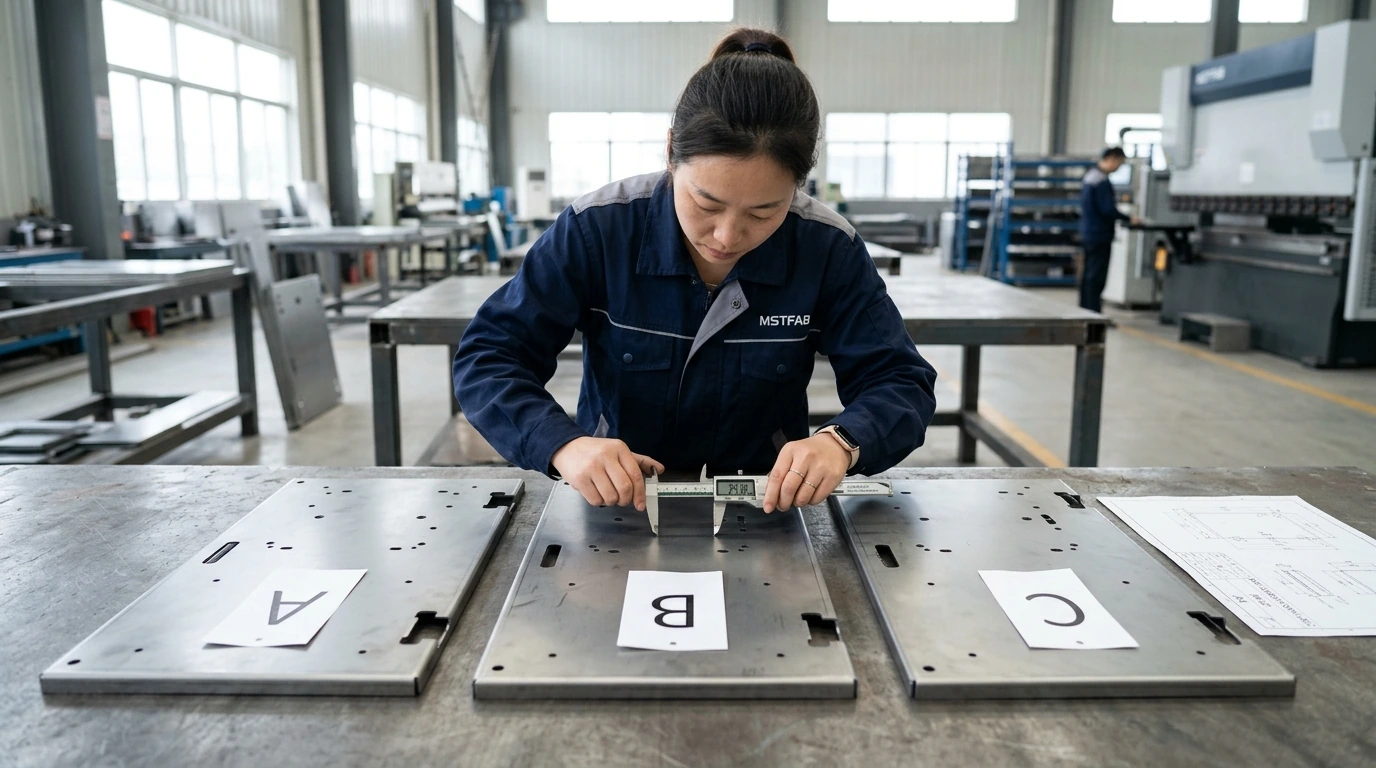
When replacing panels across an installed base of 50 or 200 machines, validating a single first-article part or small pilot run on an actual cabinet is far cheaper than reworking a full batch in the field.
Once the trial-fit panel bolts up cleanly and latch/hinge operation is confirmed, retaining an approved golden sample provides a physical benchmark for future service replenishments.
Our inspection team records critical hole-to-datum pitches, flange heights, flatness and coating thickness after finishing so every spare panel matches the approved reference.
Review MSTFAB dimensional and finish quality control procedures →

07 / Service Packaging and Scope
Pack and label replacement panels individually for long-term spare-parts storage.
Unlike production-line panels that are unpacked all at once on the factory floor, replacement panels may sit in a regional service warehouse for months before being shipped individually to a customer site.
Specify individual PE film wrapping, foam edge protectors and boxed or separated packing per our custom metal parts packaging guide, with outer export pallets or crates meeting IPPC ISPM 15 standards. Label each unit with the replacement SKU, drawing revision and compatible equipment series.
Manufacturing scope: MSTFAB manufactures drawing-based replacement sheet metal panels, covers, doors and brackets under ISO 9001 quality controls. On-site field measurement, electrical rewiring and final powered equipment safety certification remain the responsibility of the OEM or equipment operator.
08 / Ready-to-Review RFQ
Include eight inputs when quoting custom replacement sheet metal panels.
- Verified 3D STEP & 2D PDFProvide drawings matched to the exact installed equipment revision.
- Equipment model & revisionNote whether multiple historical field revisions must be supported.
- Critical mounting datumsHighlight hole patterns, hinge centers, latch cutouts and return-flange clearances.
- Material grade & thicknessSpecify SPCC steel, SGCC galvanized, 304/316L stainless or 5052/6061 aluminum.
- Hardware BOM & orientationList captive screws, PEM nuts/studs, hinges or latches and installation side.
- Finish, grain & maskingState RAL code, texture/gloss, brush direction and bare grounding zones.
- Pilot sample vs. batch qtyIndicate if 1–2 trial-fit samples are needed before releasing 10–100+ spares.
- Individual service packingDefine single-unit boxing, SKU/revision barcode labels and export destination.
Providing verified revision drawings and clear datum callouts lets our engineering team quote replacement panels that bolt onto your existing equipment on the first attempt.
OEM buyer questions on custom replacement sheet metal panels
Can replacement panels for discontinued industrial equipment be made without stamping dies?
Yes. Using CNC fiber laser cutting, turret punching, CNC press brake forming and standard self-clinching hardware, custom replacement panels and doors can be manufactured in low-to-medium quantities without investing in dedicated hard stamping tooling.
Why did a replacement panel built to our latest CAD drawing fail to fit a machine in the field?
Equipment designs frequently evolve over a product’s lifecycle. If mounting-hole pitches, hinge styles or return-flange depths were modified in a later engineering change order (ECO), a part built to the latest revision will not fit an earlier serial-number unit. Always verify which drawing revision matches the installed machine.
Can you manufacture a replacement panel from a damaged physical sample if we lost the CAD files?
A physical sample can be measured to reconstruct a new 3D CAD model and 2D production drawing, but the engineering review must distinguish wear, bent flanges and elongated holes from the original nominal design. The buyer’s engineer must review and approve the reconstructed drawing before fabrication begins.
Will a new powder-coated replacement door match the color of a five-year-old cabinet?
Coating to the original RAL code and gloss specification reproduces the factory-new finish, which often looks slightly darker or more uniform than a cabinet panel exposed to years of UV light, heat or industrial cleaning. If visual matching against an aged or custom finish is critical, supply a physical reference plaque.
When does a single ‘universal’ replacement panel work across multiple cabinet revisions?
A universal panel is practical only when the outer envelope, return flanges and hinge/latch datums are identical across revisions and minor hole shifts can be accommodated with approved slots or auxiliary hole patterns without compromising structural stiffness, ingress sealing or cosmetics.
How should replacement sheet metal panels be packed for service warehouse inventory?
Specify individual protective film or foam wrapping, corner buffers and clear part-number and revision labeling on each unit pack so service technicians can store, pick and ship single replacement panels without scratching finished faces.
Technical references
The following standards provide reference frameworks for color specification, dimensional tolerances and export wood packaging:
Send your replacement panel drawings for a fit and DFM review.
Share your STEP models, 2D PDF prints, hardware callouts and target spare-part quantities. MSTFAB will review mounting datums, finishing specs and single-unit service packaging before quoting.
Request a Replacement Panel Quote →
Have a question first? caroline@mstfab.com
 WeChat Contact
 WhatsApp Me Directly