
OEM EMPTY POWER ENCLOSURE SHELL BUYER GUIDE
Answer: An industrial power enclosure shell is drawing-defined metalwork, not a finished power system. Specify the loads it must support, its mounting interfaces and the required validation separately. A dimensional inspection alone does not establish load capacity.
This industrial power enclosure shell load and interface checklist covers build-to-print sheet metal work. MSTFAB supplies the empty enclosure and agreed mechanical hardware; the customer integrates the power equipment.
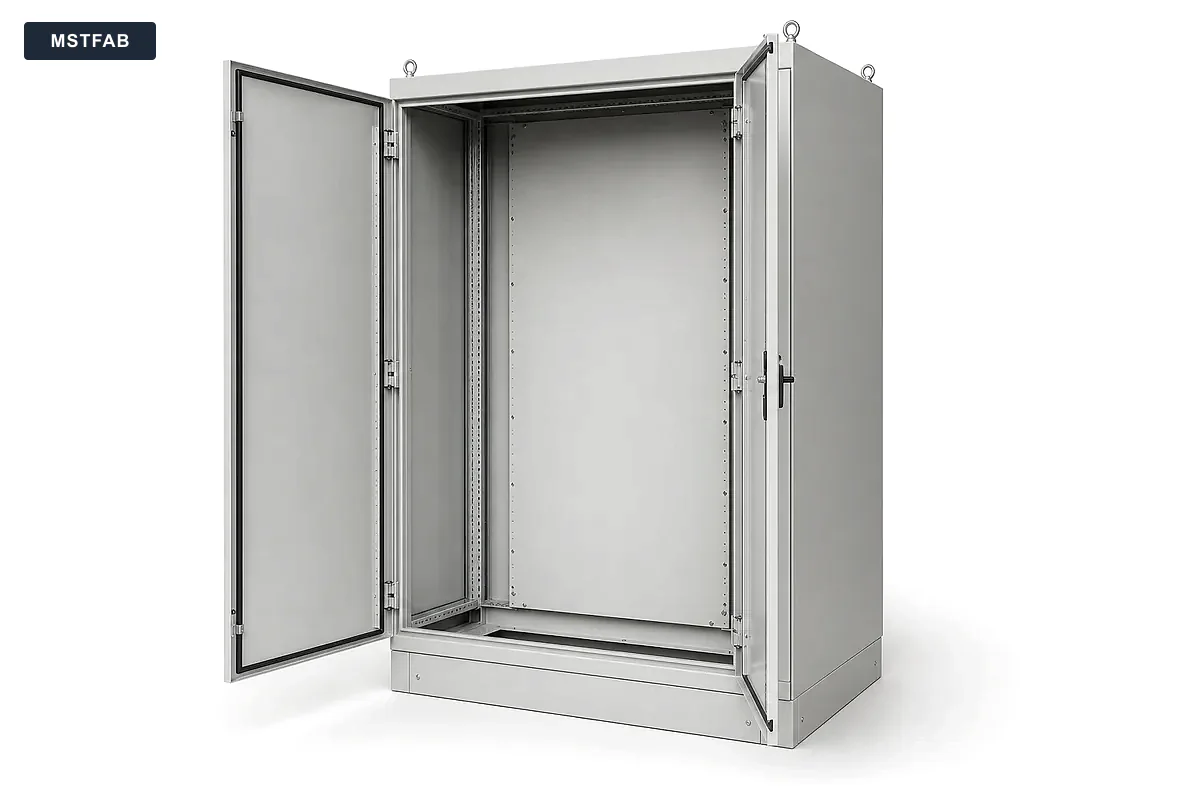
1. Lock the empty-shell scope, load cases and revision
Use one controlled assembly model, 2D drawing set and metal-part list. State the deliverable as an empty power enclosure shell for customer integration. “Power cabinet” can mean either metalwork or a live system; the purchase order must be clearer.
| MSTFAB can supply | Outside MSTFAB scope | Customer owns |
|---|---|---|
| Body, doors, frames, blank plates, partitions, brackets, gland plates and plinths | Busbars, breakers, switchgear, transformers, inverters, power supplies and batteries | Equipment layout, loads, clearances, heat, airflow and architecture |
| Customer-defined openings, PEM hardware, hinges, latches, gasket channels and grounding studs | Wiring, fans, thermal equipment, testing, commissioning and system certification | Grounding, fault behavior, ingress, safety and compliance |
List equipment and door loads, lifting method, center of gravity, mounting, shock and vibration inputs. Keep the STEP model, drawings and purchase order on one revision.
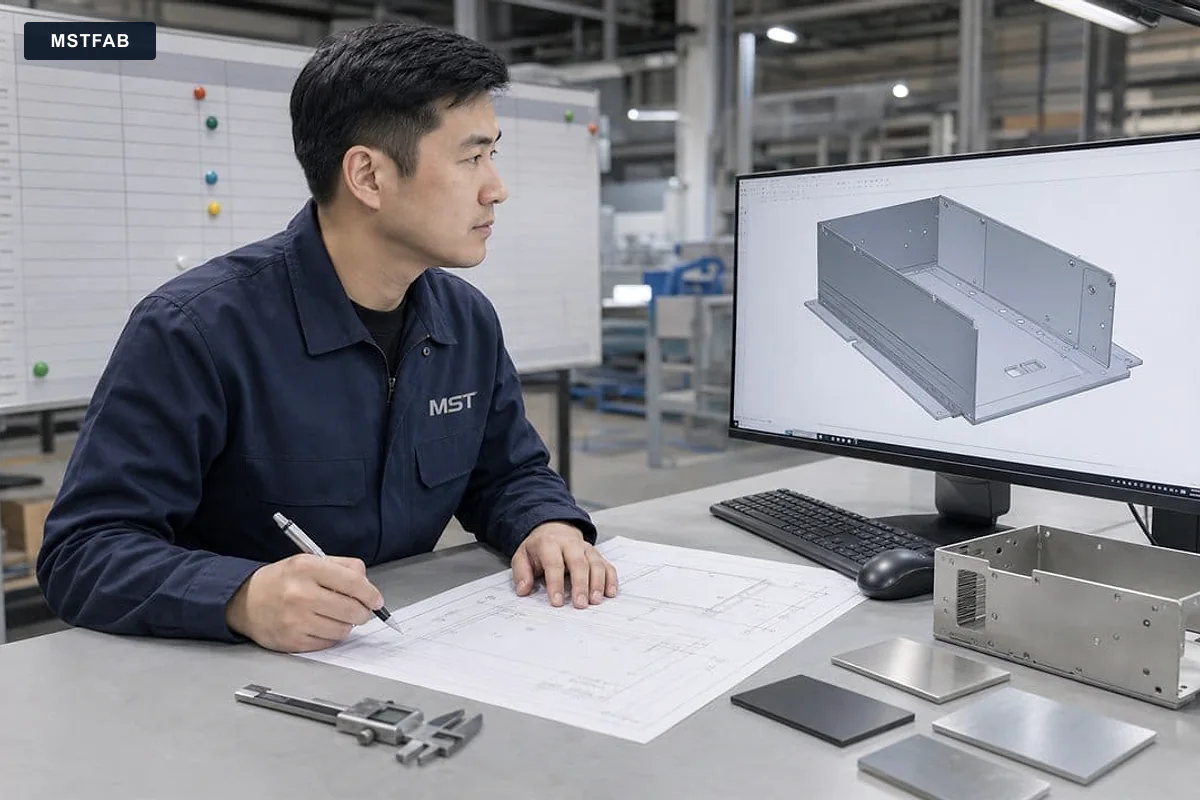
Load inputs to resolve before the shell is quoted
A component’s weight alone does not define its mounting requirements. Record where the load acts, how the enclosure is supported and which configuration the requirement applies to. If an input is missing, mark it as unresolved rather than letting a supplier quietly choose it.
| Buyer-controlled input | What to put in the package | Why fabrication needs it |
|---|---|---|
| Installed equipment | Component identity, mass, center of gravity and controlled mounting drawing | Locates the required support and interfaces without asking the fabricator to select electrical equipment |
| Support condition | Approved floor, wall, plinth or frame attachment arrangement | Defines where the enclosure connects to its supporting structure |
| Operating and service states | Door-mounted equipment, door positions, removable assemblies and applicable project loads | Identifies interfaces that may change when equipment is accessed or replaced |
| Transport and lifting configuration | Whether the shell is empty or populated, the approved handling arrangement and responsible designer | Avoids applying an empty-shell assumption to a populated cabinet |
| Acceptance and validation | Critical dimensions, allowable deformation if applicable, and the required analysis or test plan with a named owner | Separates drawing inspection from proof of performance under load |
Example: a mounting plate fits, but its support still needs review
Illustrative example, not a customer case: A buyer replaces an internal device with a heavier model that uses the same mounting holes. The plate may still pass the original dimensional inspection. That result does not approve the changed load. The responsible designer should review the new component data and support arrangement, then release any revised plate, bracket, frame and validation requirements before production.
Do not add a generic proof load or safety factor from a supplier’s marketing page. Any calculation, load test or lifting procedure must be defined and approved for the actual configuration by the responsible competent party. This checklist collects purchasing inputs; it is not a structural design or lifting instruction.
2. Define load paths and mechanical interfaces
A heavy device does not merely need four holes. Its load travels through plates, rails, brackets and the frame. Define supporting faces, bolt patterns, allowable deflection and tool access.
Dimension cable entries, vents, windows, handles and connector cutouts from stable datums. MSTFAB makes the approved geometry but does not select devices or electrical spacing.
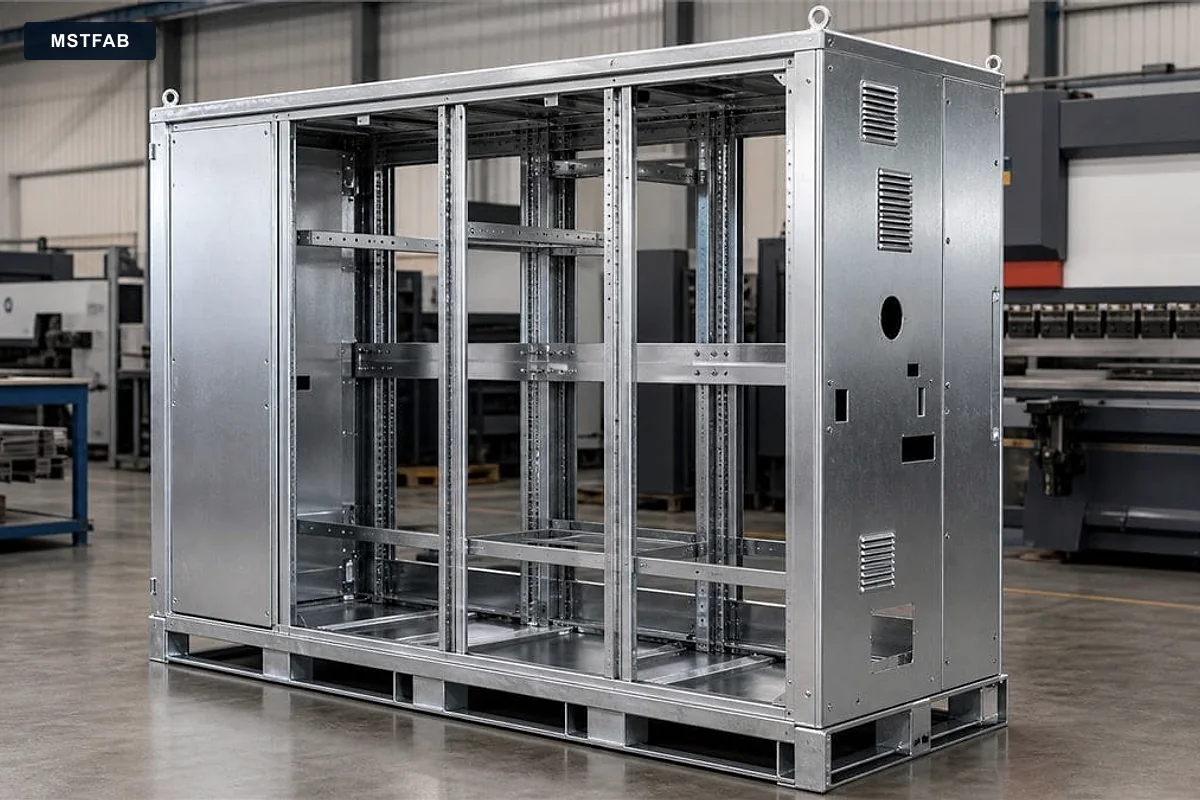
It does not locate mounting holes, loads, clearances or cable openings.
3. Select material, thickness and reinforcement from duty
Specify the material grade, condition, thickness and finish against the actual duty. Carbon steel, coated steel, stainless steel and aluminum are possible routes, not interchangeable guarantees of corrosion resistance or structural performance. Review substitutions, forming requirements and the coating system before release.
Large shells may need welded frames, returns, ribs, gussets or reinforced bases. Heavy doors require suitable hinges and local reinforcement. Electrical segregation remains customer-owned.
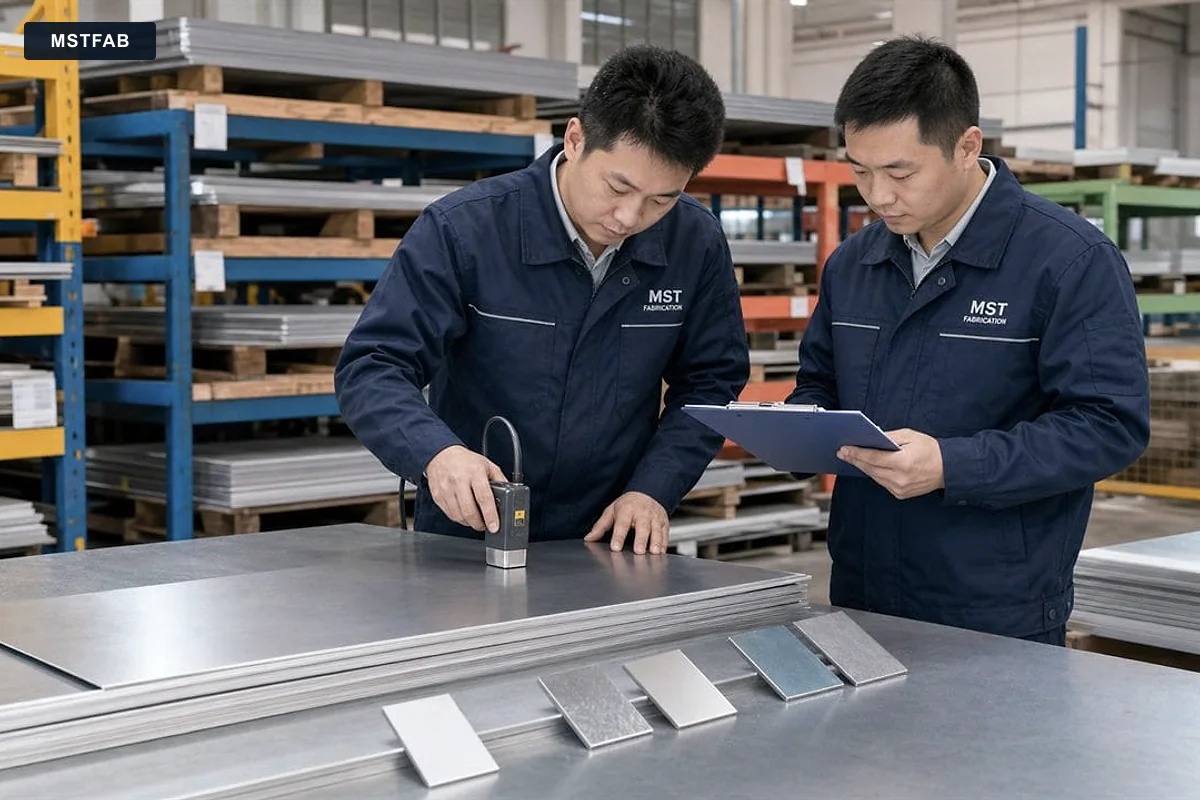
Specify grade, thickness, loads and finish. “Heavy duty” is a mood, not an inspection criterion.
4. Review cutting, bending, welding and hardware access
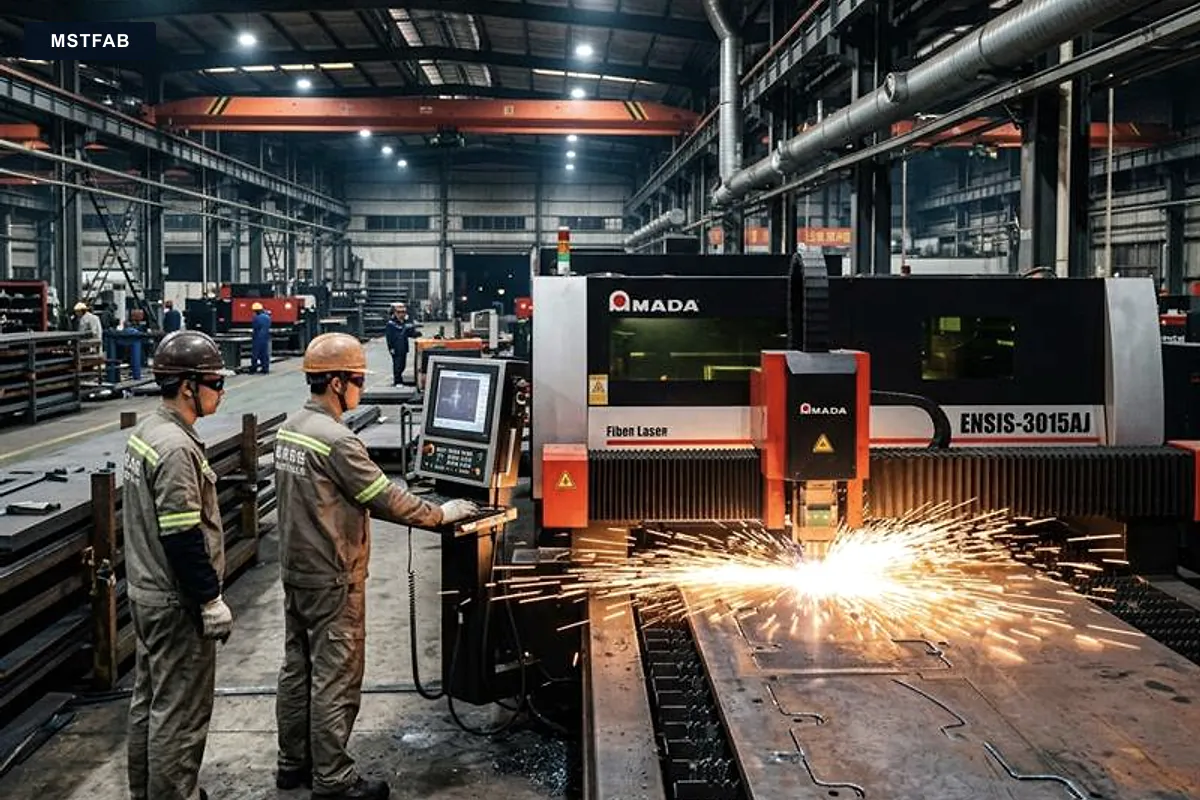
Fiber laser cutting creates blanks, slots, vents and openings. Small holes in thick plate may need drilling, reaming or tapping. Review narrow webs before cutting.
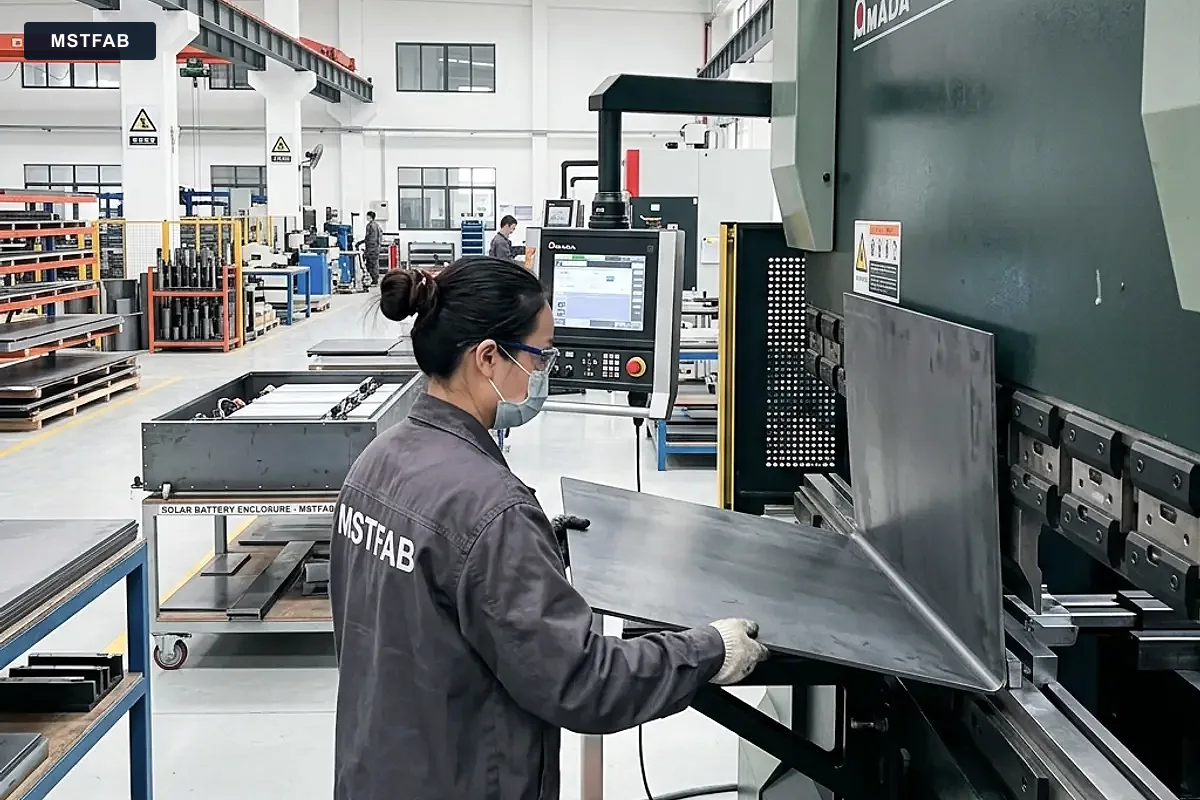
CNC bending forms channels, returns and offsets. Flange length, radius, tooling access and springback affect fit. Measure critical holes from functional faces.
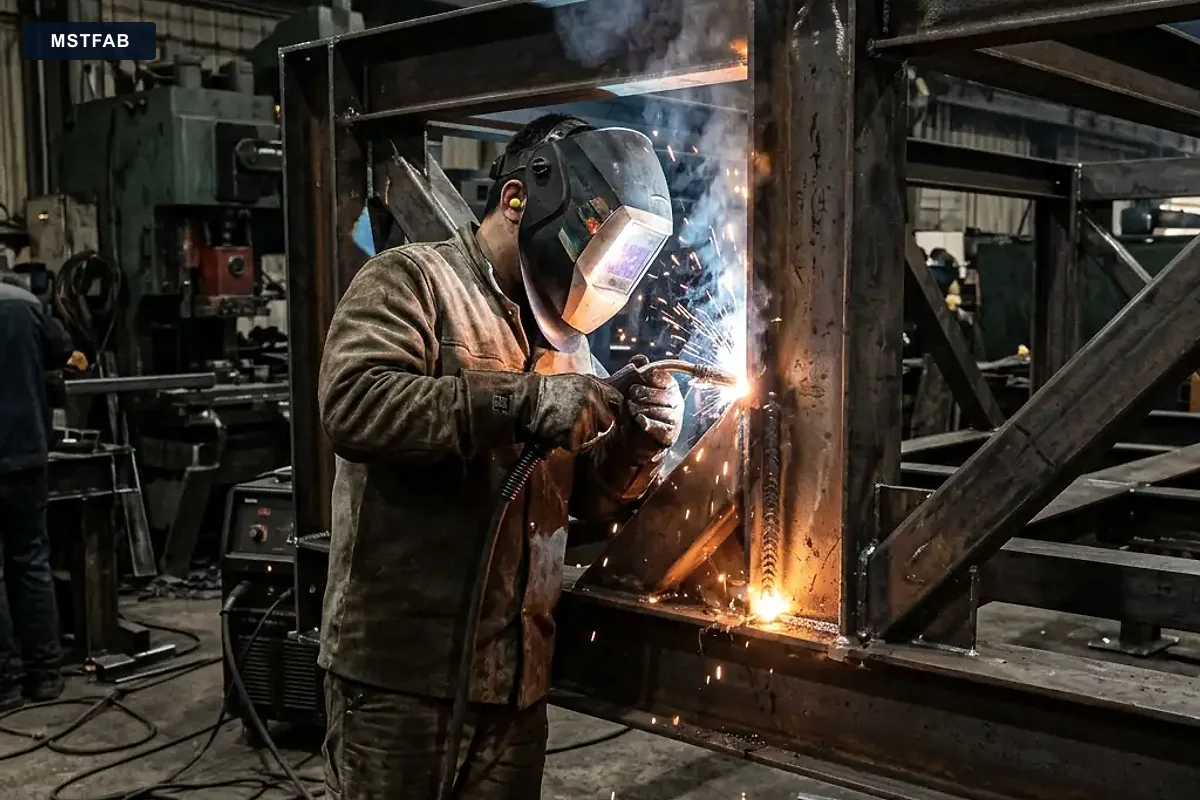
Welded frames need fixtures because heat can pull diagonals, doors and mounting datums. TIG, MIG or spot welding follows the drawing.
Plan PEM nuts, studs, hinges and latches with the bend and weld sequence. Hardware is useless if its installation tool cannot reach.
5. Specify finish, grounding zones and sealing interfaces
For powder coating, define pretreatment, color, texture, gloss, visible faces, masking and cosmetic limits. Mask ground zones, threads and sensitive fits. “Industrial gray” is not a finish specification.
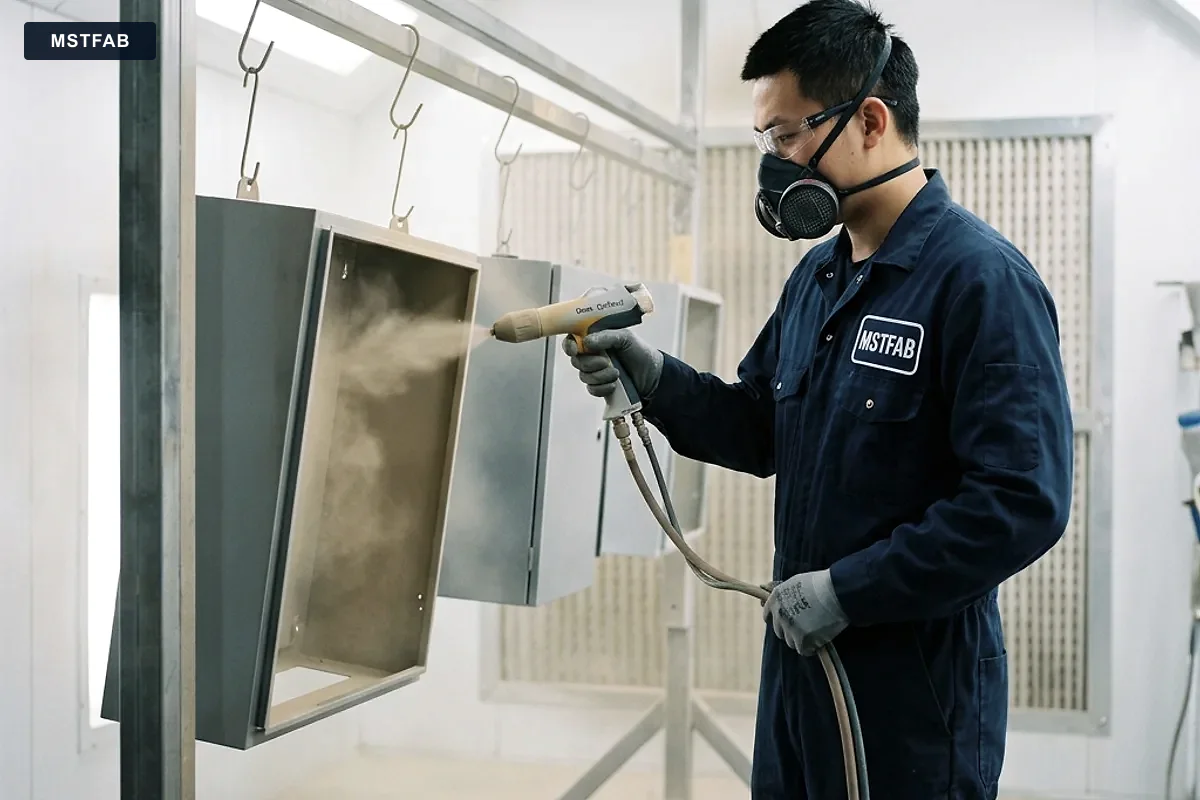
MSTFAB can install specified grounding studs and fabricate gasket channels, rain features and gland plates. The customer validates bonding and the finished system. An empty shell alone does not guarantee an IP, NEMA or safety rating.
- Pretreatment and coating system
- Color, gloss and texture
- Masked ground zones and threads
- Door gap and latch engagement
- Gasket channel geometry
- Cosmetic surface limits
6. Require first-article evidence and export-safe packing
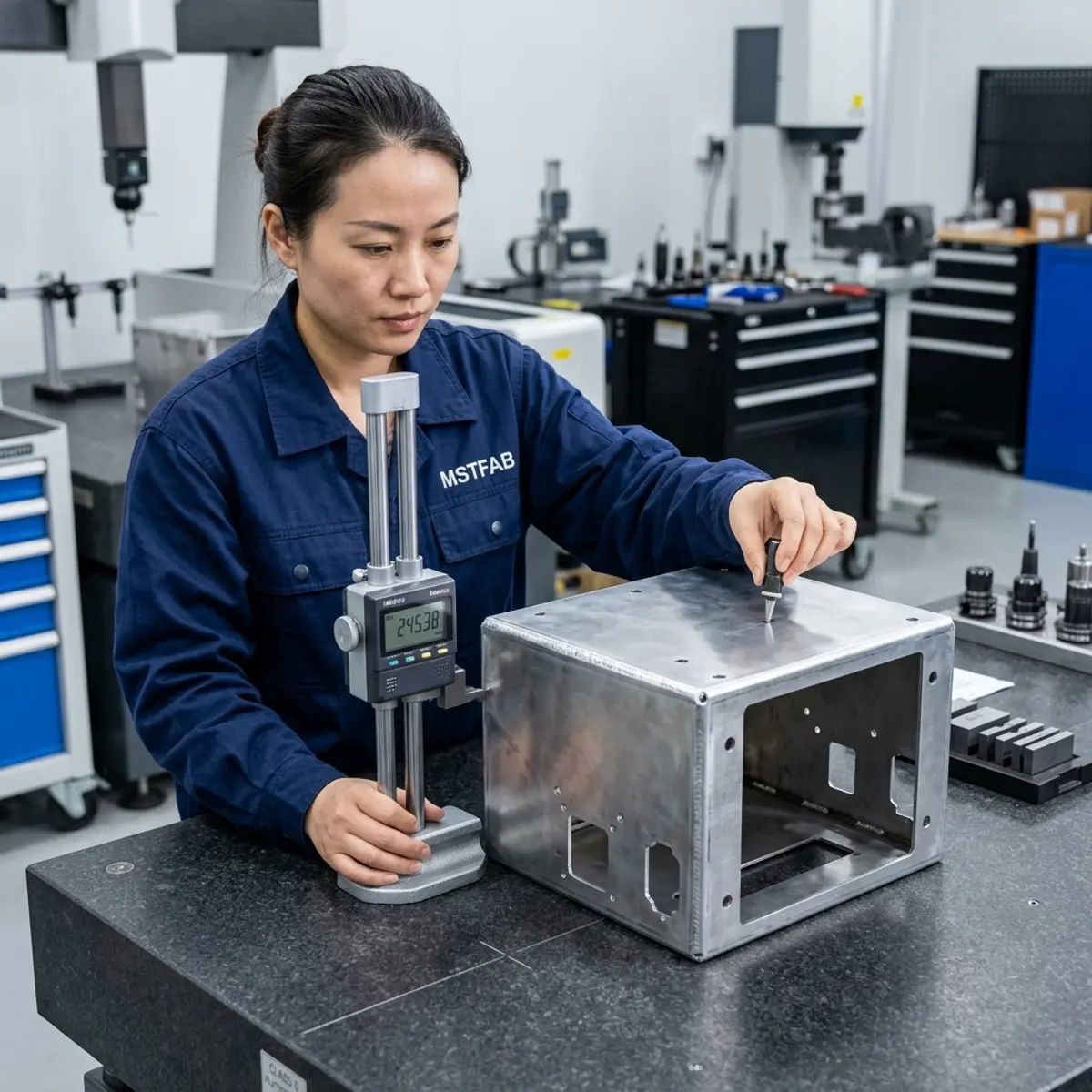
First-article dimensional inspection can record frame squareness, attachment-feature locations, mounting datums, doors, cutouts, partitions, hardware and coated clearances. Define the measurement methods before quotation. Measuring a lifting attachment or support feature does not prove its capacity; any required structural analysis or load testing needs a separate approved plan.
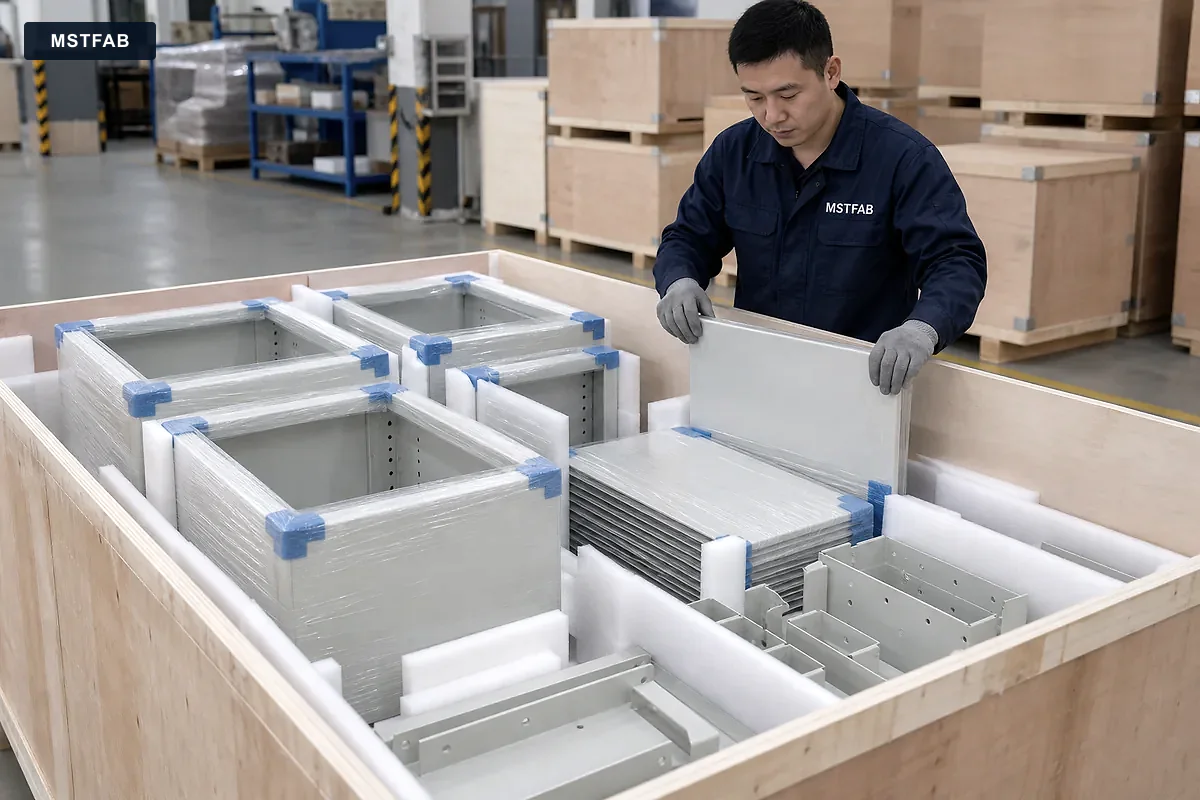
For repeat work, retain the revision, fixtures, checks and packing method. Label loose parts, separate coated surfaces and block heavy frames. A loose bracket can sign every panel during one ocean voyage.
| Quote checkpoint | Supplier should state | Buyer value |
|---|---|---|
| Scope | Included metal and hardware | Comparable quotes |
| Process | Material, forming, weld and finish | No missing operations |
| Evidence | First-article records | Reviewable quality |
What to send for a useful power enclosure RFQ
- STEP assembly and part models
- Controlled drawings and revisions
- Material and thickness
- Loads and mounting
- Datums and tolerances
- Interface drawings
- Weld and hardware
- Finish and masking
- Quantities
- Inspection and destination
Before quotation, identify who releases load inputs and who approves the finished assembly. Keep unresolved requirements visible in the quotation rather than treating them as included by default.
Frequently asked questions
Does MSTFAB manufacture a complete power system?
No. MSTFAB supplies the empty shell and agreed mechanical hardware. The customer integrates the equipment.
Can MSTFAB make device mounting features?
Yes, as customer-defined holes, rails, brackets or blank plates. MSTFAB does not select the devices.
Can MSTFAB guarantee an IP or NEMA rating?
No rating follows from an empty shell alone. The product owner validates the completed assembly.
Which materials are common?
Cold-rolled or galvanized steel, stainless steel 304 or 316, and aluminum 5052 or 6061 are common choices.
What is needed for quotation?
Send models, drawings, loads, material, interfaces, finish, quantity and inspection needs.
Send the empty-shell drawing package
Share the model, drawings, loads, material, interfaces, finish and inspection needs.
 WeChat Contact
 WhatsApp Me Directly