
Industrial custom metal parts do not get forgiven easily. A bracket with the wrong hole pattern stops assembly. A cabinet door that does not seal becomes a warranty story. A guard panel with sharp edges turns into a safety headache. And a powder-coated cover that arrives scratched? That is not “shipping character.” That is a problem with a tracking number.
Quick answer: MSTFAB provides custom metal fabrication services for industrial sheet metal parts such as enclosures, cabinet shells, access panels, machine guards, protective covers, mounting plates, brackets and welded frames. OEM buyers should check drawing revision, fabricated scope, material, thickness, DFM risk, tolerances, hardware, finish, inspection and export packaging before releasing an RFQ or PO.
Scope note: MSTFAB fabricates sheet metal parts and mechanical metal structures from your drawings. We do not supply finished industrial machines, finished electrical equipment, electronics, wiring, batteries, motors, PLC systems, certified end products or assembled working devices. We build the metal shell, frame, guard, cover or bracket. The final machine belongs to your engineering and integration team.
What We Mean by Custom Metal Fabrication Services
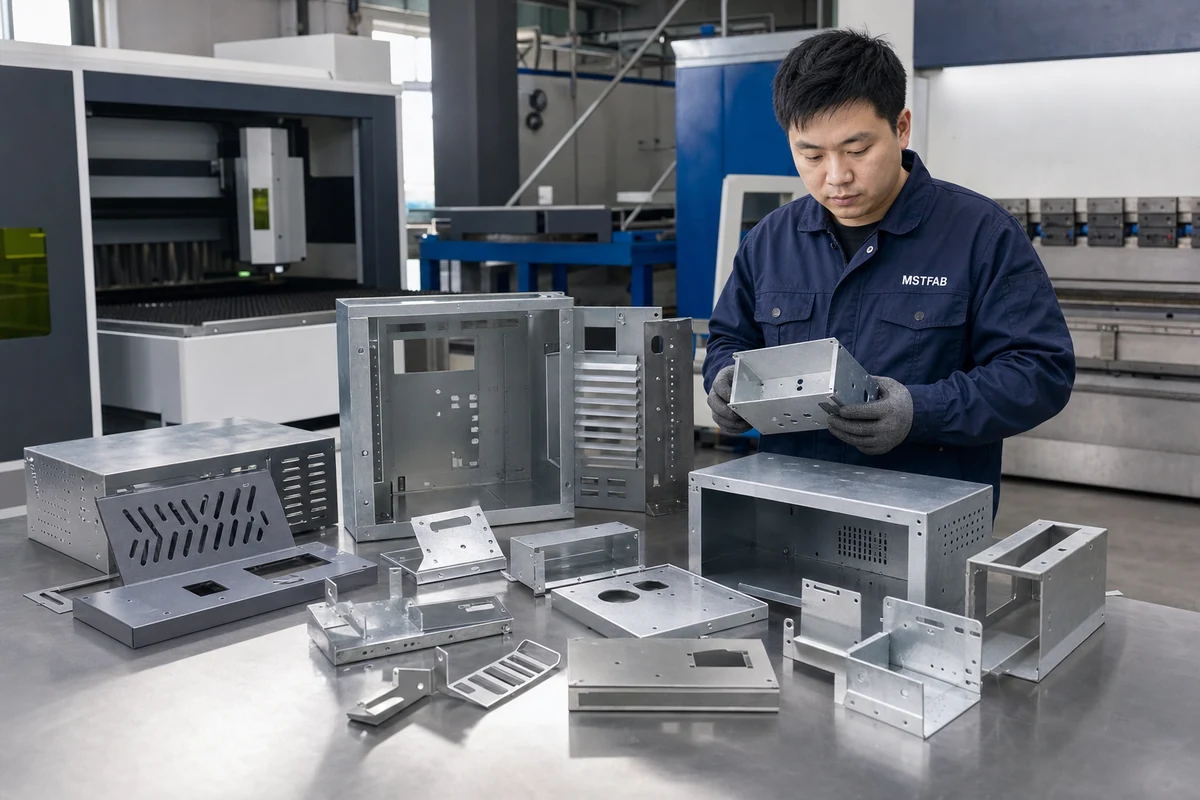
Custom metal fabrication services sound broad because they are broad. That is the problem. Some suppliers mean machining. Some mean welding. Some mean complete machines. At MSTFAB, this page is about drawing-based industrial sheet metal fabrication: cutting, bending, welding, hardware installation, finishing, inspection and packaging for fabricated metal parts.
Typical parts include industrial enclosure bodies, control cabinet shells, operator console housings, machine guards, belt covers, access doors, louvered panels, mounting plates, reinforcement brackets, welded frames, base plates and equipment covers. They are not finished electrical products. They are the metal structures that let your product become one.
That distinction matters for quoting. A bare enclosure shell, a powder-coated cabinet with hinges, and a fully wired electrical control cabinet are three very different things. If the quote does not state the boundary, the boundary will appear later as a delay, an argument, or a surprisingly energetic invoice.
Industrial Parts MSTFAB Fabricates
Industrial Enclosures and Cabinet Shells
We fabricate enclosure bodies, door panels, side panels, back plates, cable entry plates, ventilation panels, internal mounting plates, hinge brackets and lock plates. The key details are fit, door alignment, gasket surface, mounting-hole accuracy, finish protection and repeatability.
Machine Guards and Protective Covers
Machine guards, belt covers, chain covers, fan guards and removable access covers protect operators and equipment. Good guards need safe edges, accurate mounting slots, service clearance, ventilation and stiffness. A guard that rubs a belt is not guarding much except your schedule from success.
Mounting Plates, Brackets and Structural Sheet Metal Parts
Industrial equipment uses many “simple” brackets. Simple is dangerous. A bracket may look like a folded rectangle, but it controls hole alignment, load path, vibration behavior and assembly speed. For brackets and mounting plates, the drawing should state material, thickness, critical holes, bend direction and finish.
Welded Frames and Support Assemblies
Welded sheet metal frames and support structures need fixture control and distortion planning. Welding heat moves metal. Pretending otherwise is a brave way to make a crooked part. For welded industrial structures, we check seam location, fixture access, flatness, squareness and post-weld finishing.
Trust Table for OEM Buyers
| Buyer concern | Evidence to request | Why it matters |
|---|---|---|
| Will the supplier build the correct part? | Drawing revision, file list and confirmed RFQ scope. | Industrial projects often have multiple drawing versions. Wrong file, wrong part. |
| Is this a fabricated metal part or a finished machine? | Written scope: shell, panel, frame, bracket, finish, hardware and exclusions. | Prevents confusion between metal fabrication and complete equipment supply. |
| Will holes and interfaces align? | Critical dimensions, tolerance table and first article inspection plan. | Assembly failures usually start with one “small” dimension nobody checked. |
| Will the finish survive real use? | Finish spec, color/sample, coating thickness, masking and packaging photos. | Industrial parts face handling, oil, dust, vibration and shipping abuse. |
| Can the supplier repeat the part? | Process route, fixture plan, inspection report and batch photos. | A nice sample is useful only if the repeat batch follows the same rules. |
Start With the Drawing, Not the Sales Pitch
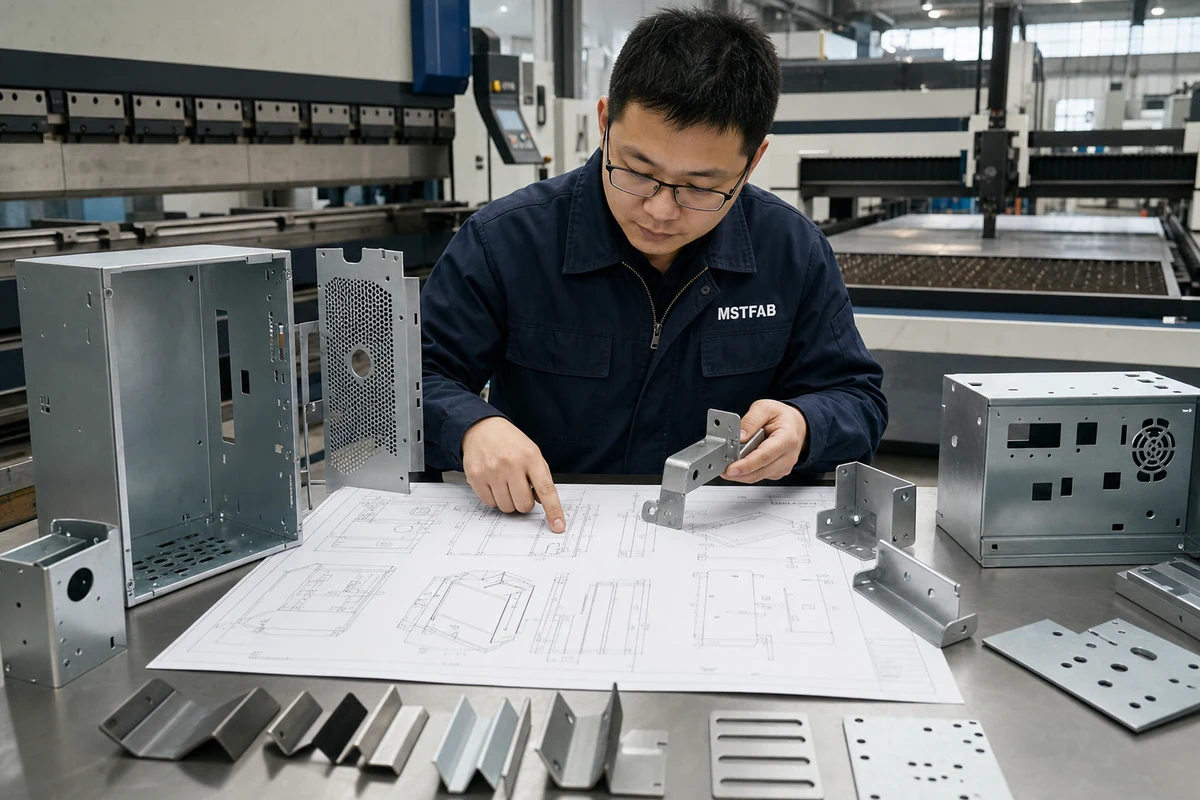
A strong RFQ begins with the drawing package. Send a PDF drawing and a 3D model, then clearly state material, thickness, finish, quantity, critical dimensions, hardware list, packaging and destination. If something is undecided, say so. Honest uncertainty is easier to manage than hidden assumptions.
Useful RFQ files include STEP, PDF drawings, BOM/hardware list, finish notes, assembly images and packaging requirements. If the part is replacing an existing guard, cover or enclosure, photos of the old part can also help, but the controlled drawing should still win. Photos are helpful. Photos are not dimensions with better lighting.
DFM Checks That Save Money
Design for manufacturability is not a fancy consultant phrase. It is the reason a part bends cleanly, welds without warping and assembles without your team reaching for a drill. For industrial sheet metal parts, DFM usually means checking bend radius, hole-to-bend distance, flange length, cutout location, weld access, hardware access and finish masking.
For detailed design rules, use DFM Design Rules for Sheet Metal Parts. In short: keep holes away from bend lines, avoid impossible sharp radii, add reliefs where needed, and mark the dimensions that actually matter. Tightening every dimension “just to be safe” is not safe. It is expensive confidence cosplay.
Material and Thickness Are Not Details
Material choice controls strength, corrosion resistance, weight, forming behavior and cost. “Steel” is not enough. SPCC, SGCC, stainless 304/316 and aluminum 5052/6061 behave differently in bending, welding and finishing. Thickness also changes everything: stiffness, bend force, hole quality, weight and freight cost.
For industrial sheet metal enclosures and guards, buyers should confirm grade, thickness, surface condition, certificate requirements and whether substitutions are allowed. If a supplier silently changes material to lower price, you did not save money. You bought a surprise with sharp edges.
Laser Cutting: Where Accuracy Starts
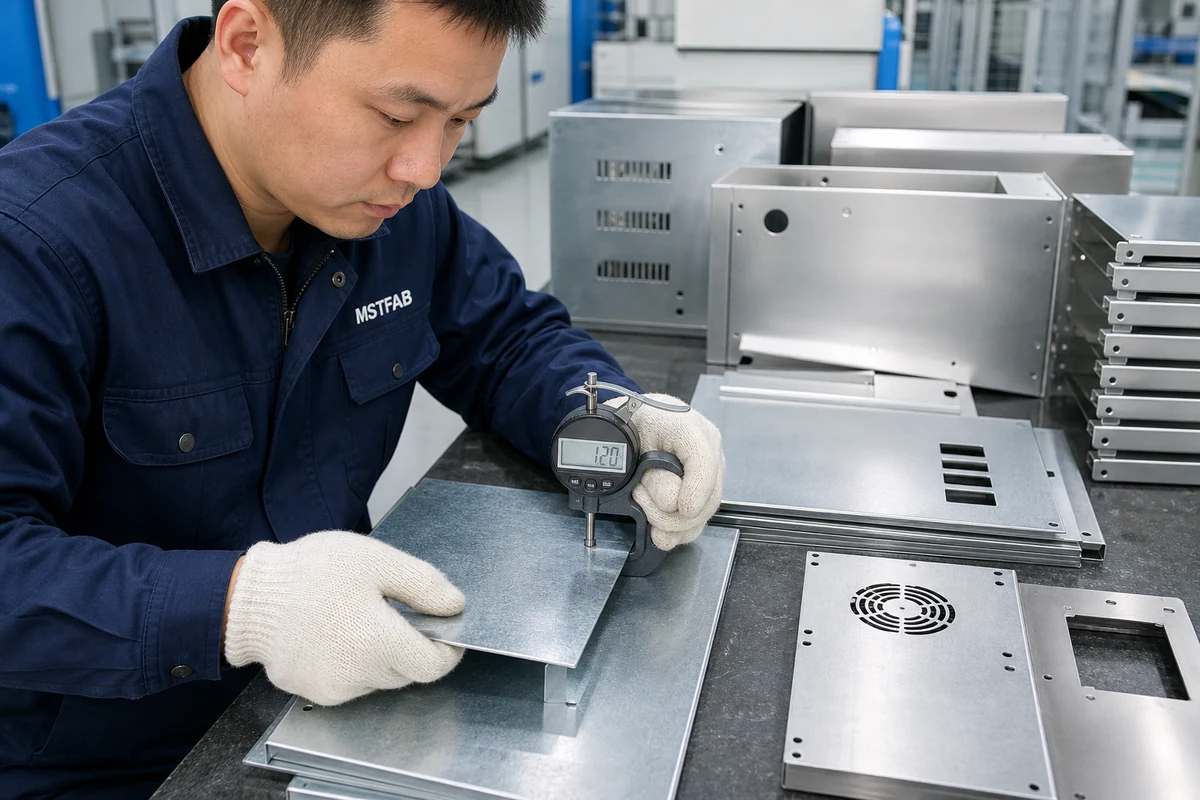
Laser cutting is usually the first manufacturing step for custom industrial panels, doors, covers and brackets. It controls hole patterns, slots, ventilation openings, cable entries, louvers, cutouts and the blank shape that later becomes the bent part.
Buyers should define which cut features are critical. Mounting holes, hinge locations, latch cutouts, gland plates, louver positions and mating slots often deserve tighter control than cosmetic outer edges. A supplier should also check whether very narrow slots, dense perforations or sharp internal corners create cost or distortion risk.
CNC Bending: Where Flat Drawings Become Real Parts
Bending is where the drawing becomes three-dimensional and the old assumptions come out to introduce themselves. Bend radius, tooling, bend order, flange length and material grain direction can affect final fit. This matters for cabinet shells, access covers, brackets, guard panels and internal mounting structures.
Good suppliers check bend feasibility before production. Better suppliers explain what needs to change and why. The best ones make you feel slightly annoyed for five minutes and save you a week of rework. That is a fair trade.

Welding and Fixture Control
Welding is often necessary for frames, support tabs, reinforced brackets and industrial cabinet structures. It also introduces heat distortion. A welded frame that is square on the drawing can become a geometry lesson if the fixture is poor or the weld sequence is wrong.
For welded industrial sheet metal parts, ask how the supplier controls fit-up, seam location, squareness, grinding, cosmetic areas and post-weld inspection. Continuous welds are not always better. Sometimes intermittent welds, symmetric welding and fixture planning give stronger real-world results with less distortion.

Hardware, Gaskets and Mechanical Assembly Scope
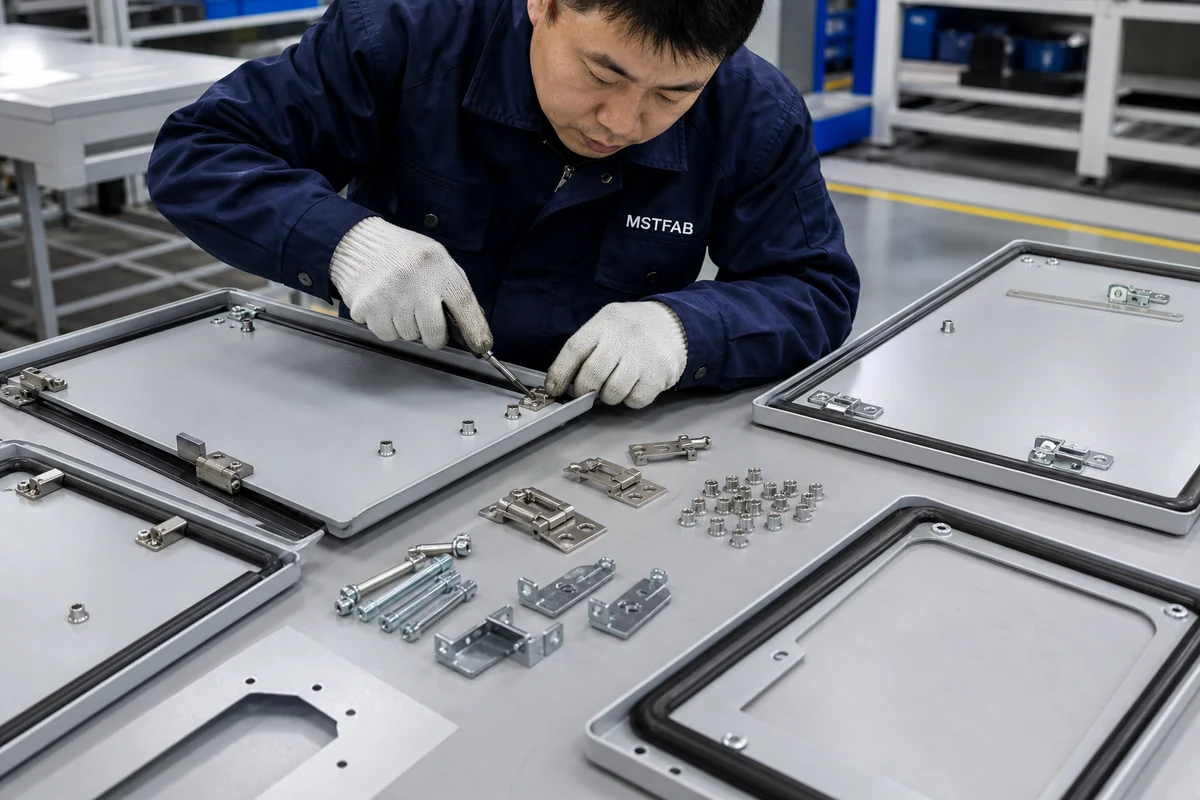
Many industrial parts are not just cut and bent. They need PEM nuts, studs, rivet nuts, hinges, handles, latch plates, grounding points, rubber gaskets, inserts or labels. These details should be part of the quote, not a late-night discovery.
Write who supplies each hardware item, who installs it, and how it will be checked. A missing insert can stop assembly as effectively as a missing door. It just does it with less drama and more emails.
Surface Finish for Industrial Parts
Surface finish affects corrosion resistance, appearance, touch safety and assembly. Powder coating is common for steel industrial enclosures and guards. Stainless may be brushed, passivated or left with a controlled finish. Aluminum may be powder coated or anodized depending on the project.
Do not write “paint black” and hope for the best. Define RAL color, gloss, texture, film thickness, masking, sample approval and cosmetic surfaces. If threads, gasket surfaces or grounding points need protection, write that down before coating. For finish decisions, see Sheet Metal Surface Finishing Guide.

Quality Control: What Should Be Checked
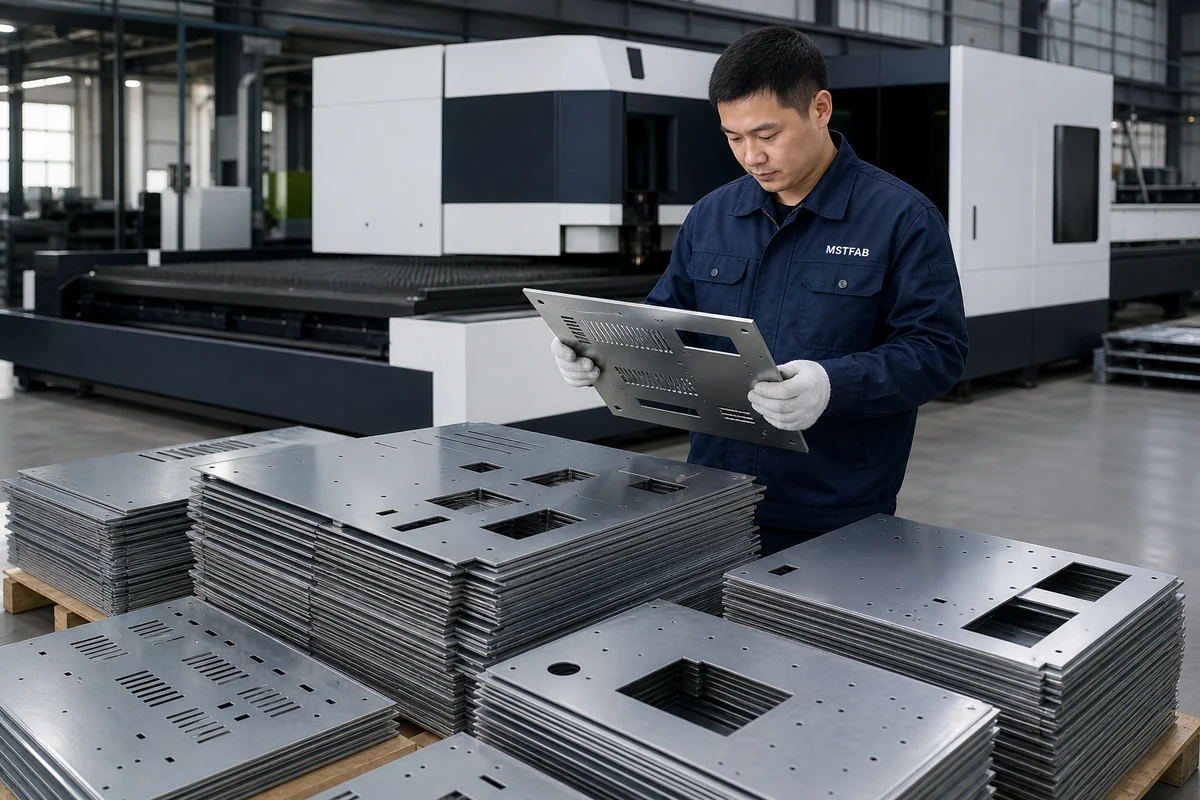
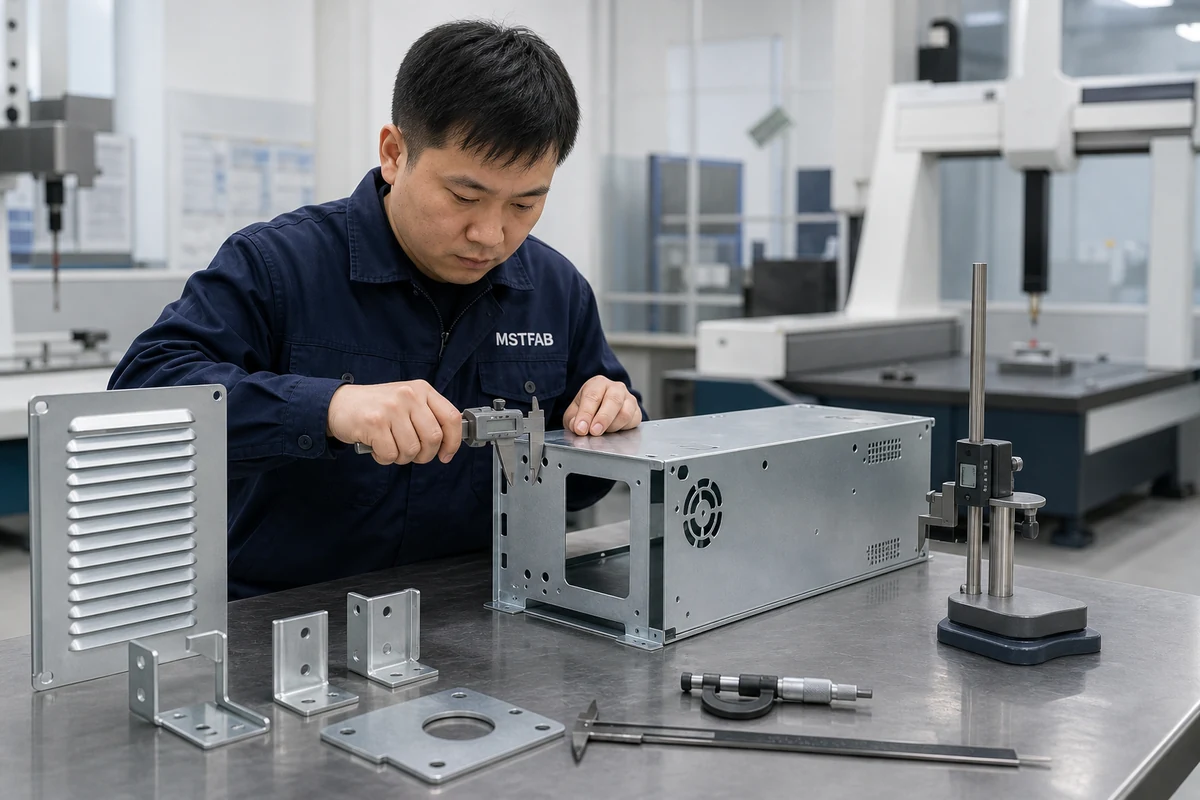
Industrial buyers do not need inspection theater. They need useful evidence. For first orders or revised drawings, request first article inspection on critical features. For repeat batches, define sampling, critical dimensions and cosmetic criteria. The goal is not to measure everything; the goal is to measure what can hurt you.
Critical checks often include hole position, flange height, door fit, panel flatness, squareness, weld location, finish thickness, hardware installation, gasket contact and packaging condition. For inspection vocabulary, read Sheet Metal Quality Control: FAI, CMM & SPC Explained.
Export Packaging: The Last Quality Gate
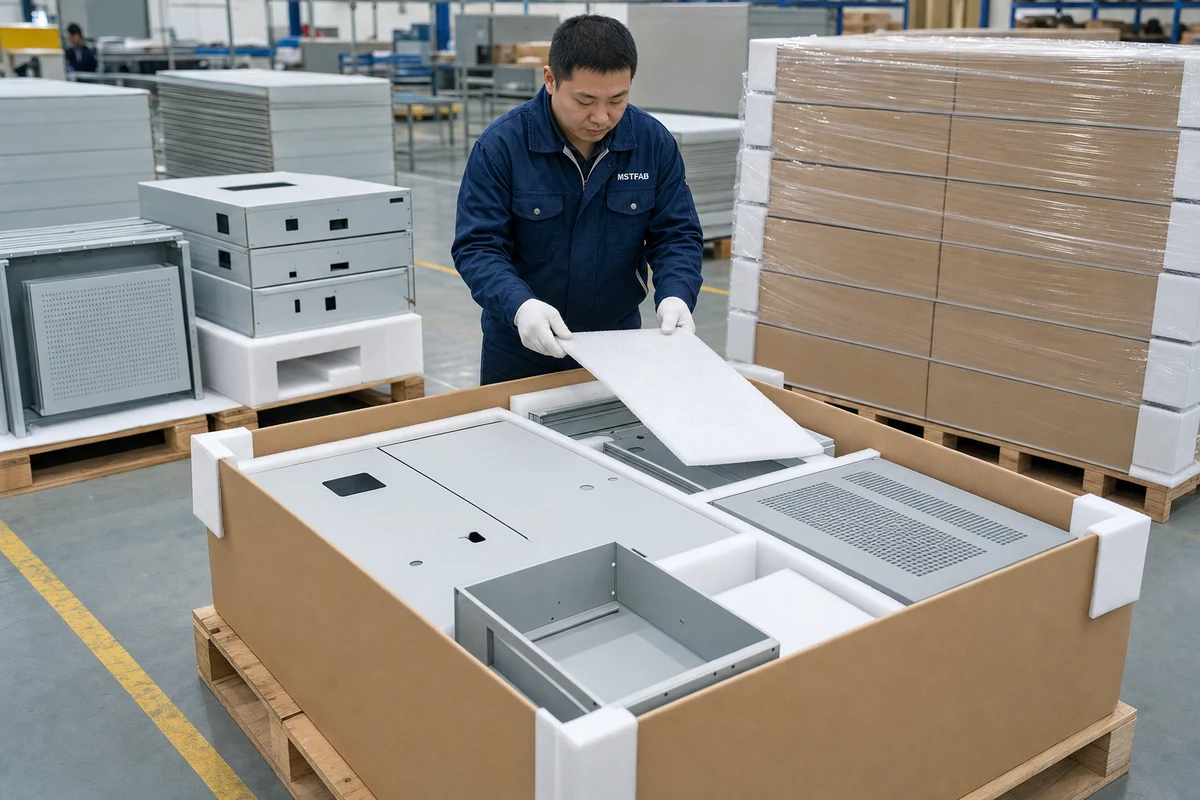
Packaging is not decoration. It is part of the product journey. Industrial sheet metal parts often have sharp corners, cosmetic surfaces, hinges, gaskets and powder-coated panels that can rub during transport. If the packaging is weak, your parts may pass QC and fail the boat ride.
Ask for foam separation, corner protection, surface film, carton or pallet plan, label rules and packing photos before shipment. For heavy or large cabinet shells, confirm pallet strength and how the parts are fixed inside the package. Freight is not gentle. It has never read your drawing.
How to Compare Quotes Without Getting Fooled
A low unit price can hide missing scope. Compare quotes line by line: material, thickness, cutting, bending, welding, hardware, finish, inspection, packaging, Incoterm and lead time. If one quote is much cheaper, ask what is excluded. The missing line item is usually where the trouble is sleeping.
For a deeper quote review, use How to Read a Sheet Metal Quote (And Spot Hidden Costs). The short version: compare total delivered scope, not just the unit number that looks good in a spreadsheet.
Red Flags for Industrial Buyers
- The supplier quotes without asking about material, finish or drawing revision.
- The quote does not state whether the scope is a fabricated metal shell or a finished product.
- Critical dimensions are not discussed before production.
- Welded frames are quoted with no fixture or distortion control plan.
- Surface finish is vague, especially for visible or outdoor parts.
- Hardware installation is assumed but not itemized.
- Packaging is missing from an export order.
- The supplier says every tolerance is easy but cannot explain the inspection method.
What MSTFAB Needs for a Clear RFQ
To quote industrial sheet metal parts clearly, send us:
- PDF drawing and 3D model with revision number.
- Material grade, thickness and finish requirement.
- Quantity now and expected repeat quantity later.
- Critical dimensions and assembly interfaces.
- Hardware list: PEM nuts, studs, hinges, latches, handles, gaskets or labels.
- Inspection needs: FAI, dimensional report, cosmetic standard or photos.
- Packaging needs and destination country.
If your project includes electronics, wiring, certification or a finished machine, separate that scope from the fabricated metal part. Clear boundaries make quotes faster, cheaper and much less haunted.
Key Takeaways
Custom metal fabrication services for industrial parts should reduce assembly risk, not create mystery. The useful supplier does more than cut and bend metal. They check the drawing, name the material, explain DFM risks, control welding and bending, verify critical dimensions, protect the finish and pack the parts for real shipping conditions.
MSTFAB focuses on custom industrial sheet metal fabrication: enclosures, cabinet shells, guards, covers, access panels, mounting plates, brackets and welded structures. If that is what your drawing needs, send your drawing to MSTFAB for review.
Frequently Asked Questions
What custom metal fabrication services does MSTFAB provide?
MSTFAB provides laser cutting, CNC bending, welding, hardware installation, finishing, inspection and export packaging for custom industrial sheet metal enclosures, guards, panels, brackets, covers and welded structures.
Does MSTFAB make finished industrial equipment?
No. MSTFAB fabricates the sheet metal shell, frame, cover, guard, bracket or cabinet structure. We do not supply finished machines, electronics, batteries, wiring, PLC systems or certified end products.
What files should I send for an industrial sheet metal RFQ?
Send a PDF drawing, 3D model, revision number, quantity, material, thickness, finish, hardware list, critical dimensions, packaging needs and destination. More clarity at RFQ stage means fewer expensive surprises later.
How do I know if an industrial sheet metal supplier is reliable?
Look for evidence: DFM feedback, itemized quote, material confirmation, inspection plan, photos of key stages, finish checks and packaging photos. A reliable supplier gives proof before you have to ask three times.
Can MSTFAB handle low-volume and repeat batch orders?
Yes. MSTFAB supports prototypes, pilot runs, low-volume batches and repeat production for custom sheet metal parts. For smaller quantities, see Low Volume Sheet Metal Fabrication Supplier for Prototype Runs.
Why is surface finish so important for industrial metal parts?
Finish affects corrosion resistance, appearance, touch safety, grounding, gasket sealing and shipping durability. Poor masking or weak coating can turn a good fabricated part into a reject after assembly or transport.
 WeChat Contact
 WhatsApp Me Directly