
The Short Answer
Reliable custom furniture connectors and structural hardware brackets depend on locked hole-to-bend datum control, burr-free countersinks that seat fasteners flush, and impact-resistant powder coating or electroplating. Cheap hardware brackets ruin premium furniture assemblies when manual punching drifts hole pitches out of alignment, uncompensated springback throws 90-degree corners off square, or thin paint chips during screwdriver installation.
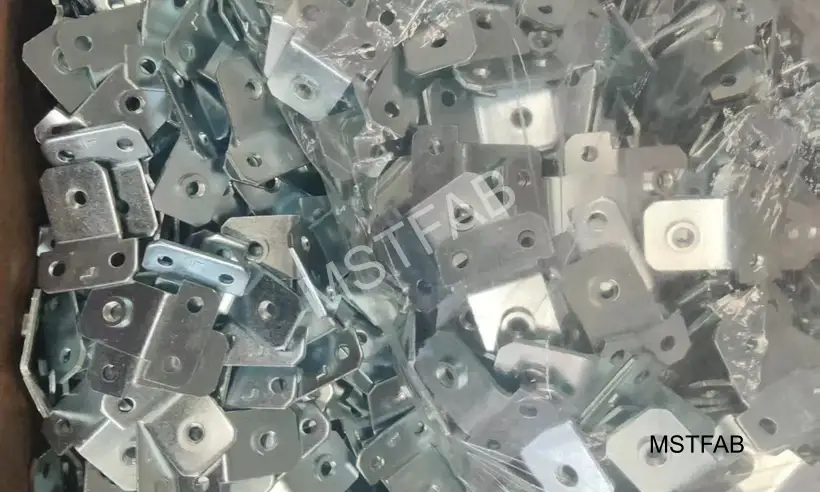
Explore this guide
01 / Structural Load and Gauge Selection
Prevent joint wobble by matching steel thickness and rib geometry to cantilever loads.
Whether you manufacture modular commercial office desks, upholstered sofa frames, architectural shelving, or heavy timber pergolas, the structural stiffness of the entire product rests on its metal connectors. When a bracket flexes under load, wood screws loosen and mitered joints gap open.
Before releasing drawings for a custom iron connector leg or mounting bracket, pair the right steel grade (SPCC, SPHC, Q235B, Q355B, or 304 stainless) with formed geometry that resists bending moments.
Embossed corner stiffening darts
Stamping a triangular gusset dart across the 90-degree bend line increases bracket bending stiffness by up to 3x without adding bulky welded gusset plates.
Heavy-gauge structural iron (3.0–8.0 mm)
Ideal for exposed timber-frame post bases, cantilever shelf brackets, and sofa leg mounting plates that carry high static and dynamic shear loads.
Precision thin-gauge cleats (1.2–2.5 mm)
Used for French cleats, concealed Z-hangers, drawer slides, and interlocking modular cabinet clips requiring tight nesting clearance.
Springback and squareness rule: For exposed furniture corner brackets, a 91.5-degree bend instead of a true 90.0-degree +/-0.5-degree bend rocks visibly against flat wood panels. Always specify angular tolerance on mating flanges.
02 / Stamping vs. Fiber Laser and CNC Bending
Select the right manufacturing route for your batch volume and tolerance.
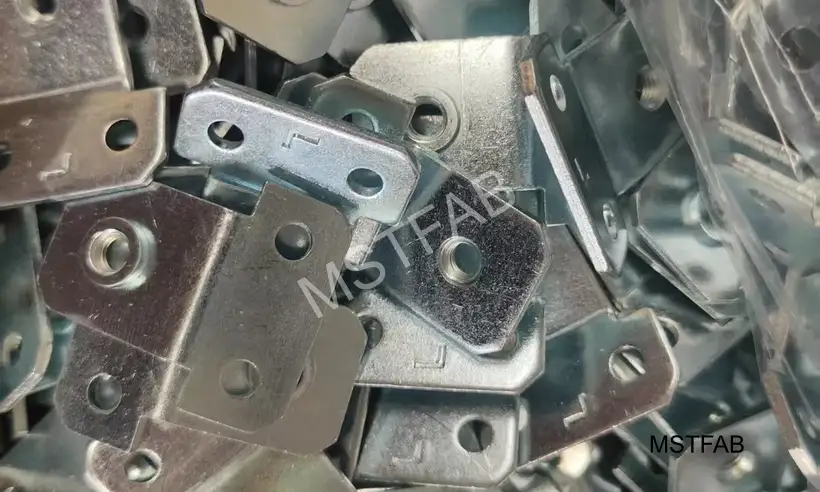
Low-tier hardware workshops often punch holes manually on single-station presses and bend flanges against makeshift backstops—resulting in hole-to-bend drift of 1.5 mm or more across a batch. When your automated CNC woodworking router drills pilot holes in a tabletop, inconsistent metal brackets bring assembly to a halt.
- Fiber laser cutting + CNC press brake forming (50 to 3,000 pcs): Zero hard-tooling cost, rapid design iteration, and +/-0.1 mm laser hole-pitch accuracy paired with optical-angle-controlled press brakes.
- Progressive or compound die stamping (5,000 to 100,000+ pcs): Hard-tooled dies blank the perimeter, pierce holes, coin countersinks, and form embossed stiffening ribs in a single high-speed press stroke for lowest unit cost.
- Hybrid laser-blank + dedicated forming die: Combines tool-free fiber laser blanking with a compact custom forming/embossing die to form complex U-channels, offsets, or curl hinges economically.
Our CNC sheet metal bending services and stamping presses are calibrated using locked flat-pattern K-factors so hole patterns align on both legs of an L- or U-bracket.
03 / Countersinks, Keyhole Slots and Fasteners
Engineer flush screw seating, burr-free edges, and captive threads.
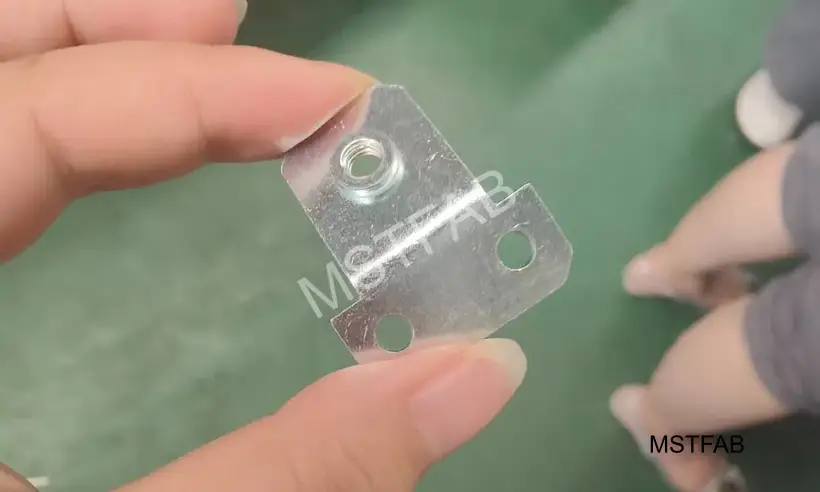
In furniture and retail fixture hardware, the interaction between the fastener head and the bracket surface determines both structural grip and consumer safety. Raised burrs or shallow countersinks cause screw heads to stand proud, scratching adjacent wood veneers or tearing upholstery fabric.
- Machine or coin 82-degree (UNC) or 90-degree (metric ISO) countersinks to controlled depth so flat-head wood and machine screws sit 0.1 mm to 0.3 mm below the top surface.
- Condition all perimeter edges via vibratory ceramic tumbling or rotary brush deburring so installers and end-users never encounter razor-sharp stamped burrs.
- Install self-clinching nuts (PEM), blind standoffs, extruded tapped holes, or projection weld nuts for knock-down (KD) flat-pack furniture requiring repeatable Allen-bolt assembly.
Validating countersink diameters, keyhole slot teardrops, and thread pull-out loads on first-article samples ensures trouble-free flat-pack assembly by your end customers.
Explore precision fiber laser cutting for custom hardware blanks →
04 / Cosmetic Finishing for Visible Hardware
Deliver chip-resistant matte black powder coat, brushed brass, or zinc plating.
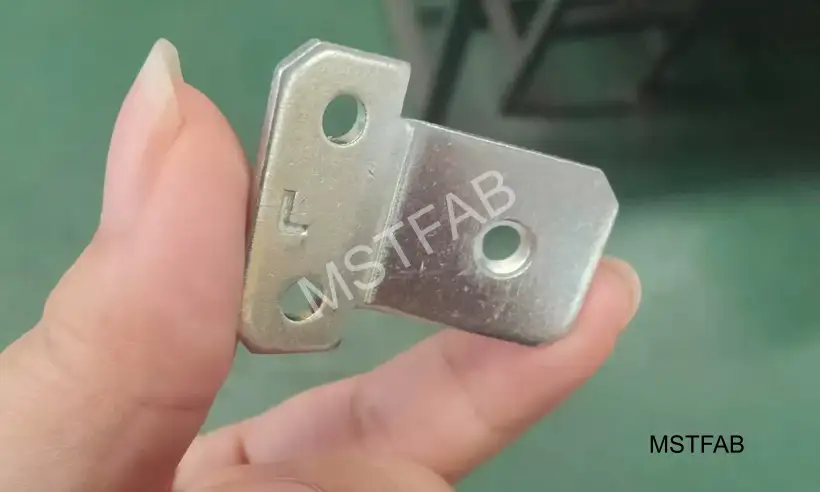
Modern industrial and minimalist furniture often turns structural iron brackets into exposed visual design elements. Conversely, concealed internal framing brackets require thin, uniform corrosion protection that does not jam tight sliding tolerances. Both demand rigorous pre-treatment.
- Architectural matte and fine-texture powder coating: Multi-stage iron-phosphate or zirconium pre-treatment followed by electrostatic powder coating (such as RAL 9005 Jet Black micro-texture) that resists chipping when screws are torqued down.
- Trivalent zinc, yellow chromate, and black oxide plating: Thin-film (8 to 15 um) corrosion protection for concealed motion hardware, bed-rail hooks, and locking cams where thick paint would cause binding.
- Electroplated brass, antique bronze, and brushed nickel: Decorative hospitality and residential hardware finishes applied over polished and vibratory-burnished steel or stainless substrates.
Review our surface treatment capabilities to specify salt-spray hours (ASTM B117), cross-hatch adhesion (ISO 2409), and gloss units (GU) on your hardware drawing.
05 / Buyer Control Matrix
Verify five quality controls before releasing furniture bracket production.
Use this checklist during supplier qualification to prevent misaligned holes, proud screw heads, and flaking finishes on custom hardware orders.

06 / Inspection Handoff
Check mating geometry, screw flushness, and finish adhesion on every batch.
For furniture and cabinetry OEMs, a 1.0 mm shift in a keyhole slot or paint build-up inside an M6 weld nut can trigger thousands of customer returns on flat-pack retail kits. Inspection must verify functional assembly, not just flat blank dimensions.
Our quality inspectors check first-off parts using custom go/no-go check fixtures that simulate your mating wood or metal frame, verify countersink flushness with your exact specified screw head, and perform cross-hatch adhesion and salt-spray testing on coated batches.
Operating under an ISO 9001 quality system, we supply documented First Article Inspection (FAI) reports, material mill certificates, and finish inspection photos prior to dispatch.
Review our sheet metal and hardware quality control process →
07 / Packing and Release
Protect cosmetic brackets with polybag kitting, barcode labels, and export cartons.
Throwing powder-coated or brushed brackets loose into a bulk carton guarantees scratched A-surfaces before the pallet even reaches the port. Furthermore, many furniture brands need brackets pre-kitted with matching screws, dowels, and Allen wrenches ready to drop straight into their master flat-pack furniture box.
Through our turnkey assembly and packaging line, we individually sleeve or foam-interleave visible cosmetic brackets, heat-seal complete hardware blister or polybag kits with custom barcode/SKU stickers, and pack master cartons onto fumigation-free export pallets.
Manufacturing scope: MSTFAB manufactures custom build-to-print sheet metal brackets, stamped connectors, and mechanical hardware kits under ISO 9001 quality management. Final furniture structural testing and end-product consumer compliance remain the responsibility of the OEM.
08 / Ready-to-Review RFQ
Include eight engineering details in your custom furniture bracket RFQ.
- 3D STEP model and 2D PDF drawingProvide 3D geometry along with a 2D drawing calling out critical hole-to-bend dimensions and angular tolerances.
- Material grade and exact thicknessSpecify cold-rolled steel (SPCC), hot-rolled pickled (SPHC / Q235B), high-strength Q355B, or 304 stainless in millimeters.
- Countersink and fastener specsDetail screw size (e.g., #8, #10, M5, M6, M8), countersink angle/diameter, or required PEM/weld nut codes.
- Deburring and edge radius standardIndicate if hand-safe vibratory tumbled radiusing is required for consumer-handled flat-pack hardware.
- Surface finish and color codeCall out RAL powder coat number, gloss level (e.g., 15 GU matte vs. sandy texture), or zinc/brass plating thickness.
- Cosmetic A-surface definitionMark which face of the bracket remains visible after furniture assembly so rack hanging marks are placed on hidden holes.
- Kitting and retail packaging needsNote if you require individual polybags, matched black/zinc screw packets, custom printed header cards, or FBA/SKU labels.
- Prototype vs. annual batch volumeShare both initial sample/pilot quantity and annual demand so we can compare laser+bend vs. progressive stamping die pricing.
Providing both your initial batch size and annual volume lets our engineering team present a clear cost comparison between tool-free laser cutting and hard-tooled stamping.
Custom hardware and furniture bracket questions from OEM buyers
Should we manufacture our furniture brackets by laser cutting + CNC bending or progressive stamping?
For initial product launches, custom hospitality runs, or annual volumes under 3,000–5,000 pieces, fiber laser cutting paired with CNC press brake bending is more economical because there is zero stamping die cost. Once a bracket design is frozen and volume exceeds 5,000–10,000+ pieces per release, investing in a progressive or compound stamping die dramatically lowers unit piece price.
How do you prevent powder coating from chipping around screw holes when installers tighten fasteners?
Paint chipping around screw heads happens when steel is poorly pre-treated or over-coated with brittle powder. We use multi-stage chemical degreasing and phosphate/zirconium conversion treatment, control dry-film thickness between 60 and 80 microns, and bake parts according to strict cure profiles—verified via ISO 2409 cross-hatch adhesion and impact testing.
Can you add stiffening ribs or gussets to make a thinner bracket stronger?
Yes. Forming an embossed triangular corner dart across the 90-degree bend line (or rolling shallow side flanges along the bracket edges) significantly increases moment of inertia and load capacity, allowing you to reduce steel weight and cost without sacrificing rigidity.
How do you keep powder coat out of tapped holes or weld nuts on brackets?
For high-precision machine threads, we either insert high-temperature silicone masking plugs prior to powder coating, install self-clinching PEM nuts after coating on non-cosmetic backsides, or run a calibrated thread-chasing tap pass before final inspection.
Can you supply matching screws, bolts, and Allen keys packed inside the same polybag as the brackets?
Yes. We provide complete turnkey hardware kitting—sourcing and inspecting matching wood screws, machine bolts, washers, and hex keys, sealing them into multi-compartment polybags with your custom printed manual or barcode label, and check-weighing every bag to guarantee zero missing parts.
What is the maximum thickness you can laser cut and bend for heavy timber or pergola connectors?
In addition to thin furniture cleats (1.0 mm to 3.0 mm), our high-power fiber lasers and heavy-tonnage CNC press brakes routinely fabricate structural post bases, T-straps, and L-brackets in 4.0 mm, 6.0 mm, 8.0 mm, and 10.0 mm carbon and stainless steel.
Technical references
Reference these international standards on your hardware drawings to define general sheet metal tolerances, electroplated coatings, and paint adhesion testing.
Send your custom hardware bracket drawings for a DFM and tooling review.
Upload your STEP, DXF, and PDF files along with finish and kitting specs. MSTFAB will compare laser-forming vs. stamping costs and return an itemized quote.
Have a question first? caroline@mstfab.com
 WeChat Contact
 WhatsApp Me Directly