
Custom China Sheet Metal Fabrication: A Procurement Guide to DFM, Tolerance Control and Supplier Risk
China offers a deep sheet metal supply base. The difficult part is not finding a factory that can quote. It is identifying a partner that reviews the drawing, controls the production route and prevents assembly problems before finished parts arrive at your plant.
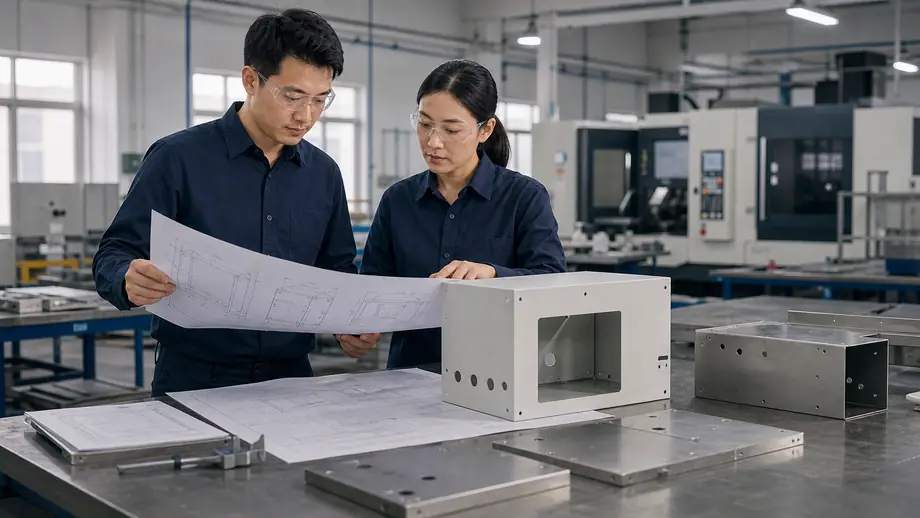
Three supplier risks worth checking before issuing a purchase order.
A credible supplier evaluation should reduce downstream rework, not create a longer list of marketing claims.
Quoting before DFM
A fast quote is useful only when bend radii, clearances, critical dimensions and finishing requirements have been reviewed first.
Prototype quality that drifts later
Buyers need a route from sample approval to repeatable batch inspection, not a carefully polished first article with no control plan.
Finish specified as a color only
Outdoor durability depends on pretreatment, cut-edge coverage and inspection. A RAL number alone does not manage corrosion risk.

A low unit price can become an expensive assembly problem.
For custom enclosures, chassis and brackets, a small fabrication error rarely stays small. A hole pattern that shifts after bending can delay hardware installation. A welded frame that moves under heat can force rework. A door flange that is not flat can compromise gasket compression.
Professional buyers evaluate the total landed cost of a part: incoming inspection, rework, assembly time, replacement freight, launch delay and warranty exposure. That is why engineering questions before quotation are a positive signal rather than a delay.
Procurement principle: the supplier that asks where the part can fail is often more valuable than the supplier that answers every question with an immediate yes.
Supplier evaluation checklist before placing an OEM order.
This is the one table worth keeping beside the RFQ. It turns vague claims into evidence a sourcing team can request and compare.
| Review Area | Evidence to Request | Cost of Skipping Review | MSTFAB Workflow |
|---|---|---|---|
| CAD and DFM review | STEP/STP plus 2D drawing review, critical-dimension questions and manufacturability comments. | Scrap, late ECOs and avoidable tooling changes. | Review bend reliefs, hole clearances, hardware access and finishing allowances before quotation. |
| Bending and tolerance stack-up | Critical tolerance list, bend sequence, springback approach and first-article measurements. | Doors bind, brackets miss mounting holes and gasket surfaces do not compress evenly. | Use CNC forming, prototype fit-up checks and inspection records for agreed critical dimensions. |
| Hardware insertion and assembly readiness | PEM nut, stud and standoff schedule with insertion access confirmed before cutting. | Manual drilling, stripped threads and slower final assembly. | Review assembly sequence so hardware positions remain accessible and repeatable. |
| Outdoor finish | Pretreatment route, coating thickness target, edge coverage and finish inspection method. | Early rust, coating lift and field complaints. | Match substrate and finish to indoor, outdoor, coastal or chemical exposure. |
| Batch and export release | FAI sign-off, final inspection checklist, packing method and agreed Incoterm. | Batch drift, transit damage and installation delays. | Connect sample approval with batch QC, export packing and FOB/CIF/DDP discussion where suitable. |
What engineering-led fabrication looks like in practice.
Real factory evidence is more useful than a page full of adjectives. These checkpoints show where supplier risk is actually reduced.

DFM review before quotation
Native 3D files and 2D drawings are reviewed together so critical dimensions, bend reliefs and assembly details are discussed early.

Prototype fit-up before batch release
Doors, rails, cable gland openings and mounting details are checked on a physical sample before quantity increases.
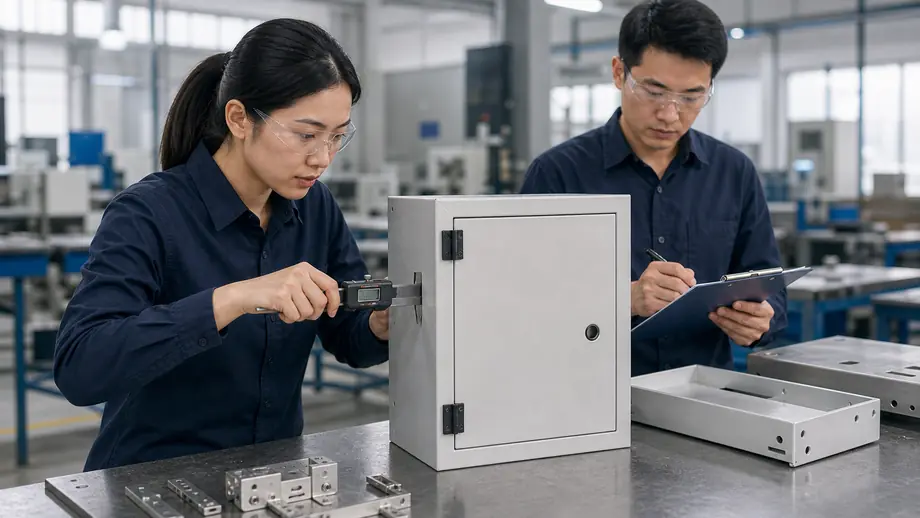
Critical dimensions measured at the enclosure
Caliper checks make the quality conversation concrete: buyers can identify the dimensions that affect their assembly most.
Process control should follow the part through the factory.
The buyer should be able to trace how a drawing becomes a repeatable, export-ready mechanical part.
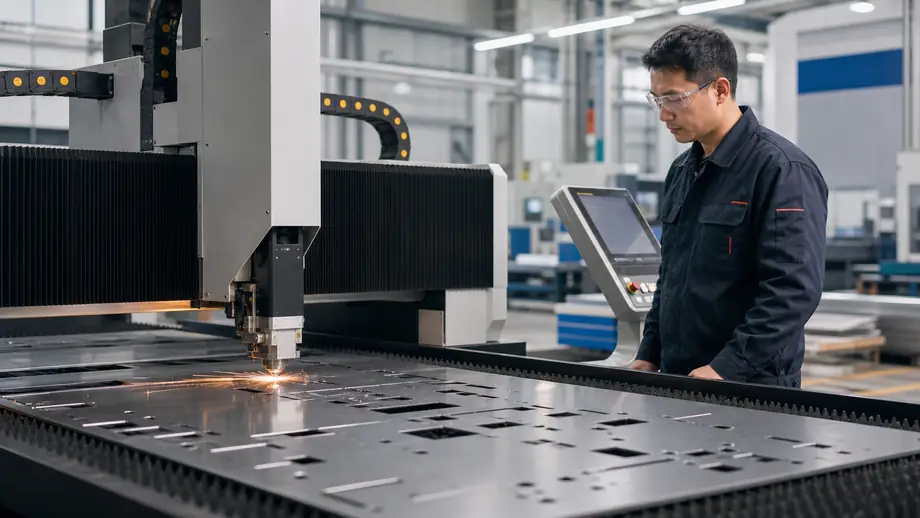
Fiber laser cutting for repeatable features
Clean openings and controlled flat patterns reduce deburring, connector fit and downstream forming problems.
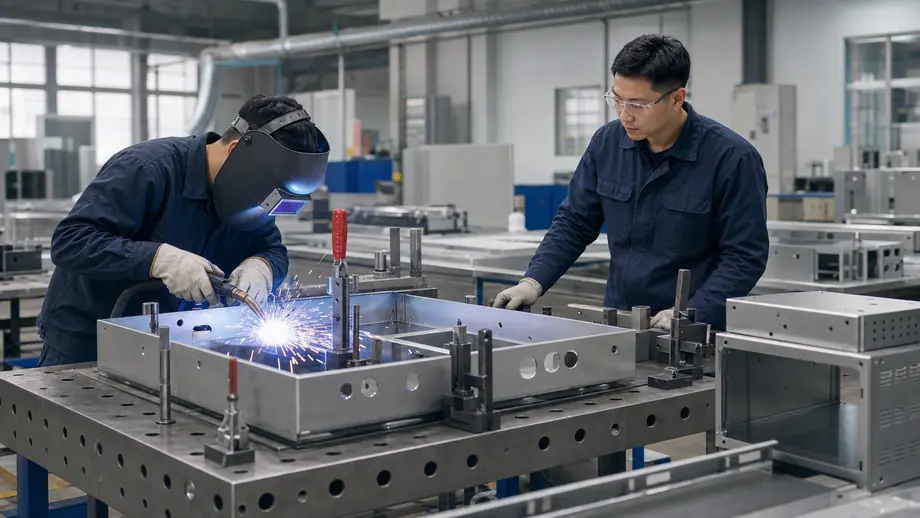
Fixture-controlled welding for stable geometry
Fixtures and planned weld sequence help manage distortion before a frame or enclosure reaches final inspection.

Final inspection before export packing
The last checkpoint connects dimensions, finish, packing protection and shipment documentation.
Protect proprietary systems by defining the supplier boundary clearly.
For many OEM projects, the right fabrication partner is not an electronics integrator. The buyer needs a factory that owns the mechanical scope completely: shells, chassis, brackets, hardware insertion, welding, finishing and inspection.
MSTFAB focuses on precision sheet metal fabrication. Customer-controlled electronics, firmware and proprietary electrical architecture remain outside the fabrication scope. That clarity simplifies responsibility and keeps the engineering discussion focused on the metal parts that affect fit, sealing and field durability.
Send a quote package that makes supplier comparison easier.
A complete RFQ allows factories to discuss risk accurately and gives procurement teams a cleaner basis for comparison.
1. Geometry
Send STEP or STP files plus 2D PDF or DXF drawings. Mark interfaces that affect your assembly.
2. Material and finish
Specify grade, thickness, surface finish, color and the operating environment: indoor, outdoor, coastal or chemical exposure.
3. Critical dimensions
Separate functional tolerances from cosmetic dimensions. Identify gasket faces, rails, mounting holes and hardware locations.
4. Commercial context
Include prototype quantity, annual forecast, destination country, packing needs and preferred Incoterm.
Related MSTFAB pages for buyer research.
Use these pages to compare bending, enclosure and rack cabinet requirements before sending your drawings.
Sheet Metal Bending Service
CNC forming and tolerance control for panels, brackets and enclosure structures.
Industrial Enclosure Manufacturing
Custom cabinets for automation, power distribution and industrial control systems.
Server Rack Cabinet Fabrication
Rack structures, rails, access panels and cable-friendly telecom enclosures.
Factory Photos
Review real Chinese factory production, engineering and inspection scenes.
China sheet metal fabrication sourcing FAQ.
Concise answers for OEM sourcing teams comparing fabrication partners.
What files should I send for a reliable sheet metal fabrication quotation?
Why should a China sheet metal supplier review drawings before quoting?
How can buyers check whether a factory controls tolerances during batch production?
What should buyers ask about outdoor powder coating?
Does MSTFAB supply internal electronics or software?
Can MSTFAB support export orders for the USA, Europe and Australia?
Send your files for a factory-direct DFM review.
Upload STEP, STP, DWG, DXF or PDF drawings with material, thickness, finish, quantity and delivery destination. MSTFAB will review manufacturability before quotation.
 WeChat Contact
 WhatsApp Me Directly