
The Short Answer
Reliable heavy-duty carbon steel sheet metal fabrication depends on matching steel grade and surface condition to downstream forming, welding, and coating processes. Specifying pickled-and-oiled hot-rolled steel (ASTM A1011 HRPO) or cold-rolled steel (ASTM A1008) instead of unpickled mill-scale plate prevents powder-coat delamination, while choosing the right assist gas during fiber laser cutting and proper V-die opening ratios during press brake forming eliminates edge blowouts and bend-line cracking.
Explore this guide
01 / Grade Selection Strategy
Match the carbon steel grade and mill finish to the functional load and coating system.
Calling out generic “mild steel” or “CRS/HRS” on an engineering drawing often forces fabricators to guess whether cosmetic surface finish, tight bend radii, or structural yield strength is the governing requirement. Hot-rolled black steel carries an abrasive iron-oxide mill scale that increases laser piercing time, wears press brake tooling, and flakes off under powder coating unless removed by abrasive blasting.
Before releasing carbon steel parts for production, separate cosmetic enclosure panels from heavy structural baseplates and specify the exact ASTM or EN material standard.
ASTM A1008 Cold-Rolled (CRS)
Ideal for 0.8 mm to 3.2 mm precision enclosures, cabinets, and internal chassis panels requiring smooth surface finish (Ra <= 1.2 um) and tight bend repeatability.
ASTM A1011 HRPO & ASTM A36
Use pickled-and-oiled A1011 HRPO for 3.0 mm to 6.0 mm brackets to avoid mill-scale removal costs, and specify A36 plate (6.0 mm to 25 mm) for heavy machinery bases and gussets.
HSLA Grade 50 / S355MC
High-strength low-alloy steels deliver 345+ MPa minimum yield strength, allowing OEMs to down-gauge mobile equipment booms and load-bearing frames without sacrificing safety factor.
DFM cost tip: Upgrading from standard hot-rolled black sheet to ASTM A1011 CS Type B HRPO (Hot-Rolled Pickled and Oiled) adds minimal raw material cost but eliminates secondary acid pickling or heavy grinding before powder coating.
02 / Fiber Laser Cutting Dynamics
Control cut-edge oxide layers by choosing oxygen vs. nitrogen assist gas strategically.
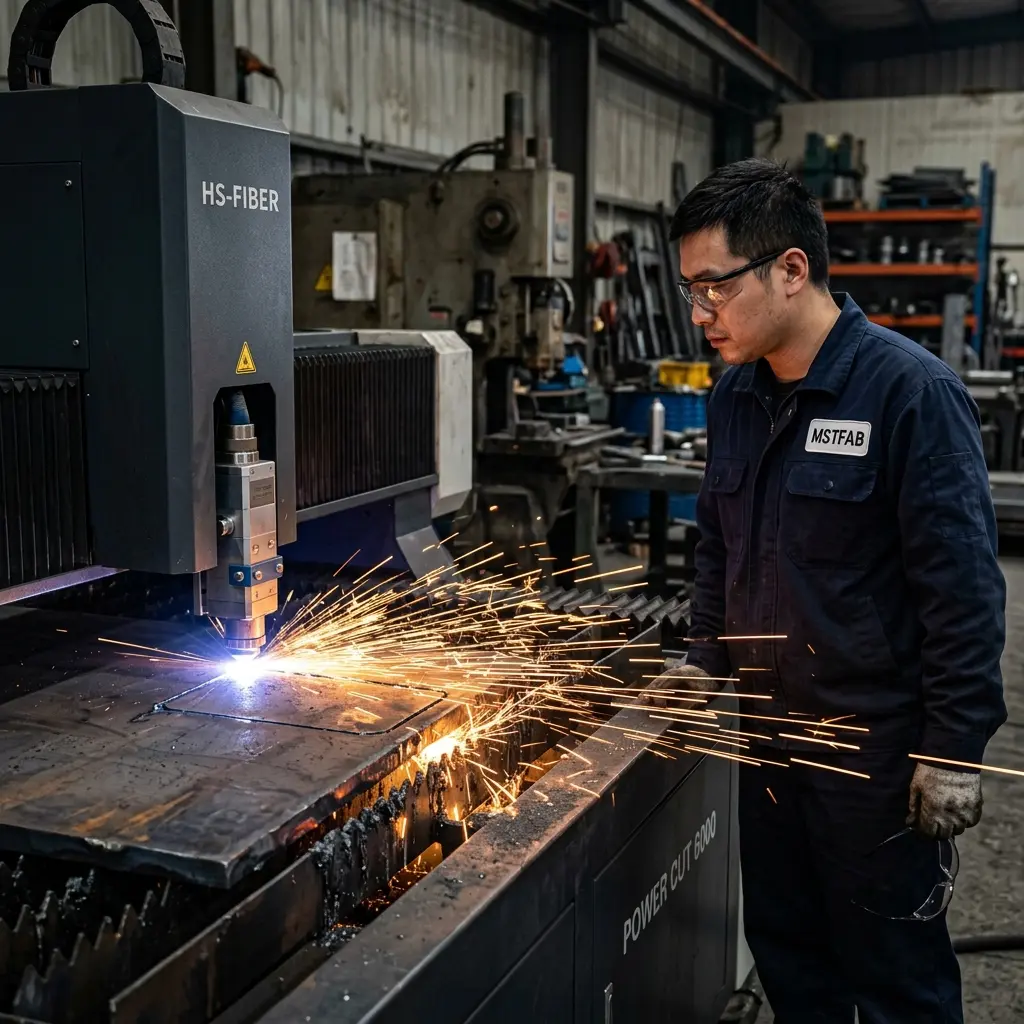
High-power fiber lasers cut carbon steel from thin 0.8 mm sheet up to 25 mm structural plate, but the choice of assist gas directly determines edge chemistry, weld porosity risk, and paint adhesion along the cut perimeter.
- Oxygen-assisted cutting (thick plate > 6 mm): Uses an exothermic reaction to slice 8 mm to 25 mm A36 plate efficiently with smooth vertical striations, but leaves a dark iron-oxide crust on the cut edge that must be ground or blasted off before painting or high-spec welding.
- High-pressure nitrogen or shop-air cutting (<= 6 mm): Vaporizes and blows molten metal out of the kerf without oxidation, delivering bright, oxide-free edges ready for direct MIG/TIG welding and powder coating without edge-peeling failure.
- Thick-plate hole-to-thickness rules: Keep laser-cut hole diameters at or above 0.8x material thickness (and >= 1.0t on plate thicker than 10 mm) to prevent pierce blowouts and taper distortion near bolt clearance holes.
Combining high-wattage sheet metal laser cutting with automated rotary-brush deburring and slag removal ensures carbon steel blanks sit flat in press brake dies and welding fixtures.
03 / Heavy-Plate Forming and Springback
Size inside bend radii and V-die openings for thick carbon steel and HSLA plate.
While thin cold-rolled steel easily forms around an inside radius equal to 0.8x to 1.0x material thickness, applying the same tight radius to 8 mm A36 plate or HSLA Grade 50 causes outer-fiber tensile cracking and excessive press brake tonnage.
- Specify inside bend radii of at least 1.5t to 2.0t for carbon steel plate above 6 mm, and 2.5t to 3.0t for high-strength low-alloy (HSLA) grades.
- Account for V-die shoulder spacing: heavy plate requires V-openings of 8t to 12t, which increases the minimum return flange length needed to span the die shoulders without dropping into the tool.
- Orient structural load-bearing bends perpendicular to the coil rolling direction, and include laser-cut bend relief slots (width >= 1.5t, depth >= R + t) wherever flanges terminate inside a plate boundary.
Using empirical K-factor tables calibrated to specific V-die widths and steel yield strengths prevents cumulative flange length errors on heavy U-channels and multi-bend machine pedestals.
04 / Structural Welding and Corrosion Protection
Pair AWS D1.1 structural welding with abrasive blasting and multi-coat barrier protection.
Carbon steel lacks intrinsic chromium-oxide passivity, meaning any weld spatter, mill scale, or unsealed lap joint will rapidly rust in humid factory or outdoor service. Heavy weldments require disciplined joint preparation and pre-coating surface conditioning.
- AWS D1.1 / D1.3 MIG and pulsed MAG welding: Bevel plate edges (30-degree to 45-degree chamfers on plate >= 8 mm) for full-penetration groove welds, and use ER70S-6 filler wire with argon-CO2 shielding gas for low-spatter wetting.
- Abrasive shot blasting (ISO 8501-1 Sa 2.5): Blast welded frames and heavy brackets to near-white metal to strip stubborn mill scale, weld silica islands, and heat tint while creating a 40 um to 75 um anchor profile.
- Multi-layer corrosion systems: Match the environment with zinc-phosphate pretreatment plus polyester powder coating for indoor machinery, epoxy zinc-rich primer under polyurethane topcoats for C4/C5 industrial exposure, or hot-dip galvanizing per ASTM A123 (with vent/drain holes designed into hollow sections).
Review our precision welding services and surface treatment options to select the right pretreatment and coating stack for your operating environment.
05 / Buyer Control Matrix
Verify five carbon steel manufacturing controls before releasing production.
Use this engineering matrix during DFM sign-off to align material grade, edge conditioning, welding quality, and corrosion testing.
06 / Quality Inspection Handoff
Validate dimensional geometry, weld integrity, and coating adhesion before shipment.
Heavy carbon steel weldments and formed brackets can accumulate dimensional drift from rolling thickness tolerances (which are wider on hot-rolled plate than cold-rolled sheet) and thermal weld shrinkage.
Our quality workflow under ISO 9001 and IATF 16949 management systems checks incoming coil/plate thickness and heat numbers, verifies press-brake bend angles under load, inspects weld penetration and squareness on granite tables or CMMs, and records dry film thickness (DFT) and cross-hatch paint adhesion on coated lots.
Where tight flatness or bore alignment is required on a welded A36 frame or pedestal, we verify post-weld machined datum pads against your 2D GD&T callouts prior to painting.
See our sheet metal quality control and inspection process →
07 / Rust Prevention and Export Packaging
Prevent flash rust on bare steel and transit damage on heavy coated weldments.
Uncoated carbon steel parts and post-weld machined mounting pads will develop surface rust within hours when exposed to ocean freight condensation or high warehouse humidity. Even powder-coated heavy brackets can chip if stacked without heavy-duty separation.
For bare or partially machined custom sheet metal fabrication orders, we apply VCI (Vapor Corrosion Inhibitor) rust-preventative oil or dry film to exposed steel faces, seal parts in VCI poly bags with desiccant packs, and strap heavy components into fumigation-free plywood crates or reinforced pallets.
Manufacturing scope: MSTFAB manufactures custom drawing-based carbon steel sheet metal parts, heavy structural brackets, welded machine frames, and enclosure shells under ISO 9001, IATF 16949, and ISO 14001 quality and environmental systems. Final machinery integration, load-rating certification, and powered equipment compliance remain the responsibility of the OEM.
08 / Ready-to-Review RFQ
Include eight engineering details in your carbon steel fabrication RFQ.
- 3D CAD STEP filesProvide neutral .STEP / .STP models with accurate sheet thickness and weldment assembly structure.
- 2D PDF tolerance drawingsCall out critical-to-function hole tolerances, flatness datums, and GD&T frames.
- Exact steel specificationState ASTM A1008 CRS, A1011 HRPO, A36, S235JR, S355MC, or galvanized G90 / DX51D.
- Weld symbols and standardDefine fillet sizes, bevel groove depths, AWS D1.1/D1.3 class, and cosmetic grind zones.
- Post-weld machining surfacesHighlight any mounting pads, bearing bores, or tapped holes machined after welding.
- Surface prep and coating codeSpecify Sa 2.5 abrasive blasting, zinc primer, RAL color, gloss, texture, and target DFT.
- Masking and bare-metal zonesMark grounding studs, mating datum pads, and threads that must remain free of powder coat.
- Batch volume and rust protectionIndicate prototype vs. production quantities and VCI packaging needs for bare steel.
Defining steel surface condition, weld class, and coating pretreatment up front eliminates quotation assumptions and prevents field corrosion surprises.
Carbon steel sheet metal fabrication questions from OEM engineers
When should we specify ASTM A1011 HRPO instead of standard hot-rolled A36 steel?
For parts between 2.5 mm and 6.0 mm that will be laser cut, formed, and powder coated, ASTM A1011 HRPO (Hot-Rolled Pickled and Oiled) is strongly preferred. The mill has already removed the brittle iron-oxide scale in an acid bath, resulting in faster laser cutting, cleaner press-brake bends, zero mill-scale flaking under powder coat, and lower secondary blasting labor.
What is the maximum carbon steel thickness you can fiber laser cut and bend?
We routinely fiber laser cut carbon steel from 0.8 mm cold-rolled sheet up to 25 mm structural plate, and CNC press-brake form carbon steel from thin gauge enclosures up to 16 mm–20 mm heavy brackets depending on bend length, inside radius, and tonnage requirements.
Why do tight inside bend radii cause cracks on thick carbon steel plate?
Hot-rolled structural steels (like A36 or S355) have lower ductility and more pronounced grain directionality than thin cold-rolled drawing steel. Bending a 10 mm plate over a sharp punch radius stretches the outer tensile fibers beyond their local fracture limit. Specifying an inside radius of 1.5t to 2.5t distributes the strain smoothly across the bend zone.
How do you stop powder coating from lifting along laser-cut edges?
Up to 6 mm thickness, we cut carbon steel with high-pressure nitrogen or compressed shop air so no oxide scale forms on the cut edge. On thicker plate cut with oxygen assist, we mechanically grind or abrasive shot-blast the cut perimeter and break sharp 90-degree edges before pretreatment and powder application.
What design adjustments are required if a welded carbon steel part will be hot-dip galvanized?
Hot-dip galvanizing immerses the steel weldment in molten zinc at ~450 C. Hollow tubes, overlapping gussets, and boxed sections must include properly sized vent and drain holes so trapped air and pickling acid do not cause pressure blowouts or ungalvanized air pockets, and thread clearances must account for the 65 um to 100+ um zinc layer.
How do you protect unpainted machined datum pads from rusting during ocean transit?
When a powder-coated carbon steel frame has post-weld machined mounting pads that must stay bare for precision assembly, we mask the pads during coating, apply a clean-removable VCI rust-inhibitor film to the bare steel after final inspection, and pack the assembly with VCI emitters and desiccants.
Technical references
Reference these material, welding, and surface preparation standards on your carbon steel fabrication drawings when applicable.
- ASTM A1008 / A1008M — Cold-Rolled Carbon Steel Sheet Specification
- ASTM A1011 / A1011M — Hot-Rolled Carbon and High-Strength Low-Alloy Steel Sheet and Strip
- AWS D1.1 / D1.3 — Structural Welding Code for Steel and Sheet Steel
- ISO 8501-1 — Preparation of Steel Substrates Before Application of Paints and Related Products
Upload your carbon steel drawings for a DFM and production review.
Share your 3D STEP models, 2D PDF drawings, steel grade, and coating specifications. MSTFAB will review formability, weld sequencing, and corrosion protection with a clear quotation.
Have a question first? caroline@mstfab.com
 WeChat Contact
 WhatsApp Me Directly