
HEAVY-DUTY AGRICULTURAL & INDUSTRIAL BRACKET FABRICATION — EXECUTIVE TECHNICAL BRIEF
Chemical fertilizers (NPK, urea, ammonium sulfate), acidic silage, pesticide sprays, and wet mud poultice destroy standard painted carbon steel within a single farming season. This engineering guide helps agricultural OEMs select the optimal cost-vs-life combination of 304/316L stainless steel, Zinc-Aluminum-Magnesium (ZAM), post-fab Hot-Dip Galvanizing (HDG), and self-draining sheet metal DFM.
- High-Strength Structural Steels (Q355B / S355JR, Z275 & SUS304): MSTFAB fabricates corrosion resistant agricultural metal components from 3.0–12.0 mm structural carbon steel, Z275/HDG galvanized steel, and 304 stainless to withstand high field vibration and impact loads.
- Grain-Perpendicular Forming Prevents Root Cracking: Heavy mounting brackets are nested with bend lines perpendicular to coil rolling grain and formed at R ≥ 1.5t–2.0t to eliminate fatigue micro-fissures.
- Robotic & Fixture-Clamped AWS D1.1 / ISO 5817 Class-B Welding: Deep-penetration MIG/TIG welding inside toggle-clamp jigs holds mounting hole pitches within ±0.25 mm without thermal distortion.
- ISO 1461 Hot-Dip Galvanizing, E-Coat & Duplex Powder Finishes: Engineered to survive liquid fertilizer, mud poultice, UV sunlight, and 750–1,000 hour ASTM B117 salt-spray testing.
Every project at MSTFAB includes a complimentary 24-hour CAD Design-for-Manufacturing (DFM) audit, heat-number-traceable EN 10204 3.1 mill certificates, and a ballooned First Article Inspection (FAI) report prior to volume release.
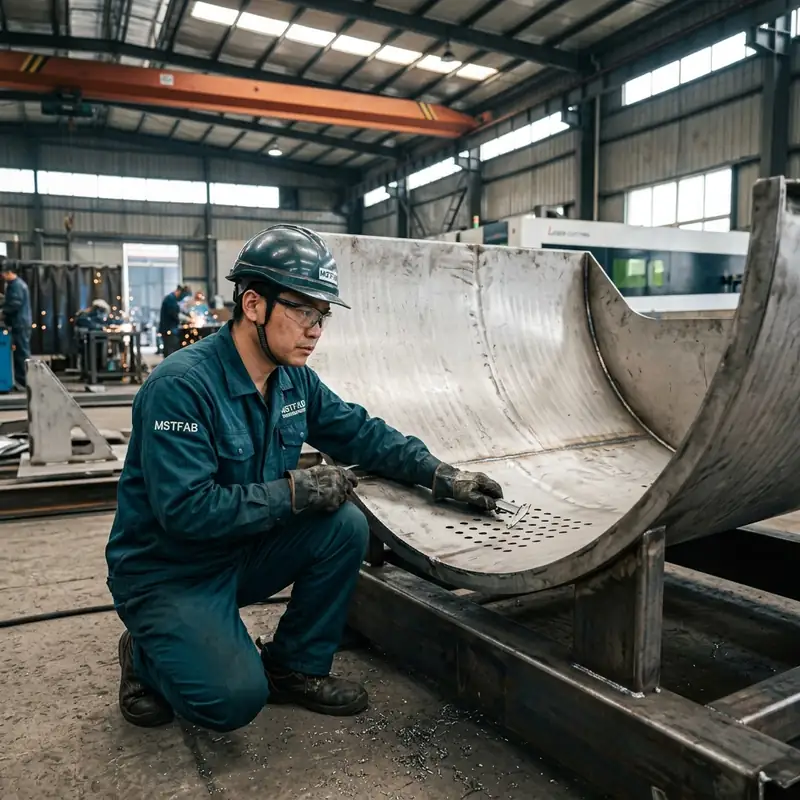
01 / Engineering Specifications & Comparison Matrix
Engineering Specifications, Tolerances & Verification Matrix: Corrosion-Resistant Agricultural Metal Components
Chemical fertilizers (NPK, urea, ammonium sulfate), acidic silage, pesticide sprays, and wet mud poultice destroy standard painted carbon steel within a single farming season. This engineering guide helps agricultural OEMs select the optimal cost-vs-life combination of 304/316L stainless steel, Zinc-Aluminum-Magnesium (ZAM), post-fab Hot-Dip Galvanizing (HDG), and self-draining sheet metal DFM. When sourcing custom sheet metal components and enclosures at industrial OEM scale, verbal assurances cannot substitute for drawing-locked process controls. Below is the engineering specification matrix governing raw material selection, dimensional tolerances (per ISO 2768-mK / fH), surface treatment durability, and metrology verification at MSTFAB.
Each parameter is verified during incoming raw material quarantine, in-process CNC stage checks, and final First Article Inspection (FAI) before shipment release:
| Engineering Parameter / Zone | Material & Process Specification | Target Tolerance / Performance Standard | Inspection Method & OEM Value |
|---|---|---|---|
| Structural Material Grades | 1.5mm–10.0mm SUS304/316L, DX51D+ZM175/Z275, ISO 1461 HDG Q355B, Al 5052-H32 | Yield strength 235–355+ MPa; Charpy impact verified | OES Spectrometer + EN 10204 3.1 MTC: Prevents bracket yielding or fatigue failure under tractor/implement shock loads |
| Laser Cutting & Slotted Holes | 6kW–12kW Fiber Laser Blanking (Round & Obround Mounting Slots) | Hole/slot pitch ±0.15 mm; Taper ≤ 0.08 mm; Dross-free bottom | Go/No-Go Pin/Slot Gauge + Optical CMM: Ensures effortless bolt-up alignment onto cast-iron tractor frames |
| Heavy Press Brake Forming | 200T–400T CNC Press Brakes with Heavy-Duty V-Dies (V = 8t–10t) | Bend angle ±0.5°; Inside radius R = 1.5t–2.0t (zero cracking) | Ultrasonic/Mag-Particle Bend Check + Protractor: Preserves full structural grain integrity at high-stress 90° knees |
| Structural Gusset Welding | Pulsed MIG / Robotic MAG Welding per AWS D1.1 / ISO 5817-B | Full root penetration; zero undercut; jig-locked hole centres | Macro Etch / Dye Penetrant (PT) + Weld Gauge: Withstands millions of cycles of field implement vibration |
| Anti-Corrosion Finishing | ISO 1461 Hot-Dip Galvanizing (≥70 μm) OR Zinc Primer + Ag Powder | 750–1,200 hrs ASTM B117 salt spray; Ammonia/fertilizer resistant | Elcometer DFT Audit + Cross-Hatch 5B: Eliminates field rust-jacking and paint flaking in mud and crop chemicals |
02 / Sheet Metal DFM & Structural Controls
Critical Sheet Metal DFM Rules & Field Failure Prevention
Most cost overruns, assembly fit-up delays, and field corrosion failures originate from subtle CAD geometry details or ambiguous drawing notes. Implementing these Design-for-Manufacturing (DFM) controls before releasing your files eliminates tool collisions, thermal warpage, and rework:
Bending Thick Structural Plate (≥5mm) Parallel to Rolling Grain
Failure Mechanism: Forming 6.0 mm Q355B/A572 plate parallel to the mill rolling direction opens orange-peel micro-cracks along the outer bend knee that snap under field vibration
Engineering Solution: Mandate grain-perpendicular laser nesting on structural brackets and specify inside bend radius R ≥ 1.5t–2.0t
Verified Outcome: Increases fatigue cycle life by >300% under implement shock loads
Unrelieved Moisture & Mud Pockets in Welded Box Brackets
Failure Mechanism: Closed gusset pockets trap wet soil and corrosive fertilizer, rotting the bracket from the inside out
Engineering Solution: Add Ø12–16 mm bottom drainage/cleanout holes and 15×15 mm corner snipes on all welded gusset plates
Verified Outcome: Allows mud washout and 100% dip-tank coating flow-through
Welding Shrinkage Pulling Bolt Holes Out of Alignment
Failure Mechanism: Multi-pass fillet welds pull U-bracket arms inward by 1.5–2.5 mm, preventing installation over the mating tractor axle housing
Engineering Solution: Pre-camber the bend angle by +1.0° and lock a solid steel spacer bar through the bolt holes during welding and cooling
Verified Outcome: Holds opposing ear spacing within ±0.25 mm
Manufacturing Scope Boundary: Painting Directly Over Black Oxygen-Laser Oxide Scale: Thick carbon steel cut with oxygen has a loose FeO edge crust that peels off in the field, taking agricultural paint with it — Engineering Fix: Mechanically rotary-brush or shot-blast all thick-plate laser edges prior to zinc priming and powder coating (Guarantees 5B coating adhesion right across the plate edge). MSTFAB manufactures custom sheet metal parts and empty mechanical enclosure shells strictly to your 3D STEP and 2D PDF drawings.
03 / Real Production Case Study & Process Control
Real Production Case Study: Granular Fertilizer Spreader Hopper Cone & Spinner Guard Redesign (14 SKUs)
Project Profile: Volume: 300 Spreader Sets/Year | Materials: 2.0mm SUS304 (Direct Fertilizer Zone) + 4.0mm Duplex Q355B Frame
OEM Engineering Challenge: A fertilizer spreader OEM faced severe corrosion perforation in the lower metering cone and rust-jacking between spot-welded frame gussets within 18 months of field service.
MSTFAB Manufacturing Solution: MSTFAB segmented the BOM by chemical exposure zone: we fabricated the direct-contact metering cone and spinner vanes from passivated 2.0 mm SUS304 stainless steel, redesigned the 4.0 mm Q355B structural frame to eliminate overlapping lap crevices (adding Ø16 mm mud-washout drain holes and 15 mm corner snipes), and applied a shot-blasted zinc-epoxy primer + UV polyester duplex finish.
- Salt & Fertilizer Fog Test: 1,200 hrs with zero structural rust or crevice bleeding
- Mud/Water Retention Pockets: Reduced to 0 via self-draining gusset DFM
- BOM Cost vs All-Stainless Frame: 41% lower cost than making the entire frame from 304SS
- Field Warranty Claims (3 Seasons): 0 corrosion perforation claims
Every production lot is archived with locked CNC laser nests, press-brake bend programs, weld fixture setups, and signed golden samples to guarantee identical repeatability across multi-year reorders.
04 / Quality Verification, Traceability & Surface Finishing
4-Stage Manufacturing Workflow, Surface Treatment & Metrology Control
To maintain Cpk ≥ 1.33 on critical-to-quality (CTQ) dimensions from prototype through series production, MSTFAB executes a closed-loop four-stage fabrication protocol:
Step 01 — Load-Path & Grain-Direction CAD/CAM Nesting: Engineers verify bend radii (R ≥ 1.5t for thick plate), orient primary bends across the rolling grain, and add tab-and-slot locators for stiffening gussets.
Step 02 — High-Power Fiber Laser Cutting & Slag/Edge Grinding: Thick structural plates (3.0–12.0 mm) are laser-cut and rotary-deburred/edge-rounded so sharp oxide scale cannot initiate fatigue cracks or paint pullback.
Step 03 — High-Tonnage CNC Press Brake Forming & Jig Welding: Brackets are formed on heavy V-dies and welded with reinforcing gussets inside rigid pin-located fixtures to keep bolt holes aligned post-weld.
Step 04 — Hot-Dip Galvanizing / Duplex Ag Powder Coat & Gauge QC: Parts receive post-fab hot-dip galvanizing or zinc-rich epoxy primer + agricultural UV polyester topcoat, followed by 100% mating pin-gauge inspection.
All raw sheets (SPCC, SGCC, SECC, SUS304/316L, Al 5052-H32/6061-T6) are verified via optical emission spectrometry (OES) or XRF upon arrival and linked by barcode to your purchase order.
Prior to export crating in ISPM-15 fumigated plywood boxes, our quality lab conducts ballooned dimensional FAI checks, dry-film thickness (DFT) mapping, ASTM D3359 cross-hatch adhesion testing, and ground-continuity verification.
05 / 8-Point OEM RFQ Checklist & Topic Cluster Hub
OEM Engineering RFQ Checklist & Connected Fabrication Hubs
Include these eight drawing and specification controls in your RFQ package so our engineering team can lock down tooling, material traceability, and inspection fixtures on day one:
- RFQ Requirement 01Zone your BOM by chemical exposure: Zone 1 (Direct liquid/granular fertilizer → SUS304/316L), Zone 2 (Splash/chutes → ZAM/Z275/HDG), Zone 3 (Guards/frames → Duplex Powder)
- RFQ Requirement 02Eliminate horizontal moisture traps: Add Ø12–16 mm drainage weep holes at the lowest point of every channel and gusset pocket
- RFQ Requirement 03Avoid unsealed spot-welded lap joints: Use continuous welds or open hemmed/standoff joints that can be pressure-washed clean
- RFQ Requirement 04Mandate mechanical edge rounding (R ≥ 0.4 mm) before zinc priming so coating does not pull back from laser-cut edges
- RFQ Requirement 05Isolate dissimilar metals: Use EPDM/nylon washers when bolting 304 stainless chutes onto galvanized or carbon-steel frames
- RFQ Requirement 06Specify ASTM A967 passivation on welded 304/316L stainless components to prevent heat-tint rust
- RFQ Requirement 07Require 1,000-hour ASTM B117 salt-spray validation and 10-point Elcometer DFT logs on coated structural parts
- RFQ Requirement 08Provide 3D STEP + 2D PDF drawings, seasonal pilot quantity, and annual production forecast
Explore Connected Sheet Metal Fabrication Services & Enclosure Hubs
CNC Press Brake Sheet Metal Bending & Forming
TIG / MIG / Robotic Sheet Metal Welding Services
Powder Coating, Passivation & Anodizing Finishes
Precision CNC Machining & Hybrid Metal Assemblies
Custom Electrical Enclosures & OEM Equipment Shells
Upload 3D STEP + 2D PDF for 24-Hour DFM & Price Quote
ISO 9001 & IATF 16949 Certified Factory Fact Sheet
06 / OEM Buyer & Engineer FAQ
Frequently Asked Questions: Corrosion-Resistant Agricultural Metal Components
Which metal is most cost-effective for parts in direct contact with granular or liquid NPK fertilizer?
For metering cones, spinner discs, and agitation baffles in direct sliding contact with hygroscopic NPK or urea fertilizer, 304 stainless steel (or 316L for acidic liquid fertilizers/pesticides) is the only material that resists both chemical attack and continuous particle abrasion. For surrounding structural frames and shields, Zinc-Aluminum-Magnesium (ZAM) steel or ISO 1461 Hot-Dip Galvanizing saves 35%–45% while providing excellent splash resistance.
Why do welded farm brackets often rust from the inside out even when heavily painted?
When two steel plates overlap in a stitch-welded lap joint or a closed 90° corner gusset without a drain snipe, capillary action sucks muddy, fertilizer-laden water into the microscopic gap. The trapped poultice stays wet for weeks (“crevice corrosion”), expanding with rust until it pops the welds. Cropping 15×15 mm corner snipes on every gusset lets water and mud wash straight through.
How do you prevent galvanic corrosion when bolting stainless steel hoppers onto carbon steel frames?
When wet fertilizer bridges a 304 stainless hopper bolted directly to a carbon-steel or galvanized frame, the steel acts as a sacrificial anode and corrodes rapidly around the bolt holes. We prevent this by specifying duplex-coated frames plus non-conductive nylon/EPDM shoulder washers under the 304 stainless mounting bolts.
Why is edge rounding so critical on powder-coated agricultural guards and hoods?
Fiber laser cutting leaves a razor-sharp 90° corner. During powder-coat baking at 200°C, liquid polymer flows away from sharp corners, leaving only 15–20 μm of paint on the edge (versus 80 μm on the flat face). Running blanks through MSTFAB’s rotary brush edge-rounding machines creates a smooth R0.4 mm radius that retains >85% coating thickness.
Can you hot-dip galvanize complex welded agricultural sub-assemblies?
Yes! We design vent and drain holes per ASTM A385 directly into your 3D CAD model during our free DFM review, weld the assembly to AWS D1.1 standards, and hot-dip galvanize to ISO 1461 (≥70–85 μm zinc thickness).
What is the lead time for custom corrosion-resistant agricultural sheet metal components?
Prototypes ship in 7–12 business days, and seasonal production batches ship in 15–22 business days.
International Standards & Engineering References
- ISO 2768-1 / 2768-2 — General Linear, Angular and Geometrical Tolerances for Sheet Metal Fabrication
- IEC 60529 / NEMA 250 — Degrees of Protection Provided by Enclosures (IP Code & Environmental Sealing)
- ISO 9001:2015 & IATF 16949:2016 — Quality Management Systems & Production Part Approval Process (PPAP)
Ready to Quote Your Custom Sheet Metal Enclosure or Fabrication Project?
Upload your 3D STEP models and 2D PDF drawings. MSTFAB will review your tolerances, material specs, and DFM details to deliver a transparent factory quote within 24 hours.
Request Your 24-Hour DFM & Custom Quote →
Direct engineering desk: caroline@mstfab.com | ISO 9001 & IATF 16949 Certified Factory in Guangzhou, China
 WeChat Contact
 WhatsApp Me Directly