
Condenser cover enclosures look simple.
A few sheet metal panels.
Some ventilation openings.
Maybe powder coating.
Install it around the condenser unit.
Easy, right?
Not always.
In real OEM projects, a poorly designed condenser cover enclosure can create problems that are much more expensive than the cover itself:
- restricted airflow
- condenser overheating
- weak panels vibrating during operation
- coating failure after outdoor exposure
- rust around louvers and cut edges
- difficult maintenance access
- poor fit during installation
- shipping deformation on large covers
At MSTFab, we often review condenser cover enclosure projects for HVAC equipment, industrial cooling systems, outdoor telecom cabinets, and electrical cooling units. Many buyers focus first on the outside appearance and unit price.
But the real purchasing question should be:
Will this enclosure protect the condenser without reducing cooling performance?
A condenser cover should not become a metal blanket.
The condenser already has a hard job. It does not need a poorly ventilated box making life worse.
For a complete overview of our sheet metal capabilities, buyers can review: Custom Sheet Metal Enclosure Fabrication
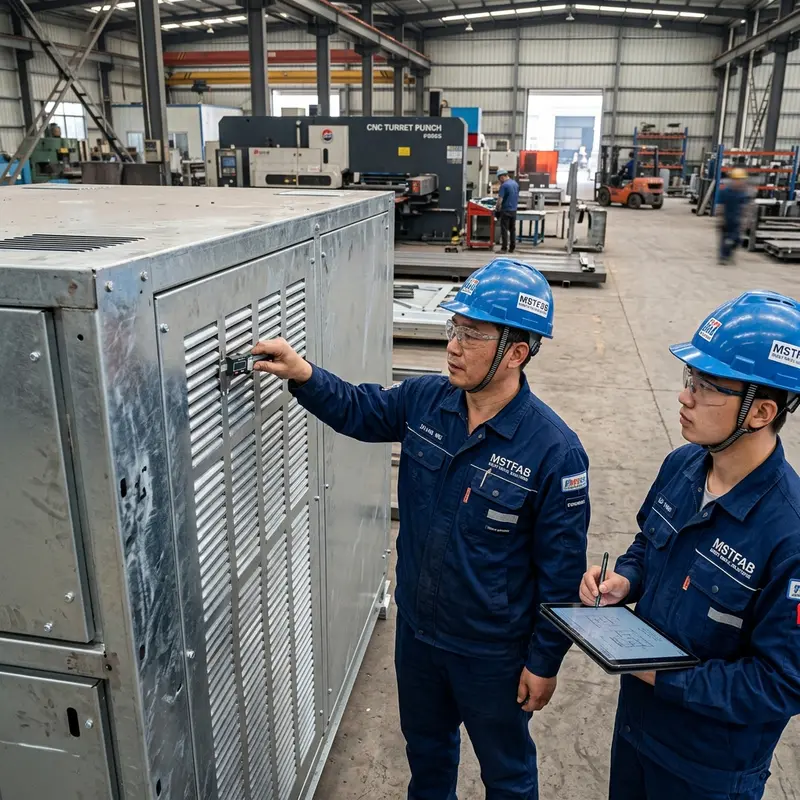
1. Airflow Is the First Procurement Check
For condenser cover enclosures, airflow is not a small detail.
It is the main function.
If the enclosure restricts air intake or discharge, the condenser may face:
- higher operating temperature
- reduced cooling efficiency
- compressor overload
- shorter equipment lifespan
- increased power consumption
- unexpected shutdowns
OEM buyers should review:
- ventilation opening area
- louver direction
- fan discharge clearance
- condenser coil clearance
- airflow path obstruction
- debris protection
- service access around ventilation areas
A common mistake is making the cover look clean and compact while reducing the open area too much.
That may look good in a product photo.
But the condenser will not applaud the design.
For related temperature-sensitive outdoor applications, buyers can also explore Custom Climate Controlled Enclosures.
2. Louvers and Perforations Need Real Manufacturing Control
Many condenser cover enclosures use louvers, punched holes, perforated panels, or laser-cut ventilation slots.
These features affect both airflow and fabrication cost.
Poorly controlled ventilation features may cause:
- sharp edges
- burrs
- coating weakness
- rust around cutouts
- inconsistent appearance
- reduced airflow performance
For outdoor condenser covers, buyers should consider:
- louver opening size
- rain direction
- drainage path
- powder coating coverage
- edge deburring
- insect or debris protection
- corrosion resistance around cutouts
Too open, and the enclosure may allow rain, dust, or debris inside.
Too closed, and the condenser cannot breathe.
A good condenser cover needs balance.
Not drama.
3. Outdoor Corrosion Protection Is Critical
Most condenser cover enclosures work outdoors or in semi-outdoor conditions.
That means they may face rain, humidity, sunlight, dust, salt air, industrial pollution, and temperature changes.
Material selection should match the actual installation environment.
Powder Coated Steel
Good for cost-effective HVAC covers, industrial condenser covers, outdoor equipment panels, and color-customized OEM projects.
Main concern: coating damage can expose steel and cause rust.
Galvanized Steel
Good for better base corrosion resistance, outdoor or semi-protected condenser covers, and cost-sensitive sheet metal covers.
Main concern: cut edges and weld areas still need protection.
Stainless Steel
Good for coastal environments, chemical plants, food processing facilities, and high-humidity outdoor locations.
The right material depends on where the condenser cover will actually be installed.
The environment always gives the final review.
And it is usually not generous.

4. Large Panels Need Structural Rigidity
Condenser cover enclosures often use large sheet metal panels.
If the structure is too weak, buyers may face:
- panel vibration
- rattling noise
- oil-canning effect
- shipping dents
- weak mounting points
- poor fit after installation
This is common when buyers reduce material thickness too much to save cost.
Better structure can often solve the problem without simply making everything thicker.
Useful design options include return flanges, reinforcement bends, formed ribs, stronger mounting edges, internal brackets, and folded panel structures. Quality CNC Sheet Metal Bending Service ensures these reinforcing bends are perfectly formed.
A heavier cover is not always a better cover.
A smarter cover is usually better.
Good sheet metal geometry can save weight, cost, and field complaints.
5. Vibration and Noise Should Be Considered Early
Condenser units vibrate during operation.
If the enclosure is not designed properly, vibration can cause rattling panels, loose screws, cracked mounting areas, customer complaints, and field service issues.
This matters for:
- rooftop HVAC units
- industrial cooling systems
- telecom cooling cabinets (see Outdoor Telecom Enclosure)
- outdoor condenser units
- mechanical equipment covers
OEM buyers should evaluate mounting hole strength, panel stiffness, fastener selection, vibration isolation, bracket position, and installation method.
A condenser cover that rattles every time the fan starts is not a premium enclosure.
It is accidental percussion equipment.
6. Maintenance Access Should Not Be an Afterthought
A condenser cover enclosure must protect equipment, but it should not make maintenance painful.
Technicians may need access to condenser coils, fans, filters, wiring, drainage areas, fasteners, and service panels.
Poor access design increases:
- maintenance time
- technician labor cost
- field damage risk
- service frustration
- equipment downtime
Buyers should define removable panel locations, screw access direction, hinge requirements, lifting method, clearance around service areas, and fastener type.
A cover that must be fully disassembled for simple maintenance is not practical.
It is just a metal puzzle with a purchase order.
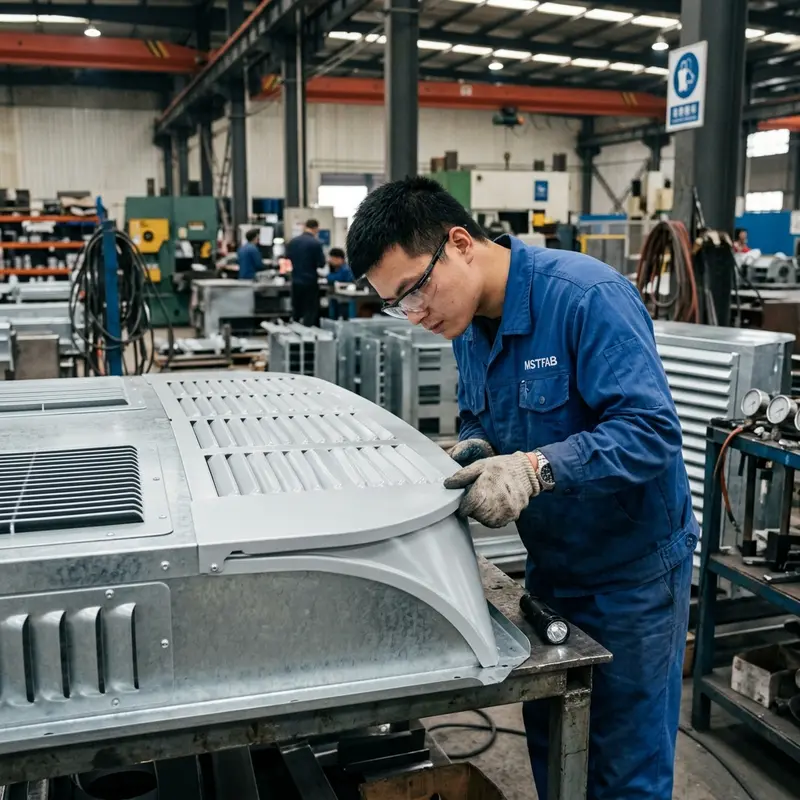
7. Powder Coating Quality Affects Outdoor Service Life
For condenser cover enclosures, powder coating is not just about color.
It affects outdoor durability.
Common powder coating problems include rust around louvers, peeling near cut edges, coating damage on corners, UV fading, poor adhesion after welding, and scratches during shipment.
Buyers should clarify RAL color, gloss level, texture requirement, coating thickness, outdoor durability requirement, UV resistance, salt spray expectation if needed, and packaging protection.
If the cover has many louvers or cutouts, edge protection becomes even more important.
Outdoor rust usually starts from the small places nobody inspected carefully.
Very small detail.
Very annoying warranty issue.
8. Shipping Protection Matters for Large Covers
Large condenser cover enclosures can be damaged during export shipment.
Common problems include bent corners, scratched powder coating, dented panels, warped covers, metal-to-metal abrasion, and moisture damage.
For overseas OEM projects, buyers should confirm pallet strength, foam separation, corner protection, protective film, carton or wooden crate requirements, no metal-to-metal contact, and moisture control.
A condenser cover that leaves the factory perfect but arrives bent is not a successful order.
It is a shipping problem wearing powder coating.
9. What Buyers Should Send for an Accurate Quote
To get a reliable condenser cover enclosure quotation, buyers should provide:
- STEP or 3D CAD files
- 2D PDF drawings
- material requirement and thickness
- ventilation or louver details
- airflow opening requirement
- indoor or outdoor application
- surface finish requirement
- annual order quantity
- mounting method
- service access requirement
- packaging requirement
If the condenser cover must fit around an existing HVAC unit or cooling system, buyers should also provide equipment dimensions, fan direction, airflow clearance, mounting points, and maintenance zones.
If the RFQ only says “condenser cover, please quote fast,” the supplier has to guess.
And guessing is not procurement.
It is just a faster way to create revision emails.
MSTFAB OEM Trust Table for Condenser Cover Enclosures
A poorly made cover turns an efficient condenser into a struggling heater. Here is how MSTFab balances maximum airflow with total outdoor protection:
| OEM Procurement Priority | MSTFAB Delivery Standard |
|---|---|
| Louver / Airflow Control | Calculated CNC louver punching ratios to guarantee massive heat exhaust while simultaneously deflecting 45-degree angle driving rain. |
| Anti-Rattle Rigidity | Strategic V-bends and cross-ribbing stamped into large flat panels to eliminate harmonic vibration and oil-canning noise during compressor start-up. |
| Cut-Edge Rust Prevention | Extensive mechanical deburring of all ventilation slots before chemical pretreatment, ensuring powder coating adheres perfectly to sharp cutouts. |
| Fast Service Access | Integration of quarter-turn fasteners, lift-off hinges, and reinforced access panels to slash technician field-maintenance time. |
| Flat-Pack & Heavy Freight | Ability to design bolt-together knock-down (KD) structures to minimize shipping volume, or ship fully welded in reinforced wooden export crates. |
Final Thoughts
Condenser cover enclosures are not just decorative metal covers.
For OEM buyers, a good condenser cover enclosure must balance airflow performance, outdoor corrosion protection, sheet metal rigidity, vibration control, powder coating durability, maintenance access, and export packaging.
At MSTFab, we support OEM customers with custom condenser cover enclosure fabrication, CNC laser cutting, CNC Sheet Metal Bending, punching, TIG Welding, powder coating, assembly, and DFM review for HVAC equipment, industrial cooling systems, telecom cabinets, and outdoor equipment protection.
For other related industrial infrastructure, consider reviewing Outdoor Network Enclosure and Electrical Cabinet Manufacturing.
The best time to solve airflow, corrosion, and service access problems is before production starts.
Not after the condenser overheats inside a very good-looking cover.
Related engineering resource: If your project involves EV charging infrastructure, review our custom EV charger enclosure fabrication capabilities for outdoor sheet metal cabinet design, powder coating, and export-ready manufacturing.
Related factory capability: For OEM buyers comparing a custom sheet metal enclosure factory, review how MSTFAB handles final assembly, protective packaging, export packing checks, and shipment-ready enclosure delivery.
custom sheet metal enclosure fabrication
MSTFAB manufactures custom sheet metal enclosures, electrical cabinets, control boxes and industrial metal housings for OEM buyers.
 WeChat Contact
 WhatsApp Me Directly