
Updated October 29, 2026 | RFQ preparation for custom sheet metal parts
Yes, you can request a sheet metal quote without a 2D drawing. A supplier may estimate from a 3D model, a dimensioned sketch or a sample. The important distinction is between a budget estimate based on assumptions and a production quotation based on agreed requirements. Missing information should be listed, not silently guessed.
A 2D PDF is a convenient way to communicate requirements, but it is not the only possible method. An agreed model-based definition can also work when the supplier can read and verify the necessary annotations.
What can a supplier quote from the files you already have?
Start by identifying what the supplier can measure and what still needs your decision. The following table is an RFQ planning guide, not a promise that every part can be priced from every input.
| Available input | Useful starting point | Clarify before production approval |
|---|---|---|
| STEP model only | Formed geometry, part envelope, holes and possible process routes. | Material grade, critical tolerances, finish, hardware, welding and the released revision. |
| DXF profile only | Flat cutting geometry after units and scale are checked. | Thickness, material, edge requirements and whether the profile is a finished flat part or a bend blank. |
| Dimensioned sketch or marked-up PDF | A preliminary review of a simple bracket, cover or panel. | Missing dimensions, bend directions, mating features and approval of any reconstructed geometry. |
| Photo or physical sample | Discussion of function and a possible reverse-engineering scope. | Measured dimensions, material identification, hidden features and who approves the recreated design. A photo alone is not a dimensioned specification. |
For a flat part, a clean DXF plus complete written material, quantity, tolerance and finish requirements may be enough for a quotation. A folded enclosure with hinges, inserts and sealing surfaces needs more definition. Complexity and missing requirements matter more than the number of attached files.
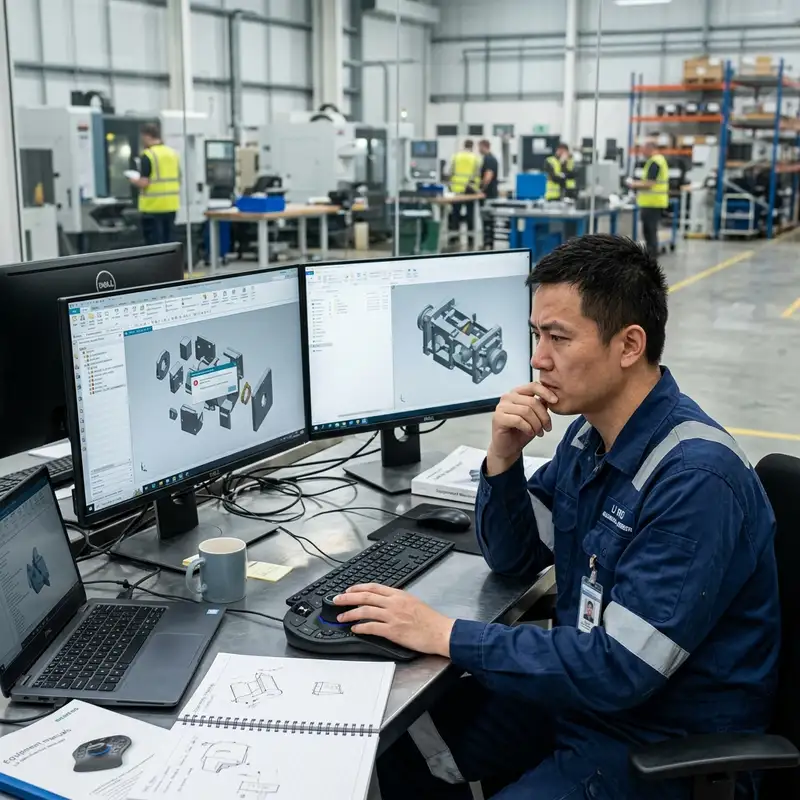
Is a STEP file enough, or do you need a 2D drawing?
Do not assume that every STEP file contains only shape. STEP can carry product and manufacturing information, including dimensions and tolerances. NIST’s STEP File Analyzer documentation describes semantic and graphical PMI, including AP242 support. Whether your exported file contains that information, and whether the recipient can interpret it, must still be checked.
Ask the supplier to confirm which annotations they received. If the model contains no usable requirements, send a PDF or a written specification linked to the same part number and revision. If two files disagree, agree which controls the disputed feature before placing the order.
For a detailed comparison of file roles, see STEP, PDF and DXF in a sheet metal RFQ. This page focuses on what to do when your documentation is not complete yet.
Minimum information to send without a finished drawing
- Part identity and revision: name or part number, file revision and whether the design is preliminary or released.
- Material and thickness: specify a grade when known. If you need alternatives, identify the operating environment and ask for separately identified options.
- Quantity: prototype quantity, first-order quantity and any forecast quantity. Do not present a forecast as a committed order.
- Fit-critical features: mark mounting holes, mating edges, gasket lands or other features that determine whether the part works. State their required tolerances.
- Secondary operations: identify threads, inserts, welds, deburring, coating, masked areas and assembly requirements, or explicitly mark them as undecided.
- Inspection and delivery: describe required records, packaging, destination and target timing. Ask the supplier to confirm feasibility.
You can annotate an existing view instead of completing a full drawing package immediately. Mark unknown items as to be confirmed; do not replace an engineering decision with an unexplained default tolerance. Use the sheet metal drawing checklist when preparing the released package.
Budget estimate versus production quotation
A budget estimate helps compare concepts while material, finish or design details are still changing. It should state the assumptions, excluded operations and circumstances that would require re-pricing.
A production quotation should identify the supplied revision, quantity, agreed specifications, scope, commercial terms and any remaining exceptions. The file extension alone does not make a quote reliable. Review the written scope alongside the price.
Before approving manufacture, resolve requirements that affect safety, fit or function. If the supplier proposes a radius change, moved hole, different material or alternate fastening method, record your acceptance in a revised file or an agreed change note.
Example: requesting an early estimate for a bent bracket
The following is an illustrative RFQ, not a customer case or a statement of MSTFAB’s production limits:
We need an initial estimate for bracket BR-017, preliminary revision A. A STEP model is attached; the 2D drawing is not released. Please compare 25 and 100 pieces in 2 mm 304 stainless steel. The mounting-hole locations are fit-critical, but their final tolerances remain under review. No coating or assembly is currently requested.
Please identify missing information, any bend or tooling concerns, and all assumptions in the estimate. Production approval will follow confirmation of the final revision, critical tolerances and inspection requirements.
This request gives the supplier a defined starting point while keeping unresolved decisions visible. It does not authorize the supplier to select tolerances or change the design without agreement.
Questions about quoting with incomplete drawings
Can I get a quote from a sketch or photo?
You can start a feasibility discussion. A dimensioned sketch supports more useful pricing than an unscaled photo. Reverse engineering, measurement and design approval may be separate work, so ask what is included before proceeding.
Will a quote without a 2D drawing always be more expensive?
No. Missing information can lead to assumptions, extra review or a price range, but it does not automatically increase the manufacturing price. Compare quotations on the same scope and ask which unresolved items could change cost.
Can a model with PMI replace a PDF?
Potentially, if both parties agree to a model-based workflow and verify that all required annotations are present and readable. A PDF remains useful when it makes requirements easier to communicate or inspect.
What should I confirm before placing a production order?
Confirm the controlling revision, material, quantity, critical dimensions, tolerances, finish, secondary operations, inspection requirements and any quotation exceptions. Resolve conflicting files before production release.
 WeChat Contact
 WhatsApp Me Directly