
The Short Answer
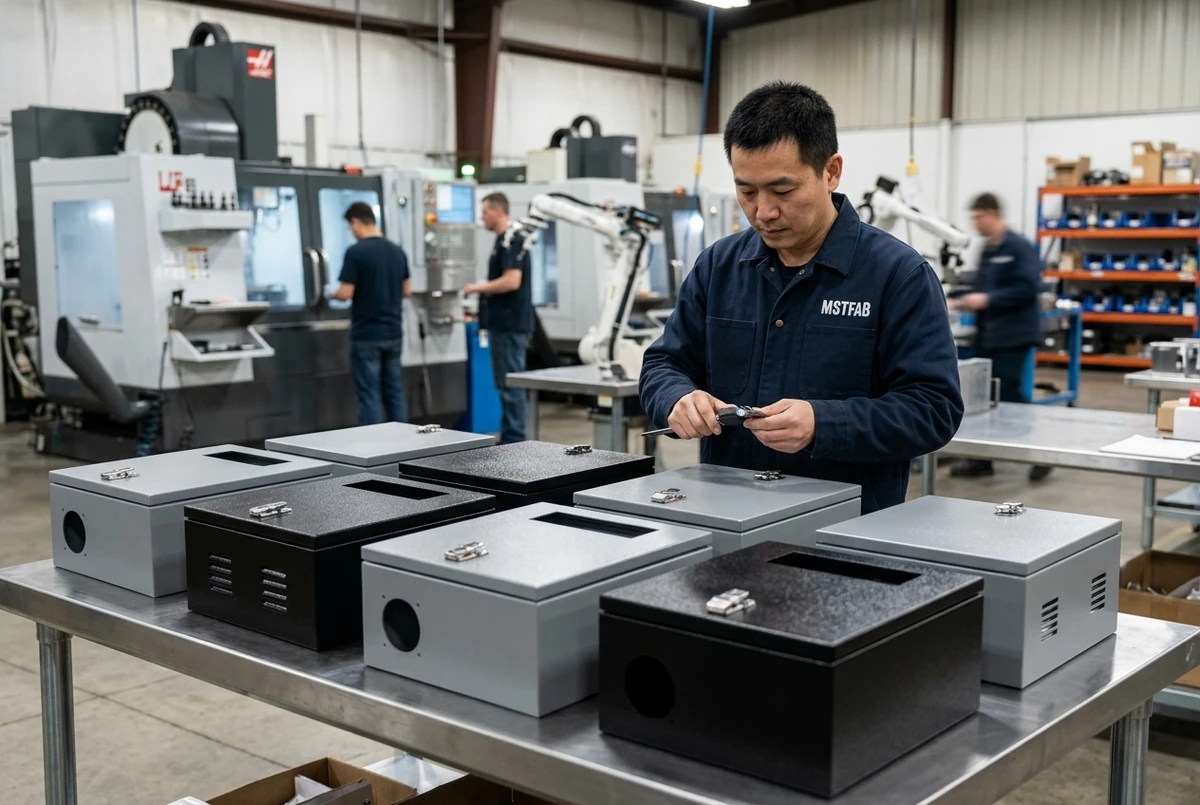
When evaluating custom metal enclosure manufacturers across the USA and global contract fabrication hubs, the optimal sourcing tier depends on annual volume, geometric complexity, and total landed cost. Standard catalog modifiers work well for low-volume enclosures that only need simple hole cutouts, whereas domestic regional job shops suit rapid prototyping and urgent local rework. For custom sheet metal geometries, multi-stage weldments, and repeatable production runs from 25 to 5,000+ units, partnering directly with an ISO 9001 and IATF 16949 certified contract fabricator like MSTFAB eliminates progressive die NRE costs through high-speed fiber laser cutting, CNC press brake forming, automated FIPFG gasket dispensing, and export-grade crating.
Explore this guide
01 / SOURCING ARCHITECTURE & TOTAL LANDED COST
Comparing Catalog Modifiers, Domestic Job Shops, and Direct Contract Fabricators
Hardware procurement engineers and OEM supply chain managers sourcing custom metal enclosures typically evaluate three distinct supplier models: off-the-shelf catalog enclosure modifiers, US domestic precision job shops, and direct global contract manufacturers. Selecting the wrong tier for a given lifecycle stage either inflates unit cost by 40% to 65% during scale-up or traps engineering teams in rigid catalog footprints that compromise internal DIN-rail density, airflow routing, and cable gland ergonomics.
Evaluating Total Cost of Ownership (TCO) requires looking beyond the ex-works unit price. A rigorous procurement model accounts for non-recurring engineering (NRE) fixtures, surface pretreatment durability, dimensional scrap rates, and freight cube utilization. Before issuing an RFQ package, review our Files Needed for Sheet Metal Fabrication Quote: STEP & DXF Guide to ensure your 3D CAD and 2D drawing package locks in accurate pricing across all supplier tiers.
Catalog Box Modifiers
Best for 1 to 20 units using standard rectangular sizes where only basic laser or milled cutouts are needed. High unit base cost and zero flexibility on box depth, flange return geometry, or integrated mounting brackets.
Domestic Local Job Shops
Ideal for 1 to 15 rapid engineering prototypes or urgent local turnarounds within 5 to 10 days. Labor-intensive TIG welding, manual deburring, and outsourced powder coating make mid-volume scaling cost-prohibitive.
Direct Contract Fabricators
Optimal for 25 to 5,000+ custom units per year. Vertically integrated CNC laser cutting, multi-axis bending, robotic/TIG seam welding, in-house 7-stage pretreatment powder coating, and automated FIPFG gasketing reduce landed cost while maintaining strict PPAP and FAI traceability.
Landed Cost Optimization Tip: For welded cabinets exceeding 600 × 600 × 300 mm, ocean freight volume (“shipping air”) can represent 18% to 28% of landed unit cost. Designing modular bolt-together sub-assemblies or nesting internal sub-plates inside the shipping footprint dramatically improves container density.
02 / PRECISION SHEET METAL WORKFLOWS
Core Manufacturing Workflows: Fiber Laser Cutting, CNC Bending, and Seam Welding
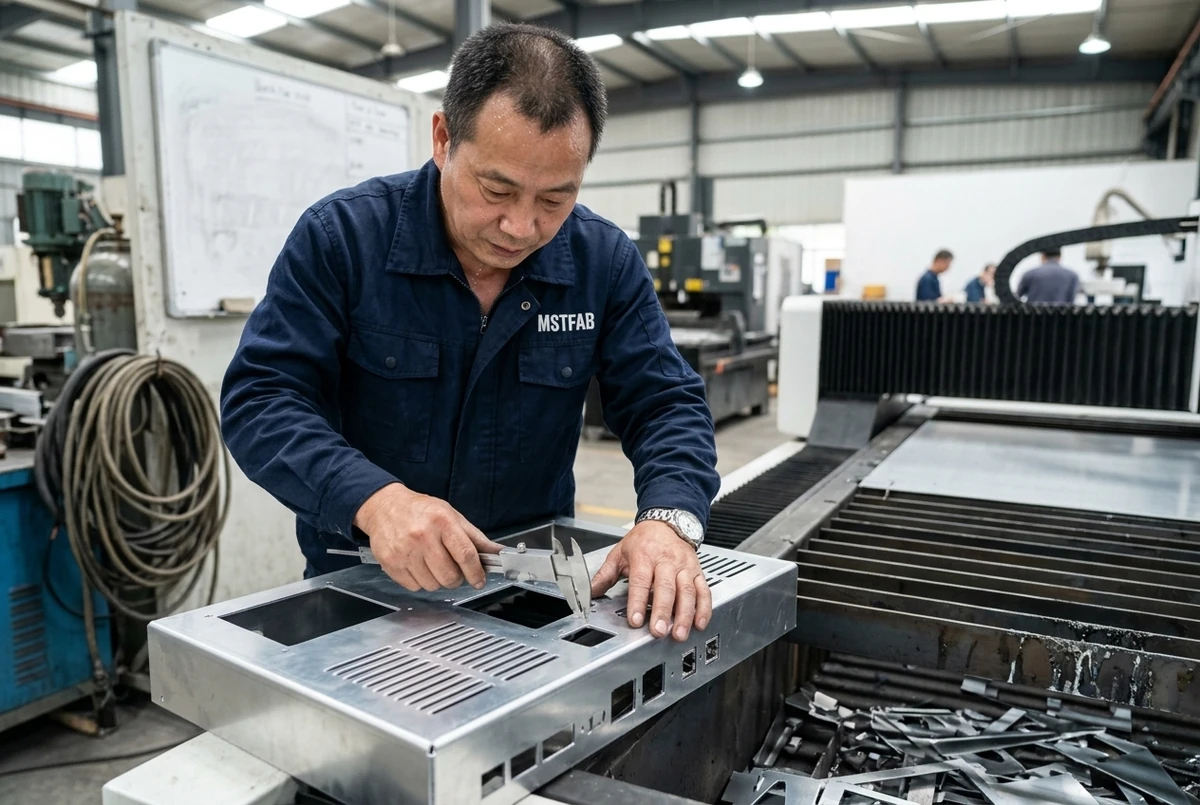
Repeatable enclosure manufacturing depends on controlling cumulative dimensional tolerances from flat blank development through final weldment stress relief. When flat pattern K-factors are guessed rather than calibrated to the specific V-die opening and material tensile batch, multi-bend door frames and gland plates suffer from corner mismatch, excessive weld gap bridging, and twisted mounting planes.
- High-Speed CNC Fiber Laser Blank Generation: 6 kW to 12 kW nitrogen-assisted fiber lasers cut cold-rolled steel (CRS), 5052-H32 aluminum, and 304/316L stainless steel with ±0.10 mm feature accuracy and oxide-free edges ready for direct powder coat adhesion.
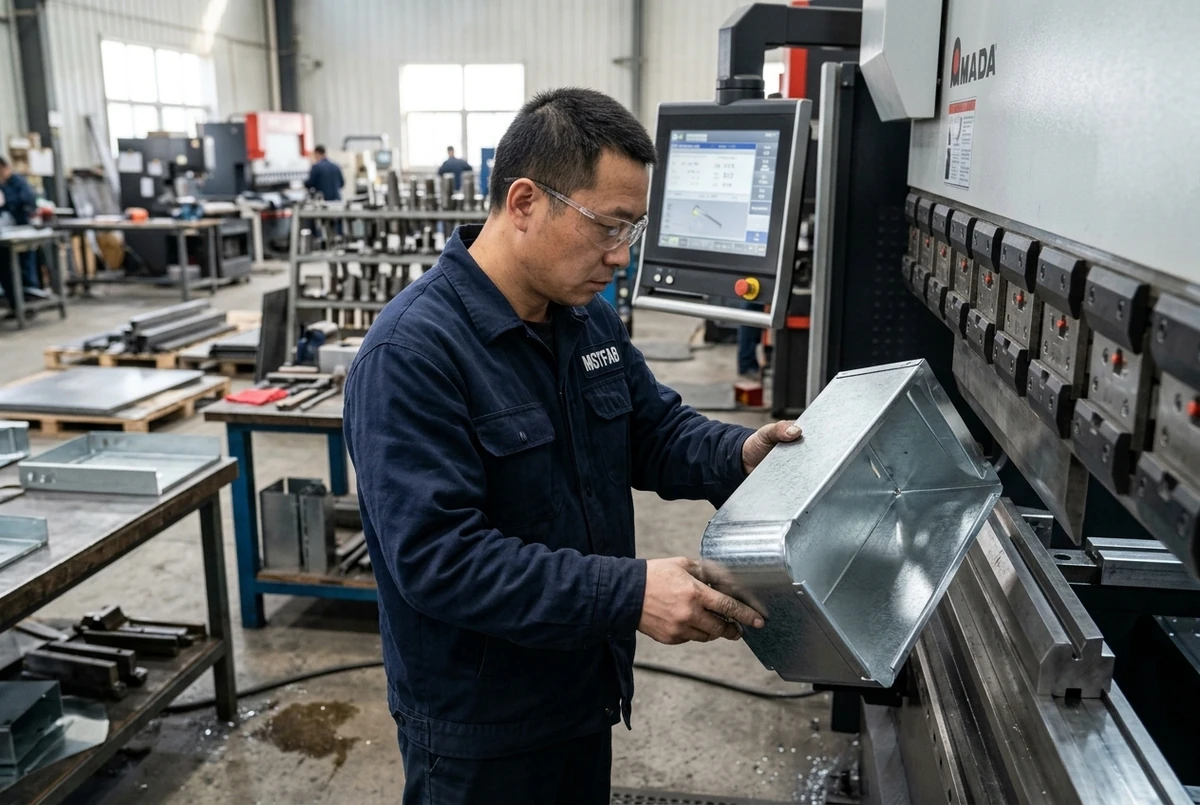
- Servo-Electric & Hydraulic CNC Press Brake Forming: Optical laser angle measurement systems compensate for coil-to-coil springback variations in real time, holding ±0.5° angularity on complex multi-bend rain gutters and knife-edge sealing channels.
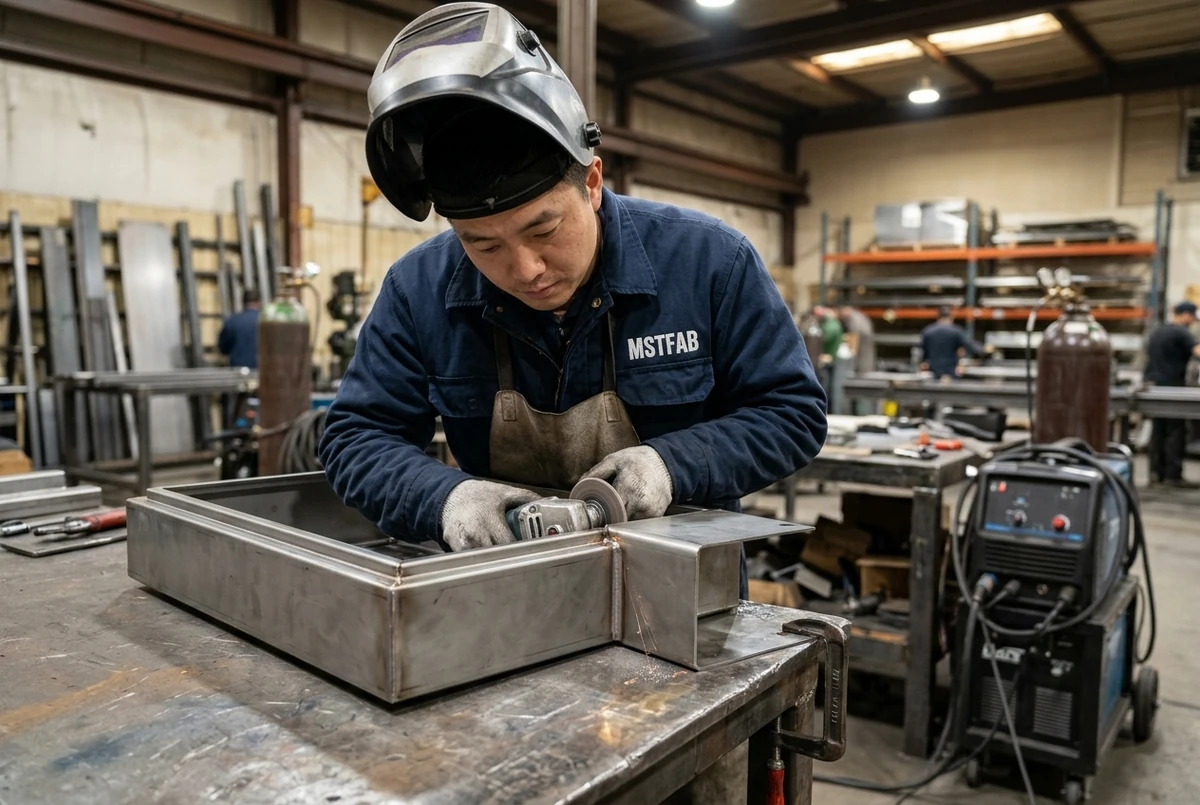
- Low-Heat-Input Pulsed TIG & Laser Seam Welding: Continuous corner seams are welded over copper chill bars to dissipate thermal energy rapidly, preventing thin-gauge panel oil-canning and preserving door-to-frame flatness within 1.0 mm per linear meter.
- Self-Clinching Hardware Installation: Hydraulic insertion presses install PEM® nuts, standoffs, and grounding studs with calibrated squeeze force into laser-sized mounting holes prior to surface finishing—or post-coat via masked/re-tapped threads where dielectric continuity is required.
To align your 2D engineering prints with realistic press brake and weldment capabilities, consult our Sheet Metal Fabrication Tolerances: GD&T and Inspection Guide and compare how tight-tolerance datum structures are verified in our Medical Bracket ±0.05 mm: Feasibility and Inspection Guide.
03 / INGRESS PROTECTION & GASKET ENGINEERING
Engineering Outdoor Enclosures for IP66 and NEMA 4X Environmental Sealing
Designing an enclosure shell to survive high-pressure hose-down, wind-driven rain, and coastal salt fog requires coordinated mechanical geometry between the enclosure body, the hinged door perimeter, and the elastomer seal. Simply applying die-cut adhesive tape foam to a flat sheet metal flange inevitably fails in the field due to corner butt-joint leakage and compression set relaxation under thermal cycling.
- Perimeter rain trough and 45° watershed lip above the upper door opening to divert standing water away from the gasket interface before opening the door.
- Hemmed 180° knife-edge return channel around the enclosure aperture that distributes clamping pressure evenly without slicing into the polyurethane elastomer.
- CNC-dispensed two-component Form-in-Place Foam Gasket (FIPFG) that cures directly onto the pretreated door channel with a seamless, splice-free perimeter.
- 30% to 45% controlled gasket compression ratio regulated by multi-point quarter-turn compression latches and heavy-duty concealed stainless steel hinges.
- Sealing washer integration or internal welded blind bosses so external mounting provisions never penetrate the dry internal electronics zone.
When sourcing larger outdoor power cabinets or modular energy enclosures, defining ownership boundaries between the structural sheet metal shell and active electrical sub-systems prevents costly scope gaps during factory acceptance testing.
Review the BESS Cabinet Shell Scope Matrix: Included, Excluded and Buyer-Owned →
04 / METALLURGY & CORROSION PROTECTION
Material Selection and Surface Finishing for C1 to C5-M Harsh Environments
Selecting the base alloy and surface treatment architecture determines both thermal dissipation performance and multi-decade corrosion resistance. While indoor automation panels thrive with cold-rolled steel (SPCC / ASTM A1008) and a 60–80 μm epoxy-polyester powder coat, marine, chemical processing, and solar inverter housings require specialized metallurgical and conversion-coating controls.
- Cold-Rolled & Galvanneal Steel (SPCC / SECC / SGCC): Cost-effective structural rigidity and high magnetic permeability for low-frequency EMI shielding; paired with zinc phosphate or zirconium nano-ceramic pretreatment plus exterior-grade TGIC-free polyester powder coating.
- Marine-Grade Aluminum (5052-H32 & 6061-T6): One-third the weight of steel with high thermal conductivity for sealed heat-sink enclosures; 5052-H32 forms tight 1.0t inner bend radii without micro-cracking, followed by RoHS-compliant trivalent chromate conversion (MIL-DTL-5541 Type II) and powder topcoat.
- Austenitic Stainless Steel (304L & 316L): Mandatory for washdown food equipment, chemical plants, and coastal infrastructure. Requires dedicated stainless-only tooling, laser nitrogen assist gas, and post-weld citric/nitric passivation to remove free iron.
- Dual-Coat E-Coat + Powder Architecture: For ISO 12944 C4 and C5-M industrial atmospheres, cathodic epoxy electrocoating penetrates internal hemmed edges before UV-stable polyester powder topcoating, exceeding 1,000-hour ASTM B117 neutral salt spray resistance.
Even 304 or 316L stainless steel enclosures will develop premature rust staining if carbon steel grinding dust or press brake die transfer contaminates the grain structure. Read our 304 Stainless Steel Free-Iron Contamination Control Guide to see how isolated fabrication cells and chemical passivation protect stainless steel enclosures.
05 / TECHNICAL VERIFICATION MATRIX
Enclosure Sourcing & Engineering Verification Matrix
Use this technical verification matrix during supplier qualification and pre-production DFM review to align drawing specifications, manufacturing process controls, and objective quality evidence before releasing production tooling or batch fabrication.

06 / EMC SHIELDING, THERMAL & STRUCTURAL DFM
Designing for EMC/EMI Attenuation, Thermal Dissipation, and Structural Rigidity
Modern industrial control cabinets house high-frequency variable frequency drives (VFDs), switching power supplies, and wireless telemetry modules that demand both electromagnetic compatibility (EMC) and predictable thermal management. Because high-frequency electromagnetic waves escape through narrow slot apertures rather than through solid metal walls, unshielded door seams and painted grounding interfaces act as slot antennas unless engineered for continuous low-impedance conductivity.
To maintain shielding effectiveness across the 30 MHz to 1 GHz spectrum, specify high-temperature silicone masking caps over copper-plated grounding studs (M6/M8) and bare metal bonding tracks around cable entry gland plates. Where environmental sealing and EMI shielding must coexist, dual-profile conductive elastomer gaskets or beryllium-copper fingerstock paired with an outer weather seal preserve both IP66 ingress protection and < 2.5 milliohm door-to-body transfer impedance.
For outdoor enclosures exposed to high solar radiation flux, passive double-wall sunshields with a 25 mm ventilated air gap reduce internal solar heat gain by up to 60% without compromising the sealed inner NEMA/IP shell. Inside high-vibration transport or seismic installations, adding 90° return stiffening flanges along wide span panels and specifying gusseted mounting ears increase the fundamental structural natural frequency above 35 Hz, preventing resonant fatigue cracking.
Submit Your Enclosure Drawings for a 24-Hour DFM & Cost Review →
07 / COMPLIANCE, QUALITY SYSTEMS & SCOPE
Quality Management Traceability and Clear OEM Certification Boundaries
Sourcing custom metal enclosures for industrial automation, renewable energy, telecommunications, and commercial instrumentation requires transparent quality system governance. MSTFAB operates under verified ISO 9001 quality management, IATF 16949 automotive process controls, and ISO 14001 environmental management standards—enforcing batch-level material traceability, calibrated CMM/optical inspection, and documented in-process quality gates from raw sheet cutting to final crating.
When evaluating supplier credentials, procurement teams should always separate factory quality management certifications (such as ISO 9001 and IATF 16949) from end-product electrical or system approvals. An empty sheet metal enclosure shell is a mechanical component built strictly to the buyer’s 3D CAD and 2D engineering specifications; final system-level safety, ingress, and electromagnetic compliance testing is conducted on the fully populated, wired assembly.
Manufacturing scope: MSTFAB manufactures custom drawing-based sheet metal parts, mechanical sub-assemblies, and unpopulated enclosure shells under ISO 9001, IATF 16949, and ISO 14001 quality systems. Final powered equipment, electrical safety, and end-system regulatory certifications remain the responsibility of the OEM.
08 / PRE-RELEASE RFQ CHECKLIST
Pre-Release Technical Drawing and RFQ Package Checklist for Custom Enclosures
- Native 3D STEP (AP214/AP242) + 2D PDF Drawing:Provide neutral 3D solid geometry for automated unfolding alongside a 2D PDF print that calls out critical datums, threads, and cosmetic surfaces.
- Explicit Material Grade & Nominal Thickness:Specify exact standard (e.g., SPCC 1.5 mm, 5052-H32 2.0 mm, or 304L 1.5 mm) rather than ambiguous gauge numbers that differ between steel and aluminum.
- Internal Bend Radius Alignment:Standardize all sheet metal bends to a consistent inside bend radius (typically R = 1.0t to 1.5t) so parts can be formed in a single V-die setup.
- Self-Clinching Fastener Callouts & Sequence:List exact PEM® part numbers (e.g., CLS-M4-2, BSO-M5-10), installation side, and whether threads must be masked during powder coating.
- Weld Joint Type & Cosmetic Grind Zones:Differentiate Class A visible exterior corners (continuous TIG weld, ground smooth) from non-visible internal structural stitch welds.
- Surface Finish, Color, Texture & Masking Map:Call out RAL or Pantone code, gloss level, texture (smooth vs. fine sand/wrinkle), DFT range, and hatched masking zones on the 2D drawing.
- Gasket Material & Latch Hardware BOM:Specify dispensed FIPFG polyurethane foam vs. EPDM profile, along with exact hinge, quarter-turn lock, and gland plate fastener specifications.
- Batch Quantity Tiers & Packaging Standard:Include prototype quantity alongside EAU (Estimated Annual Usage) and required export palletizing or individual carton drop-test criteria.
Providing these eight engineering inputs up front eliminates multi-day RFQ clarification loops, prevents conservative risk buffers in unit pricing, and enables MSTFAB to return a detailed DFM and landed-cost quotation within 24 hours.
Frequently Asked Questions: Sourcing Custom Metal Enclosures
What is the typical MOQ and lead time when ordering custom metal enclosures from MSTFAB?
We support low-volume prototyping starting from 1 to 10 units (typically 7 to 12 calendar days via soft-tooled CNC laser cutting and press brake forming) and scale seamlessly into production batches of 25 to 5,000+ units (typically 2 to 4 weeks depending on surface finishing and hardware complexity).
How do you prevent thin-gauge sheet metal doors and side panels from warping during welding?
Our welding engineers utilize precision modular clamping fixtures, copper heat-sink chill bars, and pulsed TIG or fiber-laser seam welding parameters that minimize the heat-affected zone (HAZ). For wide doors exceeding 500 mm, we incorporate formed perimeter return flanges or spot-welded internal hat-section stiffeners.
Why is CNC-dispensed FIPFG gasketing preferred over manual adhesive foam tape for outdoor enclosures?
Manual die-cut foam tape relies on pressure-sensitive adhesive that peels under high humidity and leaves vulnerable mitered corner seams where water wicks inside. CNC Form-in-Place Foam Gasketing (FIPFG) dispenses a liquid two-part polyurethane elastomer directly into the door channel, curing into a chemical bond with only a single micro-bonded overlap and 95%+ compression recovery.
Can you install internal sub-plates, DIN rails, viewing windows, and compression latches before shipment?
Yes. We provide complete mechanical sub-assembly including galvanized or alodine-treated internal mounting backplanes (sub-plates), polycarbonate or tempered glass viewing windows bonded with structural gaskets, hinges, quarter-turn compression locks, louvers, and pre-installed self-clinching hardware.
How are powder-coated or brushed stainless enclosures protected from transit damage during international freight?
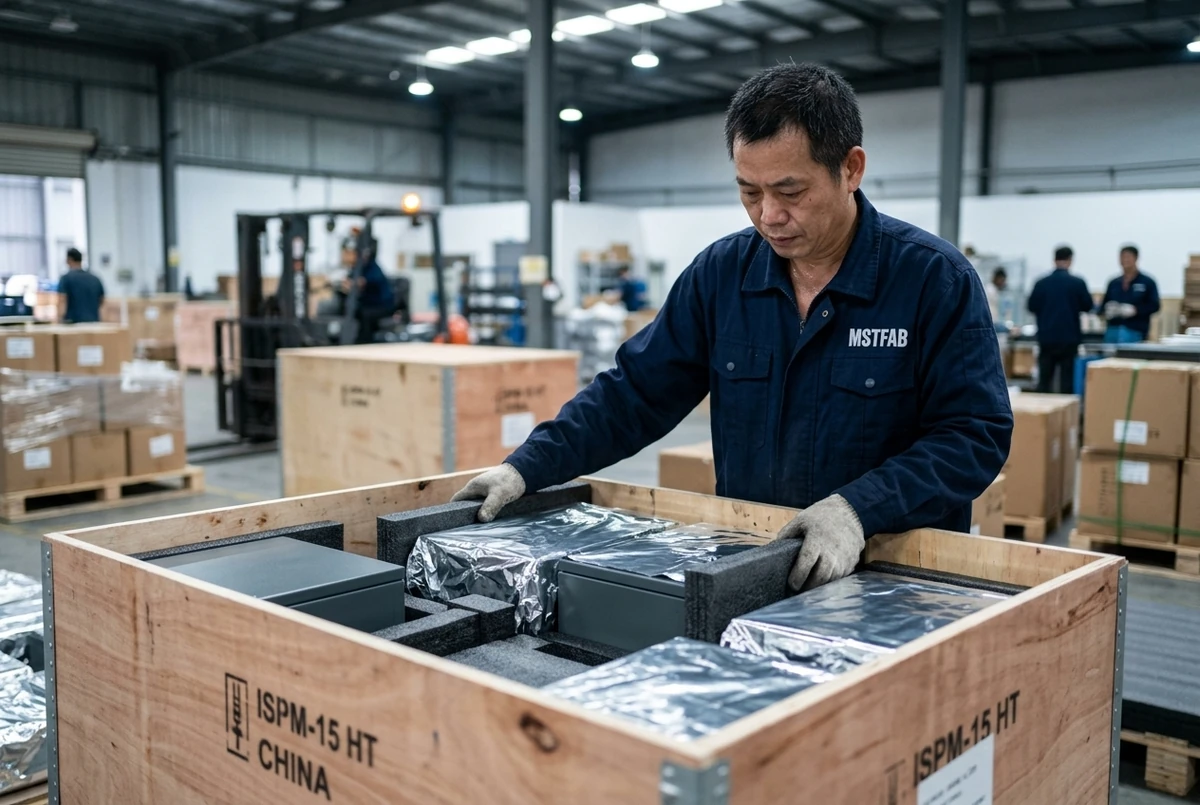
Every finished enclosure is wrapped in non-abrasive EPE foam and VCI anti-corrosion film, separated by custom-slotted honeycomb cardboard dividers, and secured inside ISPM-15 certified heat-treated plywood export crates with reinforced steel corner protectors.
What quality inspection documentation is included with production enclosure shipments?
Every production shipment includes an incoming material verification report (with EN 10204 3.1 mill certificates upon request), First Article Inspection (FAI) dimensional data, coating dry film thickness (DFT) and cross-hatch adhesion test logs, and pre-shipment visual and packaging verification photos.
Technical references
Key international engineering standards and design references applicable to custom sheet metal enclosure fabrication and verification:
- ISO 2768-1 / ISO 2768-2 — General tolerances for linear and angular dimensions and geometrical tolerances without individual tolerance indications
- ISO 12944 — Paints and varnishes: Corrosion protection of steel structures by protective paint systems (C1 to C5/CX atmospheric categories)
- IEC 60529 / NEMA 250 — Degrees of protection provided by enclosures (IP Code) and environmental design guidelines for electrical enclosures
- ISO 5817 — Welding: Fusion-welded joints in steel, nickel, titanium and their alloys (quality levels for imperfections)
Ready to Benchmark Your Custom Metal Enclosure Quote?
Send us your 3D STEP files, 2D PDF drawings, and target batch quantities. Our manufacturing engineers will review your bend radii, seam weld geometry, sealing profile, and coating specs—and deliver a transparent DFM analysis and quotation within 24 hours.
Submit Your Enclosure Drawings →
Have a question first? caroline@mstfab.com
 WeChat Contact
 WhatsApp Me Directly