
Selecting between aluminum and steel is one of the most critical structural and financial decisions in custom sheet metal fabrication. Sourcing directors and mechanical engineers often begin with a simplistic metric: raw steel coil costs significantly less per kilogram than raw aluminum ingot. However, evaluating true Total Cost of Ownership (TCO) requires balancing material density (2.70 g/cm³ for aluminum vs 7.85 g/cm³ for steel), structural flexural rigidity (Esteel ≈ 205 GPa vs Eal ≈ 70 GPa), fiber laser cutting speeds, forming K-factors, post-fabrication finishing requirements (anodizing vs powder coating vs electro-galvanizing), and global shipping freight. As an ISO 9001:2015 and ISO 13485:2016 certified sheet metal supplier, MSTFAB delivers data-driven Design for Manufacturability (DFM) analyses to help OEM teams select the optimal material alloy, calculate accurate sheet thickness equivalence, and secure competitive production quotes.
Table of Contents
- 1. Density, Weight, and Flexural Rigidity: The Physics of Equivalence
- 2. Common Sheet Alloys: 5052, 6061, SPCC, SECC, and Stainless 304/316
- 3. Press Brake Bending: Minimum Radii, Springback, and K-Factors
- 4. Fiber Laser Cutting Dynamics: Kerf, Speed, and Assist Gas Economics
- 5. Fastener Clinching (PEM): Retention, Hardness Delta, and Galvanic Isolation
- 6. Electrochemical Galvanic Corrosion Engineering in Bimetallic Assemblies
- 7. Thermal Dissipation and High-Frequency EMI Shielding Dynamics
- 8. Precision Welding: Arc Stability, Thermal Conductivity, and Distortion
- 9. Surface Finishing and Corrosion Protection: Anodize vs Powder vs Zinc
- 10. Total Landed Cost Analysis: Material, Processing, Finishing, and Freight
- 11. Life-Cycle Carbon Footprint, Scope 3 Emissions, and Circular Recycling
- 12. Comprehensive Engineering Data Matrices and Selection Benchmarks
- 13. Real-World OEM Case Studies: Aluminum vs Steel Trade-Offs
- 14. How to Prepare CAD Models and RFQs for 24-Hour Quoting
- 15. Frequently Asked Technical Questions (32 Detailed Engineering Q&As)
1. Density, Weight, and Flexural Rigidity: The Physics of Equivalence
A common mistake in initial sheet metal design is performing a “one-to-one thickness substitution” between aluminum and steel. Replacing a 1.5 mm cold-rolled steel bracket with a 1.5 mm 5052-H32 aluminum bracket will indeed cut the part’s weight by 65.6%. However, because aluminum’s modulus of elasticity (E ≈ 70 GPa) is only one-third that of steel (E ≈ 205 GPa), the 1.5 mm aluminum bracket will deflect three times more under the identical mechanical payload.
The Mathematics of Equal Flexural Stiffness
The elastic deflection δ of a flat sheet metal panel or cantilevered shelf subjected to a point load P across span L is governed by beam bending mechanics:
δ = (P × L³) / (4 × E × b × T³)
Where b is width and T is sheet thickness. To achieve identical deflection (δal = δsteel) between an aluminum sheet and a steel sheet of equal width and span, the flexural rigidity product (E × I) must be equal:
Eal × (Tal)³ = Esteel × (Tsteel)³
Tal = Tsteel × (Esteel / Eal)^(1/3) = Tsteel × (205 / 70)^(1/3) ≈ 1.431 × Tsteel
This fundamental physics equation reveals that an aluminum sheet must be approximately 43% to 44% thicker than a steel sheet to match its flexural stiffness. For example, replacing a 1.0 mm steel panel requires a 1.5 mm aluminum sheet, while replacing a 2.0 mm steel panel requires a 3.0 mm aluminum sheet.
Net Weight Savings at Equivalent Stiffness
Even after increasing thickness by 43.1% to achieve equal rigidity, aluminum delivers substantial net weight savings due to its low density (hoal = 2.70 g/cm³ vs hosteel = 7.85 g/cm³):
Wal / Wsteel = (ρal × Tal) / (ρsteel × Tsteel) = (2.70 × 1.431 × Tsteel) / (7.85 × Tsteel) ≈ 0.492
Thus, an aluminum structure engineered for equivalent bending stiffness achieves an outstanding 50.8% net weight reduction compared to steel. In mobile equipment, aerospace avionics, electric vehicles, and handheld medical devices, this 50% mass reduction drastically improves battery range, reduces operator fatigue, and slashes global airfreight shipping expenses.
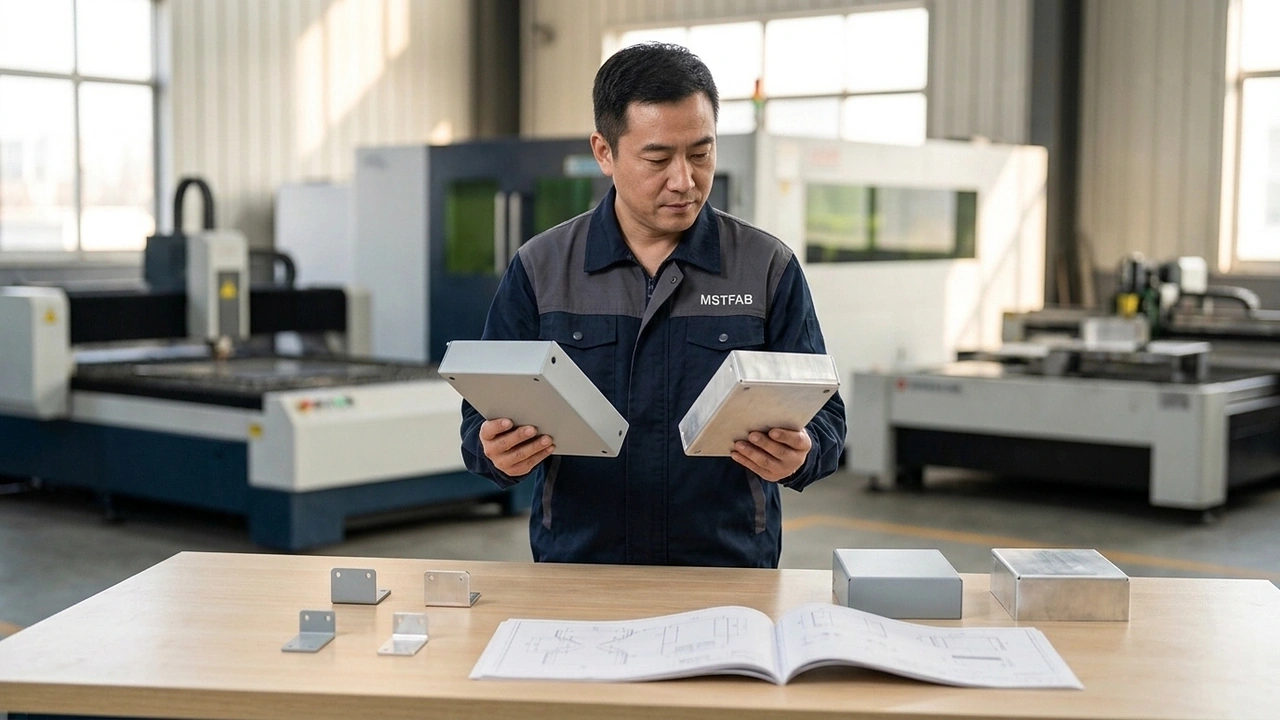
Figure 1: MSTFAB engineering benchmark comparing powder-coated cold-rolled steel enclosures against anodized 5052-H32 aluminum chassis components to determine cost-performance parity.
2. Common Sheet Alloys: 5052, 6061, SPCC, SECC, and Stainless 304/316
Selecting the right alloy within the aluminum or steel family is just as important as choosing between the two metals. The table below outlines the mechanical and metallurgical profiles of the primary grades processed at MSTFAB:
| Alloy & Specification | Density (g/cm³) | Yield Strength (MPa) | Tensile Strength (MPa) | Elastic Modulus (GPa) | Key Characteristic |
|---|---|---|---|---|---|
| Aluminum 5052-H32 | 2.68 | 195 – 215 | 230 – 260 | 70.3 | Premier sheet metal alloy; excellent formability, corrosion-proof, weldable |
| Aluminum 6061-T6 | 2.70 | 275 – 310 | 310 – 340 | 68.9 | High strength; structural frames and machined baseplates; cracks if bent tight |
| SPCC Cold Rolled Steel | 7.85 | 130 – 210 | 270 – 380 | 207 | Standard commercial steel; lowest raw material cost; requires paint/plating |
| SECC Electro-Galvanized | 7.85 | 140 – 240 | 270 – 410 | 205 | Zinc-coated sheet with anti-fingerprint resin; ideal for internal computer chassis |
| AISI 304 Stainless Steel | 7.93 | 205 – 260 | 515 – 690 | 193 | Austenitic stainless; outstanding corrosion resistance; sanitary food/medical use |
| AISI 316L Stainless Steel | 8.00 | 220 – 290 | 520 – 680 | 193 | Molybdenum-bearing; ultra-low carbon; resists chloride pitting & bleach |
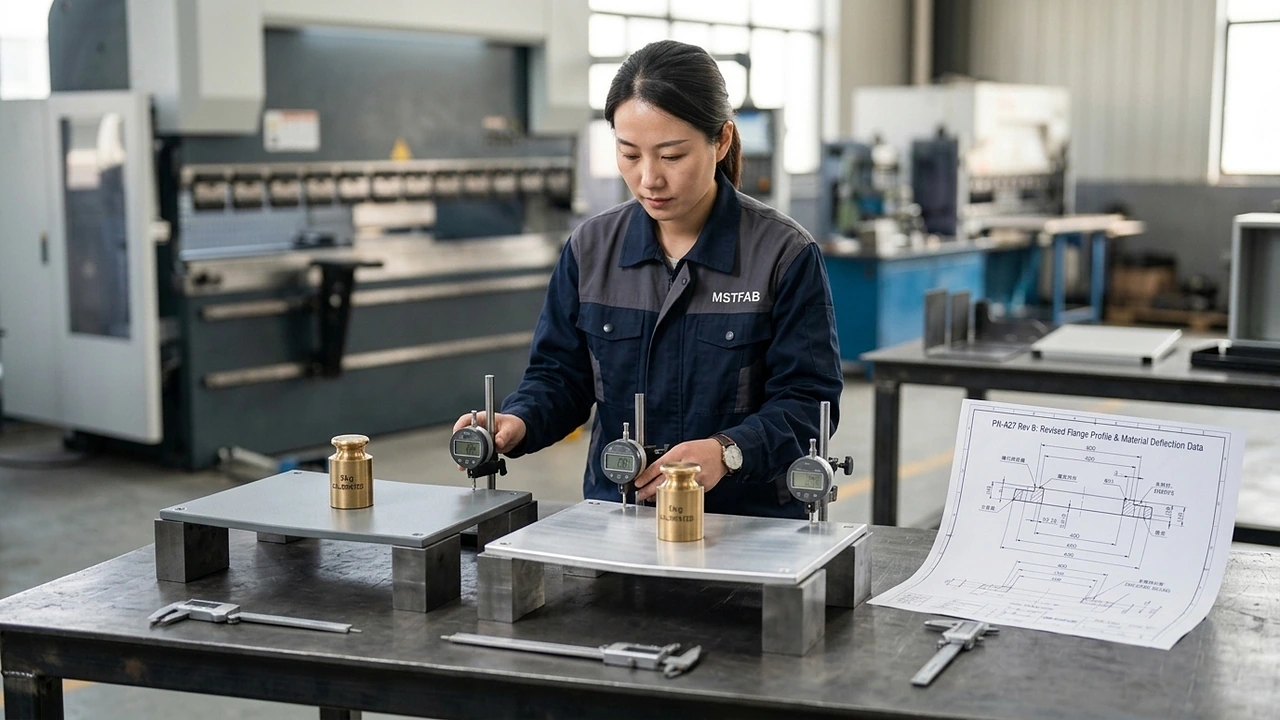
Figure 2: Empirical deflection test measuring elastic deformation of aluminum and steel test panels under point loads on a precision granite surface plate.
3. Press Brake Bending: Minimum Radii, Springback, and K-Factors
Forming characteristics differ radically between aluminum and steel. Steel is an exceptionally ductile, forgiving material capable of withstanding sharp inside bend radii (Rmin ≈ 0.5 × T) without tearing. Aluminum, by contrast, has lower elongation at break and is prone to tensile micro-fracturing along outer bend radii if forced into overly sharp punches.
Inside Bend Radius Guidelines
- 5052-H32 Aluminum: Can achieve an inside bend radius equal to material thickness (Rmin = 1.0 × T) when bent perpendicular to the rolling grain. If bent parallel to grain, Rmin ≥ 1.5 × T must be specified to avoid orange-peel cracking.
- 6061-T6 Aluminum: Being a precipitation-hardened aerospace temper, 6061-T6 has low ductility. Sharp bends will crack immediately. The minimum safe bend radius is Rmin ≥ 2.5 × T to 3.0 × T, and parts should be annealed to 6061-O if tight bends are mandatory, then re-heat treated.
- Cold-Rolled Steel (SPCC/SECC): Highly ductile ferrite-pearlite microstructure accommodates tight bends (Rmin = 0.5 × T to 1.0 × T) in any grain orientation without surface degradation.
K-Factor and Tooling Contamination
Neutral axis shift during air bending varies by alloy. MSTFAB utilizes calibrated K-factors: K = 0.44 for 5052-H32 aluminum, K = 0.42 for SPCC mild steel, and K = 0.38 for 304 stainless steel. Furthermore, bending aluminum on press brake dies that previously formed carbon steel can embed free iron particles into the aluminum surface. This causes severe galvanic pitting during subsequent anodizing or outdoor exposure. MSTFAB prevents cross-contamination by maintaining dedicated aluminum V-dies and utilizing non-marking urethane protective films.
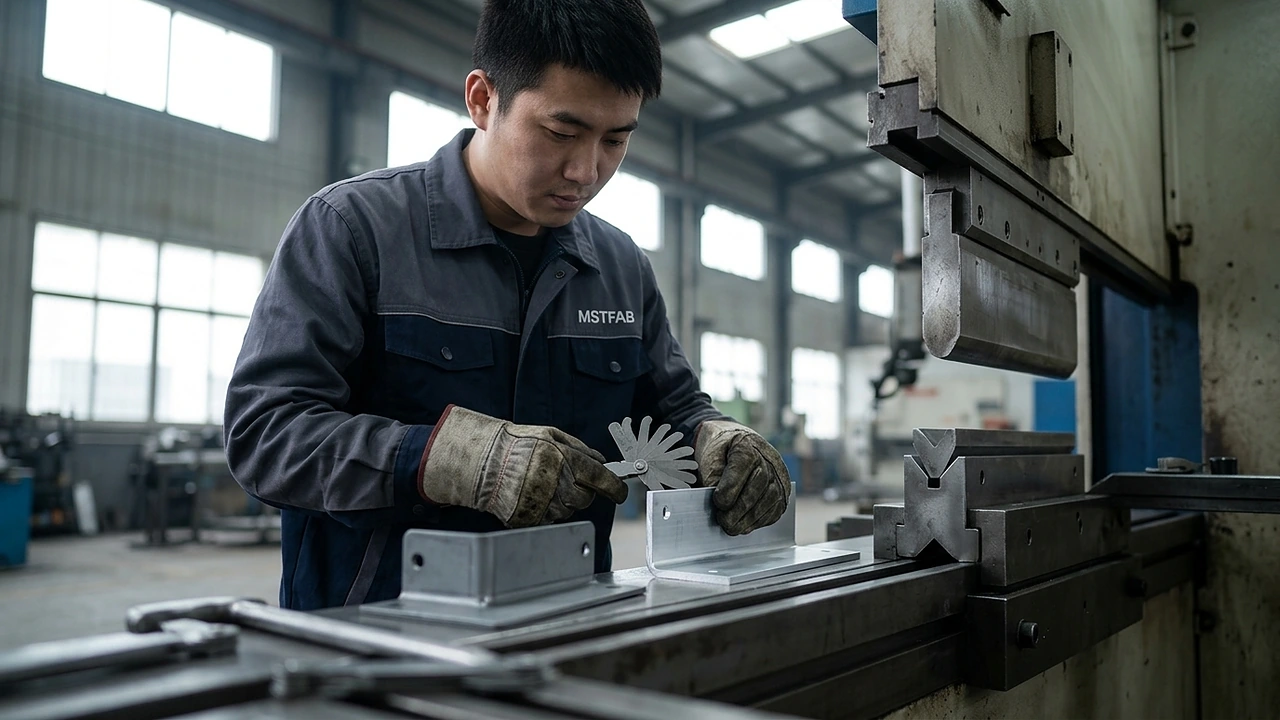
Figure 3: Metrology inspection of inside bend radii on aluminum vs. steel brackets using precision radius leaf gauges to ensure no micro-fracturing occurs.
4. Fiber Laser Cutting Dynamics: Kerf, Speed, and Assist Gas Economics
Fiber laser cutting parameters differ significantly between aluminum and steel due to variations in optical reflectivity, thermal conductivity, and chemical reactivity:
- Thermal Conductivity Sink Effect: Aluminum conducts heat at approximately 138 W/m·K, more than double that of carbon steel (54 W/m·K) and eight times that of stainless steel (16 W/m·K). During laser piercing and cutting, heat rapidly dissipates away from the cut zone into the parent sheet. Fiber lasers require high peak pulse power (6 kW to 12 kW) and fast feed rates to vaporize aluminum before thermal bleeding overheats the surrounding sheet.
- Assist Gas Economics:
- Carbon Steel: Can be cut with economical low-pressure oxygen (0.5 to 3 bar). Oxygen initiates an exothermic oxidation burn that boosts cutting speed and allows clean cutting of heavy 20 mm plates with modest laser power.
- Aluminum & Stainless Steel: Require high-pressure nitrogen assist gas (18 to 24 bar). Nitrogen operates as a purely mechanical gas jet that flushes molten aluminum out of the kerf. Because nitrogen consumption at 20 bar is substantial (40 – 80 m³/hour), laser cutting operational costs for aluminum are typically 15% to 25% higher than oxygen-cut mild steel of the same thickness.
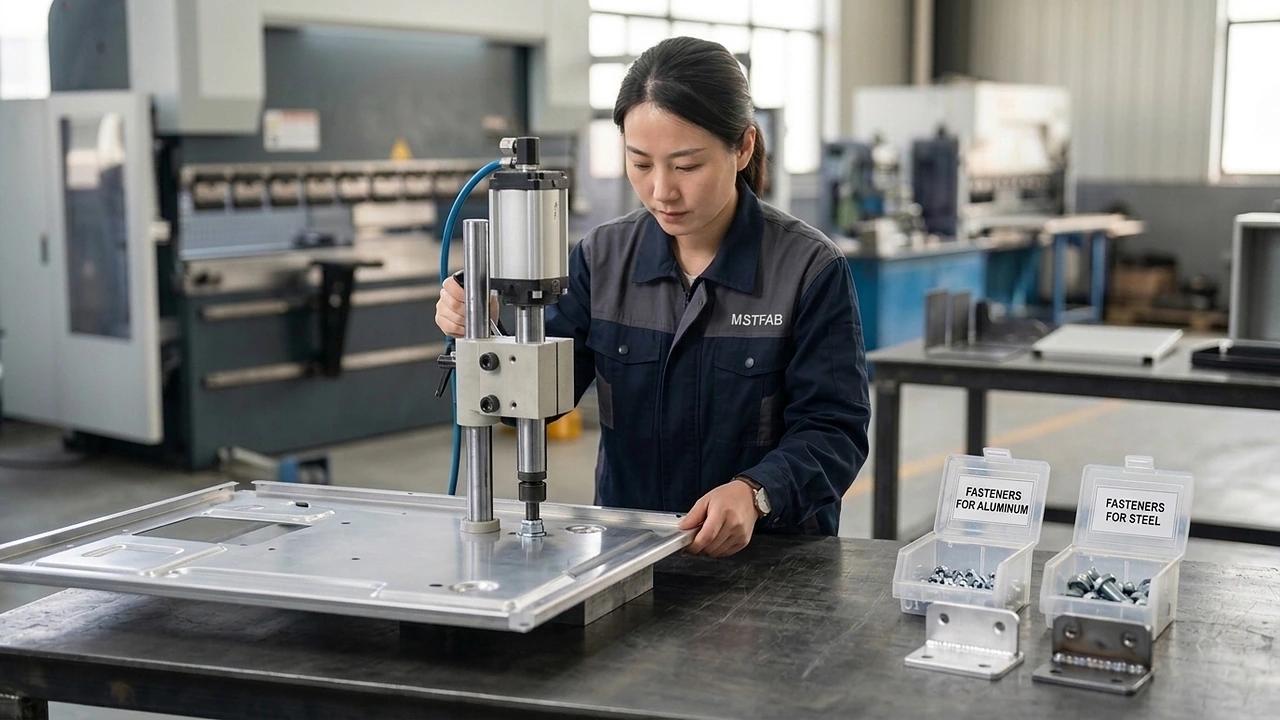
Figure 4: Hardware clinching station: installing self-clinching PEM nuts and standoffs with color-coded hardware management to prevent cross-alloy galvanic contamination.
5. Fastener Clinching (PEM): Retention, Hardness Delta, and Galvanic Isolation
Self-clinching fasteners (PEM nuts, studs, standoffs) require a mandatory hardness differential: the host sheet metal must be at least 20 points Rockwell B softer than the fastener to ensure the sheet metal cold-flows into the clinch undercut without damaging the fastener.
Fastener Selection Rules for Aluminum vs Steel
- Installing Fasteners in Steel Sheets: Standard zinc-plated case-hardened carbon steel fasteners (PEM S nuts, FH studs) or 300-series stainless steel fasteners (PEM CLS nuts) can be installed directly into SPCC and SECC sheets (HRB ≤ 80) with exceptional push-out retention (> 1,350 N for M4).
- Installing Fasteners in Aluminum Sheets: Standard carbon steel fasteners should never be installed in aluminum if exposed to humidity or marine atmospheres. The electrochemical potential difference between carbon steel (E° ≈ -0.44 V) and aluminum (E° ≈ -1.66 V) exceeds 1.2 Volts, triggering rapid galvanic corrosion that turns the aluminum around the clinch hole into white aluminum hydroxide powder, leading to fastener tear-out.
- Approved Fasteners for Aluminum: MSTFAB specifies 300-series austenitic stainless steel fasteners (PEM CLS/FHS) with passivation, aluminum alloy fasteners (PEM CLA nuts in 7075-T6 aluminum), or specialized zinc-nickel plated fasteners tested to 1,000-hour ASTM B117 salt spray ratings.
6. Electrochemical Galvanic Corrosion Engineering in Bimetallic Assemblies
When aluminum and steel components are combined into a single hybrid assembly (such as a steel structural base joined to an aluminum cosmetic shell), designers must account for electrochemical galvanic coupling. In the presence of an electrolyte (condensed moisture, salt spray, or cleaning washdowns), the two dissimilar metals establish a galvanic cell.
The Galvanic Potential Hierarchy
According to military standard MIL-STD-889D, the open-circuit corrosion potentials in a 3.5% NaCl electrolyte indicate the relative anodic/cathodic relationship:
- Active Anode: 5052/6061 Aluminum (-0.85 V vs Saturated Calomel Electrode – SCE)
- Intermediate: Carbon Steel / Cold-Rolled Steel (-0.60 V to -0.70 V)
- Noble Cathode: Passivated 304/316 Stainless Steel (-0.08 V to -0.15 V)
When aluminum is in direct electrical contact with stainless steel or carbon steel, the voltage differential exceeds the critical 0.15 V threshold for harsh outdoor environments, making aluminum the sacrificial anode. The corrosion rate is further multiplied by the Anode-to-Cathode Area Ratio: a small aluminum rivet or thin bracket attached to a massive steel frame will corrode aggressively within weeks.
Practical Isolation Strategies
- Dielectric Barrier Isolation: Installing non-conductive nylon, EPDM, or polyimide Mylar washers and shoulder bushings between aluminum flanges and steel mounting hardware breaks the electrical circuit, preventing galvanic electron transfer.
- Electroless Nickel Plating or Zinc-Nickel (Zn-Ni): Fasteners and steel brackets coated with 12% to 15% zinc-nickel alloy achieve an open-circuit potential of -0.80 V, matching aluminum’s potential and neutralizing galvanic driving force.
- Chemical Conversion Coating (Alodine / SurTec 650): Class 1A hex-free chromate conversion coating creates a dense fluorozirconate protective barrier that significantly impedes ionic transfer across contact interfaces.
7. Thermal Dissipation and High-Frequency EMI Shielding Dynamics
In electronic enclosures, telecommunications subracks, and high-voltage power converters, the enclosure performs double duty as a heat sink and an electromagnetic interference (EMI) shield.
Thermal Dissipation Dynamics
Heat conduction across the enclosure wall follows Fourier’s Law:
Q = -k × A × (dT / dx)
Where k is thermal conductivity. 5052-H32 aluminum (k = 138 W/m·K) conducts thermal energy 2.5 times faster than mild steel (k = 54 W/m·K) and 8.5 times faster than stainless steel (k = 16.2 W/m·K). For power inverter enclosures, sealed outdoor battery pods, and processor cooling shrouds, utilizing aluminum allows the outer enclosure panels to function as direct conduction heat spreaders, lowering internal component junction temperatures by 12°C to 18°C without auxiliary fans.
Electromagnetic Shielding Effectiveness (SE)
Total shielding attenuation SE (in dB) consists of absorption loss (A), reflection loss (R), and multiple internal reflection correction (B):
SE = R + A + B
Electromagnetic skin depth δ is inversely proportional to frequency f, magnetic permeability μ, and electrical conductivity σ:
δ = 1 / √(π × f × μ × σ)
- High-Frequency RF & Plane Waves (> 100 MHz to 10 GHz): Aluminum’s superior electrical conductivity (35% to 43% IACS vs steel’s 12%) produces exceptionally high reflection and absorption losses, delivering > 75 dB shielding attenuation for 5G telecommunications, Wi-Fi 6E, and radar avionics.
- Low-Frequency Magnetic Fields (< 100 kHz): Carbon steel and silicon steel provide superior shielding against low-frequency AC magnetic fields emitted by large 50/60 Hz power transformers, because steel’s high relative magnetic permeability (μr > 1,000) diverts magnetic flux lines through the enclosure wall away from sensitive sensor electronics.
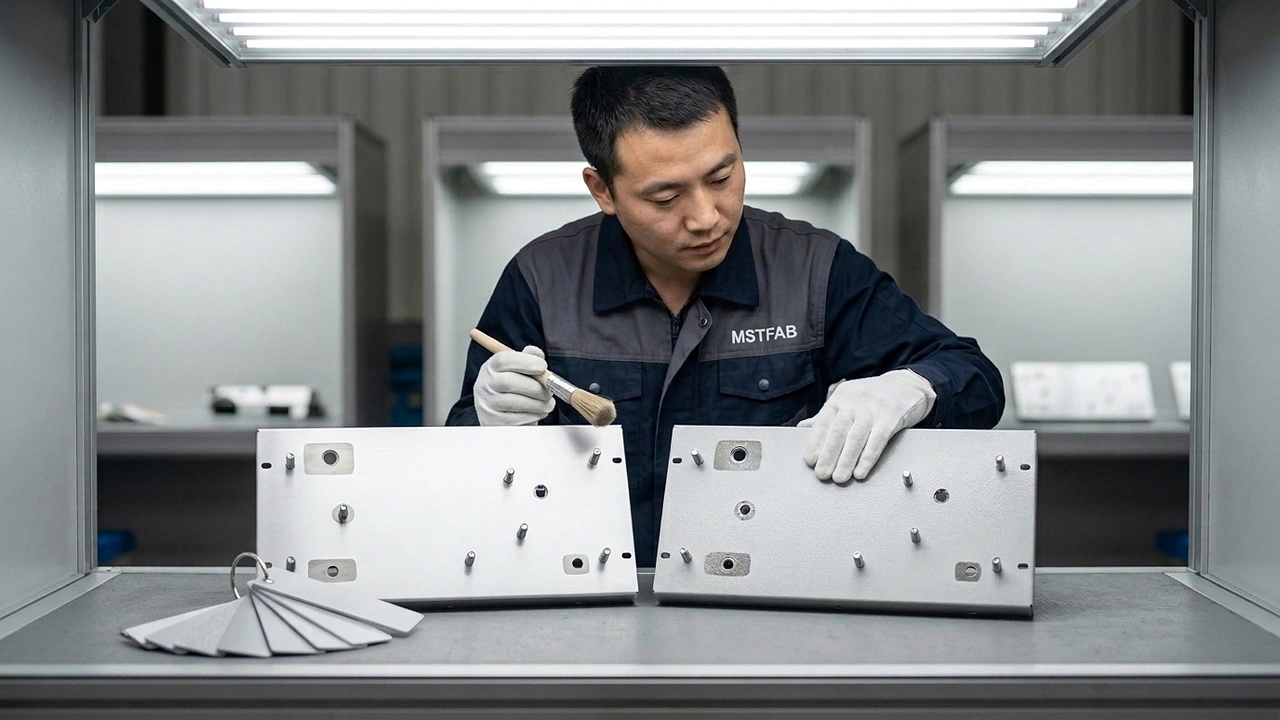
Figure 5: Surface finishing verification comparing clear-anodized aluminum panels with electrostatic powder-coated steel panels, verifying film thickness and electrical grounding pads.
8. Precision Welding: Arc Stability, Thermal Conductivity, and Distortion
Welding aluminum is fundamentally more challenging than welding mild or stainless steel due to three physical factors:
- Refractory Surface Oxide Layer (Al2O3): Aluminum naturally forms a microscopic aluminum oxide surface film with a melting temperature of 2,072°C, whereas the underlying aluminum base metal melts at just 660°C. In TIG welding, alternating current (AC) is mandatory: the reverse-polarity half-cycle provides “cathodic cleaning” that blasts away the oxide skin, while the straight-polarity half-cycle penetrates the base metal. Steel, with an iron oxide melting point near that of iron, welds effortlessly under standard direct current (DC).
- High Thermal Dissipation and Distortion: Because aluminum conducts heat rapidly, welding requires 50% more heat input per unit time to establish a puddle, followed by rapid cooling. This wide thermal gradient creates severe angular distortion unless parts are clamped in heavy 3D modular fixtures with copper chill bars.
- Hydrogen Porosity: Liquid aluminum has extreme solubility for hydrogen gas, which precipitates out as microscopic voids upon solidification. MSTFAB utilizes 99.999% pure argon shielding gas and mechanically deoxidizes weld joints with stainless steel wire brushes immediately prior to welding to ensure porosity-free AWS D1.2 compliant welds.
9. Surface Finishing and Corrosion Protection: Anodize vs Powder vs Zinc
Surface finishing represents a major cost driver that often swings the economic advantage from steel to aluminum or vice-versa:
- Aluminum Finishing Advantages: Aluminum passivates naturally, creating a self-healing oxide barrier. For indoor server racks or electronics housings, 5052-H32 aluminum can often be deployed bare or with a low-cost trivalent chromate chemical conversion film (MIL-DTL-5541 Class 3, e.g., SurTec 650) that preserves electrical conductivity for EMI shielding at minimal cost. Furthermore, aluminum can be anodized (MIL-A-8625 Type II sulfuric or Type III hardcoat) to produce aesthetic, scratch-resistant metallic finishes that cannot peel.
- Steel Finishing Requirements: Raw carbon steel (SPCC) will flash-rust within hours in ambient humidity. It mandates a complete anti-corrosion coating system: multi-stage degreasing, zinc or iron phosphate pre-treatment, cathodic e-coat primer, and electrostatic powder coating (60 – 90 μ m). For pre-plated options, SECC electro-galvanized sheet offers excellent indoor corrosion resistance at lower processing cost, but raw cut edges remain vulnerable unless painted.
- Stainless Steel Finishing: 304 and 316L stainless steel require no paint coatings. They achieve sanitary, corrosion-proof longevity through mechanical graining (#4 sanitary brush, Ra ≤ 0.4 μ m) followed by citric acid passivation per ASTM A967 / A967M or electropolishing per ASTM B912.
10. Total Landed Cost Analysis: Material, Processing, Finishing, and Freight
When requesting quotations from sheet metal suppliers, looking solely at the bill of materials (BOM) raw material cost creates a false impression. The table below illustrates a real-world cost breakdown for a 500-unit batch of an industrial equipment chassis cover:
| Cost Component | 1.5 mm Cold Rolled Steel (SPCC) | 2.0 mm 5052-H32 Aluminum (Equal Stiffness) | 1.5 mm AISI 304 Stainless Steel |
|---|---|---|---|
| Raw Material Cost / Part | 8.40 (Base) | 16.20 (+92.8%) | 28.50 (+239.3%) |
| Fiber Laser Cutting Cost | 3.50 (O2 assist gas) | 4.80 (High-pressure N2) | 5.20 (High-pressure N2) |
| CNC Press Brake Bending | 4.20 (Standard tooling) | 4.60 (Urethane die film) | 5.80 (Higher tonnage setup) |
| Clinch Hardware (4x M4 PEM) | 1.20 (Carbon steel studs) | 2.40 (Stainless studs) | 2.60 (Hardened stainless) |
| Surface Finishing | 12.50 (Pretreat + Powder Coat) | 6.50 (Clear Chem Film Class 3) | 4.50 (Passivation only) |
| Air / Ocean Freight per Part | 9.80 (7.85 kg weight) | 4.90 (3.92 kg weight – 50% lighter!) | 9.90 (7.93 kg weight) |
| Total Landed Cost / Part | 39.60 | 39.40 (Lowest Total Cost!) | 56.50 |
Key Takeaway: While raw aluminum material cost is nearly double that of cold-rolled steel, the savings in surface finishing (chem film vs full powder coat) and 50% international shipping freight make the aluminum assembly cheaper overall!
11. Life-Cycle Carbon Footprint, Scope 3 Emissions, and Circular Recycling
Modern procurement standards increasingly factor embodied greenhouse gas emissions (Scope 3) into supplier quotations. Aluminum and steel offer distinct sustainability trade-offs:
- Embodied Carbon of Primary vs. Recycled Aluminum: Smelting primary bauxite ore into aluminum requires immense electrical energy, generating 11.5to16.5 kg CO2eper kilogram of metal. However, recycling post-industrial aluminum scrap requires only 5% of the original smelting energy, slashing emissions to 0.5to1.2 kg CO2e/kg. MSTFAB sources aluminum sheet containing over 75% certified recycled scrap content.
- Steel Circularity and Magnetic Scrap Recovery: Steel is the most recycled material on earth, with 100% recyclability without property degradation. Electric Arc Furnace (EAF) steel production utilizing scrap produces approximately 0.4to0.8 kg CO2e/kg, lower than primary aluminum. In end-of-life recycling facilities, steel’s ferromagnetism allows high-efficiency magnetic crane sorting at minimal labor cost.
12. Comprehensive Engineering Data Matrices and Selection Benchmarks
Table 1: Physical & Mechanical Properties Matrix
| Material Grade | Modulus E (GPa) | Thermal Conduct. (W/m·K) | Thermal Expans. (μ m/m·K) | Electrical Conduct. (% IACS) | Magnetic Permeability (μ r) |
|---|---|---|---|---|---|
| 5052-H32 Aluminum | 70.3 | 138 | 23.8 | 35% | 1.0000 (Non-magnetic) |
| 6061-T6 Aluminum | 68.9 | 167 | 23.6 | 43% | 1.0000 (Non-magnetic) |
| SPCC Cold Rolled Steel | 207 | 54 | 11.7 | 12% | > 1,000 (Ferromagnetic) |
| SECC Electro-Galv. | 205 | 52 | 11.8 | 13% | > 1,000 (Ferromagnetic) |
| 304 Stainless Steel | 193 | 16.2 | 17.3 | 2.5% | 1.02 – 1.05 (Slight magnetic cold work) |
| 316L Stainless Steel | 193 | 16.3 | 16.0 | 2.3% | ≤ 1.008 (Non-magnetic) |
Table 2: Equivalent Stiffness & Weight Comparison Table
| Baseline Steel Thickness | Baseline Steel Weight (kg/m²) | Equivalent Stiffness Aluminum | Aluminum Weight (kg/m²) | Net Weight Savings |
|---|---|---|---|---|
| 0.8 mm (22 Ga) | 6.28 kg/m² | 1.2 mm Aluminum | 3.22 kg/m² | 48.7% Lighter |
| 1.0 mm (20 Ga) | 7.85 kg/m² | 1.5 mm Aluminum | 4.02 kg/m² | 48.8% Lighter |
| 1.5 mm (16 Ga) | 11.78 kg/m² | 2.0 mm Aluminum | 5.36 kg/m² | 54.5% Lighter |
| 2.0 mm (14 Ga) | 15.70 kg/m² | 3.0 mm Aluminum | 8.04 kg/m² | 48.8% Lighter |
| 3.0 mm (11 Ga) | 23.55 kg/m² | 4.5 mm Aluminum | 12.06 kg/m² | 48.8% Lighter |
13. Real-World OEM Case Studies: Aluminum vs Steel Trade-Offs
Case Study 1: Aerospace In-Flight Entertainment Server Enclosure
OEM Problem: An avionics manufacturer needed to replace an existing 1.2 mm cold-rolled steel 3U rack chassis to meet strict commercial airline payload weight targets. The server chassis weighed 6.8 kg bare, incurring heavy fuel-burn penalties.
MSTFAB Solution:
- Engineered an equivalent-stiffness chassis utilizing 1.8 mm 5052-H32 aluminum with return flange stiffeners and corner gussets.
- Specified clear trivalent chemical conversion coating (MIL-DTL-5541 Class 3) to guarantee low surface electrical resistance (≤ 2.5 mΩ) for lightning ground paths and EMI shielding.
- Utilized 300-series stainless steel PEM standoffs with passivated surfaces, preventing galvanic corrosion.
Quantifiable Outcome: Bare chassis mass dropped from 6.8 kg to 3.2 kg (52.9% weight reduction), passing all RTCA DO-160G Section 8 vibration and shock certifications. The airline customer saved an estimated4,200 per aircraft in annual jet fuel costs.
Case Study 2: High-Volume Industrial EV Charging Station Kiosk
OEM Problem: An electric vehicle infrastructure provider designed a 50 kW public fast-charger housing in 2.0 mm 5052-H32 aluminum. However, escalating raw aluminum spot prices drove enclosure production costs above their target budget.
MSTFAB Solution:
- Conducted a value-engineering study: transitioned the main structural skeleton from 2.0 mm aluminum to 1.5 mm electro-galvanized SECC steel with high-durability polyester powder coating.
- Retained 2.0 mm 5052-H32 aluminum exclusively for the front hinged user-interface door where weight reduction was necessary for ergonomic technician opening and anti-graffiti anodizing.
- Integrated EPDM insulating washers and Dacromet-coated fasteners at all aluminum-to-steel junction points to prevent galvanic reaction.
Quantifiable Outcome: Total enclosure manufacturing cost dropped by 28.4% (142 unit cost reduction per charging kiosk) without compromising NEMA 3R outdoor weatherproof ratings.
Case Study 3: Commercial Electric Delivery Van Battery Enclosure Armor
OEM Problem: A commercial fleet EV builder struggled between using 2.5 mm high-strength steel (Domex 700) or 4.0 mm 5052-H32 aluminum for under-chassis battery pack protective bottom armor plates. The design required passing strict UNECE R100.02 mechanical impact and puncture resistance tests while preserving vehicle payload rating.
MSTFAB Solution:
- Performed comparative non-linear dynamic FEA simulations evaluating kinetic energy absorption during high-speed debris impact.
- Selected 4.0 mm 5052-H32 aluminum plate reinforced with stamped 15 mm hat-channel longitudinal ribs, optimizing crush stroke deceleration.
- Applied automated robotic laser-welded perimeter seal rings and a specialized elastomeric polyurea chip-resistant undercoating.
- Installed passivated 316 stainless steel high-torque blind clinch studs to anchor the cover to the vehicle frame.
Quantifiable Outcome: The aluminum armor assembly reduced total pack mass by 42.6 kg (47.2% lighter than the steel baseline), fully absorbed a 20 kJ debris impact without cell deformation, and boosted the commercial van’s single-charge delivery range by 8.4 kilometers.
14. How to Prepare CAD Models and RFQs for 24-Hour Quoting
To receive rapid, production-ready sheet metal quotations with accurate DFM feedback, follow these best practices when submitting RFQ packages to MSTFAB:
- Provide 3D STEP / SolidWorks Models: Native 3D CAD files allow our CAM software to unfold parts automatically using verified K-factors, verifying bend clearance and press brake backgauge collision risks.
- Attach 2D PDF Engineering Prints: 2D prints must define primary datum schemes, Critical to Quality (CTQ) dimensions, surface finishing specifications (e.g., “Powder coat RAL 7035 texture, DFT 60-90 μ m” or “Clear Anodize Type II Class 1”), and thread callouts.
- Specify Annual and Batch Volumes: Sheet metal pricing is highly volume-dependent. Specifying Estimated Annual Usage (EAU) and standard batch releases allows MSTFAB to optimize raw material master coil nesting and amortize tooling costs efficiently.
15. Frequently Asked Technical Questions (32 Detailed Engineering Q&As)
Q1: Why is raw aluminum price per kilogram misleading when comparing part costs to steel?
Because aluminum is roughly one-third the density of steel (2.70 g/cm ³vs7.85 g/cm ³), one kilogram of aluminum yields nearly three times more physical surface area and sheet volume than one kilogram of steel.
Q2: How much thicker must aluminum be to match the bending stiffness of steel?
Based on elastic beam bending mechanics (E · I), an aluminum sheet must be approximately 43.1% to 44% thicker (Tal ≈ 1.44 × Tsteel) to achieve identical flexural rigidity.
Q3: What is the net weight savings of an aluminum part engineered for equal stiffness to steel?
At 43.1% greater thickness, the aluminum panel achieves approximately 50.8% net weight reduction compared to the equivalent-stiffness steel panel due to aluminum’s substantially lower density.
Q4: Why is 5052-H32 preferred over 6061-T6 for sheet metal forming?
5052-H32 possesses superior ductility and can be formed to an inside radius ofR = 1.0 × Twithout cracking. 6061-T6 is brittle in bending, requiring generous radii (R ≥ 2.5 × T) or annealing to prevent fracture.
Q5: Can standard carbon steel PEM fasteners be installed in aluminum sheets?
No. Installing carbon steel fasteners into aluminum creates a strong galvanic couple (> 1.2 Vpotential difference) that causes rapid galvanic corrosion of the aluminum. 300-series stainless steel or aluminum fasteners must be used.
Q6: Why does fiber laser cutting of aluminum cost more than cutting mild steel?
Aluminum requires high-pressure nitrogen assist gas (18 to 24 bar) to blow molten dross away without oxidation, consuming significant volumes of nitrogen gas. Mild steel can be cut with inexpensive low-pressure oxygen assist.
Q7: What is SECC steel and why is it popular for internal electronics chassis?
SECC is cold-rolled steel electro-plated with a microscopic zinc layer and treated with an organic anti-fingerprint resin. It offers built-in corrosion resistance and excellent electrical ground continuity without post-fabrication painting.
Q8: How does thermal conductivity affect welding aluminum vs steel?
Aluminum conducts heat 2.5 times faster than steel and 8 times faster than stainless steel. It acts as an aggressive heat sink, requiring high power input (AC TIG or pulsed laser) to establish a molten pool and preheating on thick sections.
Q9: What is the benefit of chemical conversion coating (Alodine / Chem Film) on aluminum?
MIL-DTL-5541 Class 3 chemical conversion films provide outstanding corrosion protection while maintaining low surface electrical contact resistance, critical for chassis grounding and EMI shielding.
Q10: When is cold-rolled steel (SPCC) the most economical material choice?
SPCC is the most cost-effective choice for high-mass, stationary indoor equipment (transformer cradles, heavy server cabinets, base plates) where weight is not penalized and parts will be powder-coated.
Q11: How do you prevent cross-contamination when bending aluminum on press brakes?
We use dedicated aluminum tooling or apply heavy-duty non-marking polyurethane protective die tape across the V-die opening, preventing iron carbon transfer from previous steel bending jobs.
Q12: What is the difference between 304 and 316L stainless steel for sheet metal parts?
316L contains 2% to 3% molybdenum and ultra-low carbon (≤ 0.03%), providing superior resistance to pitting corrosion in saltwater, hospital bleach, and chemical processing compared to 304.
Q13: How does international freight cost impact the choice between steel and aluminum?
For products shipped via air freight or overseas container logistics, aluminum’s 50% weight reduction often generates freight savings that exceed the initial raw material price premium.
Q14: What is anodic hardcoating (Type III Anodize) and when should it be specified?
MIL-A-8625 Type III Hardcoat produces a dense 50 μ m aluminum oxide layer with hardness up to 65 HRC, offering extreme abrasion and wear resistance for sliding rails and military equipment.
Q15: Can aluminum and steel parts be joined directly by welding?
Direct fusion welding of aluminum to steel forms brittle Fe-Al intermetallic compounds that crack easily. Joining requires mechanical clinching, structural adhesives, blind rivets, or explosive transition bimetal strips.
Q16: How do thermal expansion rates differ between aluminum and steel?
Aluminum has a coefficient of thermal expansion of approximately 23.8 μ m/m·K, roughly double that of carbon steel (11.7 μ m/m·K). Hybrid assemblies must accommodate differential expansion at joints.
Q17: What is the typical lead time for aluminum vs steel sheet metal prototypes?
Standard sheet metal prototypes (laser cut, CNC bent, hardware inserted, and chem-filmed or powder-coated) ship within 5 to 7 working days for both aluminum and steel.
Q18: What is the maximum sheet thickness MSTFAB can cut on fiber lasers?
Our high-power fiber lasers cut carbon steel up to 25 mm, stainless steel up to 16 mm, and aluminum alloys up to 12 mm with high-pressure nitrogen assist.
Q19: How do you prevent thread galling when tightening screws into stainless steel PEM hardware?
We recommend using anti-seize lubricants, molybdenum disulfide dry film lubricants, or pairing stainless PEM nuts with zinc-plated carbon steel or brass screws to prevent galling.
Q20: What are the EMI shielding advantages of aluminum vs steel?
Aluminum provides superior high-frequency electric field and plane-wave shielding due to its high electrical conductivity (35-43% IACS). Steel provides better low-frequency magnetic field shielding due to its high magnetic permeability.
Q21: How does MSTFAB ensure color match between powder-coated steel and anodized aluminum parts?
Anodizing produces a semi-translucent metallic luster that cannot be matched 100% to opaque powder coat. When matching is required, we apply matched powder coating (specifying identical RAL codes) across both substrates.
Q22: What is the benefit of Cold Metal Transfer (CMT) for welding thin aluminum?
CMT mechanically retracts the wire electrode at short-circuit detachment, delivering zero spatter, ultra-low heat input, and the capability to weld 1.0 mm aluminum without burn-through.
Q23: How do you verify coating adhesion on powder-coated steel parts?
We perform cross-hatch adhesion testing per ASTM D3359 Method B, requiring Class 4B or 5B (zero flaking of lattice squares), accompanied by dry film thickness verification per ASTM B499.
Q24: Can 5052-H32 aluminum be powder coated directly without pre-treatment?
No. Direct powder application over untreated aluminum leads to delamination. Aluminum must undergo multi-stage alkaline cleaning, acid deoxidation, and zirconium or chromate conversion coating to guarantee 1,000-hour salt spray adhesion.
Q25: What is the difference between air bending K-factors for aluminum and steel?
Due to differences in strain hardening and neutral axis shift, aluminum 5052-H32 typically exhibits a K-factor ofK ≈ 0.44, while SPCC mild steel exhibits K ≈ 0.42 and stainless steel exhibits K ≈ 0.38.
Q26: What file formats are preferred for sheet metal quotation at MSTFAB?
We accept native 3D CAD models (SolidWorks, Inventor, Creo) and neutral 3D files (STEP AP214/242, IGES), accompanied by 2D PDF drawings detailing tolerances, finishing, and critical dimensions.
Q27: How do you prevent scratches on cosmetic aluminum covers during shipping?
Class A cosmetic aluminum panels receive low-tack protective PE film immediately after surface finishing, followed by individual placement into custom CNC-routed polyethylene foam cells inside export crates.
Q28: What is the typical tensile strength difference between 5052-H32 and mild steel?
5052-H32 aluminum exhibits a yield strength of 195 – 215 MPa and tensile strength of 230 – 260 MPa, which is comparable to commercial SPCC mild steel (yield 130 – 210 MPa, tensile 270 – 380 MPa).
Q29: Are MSTFAB’s sheet metal materials compliant with RoHS and EU REACH Regulation regulations?
Yes. 100% of our raw sheet metal stock, fasteners, conversion coatings, and powder coat formulations are certified compliant with EU RoHS Directive 2011/65/EU and EU REACH Regulation (EC) 1907/2006.
Q30: Can MSTFAB supply hybrid assemblies combining both aluminum and steel?
Yes. Many of our OEM clients utilize hybrid structures: heavy structural steel frames for base load support paired with lightweight, precision-anodized aluminum cover panels and front bezels.
Q31: How do you verify push-out force on clinch nuts installed in aluminum?
We conduct calibrated tensile push-out tests on production sample coupons using digital force gauges, verifying that M3/M4 PEM nuts exceed PennEngineering minimum retention standards (> 580 N in aluminum).
Q32: How can an OEM request an aluminum vs steel DFM cost comparison quote from MSTFAB?
Upload your 3D CAD files (STEP, SolidWorks) to our secure engineering portal. Specify your target annual volume and performance environment. Our DFM engineering team will calculate thickness equivalence, compare landed costs, and deliver a comprehensive quote within 24 to 48 hours.
Optimize Your Material Selection with MSTFAB’s Engineering Team
Stop guessing between aluminum and steel. Partner with MSTFAB for ISO 9001 and ISO 13485 certified sheet metal fabrication backed by scientific DFM stiffness calculations, advanced fiber laser cutting, precision CNC forming, and full landed-cost optimization. Submit your CAD models today for a 24-hour comparative quotation.
 WeChat Contact
 WhatsApp Me Directly