
The CAD file says “bracket.” The field says mud, vibration, fertilizer residue, pressure washing, hurried service work, and one loose bolt waiting for the worst possible afternoon. A useful agricultural metal parts RFQ has to describe both worlds.
Quick answer: send controlled 2D drawings and 3D models, revision and quantity, material and finish, load and mounting information, critical interfaces, weld requirements, field environment, inspection evidence, packing needs, and the approval route. Mark what is mandatory and where the supplier may propose DFM changes.
The goal is not to make the RFQ thick enough to stop a tractor. It is to remove the few ambiguities that create wrong materials, distorted frames, blocked service access, surprise tooling charges, and parts that arrive ready for a repair meeting.
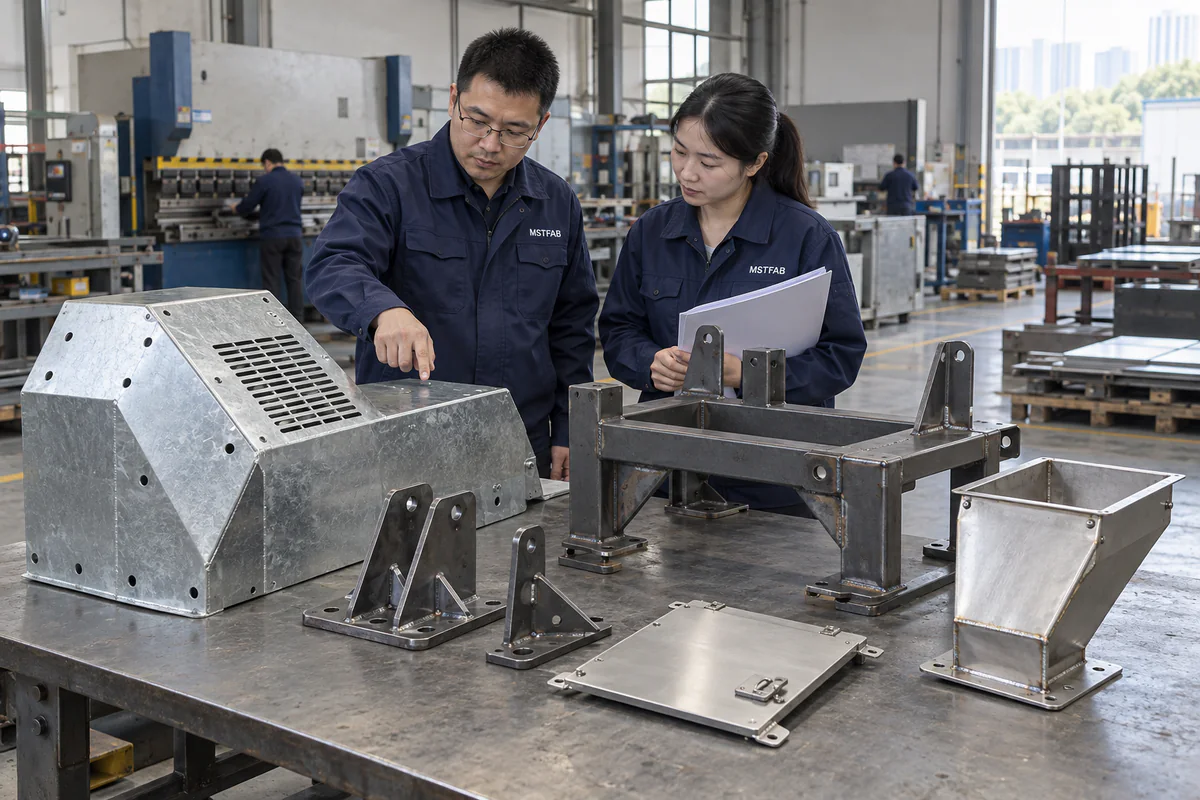
State who owns the completed machine design, safety assessment, field validation, and market compliance. A sheet metal supplier can manufacture and inspect released mechanical parts. The equipment OEM remains responsible for the function and safety of the finished machine unless the contract explicitly assigns a different scope.
Start With a Controlled RFQ Package
Send a 3D model for geometry and a 2D drawing for requirements that geometry cannot explain by itself. The revision identifiers should match. A screenshot pasted into an email may look decisive, but it has the manufacturing authority of a napkin sketch.
Your package should identify the part number, drawing revision, unit system, prototype quantity, production quantity, annual estimate, variant mix, target date, delivery destination, and Incoterm request. Separate a real purchase quantity from a forecast. Suppliers can price twenty parts honestly; they cannot manufacture the optimism in a five-year spreadsheet.
For the wider fabrication scope behind this checklist, see MSTFAB’s agricultural sheet metal parts manufacturing page.
Describe the Field, Not Just the Part
A supplier cannot infer the real duty cycle from a STEP file. Two identical-looking covers may need very different materials, drains, hinges, coatings, and inspection because one lives inside a dry shed and the other sits beside a fertilizer system.
Do not ask the fabricator to guess a final load rating from sheet thickness alone. Loads travel through bends, welds, fasteners, interfaces, and the supporting machine. The OEM or its responsible engineer should define the load case and acceptance basis.
Use DFM Before the Quote Becomes a Purchase Order
Design for manufacturability is most valuable while a revision is still cheap to change. A good review identifies features that add setup, distort during forming, trap water, block welding access, complicate coating, or make field service unnecessarily theatrical.
Common agricultural-part checks include bend relief near openings, hole-to-bend distance, common radii, tool access, grain direction where relevant, weld access, locating tabs, drain paths, protected edges, removable wear areas, hardware masking, and room for a socket or gloved hand.
Every proposal should show the original feature, proposed change, manufacturing reason, functional trade-off, and approval owner. A supplier should not quietly improve your drawing into a different part. Use the sheet metal DFM guide to structure that conversation.

Specify Forming, Welding, Hardware, and Tolerances
A title-block tolerance applied to every feature can make an ordinary guard surprisingly expensive. Mark the interfaces that control installation, alignment, sealing, movement, or appearance. Give functional dimensions a datum and a measurable acceptance limit; leave noncritical edges enough room for a practical process.
Material and thickness
Name the material designation and nominal thickness, plus any grain, temper, coating, or traceability requirement that affects function. If substitutions are allowed, require written approval before production. “Equivalent material” is not a complete specification; it is the start of a discussion.
Bends and formed geometry
State inside radius only when it matters, and identify flange lengths, formed angles, hems, joggles, louvers, and flatness requirements that control fit. A supplier should confirm tool access and likely springback before promising a finished dimension.
Welds and distortion control
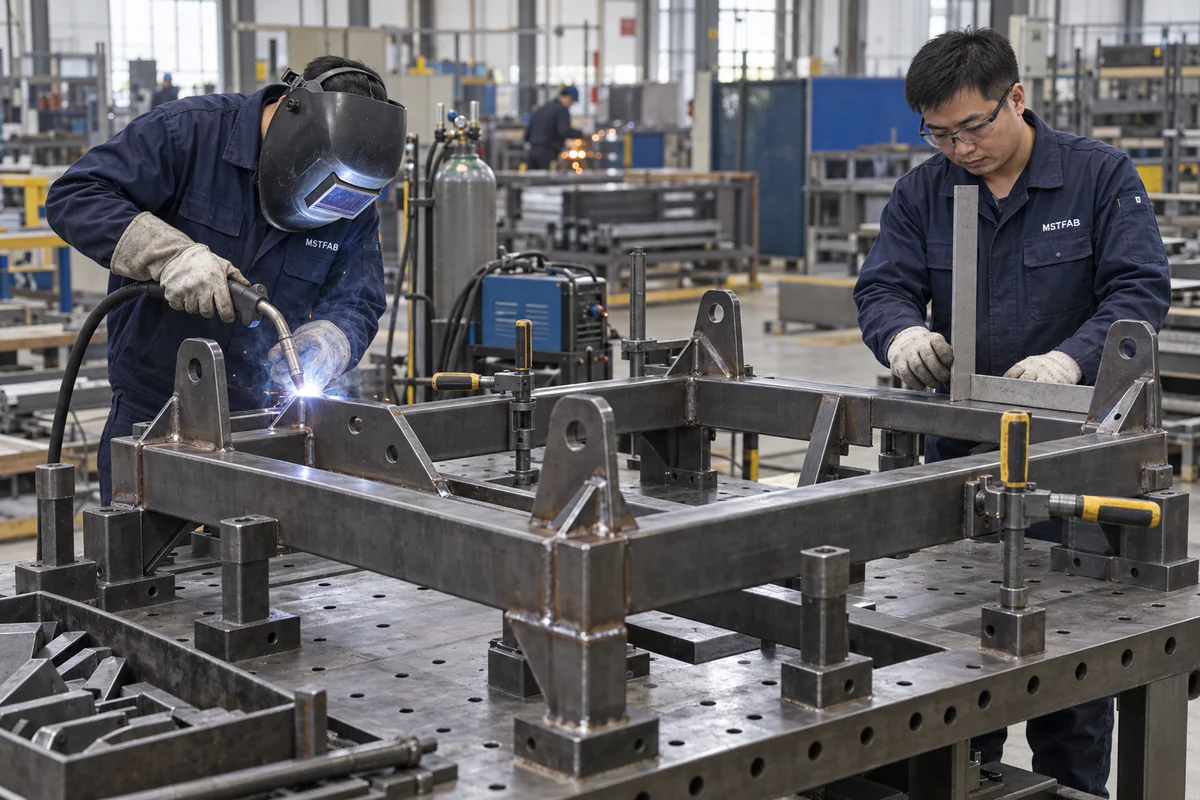
Define joint location, weld type and size, continuity, appearance, grinding limits, and any process or qualification requirement in the contract. Also mark the geometry that must remain square after welding. Weld sequence and fixturing can control distortion; a heroic amount of grinding usually controls only the evidence.
For drawing and scope examples, review MSTFAB’s sheet metal welding service guidance.
Hardware and assembly details
List purchased hardware by manufacturer and part number when interchangeability matters. State installation direction, torque or pull-out requirement if applicable, thread masks, captive-fastener retention, and whether mating samples or gauges will be provided.
Make Competing Quotes Price the Same Job
A useful quotation identifies the drawing revision, quantity, material, fabrication route, purchased hardware, finishing, inspection, packing, currency, Incoterm, exclusions, and lead-time start point. Ask suppliers to separate one-time tooling or fixture cost from recurring unit cost.
When one quote includes first-article measurement and export packing while another says only “metal part,” the lower number has not won. It has simply arrived before the rest of its costs.
Ask for assumptions in writing. Which finish system was priced? Are welds continuous or intermittent? Is masking included? Who buys special fasteners? Does lead time begin at purchase order, drawing approval, deposit, or material receipt? Small sentences prevent large invoice archaeology.
Buyer Trust Table: Seven Checks Before Supplier Approval
Use the same evidence request for every bidder. The table is not a universal supplier ranking; it is a way to compare control, accountability, and fit for your project.
| Check | Evidence to request | Buyer value | Weak answer |
|---|---|---|---|
| D1 Supplier identity | Legal entity, manufacturing address, responsible project contact, and the planned production route. | Shows who reviews, makes, inspects, finishes, and invoices the parts. | A gallery of machines with no accountable location. |
| D2 Drawing control | Acknowledged part numbers and revisions, clarification log, approved changes, and obsolete-file control. | Reduces the chance of making yesterday’s idea beautifully. | “We used the file from the email.” |
| D3 DFM discipline | Marked proposals with manufacturing reason, risk, cost effect, and buyer approval. | Improves cost and repeatability without silent design changes. | Unrecorded shop-floor adjustments. |
| D4 Process control | Tooling and fixture plan, weld sequence, hardware controls, special-process route, and critical checks. | Connects the drawing to a repeatable production method. | “Our operator will know.” |
| D5 First article | Representative sample, released revision, risk-based characteristics, results, deviations, and approval record. | Finds fit, distortion, hardware, and finish issues before the batch is released. | A beauty photo with no measured requirement. |
| D6 Material and finish | Specified grade and finish, agreed records, coating controls, masks, approved substitutions, and change notice. | Prevents quiet changes that alter corrosion performance, fit, or appearance. | “Outdoor powder coat” with no system or preparation. |
| D7 Packing and delivery | Protection plan, package size and weight, labels, Incoterm, destination, photos, and damage route. | Protects formed corners and coated faces through the actual shipment. | Heavy parts introduced to one optimistic carton. |
Approve a Representative First Article
The first article should use the intended material, forming, welding, hardware, finish, and inspection route closely enough to answer the main risks. Record the part number, revision, sample identity, requirement, result, method, date, and disposition.
Choose characteristics from function: mounting datums, frame squareness, guard clearance, hinge or access-panel fit, critical hole patterns, hardware position, weld requirements, drainage features, coating thickness, masks, and cosmetic faces. Not every dimension needs equal ceremony. Measure what can stop assembly, service, safety, or field life.
Define who may approve a deviation and whether approval applies to one sample, one batch, or the drawing itself. Otherwise a temporary concession can become a permanent feature with impressive speed.

Match Material and Finish Evidence to the Risk
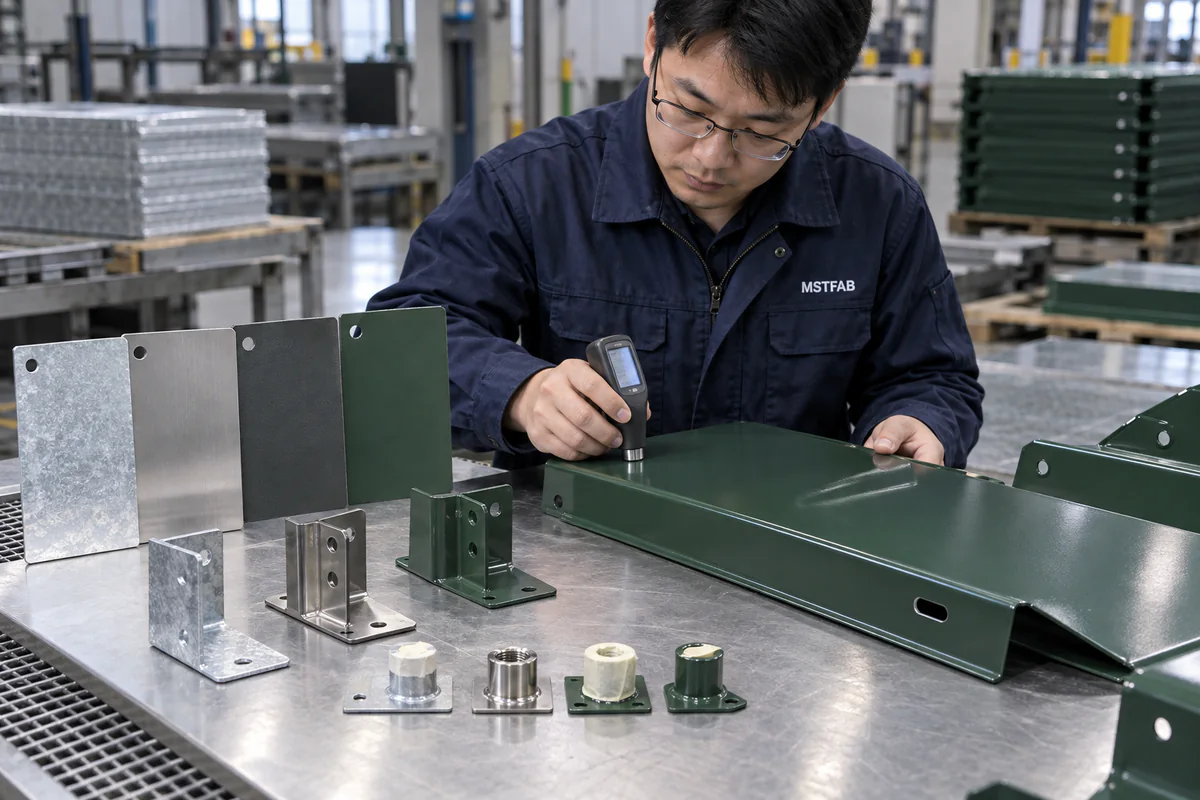
State the service environment before choosing a finish. Galvanized steel, painted carbon steel, stainless steel, and aluminum solve different combinations of cost, corrosion, weight, forming, welding, and appearance. The finish system also depends on pretreatment, edge condition, weld cleanup, masks, color, texture, thickness, and repair rules.
ISO 12944 provides a framework for corrosion protection of steel structures by protective paint systems, including environment classification, design considerations, system selection, and laboratory assessment. Its test results are selection aids, not exact predictions of field durability. Likewise, ASTM B117 describes operation of salt-spray apparatus and warns that stand-alone results do not reliably predict natural-service performance.
That matters in an RFQ. “500 hours salt spray” is not a complete finish specification unless the project also defines substrate, preparation, coating system, specimen, scribe method if any, acceptance criteria, and why that test represents the risk. Use the sheet metal surface finishing guide to build a clearer finish note.
Specify the Condition Required at Delivery
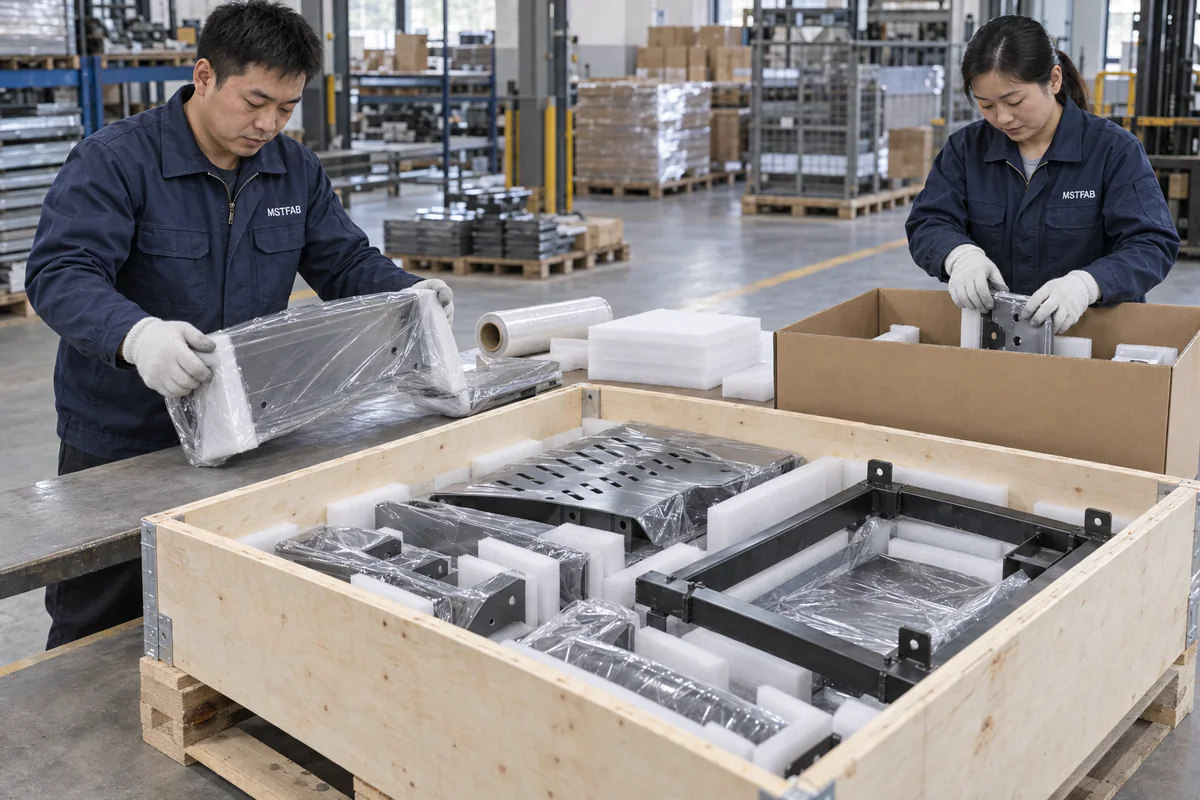
A part can pass final inspection and still fail procurement between the factory door and your receiving dock. Guards rub together, welded frames shift, threaded inserts collect debris, and a sharp flange can defeat a thin carton before the shipment clears its first warehouse.
Define protective film, separators, edge guards, rust prevention where applicable, desiccant or moisture barrier when justified, fixture or blocking points, stacking limit, carton or crate construction, pallet rules, package dimensions, labels, gross weight, and pre-shipment photos. If your line needs parts in a specific orientation, put that in the packing requirement rather than teaching it during unloading.
What MSTFAB Can Quote and What the Buyer Must Define
MSTFAB manufacturing scope
- Drawing-based agricultural guards, covers, panels, brackets, frames, chutes, hoppers, and related mechanical sheet metal parts.
- Laser cutting, CNC bending, welding, grinding, hardware insertion, specified finishing, mechanical assembly, and export packing.
- Agreed DFM review, first-article evidence, dimensional inspection, coating checks, and documented production changes.
Buyer-owned decisions
- Finished-machine function, load cases, safety assessment, regulatory scope, field validation, and final acceptance.
- Released geometry, material and finish performance, critical characteristics, allowable substitutions, and deviation authority.
- Mating components, hydraulic or electrical systems, wear life, installation, maintenance route, destination, and Incoterm.
Copy This Checklist Into Your Next RFQ
- Controlled 2D drawings and 3D models with matching part numbers, revision, units, and scale.
- Prototype, production, annual, and variant quantities listed separately.
- Material designation, thickness, allowed substitutions, and evidence required.
- Field loads, vibration, impact, moisture, chemicals, temperature, UV, cleaning, and service conditions.
- Datums, critical dimensions, mating parts, guard clearances, and sample or gauge availability.
- Bend, weld, grinding, hardware, masking, and assembly requirements.
- Finish system, pretreatment, color, texture, thickness, edge and cosmetic acceptance.
- First-article scope, inspection records, deviation route, and production release owner.
- Packing protection, package limits, destination, Incoterm, labeling, and required date.
- Requested cost breakdown, one-time charges, exclusions, payment terms, and lead-time trigger.
Key Takeaways
- A strong RFQ describes field duty, interfaces, and acceptance, not just a shape and quantity.
- Use controlled 2D and 3D files, and require approval before any manufacturing change.
- Apply tight tolerances and inspection to functional risks instead of every harmless edge.
- Define welding, finish, evidence, and packing clearly enough that every supplier prices the same scope.
- Keep completed-machine safety, regulatory decisions, and field validation with the responsible OEM team.
Frequently Asked Questions
Do I need both a 2D drawing and a 3D model for an RFQ?
Usually, yes. The 3D model defines geometry efficiently, while the 2D drawing carries datums, tolerances, materials, finishes, welds, hardware, notes, and acceptance requirements. Give both files matching part numbers and revisions.
What field information matters most for agricultural sheet metal parts?
Describe loads, vibration, impact, mounting interfaces, rain or washdown, soil and trapped debris, fertilizer or pesticide exposure, temperature, sunlight, cleaning, and maintenance access. Prioritize the conditions that can change material, geometry, finish, or inspection.
Should every dimension have a tight tolerance?
No. Tight control should follow function. Identify datums and the dimensions that affect mounting, movement, guarding, sealing, alignment, or appearance. Let noncritical features use a practical process tolerance agreed with the supplier.
Is a salt-spray hour claim enough to specify outdoor durability?
No. Define substrate, preparation, coating system, test method, specimen, acceptance criteria, and service environment. Laboratory corrosion tests can support selection and comparison, but a stand-alone hour number does not predict exact outdoor life.
What should I approve before agricultural metal parts enter production?
Approve the released revision, DFM changes, representative first article, critical inspection results, weld and hardware condition, finish sample and masks, allowed deviations, packing method, quantity, and delivery plan.
Send the Conditions That the Part Must Survive
Share your controlled drawings, quantity, material, finish, field duty, critical interfaces, inspection needs, destination, and timing. MSTFAB will review the mechanical fabrication scope and return questions before those questions become metal.
Technical references: ISO 4254-1 agricultural machinery safety overview; ISO 12944 protective paint systems catalogue; ISO 12944-6 laboratory performance test methods; ASTM B117 salt-spray apparatus practice. The buyer’s current contract, adopted regulations, machine risk assessment, and applicable standard editions take precedence.
 WeChat Contact
 WhatsApp Me Directly