
You need twelve custom enclosures, not twelve thousand. The first quote has a painful setup charge, the second hides a 500-piece minimum, and the third is suspiciously cheap because half the scope has wandered off. Welcome to small-batch sourcing, where the unit price often has more drama than the part.
Quick answer: an affordable small order is not simply the lowest price per box. It is the lowest credible total cost for the quantity you actually need, including engineering, setup, tooling, finishing, inspection, packaging, freight, and the cost of getting a bad first article.
The best savings usually come from a drawing that suits laser cutting and CNC bending, standard hardware and finishes, a clearly separated setup charge, and inspection focused on the features that can ruin fit. Cheap parts are useful. Cheap surprises are less charming.
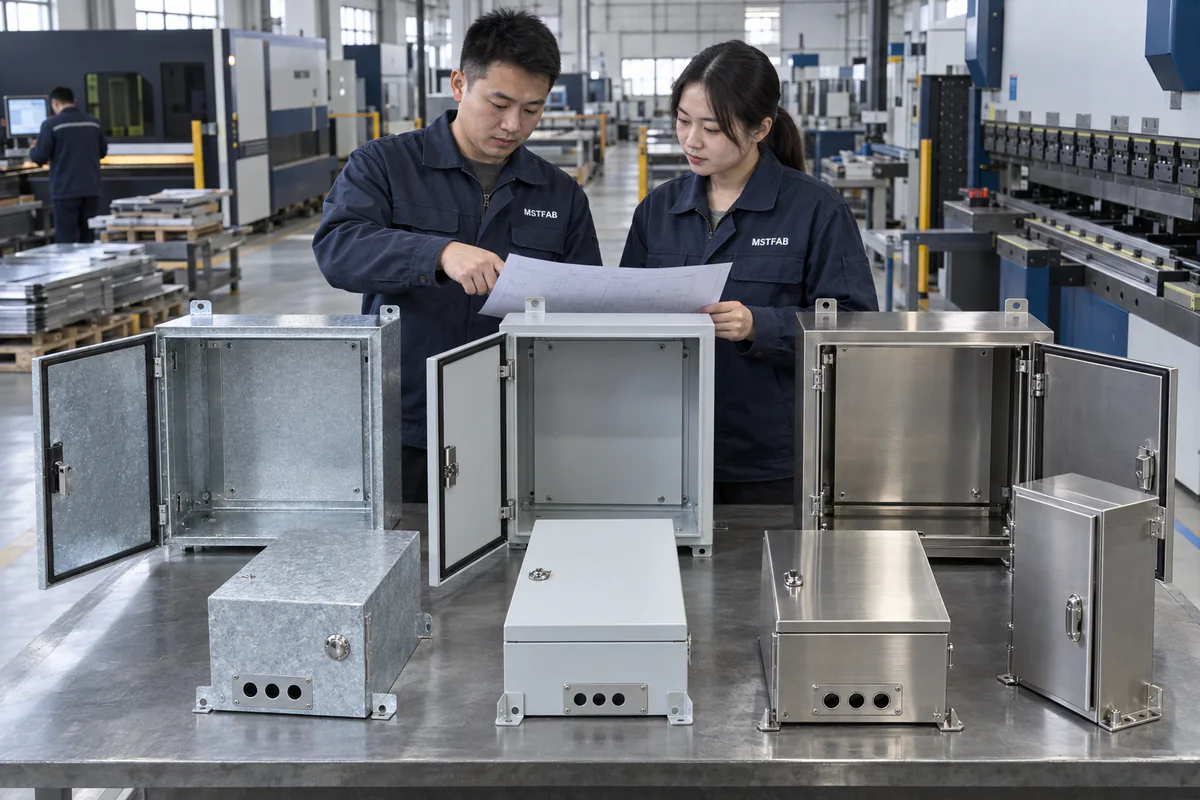
Put every quotation on the same scope: drawing revision, material and thickness, finish, hardware, quantity, setup and tooling, inspection, packaging, Incoterm, delivery destination, and lead-time start point. If one quote includes these items and another is silent, you are comparing a complete lunch with the price of a napkin.
What “Affordable” Should Mean for a Small Custom Order
Small batches carry the same one-time work as larger orders: drawing review, programming, nesting, tool setup, fixture planning, first-article measurement, finish setup, packing design, and order administration. The difference is that fewer parts share those costs.
That does not make low-volume work automatically expensive. It means buyers should separate fixed cost from recurring cost and ask which design changes remove operations without changing function. A supplier who can explain the cost structure gives you something to improve. A supplier who only repeats the unit price gives you a number to stare at.
The useful comparison is total delivered cost for the approved quantity. A slightly higher part price can be the cheaper purchase when it avoids a custom tool, includes the required inspection, and arrives without cosmetic damage.
DFM Is Where Honest Savings Usually Live
Design for manufacturability does not mean making the enclosure worse. It means removing complexity that does not buy function. For low volume, every extra setup and special component has a loud voice because so few parts are available to share the bill.
A useful review should show the original feature, the proposed change, the manufacturing reason, the effect on fit or risk, and who approves it. “Make cheaper” is not a revision note. For a deeper review checklist, see our DFM guide for sheet metal enclosures.
Ask for a Quote That Shows the Setup
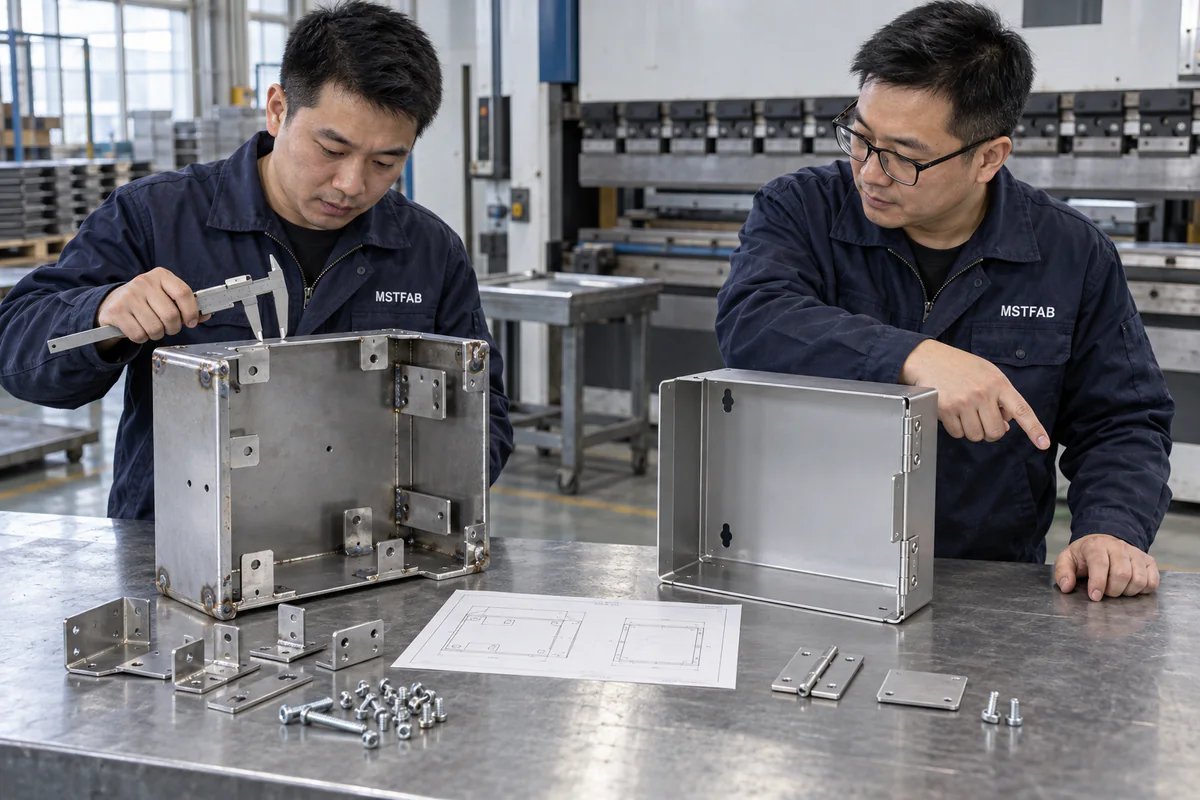
Some buyers ask suppliers to hide setup inside the unit price because one line feels easier to approve. That usually makes the comparison harder. If setup is visible, you can see why a prototype costs more, what the production unit cost becomes, and whether a future repeat order should carry the same charge.
A practical small-order quotation should state:
- the exact quantity and any price breaks;
- material grade, thickness, approved substitutions, and evidence included;
- programming, setup, fixture, and special-tool charges;
- cutting, bending, welding, grinding, hardware, and assembly scope;
- finish specification, masking, cosmetic class, and color-control basis;
- first article, inspection report, sample approval, and rework assumptions;
- packing method, Incoterm, destination, currency, and lead-time start point.
Our sheet metal quote guide explains why a two-line quotation can become a long invoice. The goal is not paperwork for sport. It is making sure each bidder priced the same job.
Buy One Controlled First Article Before Buying Twelve Problems
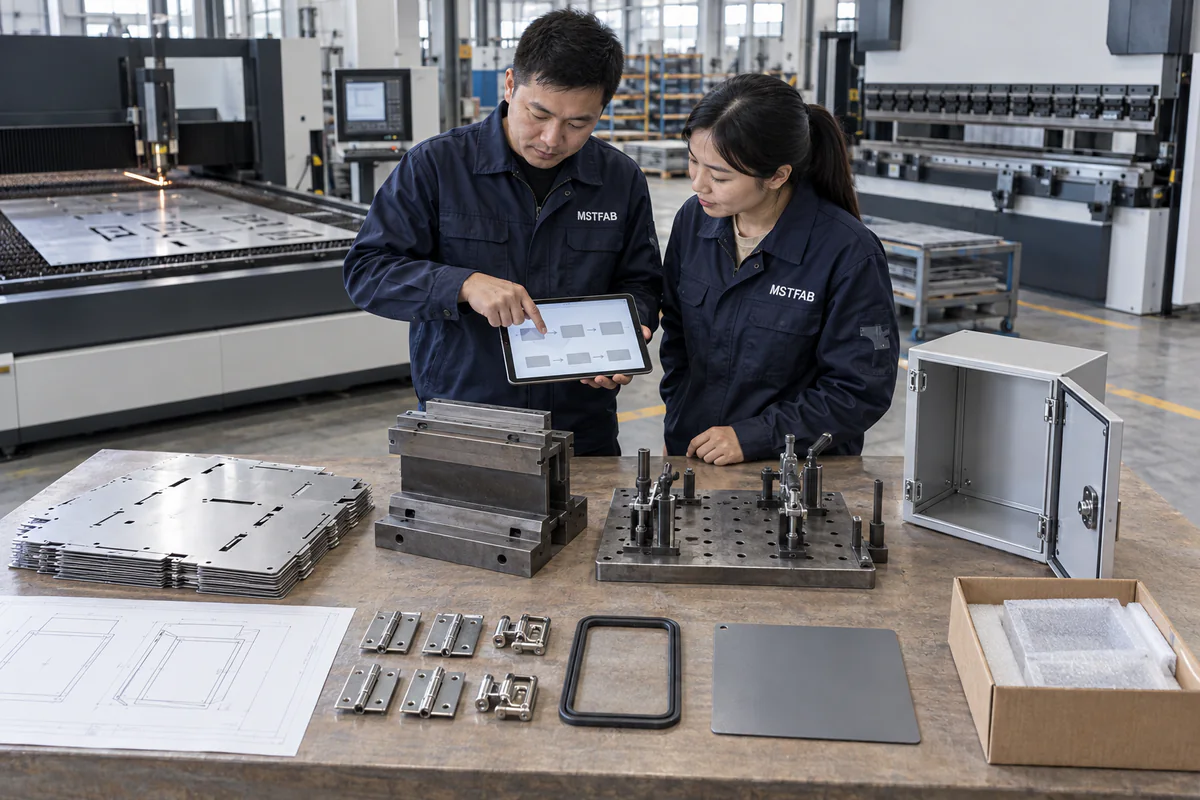
A prototype or first article is valuable when it represents the intended material, process, hardware, and finish closely enough to answer the project’s main risks. It should not be a hand-finished showpiece that production cannot repeat.
Choose the inspection scope from the design. Typical enclosure checks include overall dimensions, mounting datums, door and panel fit, hinge and latch position, cutouts, gland-plate pattern, insert location, grounding features, gasket land, finish thickness, masks, and cosmetic surfaces. The report should identify the part, revision, sample, requirement, result, method, date, and disposition.
Not every dimension needs a ceremonial measurement. Inspect the features that affect installation, sealing, assembly, safety, and visible quality. A hundred unchecked boxes do not become safer because the report has a hundred rows.
For a practical evidence format, use the first-article inspection guide.

Material and Certification: Match the Evidence to the Risk
Every order needs clear material identification. Not every order needs the same certificate package. State the alloy or steel designation, thickness, finish, environment, traceability requirement, and allowed substitutions first. Then request evidence that answers those requirements.
EN 10204 3.1 documents, heat or coil linkage, supplier declarations, coating records, restricted-substance declarations, or additional verification can be appropriate when the contract and risk justify them. PMI is useful for some alloy-identification problems, but it does not prove sheet thickness, temper, mechanical properties, galvanized coating mass, pretreatment, or the complete powder system. Making PMI universal is not strict quality control; sometimes it is simply the wrong test wearing a serious face.
Ratings need the same discipline. IEC 60529 classifies degrees of protection provided by enclosures, while UL offers certification routes for enclosures and related components. An empty custom shell, a gasket sample, and a marketing sentence do not automatically establish the rating of every completed configuration.
Use our surface finishing guide to define pretreatment, coating, texture, thickness, masks, and service environment before asking suppliers to price “powder coat gray.”
Buyer Trust Table: Seven Checks for a Small-Order Supplier
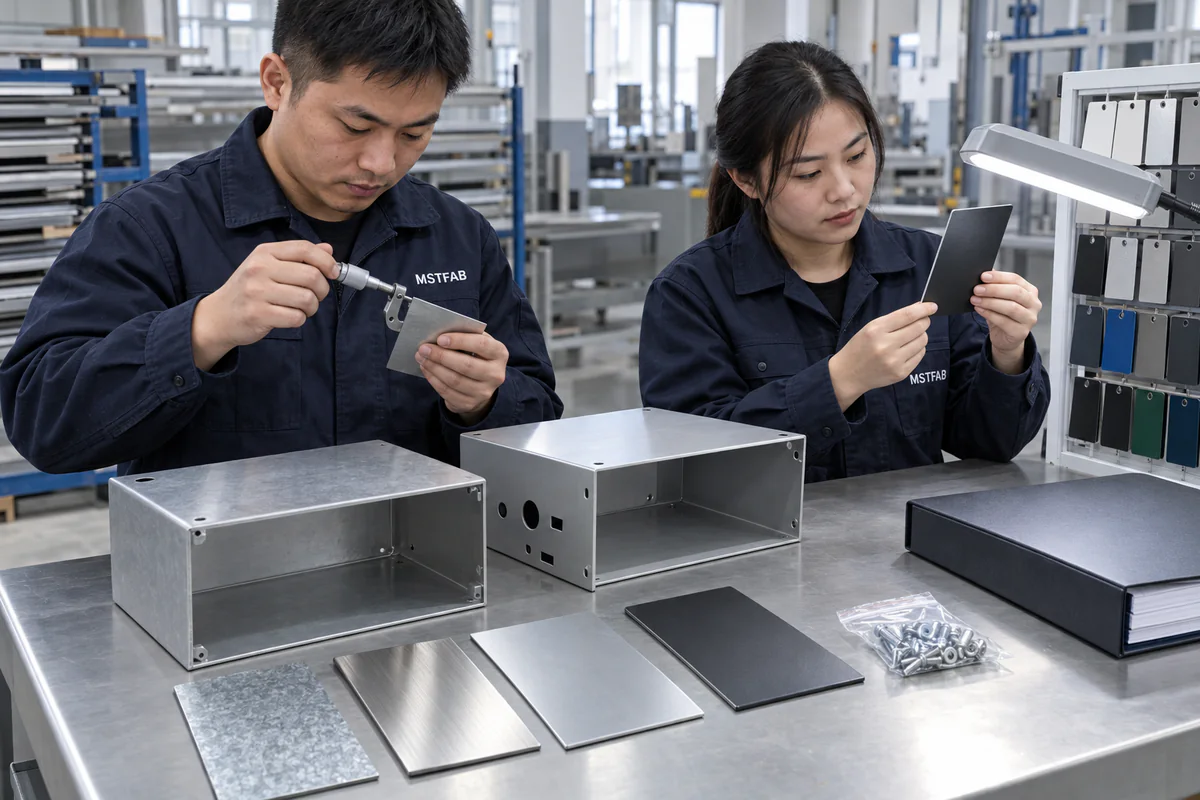
Score suppliers against the same evidence request. The purpose is not to crown a universal “best manufacturer.” It is to find the process that fits your part, quantity, risk, destination, and next order.
| Check | Evidence to request | Buyer value | Weak answer |
|---|---|---|---|
| D1 Supplier identity | Legal entity, manufacturing address, responsible contact, and project-linked factory route. | Shows who cuts, bends, finishes, inspects, and invoices the parts. | A photo gallery with no accountable factory. |
| D2 Small-order fit | Accepted quantity, setup model, variant handling, scheduling rule, and realistic reorder route. | Confirms that a small PO will not be treated as production background noise. | A low sample price tied to a hidden future volume. |
| D3 DFM value | Revision-marked proposals showing operation, tooling, material, or hardware savings and their trade-offs. | Lowers cost through engineering rather than missing scope. | “We will use something similar.” |
| D4 Quote clarity | Material, setup, tooling, unit and total price, finish, inspection, packing, Incoterm, and exclusions. | Makes competing quotes and future reorders comparable. | One unit price and the word “standard.” |
| D5 First article | Released revision, representative sample, risk-based CTQs, recorded results, and approval route. | Finds fit and finish problems before the whole order is completed. | A beauty photo with no measurements. |
| D6 Material and change control | Specified material and finish, lot or record scope, approved substitutions, and buyer change notification. | Stops quiet changes from altering function or appearance. | “Same as last time, probably.” |
| D7 Packing and delivery | Individual protection, carton or pallet plan, labels, shipment size, destination, photos, and damage route. | Keeps a small order economical through the final meter of delivery. | Industrial parts loose in a heroic carton. |
Small Orders Need Right-Sized Packaging
A twelve-piece order may travel by parcel, air freight, consolidated cargo, or a compact pallet. Packaging designed only for full-container volume can be too heavy, too expensive, or simply unavailable for the route you will use.
Define protective film, foam or separators, latch protection, corner control, carton strength, moisture protection where needed, orientation, package count, gross dimensions, labels, and pre-shipment photos. Finished enclosures can pass inspection and still arrive as a very expensive collection of scratches.
Also compare freight on packed dimensions, not bare part dimensions. A design change that allows nesting, removable feet, flat-packed loose panels, or a shared carton size can reduce delivered cost, but only when it does not create assembly damage or shift work unexpectedly to the buyer.

What MSTFAB Can Quote and What the Buyer Must Define
MSTFAB manufacturing scope
- Drawing-based empty metal enclosure shells and related panels or brackets.
- Laser cutting, CNC bending, welding, grinding, hardware insertion, and specified finishing.
- Doors, mounting plates, gland plates, hinges, latches, gaskets, studs, vents, cutouts, and masks as released.
- Agreed DFM review, first-article evidence, mechanical inspection, assembly, and export packing.
Buyer-owned decisions
- Functional requirements, final assembly architecture, standards, ratings, and market approvals.
- Material and finish performance, acceptable substitutions, critical dimensions, and cosmetic class.
- Electronics, wiring, thermal design, EMC, bonding path, and completed-product validation.
- Quantity, variant mix, destination, Incoterm, acceptance route, and production release.
The RFQ That Gets a Useful Small-Batch Quote
- Send the controlled 2D drawing and 3D model with matching revision identifiers.
- State prototype quantity, production quantity, variant mix, and likely repeat quantity separately.
- Name the material, thickness, finish, color, texture, masks, cosmetic faces, and allowed substitutions.
- Identify the dimensions and interfaces that can stop installation or assembly.
- List hardware by manufacturer and part number, or explicitly allow supplier proposals.
- Define first-article, inspection, material, finish, and traceability evidence according to risk.
- Give the delivery country, postal code, Incoterm preference, packing constraints, and required date.
Key Takeaways
- Affordable means the lowest credible total cost for the quantity and scope you need, not the lowest isolated unit price.
- Separate setup from recurring cost so prototypes, production, and repeat orders can be compared honestly.
- Use DFM to remove operations, special tools, unique hardware, and unnecessary tolerance before removing inspection.
- Choose material certificates, testing, and traceability from the actual risk; PMI is not a universal answer.
- Approve a representative first article and plan packaging for the shipment route before releasing the full batch.
Frequently Asked Questions
Why is a small custom enclosure order expensive per piece?
Programming, engineering review, setup, fixture planning, first-article work, finish setup, and packing preparation still happen even when the quantity is small. Fewer parts share those one-time costs, so the unit price rises.
How can I lower the price without lowering quality?
Reduce manufacturing complexity first: use practical bend geometry, standard hardware and finishes, shared features across variants, and tight tolerances only on functional interfaces. Then separate setup from recurring cost and focus inspection on real risks.
Should a supplier have no MOQ for custom enclosures?
Not necessarily. Every process has an economic minimum based on setup, material purchasing, finishing, and administration. Ask for the true minimum, the total order value, and the next price break instead of treating “no MOQ” as a quality badge.
Do small orders always need EN 10204 3.1 documents and PMI?
No. Define evidence from the material, contract, traceability requirement, consequence of failure, and applicable standards. PMI can help identify some alloys, but it does not prove every property or finish requirement.
What should I approve before the full small batch is produced?
Approve the released revision, representative first article, critical dimensions, hardware, finish appearance and masks, inspection plan, allowed deviations, packaging method, and delivery schedule. Record the approval so a future reorder has a usable baseline.
Send the Real Quantity, Not the Dream Forecast
Share your released drawing, prototype and production quantities, material, finish, hardware, critical dimensions, inspection needs, destination, and timing. MSTFAB will review the empty enclosure shell for manufacturability and quote the work that the current order actually requires.
Technical references: ISO 9001 official quality-management overview; IEC 60529 IP Code publication; UL enclosure and related-component certification. Project specifications, current standards editions, adopted codes, and certification-body requirements take precedence.
 WeChat Contact
 WhatsApp Me Directly